


Iran’s Economy Has Been Battered. Its Leaders Still Think Trump Will Blink First

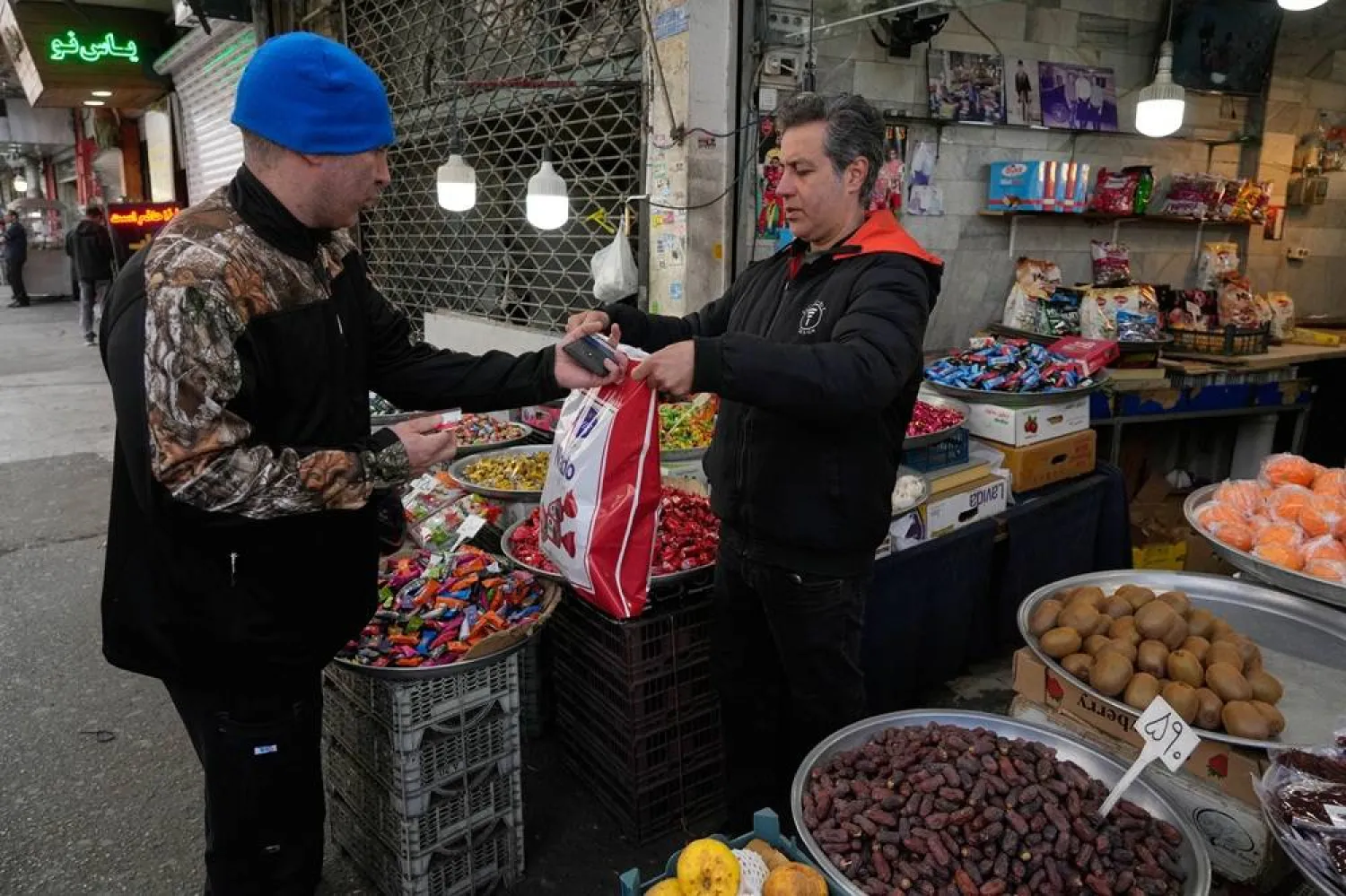
People conduct their businesses around the traditional grand bazaar of Tehran, Iran, March 29, 2026. (AP)
TT

Iran’s Economy Has Been Battered. Its Leaders Still Think Trump Will Blink First

People conduct their businesses around the traditional grand bazaar of Tehran, Iran, March 29, 2026. (AP)

In the heartland of Iran’s famed carpet-making industry, manufacturing has ground to a near halt. Dairies struggle to find packages for milk and butter. Giant steel mills that once drove Iran’s economy have gone silent. Hundreds of thousands have lost jobs, and millions more are at risk.

Over more than five weeks of bombardment, US and Israeli strikes hit thousands of factories. The damage is reverberating across Iran’s economy, threatening increasing waves of layoffs, even as Iranians face skyrocketing prices. The cost of chicken is up 75% the past month, and beef and lamb jumped 68%. Many dairy products have increased by half.

It could get worse as the United States blockades Iranian ports, choking off many imports and oil exports that bring in billions of dollars. Economic woes sparked the mass protests that were crushed before the war and could again push Iranians into the streets.

Still, Iran has its own weapon pointed at the global economy, with its grip on the Strait of Hormuz. Iran’s leaders say they will only reopen the key waterway for global energy if the blockade is lifted and the war ends. They are betting that an economy built to be self-reliant under decades of international sanctions can endure the pain longer than US President Donald Trump.

Iran has lost at least 1 million jobs directly because of the war, Deputy Labor Minister Gholamhossein Mohammadi said, according to state media.

But the ripple effects put some 10 million to 12 million jobs at risk — half of Iran’s labor force — warns Hadi Kahalzadeh, an Iranian economist.
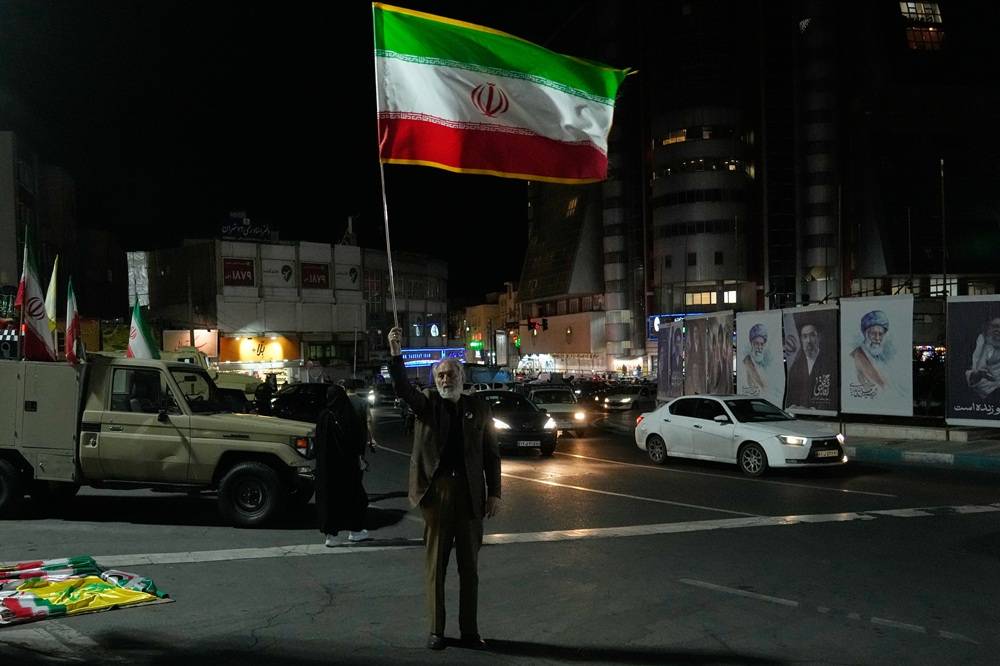
A pro-government demonstrator waves an Iranian flag during a gathering in Tehran, Iran, Monday, April 27, 2026. (AP)

Steel and petrochemical production crippled

Israel claimed to have struck the industrial base of Iran's paramilitary Revolutionary Guard. But the strikes went well beyond, hitting facilities not owned by the force.

Airstrikes damaged 20,000 factories, some 20% of the country’s production units, according to Kahalzadeh, a research fellow at Brandeis University. The stricken facilities included Tofigh Daru, Iran’s largest pharmaceutical holding, producing anticancer drugs among other things. Optics and chemical developers, and aluminum and cement factories, were also hit.

Perhaps most damaging, Israel hit Iran’s biggest steelmaking and petrochemical factories, most of them in a wave of strikes just before the April 8 ceasefire. The two biggest steel producers, Mobarakeh Steel and Khuzestan Steel, as well as smaller mills, halted production. More than 50 petrochemical complexes have been shut down, according to Iran’s semiofficial Jamaran news agency.

That has crippled Iran’s two biggest non-oil exports, and higher prices have affected everything from plastics to pipes, to fabrics and packaging for groceries like milk, butter and cheese.

Strikes are not the only cause of economic woes. The internet has largely been shut down since the protests, gutting small and medium-sized businesses reliant on online sales. Even before the US blockade, Iranian strikes on the United Arab Emirates, on which it relied for around a third of its imports, led that country to cut off trade.

Ripple effects

Around 80% of rug and carpet manufacturers have stopped operations in the industrial zone of the city of Kashan, the center of Iran’s rugmaking industry, said the son of a rugmaker. His family factory, which employs 20 to 30 people and used to machine-make hundreds of rugs a month, is among those that shut down, though his father still goes to the facility every day.

“Never have I heard my father so upset,” said the son, who lives in the United States and spoke on condition of anonymity for his family’s security.

Kashan, home to hundreds of carpet manufacturers, “relies on the rug industry and unfortunately it’s been crippled,” he said. Exports plummeted since the war began, and domestic sales are almost zero. Prices for synthetic fibers have leaped 30%- 50% — partly a downstream effect of hits on petrochemical facilities, he said.

Mehdi Bostanchi owns a ventilation and air conditioning factory, and a second producing household fans, with a total of more than 1,130 employees. Both still operate. But the HVAC factory heavily depends on the construction industry, and “construction is facing a massive shock,” he said.

Most new building is on hold, while the price of iron sheeting has more than doubled.

Bostanchi, a member of a council representing Iranian industrialists, said “all the country’s industries in some way rely on our petrochemical industry.” Even companies that don't directly need steel or petrochemical products have contracts with those that do.
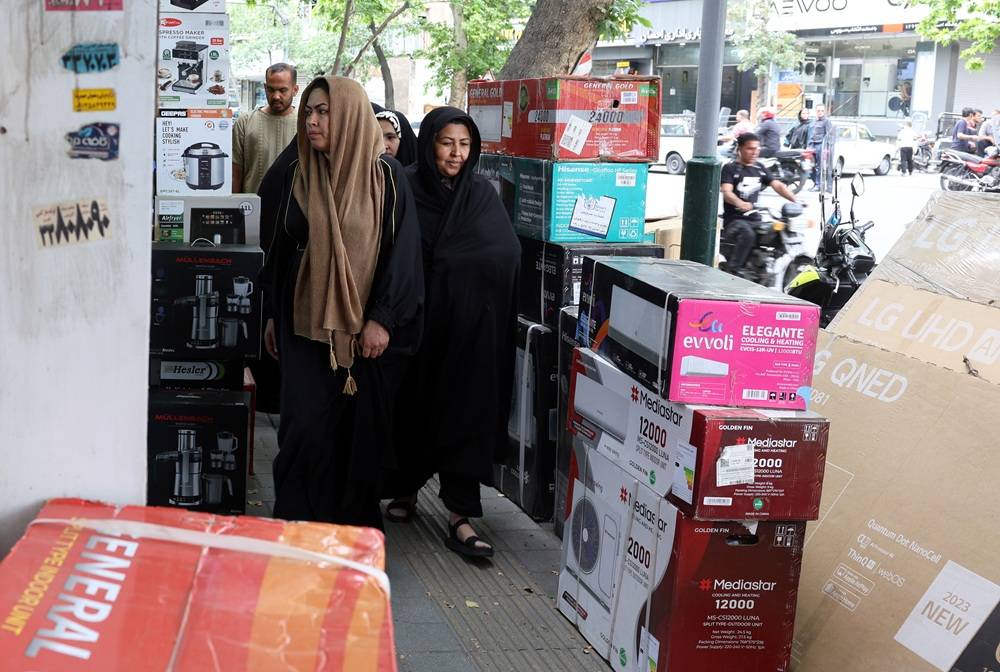
Iranians go shopping at a home appliance market in Tehran, Iran, 27 April 2026. (EPA)

A chemical engineer working at one of Iran’s biggest private construction contractors said it laid off half of its 180 headquarters staffers and had to shut down a project with Mobarakeh Steel, costing 1,000 jobs.

A Tehran resident quit his job as a consulting engineer just before the war, and the new job he had lined up is now uncertain.

“I am at the top 1% (of society), and I am without a job. I am super worried about my future,” he said, adding that people’s savings will start to run out in the coming weeks.

Both he and the chemical engineer spoke on condition of anonymity out of security concerns.

Projecting resilience

Millions took to the streets in January's protests that were triggered by worsening inflation but turned into calls for the end of the regime, bringing a bloody crackdown.

Officials are trying to reassure the public that Iran can withstand the economic pain. The government has promised to increase unemployment insurance. But the burden on Iran's social security system is rising even as its funding is gouged, since it depends heavily on its stakes in petrochemical companies and other key industries, Kahalzadeh said.

The US blockade threatens to cut off export revenues: Iran sold some $98 billion in exports in 2025, just under half of it from oil.

But a complete blockade is difficult; around half of Iran’s non-oil trade goes overland or through Caspian Sea ports, according to Esfandyar Batmanghelidj, an economic expert.

Iran has also built up significant resilience and “readiness for worst-case scenarios,” Batmanghelidj wrote for the Bourse and Bazaar Foundation, a research group he heads on economic development in West and Central Asia.

Iran maintains large reserves of vital supplies. At the end of 2025, Iran had stored up enough electrical machinery for nearly eight months, cement to last nearly six months and enough steel and iron for four months, he wrote, adding that supplies could be further stretched by rationing.

Bostanchi, the factories owner, said he believes Iran's economy could bounce back once the war ends. But how much depends on whether Iran can win an end to international sanctions.

“If we cannot lift the sanctions in any agreements, then no, the optimistic forecast ... will not happen,” he said.


Google Cloud CEO to Asharq Al-Awsat: Our Data Centers Are Crisis-Resilient, Not Bound by Borders

Thomas Kurian, CEO of Google Cloud, speaks to Asharq Al-Awsat. (Asharq Al-Awsat)
TT

Google Cloud CEO to Asharq Al-Awsat: Our Data Centers Are Crisis-Resilient, Not Bound by Borders

Thomas Kurian, CEO of Google Cloud, speaks to Asharq Al-Awsat. (Asharq Al-Awsat)

At Google Cloud Next in Las Vegas, Thomas Kurian, chief executive of Google Cloud, responded to a question from Asharq Al-Awsat about attacks on hyperscale cloud data centers amid regional tensions by moving quickly beyond physical protection. The issue, he suggested, is no longer simply how to defend infrastructure, but how to ensure customers are not left dependent on one location when disruption occurs.

Kurian said Google Cloud has managed through global conflict scenarios for many years and has built not only physical safeguards, but also a private global network with extensive redundancy linking its data centers.

The company can shift workloads away from affected locations and replicate them globally because its cloud regions operate as a unified and consistently synchronized architecture, he explained. For customers, he argued, that means they are not tied to a single physical site.

His response moved the discussion from infrastructure protection toward a broader strategic question: whether cloud architecture itself has become part of business continuity planning.

From experimentation to operations

That framing also offered one of the clearest ways to understand Google Cloud’s broader message at Next 2026. Throughout the event, attended by more than 30,000 participants, the company sought to underscore that enterprise AI is moving from experimentation into what it calls the agentic enterprise.

Google Cloud said roughly 75 percent of its customers already use its AI-powered products. Some 330 customers processed more than one trillion tokens over the past 12 months, while more than 35 customers surpassed 10 trillion tokens. The company also said its frontier models now process more than 16 billion tokens per minute, up from 10 billion in the previous quarter.

The purpose of those figures was to signal that AI is no longer a side experiment, but an operational layer companies want to use across their businesses.

Integration and openness together

Perhaps most revealing in the private Q&A with Kurian was what he suggested about where competition is heading. He argued that Google Cloud’s distinguishing advantage lies in combining proprietary chips, frontier models, infrastructure and tools, allowing the company to optimize the entire stack, from computing power to the efficiency of AI agents.

The broader argument was that the next phase of AI will not be determined only by who has the strongest model, but by who can design the broader system around it most effectively. At the same time, Kurian paired this with another point equally important to enterprise customers: openness. He stressed that he does not expect companies to rely exclusively on Google Cloud and said the company has deliberately kept its architecture open.

He pointed to support for multiple models, Google’s own chips, close collaboration with NVIDIA, compatibility with different data platforms and partnerships with third parties in security.

That matters because enterprises want the efficiency of deep integration without being locked into a closed environment. Google Cloud is signaling it can provide a vertically integrated stack while still operating across diverse enterprise technology environments.

Sovereignty at the forefront

Sovereignty also emerged as a major theme. Asked whether European customers would receive the full product offering, Kurian said the broader product is already available in Europe in compliance with sovereignty regulations, hosted across multiple sites including Germany, France, Belgium, the Netherlands, Finland and the United Kingdom.

Though the answer focused on Europe, its significance extends beyond the continent. Enterprise customers, including Saudi Arabia, increasingly want advanced AI services without giving up control over where their data is hosted and processed. That is not a side issue, but part of the architecture of trust itself.

Connectors make the difference

Kurian also addressed another practical issue tied to one of enterprise AI’s real bottlenecks.

Asked who would build the connections between Gemini Enterprise and the many applications companies already use, he said Google Cloud is doing so itself. The company already offers more than 100 connectors covering document repositories, software-as-a-service applications and databases.

He added that Google Cloud also provides a framework for building connectors and supports standards such as Bring Your Own MCP for custom-built systems.

The significance of that point lies at the heart of why many enterprise AI projects struggle: a model may be impressive in isolation, but it only becomes useful when it connects to where work actually happens — documents, business applications, records and databases.

AI and defense

The cybersecurity portion of the discussion was no less significant.

Kurian said Google Cloud recognized some time ago that as models improve at understanding software, malicious actors would use them to analyze code, discover vulnerabilities and attack systems. In his view, the response must also be driven by AI.

He described one layer focused on analyzing and repairing a company’s own code, pointing to a new model called Code Defender that helps fix vulnerabilities.

A second layer focuses on external threats, including threat hunting and threat intelligence. He pointed to Dark Web Intelligence announced at the conference, saying it can prioritize the threats customers should defend against with about 90 percent accuracy.

He also linked this logic to Google Cloud’s acquisition of Wiz, describing a layered model in which a red agent probes systems for weaknesses, a blue team identifies the needed fixes and a green layer carries out remediation.


Saudi Industry Minister Discusses Boosting Industrial Cooperation with Oman

Saudi Minister of Industry and Mineral Resources Bandar Alkhorayef and President of Oman's Public Authority for Special Economic Zones and Free Zones Qais Al-Yousef meet in Riyadh on Monday. (SPA)
TT

Saudi Industry Minister Discusses Boosting Industrial Cooperation with Oman

Saudi Minister of Industry and Mineral Resources Bandar Alkhorayef and President of Oman's Public Authority for Special Economic Zones and Free Zones Qais Al-Yousef meet in Riyadh on Monday. (SPA)

Saudi Minister of Industry and Mineral Resources Bandar Alkhorayef met in Riyadh on Monday with President of Oman's Public Authority for Special Economic Zones and Free Zones Qais Al-Yousef for talks on boosting industrial cooperation and developing joint investments between their countries.

They tackled means to strengthen cooperation in the fields of industrial cities and special economic zones, in addition to developing strategic partnerships that enhance industrial integration between the two countries in a manner that supports regional supply chains and boosts the competitiveness of the Saudi and Omani economies.

They stressed the importance of expanding industrial and investment partnerships, exchanging expertise and experiences in developing industrial infrastructure, and enabling high-quality investments in priority industrial sectors. This aligns with the objectives of the two countries’ national visions, contributing to sustainable economic development and achieving shared interests.

The meeting comes within the framework of strengthening economic relations between Saudi Arabia and Oman and advancing cooperation in the industrial sector to achieve the goals of economic development and industrial integration between them.


Gold Hits Three-Week Low with US-Iran Talks, Central Bank Decisions in Focus

A jeweller holds gold bars in Cairo, Egypt, March 9, 2026. (Reuters)
TT

Gold Hits Three-Week Low with US-Iran Talks, Central Bank Decisions in Focus

A jeweller holds gold bars in Cairo, Egypt, March 9, 2026. (Reuters)

Gold fell to a three-week low on Tuesday, as elevated oil prices kept inflation concerns high, while investors awaited key central bank decisions this week to see if the Middle East conflict has altered the interest rate outlook.

Spot gold was down 1.1% at $4,628.63 per ounce, ‌as of 0746 GMT, ‌its lowest level since April 7. ‌US ⁠gold futures for June ⁠delivery fell 1.1% to $4,642.90.

US President Donald Trump is unhappy with the latest Iranian proposal on resolving the two-month war, a US official said, dampening hopes for a resolution to the conflict that has disrupted energy supplies, fueled inflation, and killed thousands.

"Geopolitical headlines are still the main driver (of gold prices). In the ⁠event of a deal (between the US and Iran) ‌or an interim deal, the ‌dollar should weaken, and gold will likely break out to the upside," ‌said Edward Meir, analyst at Marex.

The dollar gained, ‌and oil prices rose above $111 a barrel, as the crucial Strait of Hormuz waterway remained largely shut.

Higher crude oil prices can stoke inflation by raising transportation and production costs, increasing the likelihood of higher ‌interest rates.

While gold is considered an inflation hedge, high interest rates make yield-bearing assets ⁠more attractive, weighing ⁠on its appeal.

The Bank of Japan kept interest rates steady on Tuesday but three of its nine-member board proposed hiking borrowing costs, signaling policymakers' concerns over inflationary pressures from the Middle East conflict.

The US Federal Reserve is also widely expected to hold interest rates steady at the end of its two-day meeting on Wednesday.

Investors will be focusing on other central bank decisions this week, including those from the European Central Bank, the Bank of England and the Bank of Canada.

Spot silver fell 2.9% to $73.28 per ounce, platinum lost 1.6% to $1,951.33, and palladium was down 1.6% at $1,453.38.
