


War Casts Shadow over Lebanon’s Ancient Baalbek

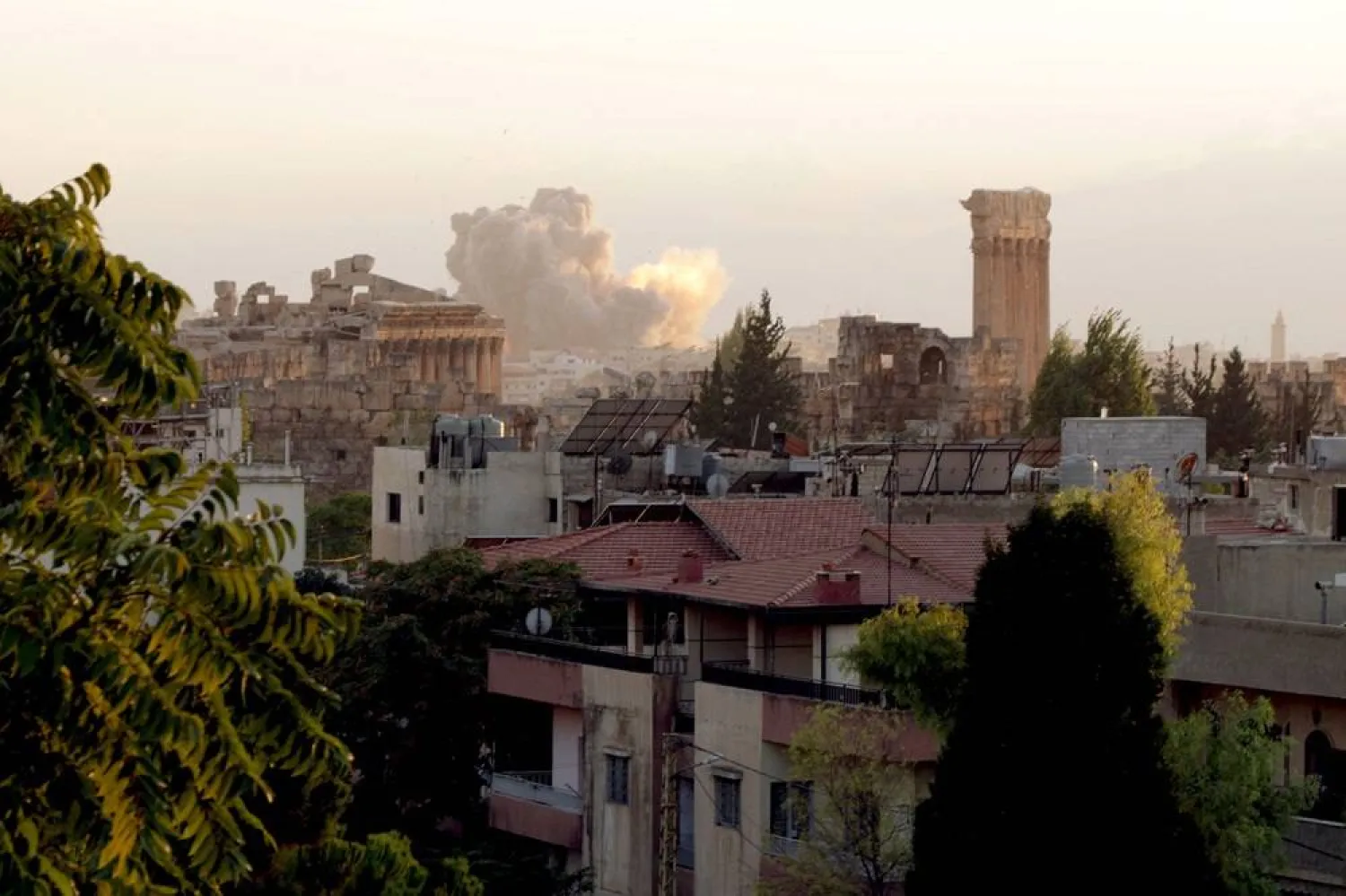
Smoke billows from the site of an Israeli airstrike on the Lebanese city of Baalbek in the Bekaa valley on September 23, 2024, behind the ancient Roman ruins and the six columns that remain standing at the Temple of Jupiter. (AFP)
TT

War Casts Shadow over Lebanon’s Ancient Baalbek

Smoke billows from the site of an Israeli airstrike on the Lebanese city of Baalbek in the Bekaa valley on September 23, 2024, behind the ancient Roman ruins and the six columns that remain standing at the Temple of Jupiter. (AFP)

Since war erupted between Israel and Hezbollah, the famed Palmyra Hotel in east Lebanon's Baalbek has been without visitors, but long-time employee Rabih Salika refuses to leave -- even as bombs drop nearby.

The hotel, which was built in 1874, once welcomed renowned guests including former French President Charles de Gaulle and American singer Nina Simone.

Overlooking a large archaeological complex encompassing the ruins of an ancient Roman town, the Palmyra has kept its doors open through several conflicts and years of economic collapse.

"This hotel hasn't closed its doors for 150 years," Salika said, explaining that it welcomed guests at the height of Lebanon's 1975-1990 civil war and during Israel's last war with Hezbollah in 2006.

The 45-year-old has worked there for more than half his life and says he will not abandon it now.

"I'm very attached to this place," he said, adding that the hotel's vast, desolate halls leave "a huge pang in my heart".

He spends his days dusting decaying furniture and antique mirrors. He clears glass shards from windows shattered by strikes.

Baalbek, known as the "City of the Sun" in ancient times, is home to one of the world's largest complex of Roman temples -- designated a World Heritage Site by UNESCO.

But the latest Israel-Hezbollah war has cast a pall over the eastern city, home to an estimated 250,000 people before the war.

Smoke billows from the site of an Israeli airstrike that targeted Lebanon's eastern city of Baalbek in the Bekaa valley on September 25, 2024, behind the ancient Roman ruins and the six columns that remain standing at the Temple of Jupiter. (AFP)

- Life at a standstill -

After a year of cross-border clashes with Hezbollah, Israel last month ramped-up strikes on the group's strongholds, including parts of Baalbek.

Only about 40 percent of Baalbek's residents remain in the city, local officials say.

On October 6, Israeli strikes fell hundreds of meters (yards) away from the Roman columns that bring tourists to the city and the Palmyra hotel.

UNESCO told AFP it was "closely following the impact of the ongoing crisis in Lebanon on the cultural heritage sites".

More than a month into the war, a handful of Baalbek's shops remain open, albeit for short periods of time.

"The market is almost always closed. It opens for one hour a day, and sometimes not at all," said Baalbek mayor Mustafa al-Shall.

Residents shop for groceries quickly in the morning, rarely venturing out after sundown.

They try "not to linger on the streets fearing an air strike could hit at any moment," he said.

Last year, nearly 70,000 tourists and 100,000 Lebanese visited Baalbek. But the city has only attracted five percent of those figures so far this year, the mayor said.

Even before the war, local authorities in Baalbek were struggling to provide public services due to a five-year economic crisis.

Now municipality employees are mainly working to clear the rubble from the streets and provide assistance to shelters housing the displaced.

A Baalbek hospital was put out of service by a recent Israeli strike, leaving only five other facilities still fully functioning, Shall said.

A cat walks at the entrance of the historical Palmyra hotel in the eastern Lebanese city of Baalbek on October 19, 2024. (AFP)

- 'No one' -

Baalbek resident Hussein al-Jammal said the war has turned his life upside down.

"The streets were full of life, the citadel was welcoming visitors, restaurants were open, and the markets were crowded," the 37-year-old social worker said.

"Now, there is no one."

His young children and his wife have fled the fighting, but he said he had a duty to stay behind and help those in need.

"I work in the humanitarian field, I cannot leave, even if everyone leaves," he said.

Only four homes in his neighborhood are still inhabited, he said, mostly by vulnerable elderly people.

"I pay them a visit every morning to see what they need," he said, but "it's hard to be away from your family".

This picture shows closed shops on an empty street in the eastern Lebanese city of Baalbek on October 19, 2024. (AFP)

Rasha al-Rifai, 45, provides psychological support to women facing gender-based violence.

But in the month since the war began, she has lost contact with many.

"Before the war... we didn't worry about anything," said Rifai, who lives with her elderly parents.

"Now everything has changed, we work remotely, we don't see anyone, most of the people I know have left."

"In the 2006 war we were displaced several times, it was a very difficult experience, we don't want this to happen again," she said.

"We will stay here as long as it is bearable."


Jazan Festival 2026 Kicks Off Thursday with Grand Parade

his year’s festival offers an unprecedented experience that brings together the charm of the region’s unique geographic diversity - SPA
TT

Jazan Festival 2026 Kicks Off Thursday with Grand Parade

his year’s festival offers an unprecedented experience that brings together the charm of the region’s unique geographic diversity - SPA

The Jazan Festival 2026 will launch on Thursday in a carnival anticipated by thousands of visitors from within the region and beyond.

The festival will open with a grand celebratory parade starting at 3:45 p.m. along the Jazan city waterfront, signaling the start of an entertainment and cultural season that will extend for several months, according to SPA.

This year’s festival offers an unprecedented experience that brings together the charm of the region’s unique geographic diversity, from its towering green mountains and golden beaches to its picturesque islands, alongside the authenticity of its rich heritage, complemented by modern touches in entertainment programs designed to meet the aspirations of all age groups.

Performing arts inspired by local folklore will add an authentic dimension, while moving installations will flow in harmonious rhythm.

Completing the visual spectacle, integrated light and sound shows will create an enchanting atmosphere before the festivities conclude with a dazzling fireworks display lighting up the Jazan sky in vibrant colors.


UNESCO Chair in Translating Cultures Hosts Lectures on Safeguarding Intangible Cultural Heritage

The program was presented as an advanced knowledge initiative that combined theoretical perspectives with practical application - SPA
TT

UNESCO Chair in Translating Cultures Hosts Lectures on Safeguarding Intangible Cultural Heritage

The program was presented as an advanced knowledge initiative that combined theoretical perspectives with practical application - SPA

The United Nations Educational, Scientific and Cultural Organization (UNESCO) Chair in Translating Cultures at the King Faisal Center for Research and Islamic Studies (KFCRIS), with support from the Literature, Publishing, and Translation Commission, organized a training course and a series of specialized lectures on the translation and safeguarding of intangible cultural heritage, SPA reported.

The program was presented as an advanced knowledge initiative that combined theoretical perspectives with practical application, opening space for in-depth discussion of the challenges of translating intangible heritage as a living, evolving form of culture closely tied to its cultural, social, and performative contexts.

The course and lectures adopted a comprehensive approach that views translation as a cultural tool for preserving oral memory and building bridges between local specificity and the global sphere.

This approach was reflected through applied models, field experiences, and contemporary conceptual frameworks.


Ancient Egyptian Pharaoh’s Boat Is Being Reassembled in Public at Grand Egyptian Museum

People walk next to King Khufu's boat gem, also known as the Solar Boat, as work to restore the second solar boat has started with wooden planks part of the 1,650-piece structure being installed on a metal frame through Egyptian-Japanese cooperation with two Japanese universities, marking the start of preparations for the second boat's public display at the Grand Egyptian Museum (GEM), near the Giza Pyramid Complex, in Giza, Egypt, December 23, 2025.
TT

Ancient Egyptian Pharaoh’s Boat Is Being Reassembled in Public at Grand Egyptian Museum

People walk next to King Khufu's boat gem, also known as the Solar Boat, as work to restore the second solar boat has started with wooden planks part of the 1,650-piece structure being installed on a metal frame through Egyptian-Japanese cooperation with two Japanese universities, marking the start of preparations for the second boat's public display at the Grand Egyptian Museum (GEM), near the Giza Pyramid Complex, in Giza, Egypt, December 23, 2025.

A boat belonging to an Egyptian pharaoh is being assembled in full view at the Grand Egyptian Museum’s exhibition hall.

Staff began piecing together the cedarwood boat, one of two that were found that belong to King Khufu, Tuesday morning as dozens of visitors watched.

The assembly of the 42-meter (137-foot) -long vessel, which sits next to its already-assembled twin that has been on display, is expected to take around four years, according to Issa Zeidan, head of restoration at the Grand Egyptian Museum. It contains 1,650 wooden pieces.

King Khufu ruled ancient Egypt more than 4,500 years ago and built the Great Pyramid of Giza.

“You’re witnessing today one of the most important restoration projects in the 21st century,” said Tourism and Antiquities Minister Sherif Fathy, who attended the event.

The $1 billion museum, also known as GEM, was touted as the world’s largest when it was lavishly inaugurated last month. It's home to nearly 50,000 artifacts, including the collection of treasures from the tomb of the famed King Tutankhamun, which was discovered in 1922. The museum, located near the pyramids at the edge of Cairo, is expected to boost Egypt’s tourism revenues and help bolster its economy.

The boat was one of two discovered in 1954, opposite the southern side of the Great Pyramid. The excavation of its wooden parts began in 2014, according to the museum’s website.

The exact purpose of the boats remains unclear, but experts believe they were either used to transport King Khufu’s body during his funeral or were meant to be used for his afterlife journey with the sun god Ra, according to the museum.
