Louvre Museum Shuts Down, Sounding the Alarm on Overtourism

Tourists wait outside the Louvre Museum, which failed to open on time on Monday, June 16, 2025 in Paris. (AP)
TT

Louvre Museum Shuts Down, Sounding the Alarm on Overtourism

Tourists wait outside the Louvre Museum, which failed to open on time on Monday, June 16, 2025 in Paris. (AP)

The Louvre, the world’s most-visited museum and a global symbol of art, beauty and endurance, remained shuttered most of Monday when staff went on strike in frustration over what they called unmanageable crowds at an institution crumbling from within. 

It was an almost unthinkable sight: the home to works by Leonardo da Vinci and millennia of civilization’s greatest treasures, paralyzed by the very people tasked with welcoming the world to its galleries. 

Thousands of stranded and confused visitors, tickets in hand, were corralled into unmoving lines beneath I.M. Pei's glass pyramid. 

"It’s the Mona Lisa moan out here," said Kevin Ward, 62, from Milwaukee. "Thousands of people waiting, no communication, no explanation. I guess even she needs a day off." 

The Louvre has become a bellwether of global overtourism, overwhelmed by its own popularity. As tourism magnets from Venice to the Acropolis scramble to cap crowds, the world’s most iconic museum is reaching a reckoning of its own. 

The spontaneous strike erupted during a routine internal meeting, as gallery attendants, ticket agents and security personnel refused to take up their posts in protest over unmanageable crowds, chronic understaffing and what one union called "untenable" working conditions. 

It’s rare for the Louvre to close its doors. It has happened during war, during the pandemic, and in a handful of strikes, including spontaneous walkouts over overcrowding in 2019 and safety fears in 2013. But seldom has it happened so suddenly, without warning, and in full view of the crowds. 

What's more, the disruption comes just months after President Emmanuel Macron unveiled a sweeping decade-long plan to rescue the Louvre from precisely the problems now boiling over - water leaks, dangerous temperature swings, outdated infrastructure, and foot traffic far beyond what the museum can handle. 

But for workers on the ground, that promised future feels distant. 

"We can’t wait six years for help," said Sarah Sefian of the CGT-Culture union. "Our teams are under pressure now. It’s not just about the art; it’s about the people protecting it." 

The Mona Lisa’s daily mob  

At the center of it all is the Mona Lisa, a 16th-century portrait that draws modern-day crowds more akin to a celebrity meet-and-greet than an art experience. 

Roughly 20,000 people a day squeeze into the Salle des États, the museum’s largest room, just to snap a selfie with Leonardo da Vinci’s enigmatic woman behind protective glass. The scene is often noisy, jostling, and so dense that many barely glance at the masterpieces flanking her. Works by Titian and Veronese that go largely ignored. 

"You don’t see a painting," said Ji-Hyun Park, 28, who flew from Seoul to Paris. "You see phones. You see elbows. You feel heat. And then, you’re pushed out." 

Macron’s renovation blueprint, dubbed the "Louvre New Renaissance," promises a remedy. The Mona Lisa will finally get her own dedicated room, accessible through a timed-entry ticket. A new entrance near the Seine River is also planned by 2031 to relieve pressure from the overwhelmed pyramid hub. 

"Conditions of display, explanation and presentation will be up to what the Mona Lisa deserves," Macron said in January. 

But Louvre workers call Macron hypocritical and say the €700–800 million renovation plan masks a deeper crisis. While Macron is investing in new entrances and exhibition space, the Louvre’s annual operating subsidies from the French state have shrunk by more than 20% over the past decade, even as visitor numbers soared. 

"We take it very badly that Monsieur Le President makes his speeches here in our museum," Sefian said, "but when you scratch the surface, the financial investment of the state is getting worse with each passing year." 

While many striking staff plan to remain off duty all day, Sefian said some workers may return temporarily to open a limited "masterpiece route" for a couple of hours, allowing access to select highlights including the Mona Lisa and the Venus de Milo. The full museum might reopen as normal on Wednesday, and some tourists with time-sensitive tickets for Monday may be allowed to reuse them then. On Tuesday the Louvre is closed. 

A museum in limbo  

The Louvre welcomed 8.7 million visitors last year, more than double what its infrastructure was designed to accommodate. Even with a daily cap of 30,000, staff say the experience has become a daily test of endurance, with too few rest areas, limited bathrooms, and summer heat magnified by the pyramid’s greenhouse effect. 

In a leaked memo, Louvre President Laurence des Cars warned that parts of the building are "no longer watertight," that temperature fluctuations endanger priceless art, and that even basic visitor needs, such as food, restrooms, signage, fall far below international standards. She described the experience simply as "a physical ordeal." 

"What began as a scheduled monthly information session turned into a mass expression of exasperation," Sefian said. Talks between workers and management began at 10:30 a.m. and continued into the afternoon. 

The full renovation plan is expected to be financed through ticket revenue, private donations, state funds, and licensing fees from the Louvre’s Abu Dhabi branch. Ticket prices for non-EU tourists are expected to rise later this year. 

But workers say their needs are more urgent than any 10-year plan. 

Unlike other major sites in Paris, such as Notre Dame cathedral or the Centre Pompidou museum, both of which are undergoing government-backed restorations, the Louvre remains stuck in limbo — neither fully funded nor fully functional. 

President Macron, who delivered his 2017 election victory speech at the Louvre and showcased it during the 2024 Paris Olympics, has promised a safer, more modern museum by the end of the decade. 

Until then, France’s greatest cultural treasure and the millions who flock to see it remain caught between the cracks. 


Archaeological Replicas Showcase Saudi Arabia's Rich History at Kuala Lumpur Int’l Book Fair

The replicas include selected examples of historical artifacts discovered across various regions of the Kingdom. (SPA)
TT

Archaeological Replicas Showcase Saudi Arabia's Rich History at Kuala Lumpur Int’l Book Fair

The replicas include selected examples of historical artifacts discovered across various regions of the Kingdom. (SPA)

Saudi Arabia's Heritage Commission, through the Kingdom's pavilion at the Kuala Lumpur International Book Fair 2026, showcased a collection of rare archaeological replicas, offering visitors an educational experience that highlights the depth of Saudi history and the diversity of civilizations that flourished on the Arabian Peninsula over thousands of years.

The replicas include selected examples of historical artifacts discovered across various regions of the Kingdom, including stone inscriptions, ancient writings, and carved artifacts dating back to different periods before Christ.

These pieces reflect the cultural, civilizational, and commercial activity that characterized the Arabian Peninsula throughout history.

The pavilion features a documentary film on the ancient city of Al-Faw, highlighting its history and cultural significance, in addition to an interactive digital screen presenting archaeological sites from across the Kingdom.

The exhibition has attracted strong interest from history and heritage enthusiasts as part of the Kingdom’s extensive cultural presence at the fair, led by the Literature, Publishing and Translation Commission. The event runs through June 7.


Elizabeth Blackadder Exhibition Reveals Wintry Tuscan Landscapes

"Winter Hillside", circa 1955-56, is one of the works to be exhibited at the Jenna Burlingham Gallery. (Jenna Burlingham Gallery)
TT

Elizabeth Blackadder Exhibition Reveals Wintry Tuscan Landscapes

"Winter Hillside", circa 1955-56, is one of the works to be exhibited at the Jenna Burlingham Gallery. (Jenna Burlingham Gallery)

She may be best known for accessible paintings of flowers and cats, but a new exhibition of Elizabeth Blackadder’s work focuses instead on chilly landscapes and pared-back still life compositions.

The show in Hampshire, far from Blackadder’s Scottish home, presents a less familiar side of the artist, with most of the pieces exhibited for the first time, reported The Guardian.

Earlier works include a series of Italian landscapes rendered in gouache and watercolor in the 1950s soon after Blackadder left art college. The still life oil paintings are from the 1960s and 1970s.

The art writer and editor Anna Brady said Blackadder, who died in 2021 aged 89, painted the Italian landscapes after winning a travelling scholarship.

Writing in the show’s catalogue, she said: “Based in Florence, Blackadder would take a bus out into the countryside to paint. While we may have romantic ideals of painting trips to Tuscany, the reality of being a young woman, painting outside and alone, through a bitter winter in postwar Italy would have been altogether harsher. We can almost feel the chill on her fingertips in the group of inky Tuscan landscapes.”

In the later still life paintings, personal objects, such as a coffee pot, appear time and again.

Brady said: “Blackadder seems to gain confidence in doing more with less, her compositions becoming increasingly refined and pared back to the essentials.”

The gallery director, Jenna Burlingham, said: “What makes this exhibition so exciting is that it shines a light on works from the first two decades of Elizabeth Blackadder’s career.”


Ukrainian Haiku Poet Finds Small Miracles in War

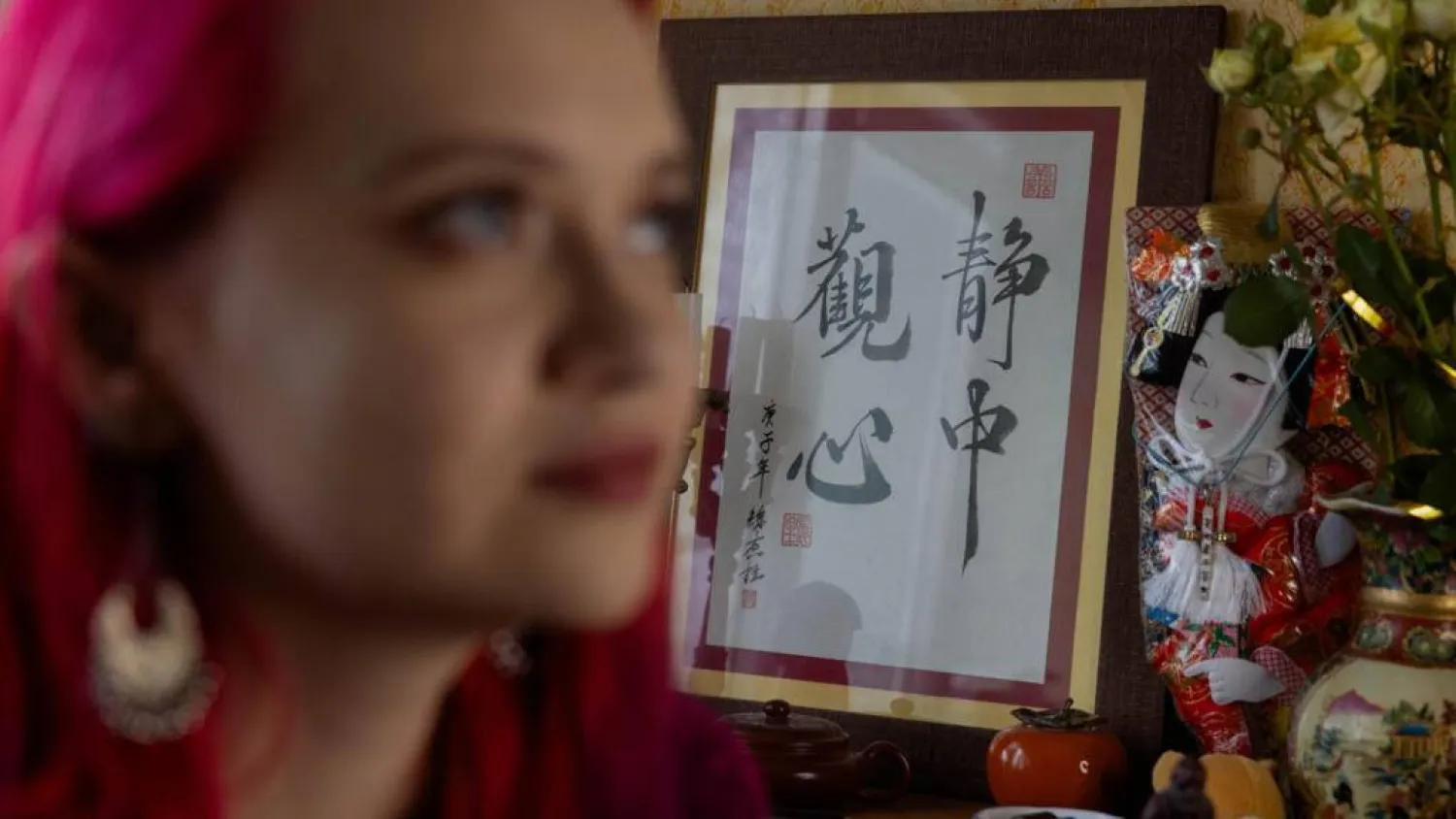
For Vladislava Simonova, haiku is a way of finding poetry in ordinary moments. Tetiana DZHAFAROVA / AFP
TT

Ukrainian Haiku Poet Finds Small Miracles in War

For Vladislava Simonova, haiku is a way of finding poetry in ordinary moments. Tetiana DZHAFAROVA / AFP

A temperamental lift leads to the apartment in central Ukraine of a 27-year-old poet celebrated in Japan but almost unknown in her own country.

With pink hair, fuchsia sweater and matching socks, Vladislava Simonova tells the story of her burgeoning career 7,800 kilometers (4,850 miles) away in a country she has never visited.

But here in the central Ukrainian city of Poltava, she lives near a trolleybus depot, which is just one of the sites targeted by Russian drones whose constant buzzing puts her on edge.

Just as she mentions the word "explosion" to describe the terror of Russian strikes, a drone whizzes overhead and explodes in the distance.

Next to her, a shelf holds 15 books with colorful spines -- a collection of contemporary Ukrainian poets -- two Japanese teapots, three religious icons and a figurine of Phoebe Buffay from the series "Friends".

"I never thought that I would be writing about war," she told AFP.

"With time, I somehow came to realize that ... tiny details can convey the tragedy of this great war much better than perhaps dozens of reports," she added.

Simonova is among a whole generation of artists bearing witness to the invasion that has devastated Ukrainian cultural life.

Simonova said she discovered haiku -- her preferred form -- in 2013, when she was a teenager.

The three-line poems, made up of 17 syllables in a 5-7-5 pattern, were codified in 17th-century Japan to capture the beauty of nature, daily life and fleeting moments with simplicity.

For years, she studied the Japanese masters -- Basho, Buson, Issa -- and wrote more than 600 haiku which, she said, gradually became less "clumsy":

He walks so proudly,

On soft apricot petals

This plump little cat.

24.04.2015

Not bothered by rain,

I tremble my way back home

With a pine sapling.

16.10.2014

- 'Communion' -

In 2018, Simonova won a competition organized by a Japanese foundation.

When Russia launched its full-scale invasion in February 2022, she was living in Kharkiv.

Russian forces tried to seize the northeastern city and have been shelling it constantly since being pushed back.

For three months when Russian troops first crossed the border, she survived by living in an underground shelter.

Instead of a storm --

The rumbling of explosions.

Springtime has arrived.

14.05.2022

A house in ruins.

Through the hole in the rooftop,

Stars are glimmering.

14.05.2022

In March 2022, from her shelter, Simonova gave a written interview to Japan's The Asahi Shimbun newspaper.

A few weeks later, renowned poet Madoka Mayuzumi got in touch.

She told AFP that Simonova has a "deep understanding" of the essence of haiku.

"Even in the midst of war, she gazes up at the moon and stars and admires flowers... her haiku reflect a communion with nature," Mayuzumi said.

"Despite the themes that tend to be sombre, her work possesses a sense of optimism," Mayuzumi added.

Bees oblivious

To the air-raid siren's sound.

Linden trees in bloom.

19.06.2022

With around 10 others, Mayuzumi helped Simonova translate and publish her first collection in Japan in 2023.

The book received "very high praise", Mayuzumi said.

Throughout Japan's history, she added, people have written haiku in dark times, including after the 1945 atomic bombings and the 2011 tsunami.

- 'Cherry blossoms' -

In August 2022, the underground shelter in Kharkiv where Simonova had lived was destroyed by a Russian missile. She moved to Poltava.

She published a second collection in Japan in 2024, followed by another in Denmark in early 2026.

She dreams of publishing one in Ukraine.

Before the war, she wrote in Russian. She later switched to Ukrainian.

The translation of the poems was complex. The two related languages often use words of different lengths -- "umbrella", for example, is one syllable in Russian, but four in Ukrainian.

Simonova does not read prose, "only poetry". And the Bible. She belongs to Poltava's tiny Catholic community.

During AFP's visit, she suggests going to the park, says goodbye to her husband -- who stays at home -- before hurrying down the stairs of her Soviet-era apartment block. The lift was not working.

It is a cold spring Sunday and the park is almost empty. She sits on a tree branch near a pond, wearing a multicolored puffer jacket.

Since childhood, Simonova has suffered from a serious heart condition that leaves her exhausted.

She discovered haiku in a hospital, in an anthology that also contained "Persian poems".

As the wind blows, she stands up and reads aloud for the first time in public, reciting each poem twice.

The first is for friends no longer around:

They scatter away

Like cherry blossoms in wind,

People I hold close.

The second is a memory of Kharkiv.

I clutch in my palm

Some fragments of a missile.

The pain stays with me.

She leafs through her pink-covered collection, then chooses one last poem.

What a sky it is!

And yet from that very sky

Missiles fall on us.