


Strings of Identity: Kashmir's Fading Music Endures

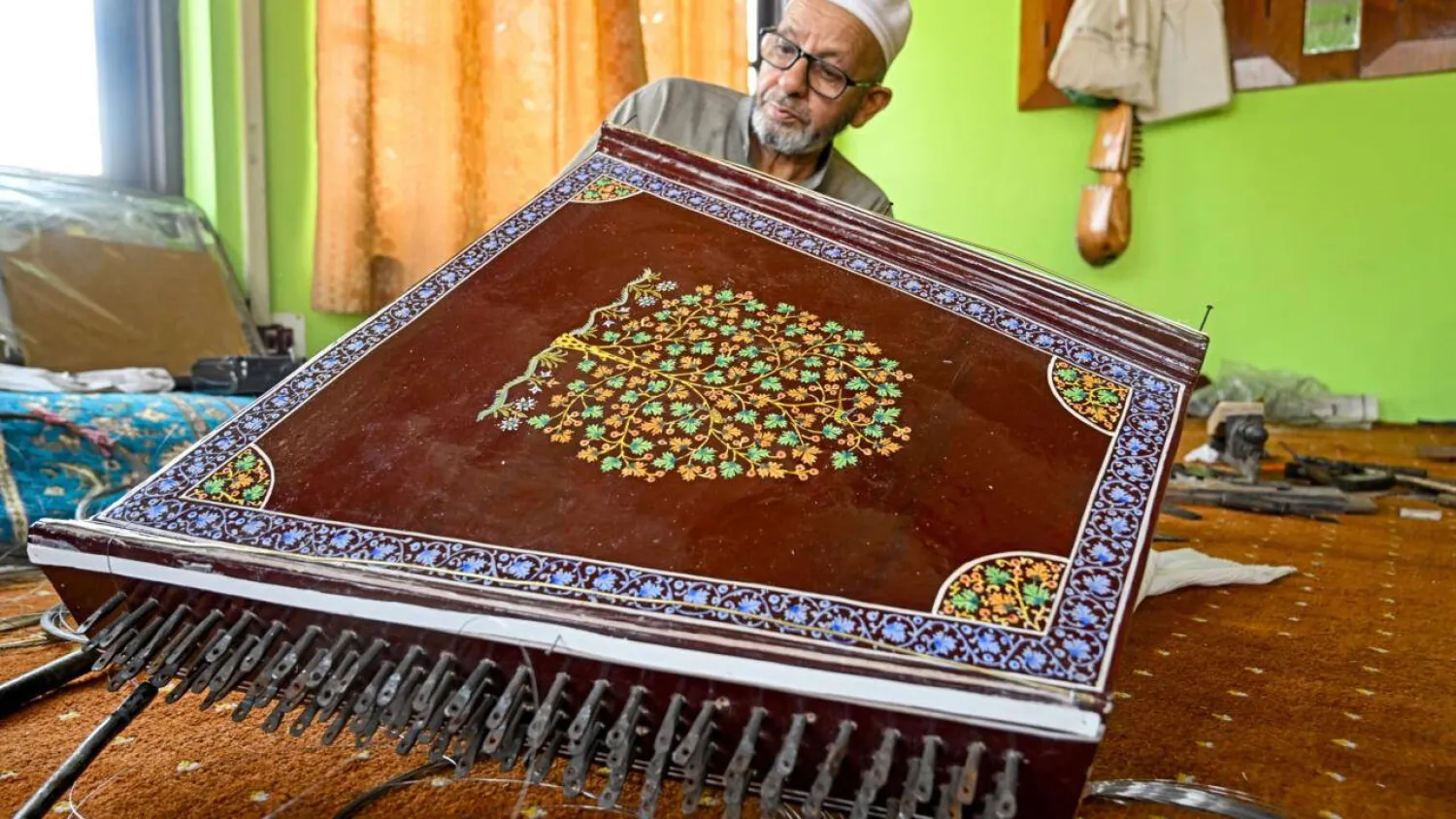
Generations of artisans in Indian-administered Kashmir have been making musical instruments such as the santoor, a zither-like, hundred-stringed instrument. Tauseef MUSTAFA / AFP
TT

Strings of Identity: Kashmir's Fading Music Endures

Generations of artisans in Indian-administered Kashmir have been making musical instruments such as the santoor, a zither-like, hundred-stringed instrument. Tauseef MUSTAFA / AFP

In a modest workshop filled with the fragrance of seasoned wood, 78-year-old Ghulam Mohammad Zaz continues a craft his family has preserved for eight generations -- the making of the Kashmiri santoor.

Surrounded by tools that have outlived artisans, he works slowly, each strike and polish echoing centuries of tradition crafting the musical instrument, AFP reported.

"Seven generations have worked and I am the eighth; I have no guarantee anyone after me will do this work," Zaz said softly, speaking in Kashmiri.

Once, several of his family members shared this craft in the heart of Kashmir's main city Srinagar, in the Indian-administered part of the Himalayan territory.

Today, he is the last in the city to make the instruments by hand.

"If I tell anyone to make something, they won't know what to do or how to make it," said Zaz, who produces around eight to 10 instruments every year, selling for around 50,000 rupees ($565) each.

"It is not as simple as just picking some wood -- one needs to find the right kind of wood."

The santoor, a hundred-stringed zither-like instrument played with hammers, has long been central to Kashmir's musical identity, giving the Muslim-majority region its cultural distinctiveness.

The contested Himalayan territory has been divided between India and Pakistan since independence from Britain in 1947.

Militants have fought Indian rule, demanding independence or a merger with Pakistan.

Tensions remain high between New Delhi and Islamabad.

In May, clashes between the nuclear-armed rivals sparked the worst fighting since 1999, killing more than 70 people in missile, drone and artillery exchanges.

Mystical music

Historically, the santoor formed the backbone of "sufiana musiqi", Kashmir's mystical music tradition, with its hypnotic and reverberating sound bringing tranquility.

"Musicians used to come from Iran to Kashmir, they used to play santoor and other instruments," said Muzaffar Bhat, a music professor at a government college in Anantnag.

"They used to sing in Persian... we adapted the santoor from them and assimilated it into our music."

The instrument received a new life in the 20th century.

In the 1950s, celebrated Indian musician Shivkumar Sharma -- born in Jammu and Kashmir in 1938 -- used the santoor to play classical music.

"Due to that, this became popularized in the classical circles throughout India," Bhat said.

Suddenly, the santoor was no longer confined to Kashmiri sufiana gatherings -— it had become a celebrated voice in Indian classical music.

Yet tradition faced challenges as Western instruments and global music trends began to overshadow local sounds.

"A lot of our traditional Kashmiri instruments became sidelined," said Bhat.

For craftsmen like Zaz, this meant fewer patrons, fewer students, and the slow decline of a centuries-old family profession.

Zaz sells his instruments in Kashmir, but also receives orders from Europe and the Middle East.

But there is hope. A revival, however modest, is taking root.

"Since the last few years, a new trend has started," Bhat said. "Our youngsters have started to learn our traditional instruments."




Prince Mohammed bin Salman Project Revitalizes 19th-Century Al-Habish Mosque in Al-Hofuf

This comes as part of the Kingdom-wide initiative to safeguard ancient mosques and highlight Saudi Arabia's cultural heritage under Vision 2030 - SPA
TT

Prince Mohammed bin Salman Project Revitalizes 19th-Century Al-Habish Mosque in Al-Hofuf

This comes as part of the Kingdom-wide initiative to safeguard ancient mosques and highlight Saudi Arabia's cultural heritage under Vision 2030 - SPA

The Prince Mohammed bin Salman Project for the Development of Historical Mosques restored Al-Habish Mosque in Al-Hofuf, Al-Ahsa Governorate, preserving its authentic architectural character and enhancing its religious and cultural significance, as part of the Kingdom-wide initiative to safeguard ancient mosques and highlight Saudi Arabia's cultural heritage under Vision 2030, reflecting the governorate's rich religious and intellectual legacy.

Situated in the heart of Al-Hofuf, it is considered one of the oldest historical mosques in Al-Ahsa. Its name is deeply intertwined with the history of the neighborhood and the lives of its inhabitants across generations, SPA reported.

Dating back to the 13th century AH (19th century CE), the mosque served not only as a place of worship but also as a beacon of knowledge, hosting classes in Islamic sciences. Among its most prominent teachers was Sheikh Abdulaziz bin Saleh Al-Alaji, a leading scholar of Al-Ahsa, reflecting the mosque's esteemed scholarly standing in the region's history.

Covering approximately 318 square meters, the mosque can accommodate around 90 worshippers. It comprises a prayer hall measuring 13.56 by 3.18 meters, a private retreat room measuring 13.73 by 2.68 meters, an 84-square-meter courtyard, an imam's room with an attached restroom, and a distinctive square minaret standing approximately 5.48 meters high.

The mosque underwent extensive development and rehabilitation in 2020 through the project, expanding its facilities to include the main prayer hall, the retreat room, the courtyard, and the minaret. The project also added a storage room, a dedicated women's prayer room, and modern restroom facilities, all while meticulously preserving the mosque’s original architectural features.


Ukraine Urges Venice Biennale to Exclude Russia

A firefighter extinguishes a blaze at a five-story residential building in Kharkiv on March 7, 2026, after it was partially destroyed by a Russian strike amid the Russian invasion of Ukraine. (Photo by SERGEY BOBOK / AFP)
TT

Ukraine Urges Venice Biennale to Exclude Russia

A firefighter extinguishes a blaze at a five-story residential building in Kharkiv on March 7, 2026, after it was partially destroyed by a Russian strike amid the Russian invasion of Ukraine. (Photo by SERGEY BOBOK / AFP)

Ukraine on Sunday called on the Venice Biennale to keep Russia out of the prestigious art event after organizers said it could participate for the first time since launching its all-out invasion in 2022.

"We call on the organizers of the Venice Biennale to reconsider their decision to allow the Russian Federation to return and to maintain the principled position demonstrated in 2022-2024," Ukraine's foreign minister, Andriy Sybiga, and culture minister, Tetyana Berezhna, said in a statement.

The organizers of the event said on Wednesday that they would allow Russia to take part in the exhibition this year, which runs from May 9 to November 22.

"La Biennale di Venezia is an open institution" and "rejects any form of exclusion or censorship of culture and art", they said in a statement.

Their decision was met with criticism, including from Italian Prime Minister Giorgia Meloni's government.

Lithuania's foreign minister called the move "abhorrent".

According to AFP, Italy's culture ministry said the move was made "entirely independently by the Biennale Foundation, despite the Italian government's opposition".

The Venice Biennale is an international cultural organization started in 1895 that presents major cultural festivals and runs its flagship art exhibition and architecture exhibition on alternating years.

Participating countries set up pavilions in Venice, and the art biennial typically attracts more than 600,000 visitors over its seven-month run.


Grabbing the Bull by the Tail: Venezuela’s Cowboy Sport

A cowboy gestures during a bull-tailing competition held as part of the "Fiestas del Alma Llanera" celebration in San Fernando de Apure, Apure State, Venezuela, on February 27, 2026. (AFP)
TT

Grabbing the Bull by the Tail: Venezuela’s Cowboy Sport

A cowboy gestures during a bull-tailing competition held as part of the "Fiestas del Alma Llanera" celebration in San Fernando de Apure, Apure State, Venezuela, on February 27, 2026. (AFP)

Four mounted cowboys jostle for position near the bull pen gate.

When the bull bolts out into the ring, a mad scramble begins as the riders vie to grab its tail and knock it to the ground.

Bull tailing, or "coleo" is to Venezuela's "llanos" (tropical grasslands) what rodeo is to Texas -- an integral part of popular culture that has survived opposition from animal welfare groups.

Unlike their Texan counterparts, "coleadores" don't try to ride the bull or grab it by the horns but rather chase its tail.

The coleo is one of the high points of the annual "llanera" fair in the central city of San Fernando de Apure, a three-day extravaganza of cowboy culture, including fast-paced, swirling "joropo" partner dancing listed on the UN's Intangible Cultural Heritage list.

Experts trace coleo to Spanish colonial times and link it to cattle herding work.

It is also practiced across the border in Colombia's "llanos," as well as in Brazil and Mexico, countries with strong cattle breeding traditions.

Most of the "coleadores" or bull tumblers learn the sport from their fathers or grandfathers. Women and children have also been known to compete.

For Neomar Sanoja, one of the judges, it's Venezuela's "national sport" -- a bold claim in a baseball mad nation.

- 'Feel the adrenaline' -

Rafael Delgado, 35, started competing at around 10, encouraged by his father, a ranch hand.

"It's part of our 'llanero' culture, part of being Venezuelan," he told AFP before entering the ring.

To reach the bull's tail, riders spur on their horses and when they draw alongside the animal's flanks, perform acrobatic maneuvers to try flip the beast.

The bull writhes, struggles back on its feet and tries to escape along the "manga de coleo," a 200-meter-long sand corridor, with the riders in hot pursuit.

Points vary depending on how the bull tumbles, with extra marks for those who manage to get all four legs in the air.

About 200 competitors took part in the four-minute bouts in San Fernando de Apure, wearing hockey helmets and padding on their arms and legs as armor.

Llanera music blared while a judge narrated the action with rapid-fire delivery.

Florelbis Linares told AFP she wanted to take up coleo despite the misgivings of her coleatero boyfriend, who she watched perform from the stands.

"You really feel the adrenaline watching from here," the 23-year-old said, her legs hanging over the guardrail around the ring.

- 'Defenseless animals' -

The bull's suffering is little cause for concern among aficionados of coleo.

Most of the animals who enter the ring are headed for the slaughterhouse.

Luis Garcia, a 32-year-old rider, accused critics of the sport of hypocrisy, noting that most show no outrage in the face of intensive cattle rearing and meat consumption.

The AnimaNaturalis animal rights NGO, which is active in Spain and Latin America, has called for the practice to be abolished.

"It is cruelty and an abuse of power by llaneros against defenseless animals," it argued on its website.

"Is this what you call culture?" the Napda Foundation, a Venezuelan animal rights foundation, asked, posting a video of coleo spectators kicking and throwing objects at a bull to force it to get back on its feet.

"The alleged 'humans' behave like beasts. This must stop now."