


Raves at Rome’s Ancient Amphitheater? New Colosseum Director Sets the Record Straight

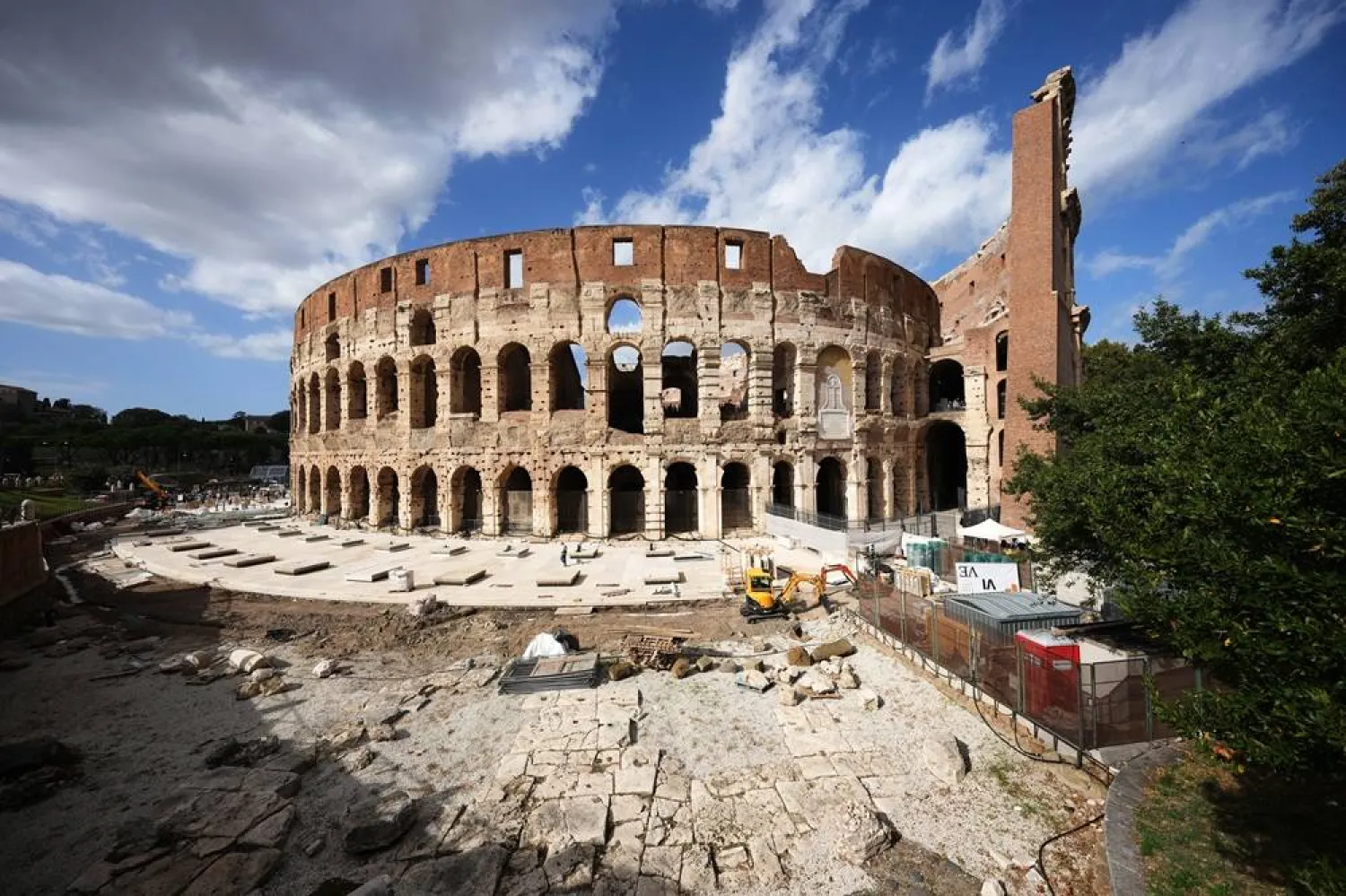
A view of the ancient Roman Colosseum, in Rome, Friday, Oct. 24, 2025. (AP)
TT

Raves at Rome’s Ancient Amphitheater? New Colosseum Director Sets the Record Straight

A view of the ancient Roman Colosseum, in Rome, Friday, Oct. 24, 2025. (AP)

The man who just took charge of Rome’s top tourist attraction wants to set the record straight: the Colosseum won’t be hosting any electronic dance music parties on his watch.

Simone Quilici, director of the Archaeological Park of the Colosseum, shared his plan to bring concerts to the almost 2,000-year-old amphitheater in an interview with an Italian newspaper earlier this month, and social media proceeded to do what it all too often does. “Massive raves” were imminent, multiple accounts trumpeted alongside AI-generated images of multicolor light beams shooting from the arena into the heavens.

Quilici told The Associated Press that he heard complaints from archaeologists and ordinary Romans, dismayed their cultural heritage could be so desecrated. Even electronic music fans expressed concern online about the damage a whomping bass beat would inflict on an ancient structure that continues yielding new wonders, like the emperor’s secret passage that opens on Oct. 27.

Concerts must respect the Colosseum as a “sacred space,” Quilici said, as it is integral to Roman identity and has become imbued with religious significance. Today, it is the site of the Via Crucis (Way of the Cross) procession during Easter, traditionally presided over by the pope.

“The music must be carefully controlled. I mentioned certain artists — not by accident — who haven’t been ‘rock’ for some time, who play calm music and attract a calm audience, because the important thing is that it’s not a wild crowd,” Quilici, 55, said Friday in his first interview with foreign media since taking over on Oct. 20. “I joked about rock in moderation — that’s what I meant, a more subdued kind of music. But it was reported the opposite of what I said.”

Concerts could be acoustic or jazz, he said, offering Sting as an example. The amphitheater could host poetry readings, dance performances and theater productions once the existing small platform is expanded. Also in the plans: historical reenactments of gladiatorial battles rooted in academic research.

“There are people who are extremely knowledgeable about daily life in past eras, with a remarkable level of scientific accuracy. So these activities are very welcome within the Colosseum park,” Quilici said. He stressed such presentations would be the antithesis of the shabbily costumed centurions who besiege the Colosseum by night, posing for photos with tourists and then harassing them for payment.

The Colosseum's first concerts and performances will take place in no less than two years, he added.

Only a handful of concerts have taken place within the Colosseum over the years, including Ray Charles in 2002, Paul McCartney in 2003 and Andrea Bocelli in 2009. All were billed as special events and audience numbers were severely restricted.

“Unfortunately, as everyone knows, tourism is a commercial activity — an industry that does not always connect with culture,” he said on the Colosseum’s uppermost balcony. “Bringing cultural activities into the mix would enrich this place, making it not only a site to visit, but also a place where one can experience and enjoy artistic events.”

Looking beyond the Colosseum

Peering down into the arena’s ruins from high above, the bustle of tourists brings to mind the cross-section of an anthill. The Colosseum had almost 9 million visitors last year, up from 7 million the year before, according to data provided by the park.

Even in October, well outside the high tourist season of summer, the place was packed.

That’s partly due to the Vatican’s Jubilee year, held once every quarter-century, which continues to draw large tour groups of pilgrims. It’s also because the Colosseum is one of just two must-see spots for short-staying tourists, along with Vatican City, and “already is at maximum capacity,” Quilici said.

Therein lies the other great ambition for his tenure: inducing tourists to go elsewhere.

The park he oversees includes not just the Colosseum, but also other sites directly adjacent like the Roman Forum, which was the heart of the ancient city’s society, and Palatine Hill, where Rome was founded and the emperor’s palace is located.

Tickets lasting 24 hours include all three destinations. Still, one-third of buyers visit only the Colosseum, according to park data. If Rome's an open-air museum, as is often said, that’s like catching a glimpse of Leonardo da Vinci’s “Mona Lisa” through the crowd at the Louvre, then leaving without even looking at the other masterpieces in the room.

“Last year, tourists in Rome didn’t stay just two and a half days; their visits increased to four days. So there’s also the opportunity to use the Colosseum as a starting point for exploring less-visited places,” he said.

Likewise, relatively few visitors go to the nearby Circus Maximus, the sprawling grounds of Rome’s high-adrenaline chariot races, depicted in the 1959 film “Ben-Hur.” The Appian Way, known as “the queen of roads,” goes even more overlooked, despite becoming a UNESCO world heritage site last year. Its giant paving stones provide passage into a golden countryside that evokes long-gone centuries and provides welcome respite from Rome’s tourist-thronged center.

Both the Circus Maximus and the Appian Park, which Quilici administered before the Colosseum, are free to visit.

All these sites and more are near to one another, though somewhat disjointed – archaeological islands mostly sliced into sections by busy roads. Quilici hopes to create new access points to his park as well as connections with others to better manage the crowds and establish one consolidated area for exploration and discovery.

“It’s a collective effort, one that requires cooperation from all the different administrations,” he said. “However, it’s more a matter of management than of infrastructure costs. Choices that sometimes can be simple decisions like limiting traffic — not necessarily involving major expenses, but rather a courageous choice to restore life to the heart of the city of Rome.”



Saudi Arabia: Ship of Tolerance Initiative Promotes Cultural Dialogue in Jeddah

The Royal Institute of Traditional Arts (Wrth) will offer traditional craft workshops throughout Ramadan. SPA
TT

Saudi Arabia: Ship of Tolerance Initiative Promotes Cultural Dialogue in Jeddah

The Royal Institute of Traditional Arts (Wrth) will offer traditional craft workshops throughout Ramadan. SPA

The Saudi Ministry of Culture, in collaboration with the "Lenobadir" volunteer and community partnership program and the Athr Foundation, has launched the Ship of Tolerance initiative in Historic Jeddah during Ramadan.

The initiative aims to enhance shared human values through arts, and promote tolerance and coexistence among children and families. It provides an educational and cultural experience aligned with the area’s unique character as a UNESCO World Heritage site.

As part of this global art project, children will create artworks that represent acceptance and dialogue.

The Royal Institute of Traditional Arts (Wrth) will offer traditional craft workshops throughout Ramadan, linking the initiative's values with local heritage and enriching visitors' connection to the region's identity.

This effort supports cultural programs with educational and social dimensions in Historic Jeddah, activating local sites for experiences that combine art, crafts, and community participation. It aligns with the National Strategy for Culture under Saudi Vision 2030, focusing on heritage preservation and expanding culture's impact on daily life.


Oscar Contender ‘Hamnet’ Boosts Tourism at Shakespeare Heritage Sites 

A view of Shakespeare’s Birthplace, William Shakespeare's childhood home, in Stratford-upon-Avon, Britain, February 9, 2026. (Reuters)
TT

Oscar Contender ‘Hamnet’ Boosts Tourism at Shakespeare Heritage Sites 

A view of Shakespeare’s Birthplace, William Shakespeare's childhood home, in Stratford-upon-Avon, Britain, February 9, 2026. (Reuters)

On a cloudy winter's day, visitors stream into what was once William Shakespeare's childhood home in Stratford-upon-Avon and the nearby Anne Hathaway's cottage, family residence of the bard's wife.

Hathaway's cottage is one of the settings for the BAFTA and Oscar best film contender "Hamnet", and the movie's success is drawing a new wave of tourists to Shakespeare sites in the town in central England.

Shakespeare's Birthplace is the house the young William once lived in and where his father worked as a glove maker, while Hathaway's cottage is where he would have visited his future wife early in their relationship.

Typically, around 250,000 visitors, from the UK, Europe, the United States, China and elsewhere, walk through the locations each year, according to the Shakespeare Birthplace Trust. ‌The charity looks after ‌Shakespeare heritage sites, which also include Shakespeare's New Place, the site of ‌the ⁠Stratford home where the ⁠bard died in 1616.

Visitors are flocking in this year thanks to "Hamnet", the film based on Maggie O'Farrell's 2020 novel, which gives a fictional account of the relationship between Shakespeare and Hathaway, also known as Agnes, and the death of their 11-year-old son Hamnet in 1596.

"Visitor numbers have increased by about 15 to 20% across all sites since the film was released back in January. I think that will only continue as we go throughout the year," Richard Patterson, chief operating officer for the Shakespeare Birthplace Trust, said.

"They particularly want ⁠to look (at) Anne Hathaway's cottage and the specifics around how the family ‌engaged in the spaces and the landscape in and around ‌the cottage... you can see why he would have been inspired."

NEW ACCESS TO SHAKESPEARE

"Hamnet" has 11 nominations at ‌Sunday's British BAFTA awards, including best film and leading actress for Jessie Buckley, who plays Agnes. It ‌also has eight Oscar nominations, with Buckley seen as the frontrunner to win best actress.

"Hamnet" is set in Stratford-upon-Avon and London although it was not filmed in Stratford.

It sees Paul Mescal's young Shakespeare fall for Agnes while teaching Latin to pay off his father's debts. The drama, seen mainly through Agnes' eyes, focuses on their ‌life together and grief over Hamnet's death, leading Shakespeare to write "Hamlet".

"Shakespeare... is notoriously enigmatic. He writes about humanity, about feeling, about emotion, about conflict, ⁠but where do we understand ⁠who he is in that story?" said Charlotte Scott, a professor of Shakespeare studies and interim director of collections, learning and research at the Shakespeare Birthplace Trust.

"And that's driven people creative and otherwise for hundreds and hundreds of years. Where is Shakespeare's heart? And this is what the film I think has so beautifully opened up."

Little is known about how the couple met. Shakespeare was 18 and Hathaway 26 when they married in 1582. Daughter Susanna arrived in 1583 and twins Judith and Hamnet in 1585.

The film acknowledges the names Hamnet and Hamlet were interchangeable back then. While grief is a dominant theme, audiences also see Shakespeare in love and as a father.

"A lot of people will see this film not necessarily having... had any kind of relationship with Shakespeare," Scott said.

"So people will come to this film, I hope, and find a new way of accessing Shakespeare that is about creativity, that is about understanding storytelling as a constant process of regeneration, but also crucially, looking at it from that kind of emotive angle."


Culture Ministry Continues Preparations in Historic Jeddah to Welcome Visitors during Ramadan 

Historic Jeddah has emerged as a leading cultural tourism destination during Ramadan. (SPA)
TT

Culture Ministry Continues Preparations in Historic Jeddah to Welcome Visitors during Ramadan 

Historic Jeddah has emerged as a leading cultural tourism destination during Ramadan. (SPA)

The Saudi Ministry of Culture is continuing its efforts to revitalize Historic Jeddah in preparation for welcoming visitors during the holy month of Ramadan, offering cultural programs, events, and heritage experiences that reflect the authenticity of the past.

The district has emerged as a leading cultural tourism destination at this time of year as part of the “The Heart of Ramadan” campaign launched by the Saudi Tourism Authority.

Visitors are provided the opportunity to explore the district’s attractions, including archaeological sites located within the geographical boundaries of the UNESCO World Heritage-listed area, which represent a central component of the Kingdom’s urban and cultural heritage.

The area also features museums that serve as gateways to understanding the city’s rich heritage and cultural development, in addition to traditional markets that narrate historical stories through locally made products and Ramadan specialties that reflect authentic traditions.

These initiatives are part of the ministry’s ongoing efforts to revitalize Historic Jeddah in line with the objectives of Saudi Vision 2030 and aiming to transform it into a vibrant hub for arts, culture, and the creative economy, while preserving its tangible and intangible heritage.