

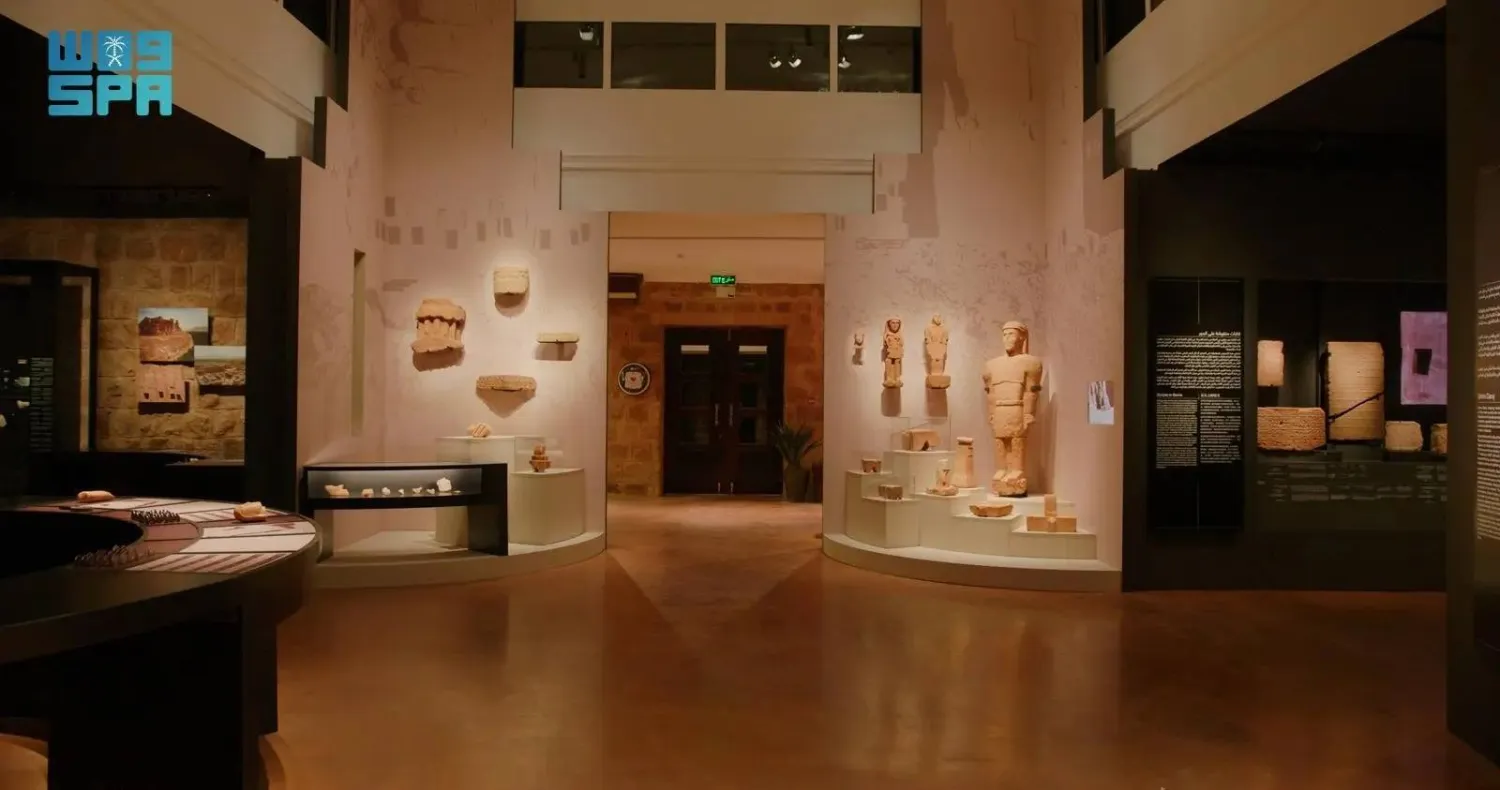

New Exhibition in Saudi Arabia's AlUla Highlights Ancient City of Dadan

The new permanent exhibition, held at the Dadan archaeological site in AlUla, presents a wide collection of traditional crafts and customs, along with material evidence of cultural exchange between ancient civilizations. (SPA)
TT

New Exhibition in Saudi Arabia's AlUla Highlights Ancient City of Dadan

The new permanent exhibition, held at the Dadan archaeological site in AlUla, presents a wide collection of traditional crafts and customs, along with material evidence of cultural exchange between ancient civilizations. (SPA)

Saudi Arabia’s AlUla is preparing to open new chapters in the history of the ancient city of Dadan, the former capital of the Kingdoms of Dadan and Lihyan, through a new permanent exhibition titled “Illuminating Discoveries – Uncovering the Layers of Dadan’s History”, reported the Saudi Press Agency on Wednesday.

The exhibition offers an in-depth experience of the city’s archaeological heritage and its flourishing civilization across centuries. It guides visitors through the features of the past and demonstrates the importance of this historical site on regional and global heritage maps.

The new permanent exhibition, held at the Dadan archaeological site in AlUla, presents a wide collection of traditional crafts and customs, along with material evidence of cultural exchange between ancient civilizations. It highlights the historical role of Dadan as a political and commercial center on the Incense Road during the first millennium BCE and earlier.

The exhibition introduces a significant new chapter in the study of the Arabian Peninsula’s ancient history. It features more than one hundred artifacts carefully uncovered by international teams working at the Dadan site in AlUla and at the nearby mountain sanctuary of Umm Daraj over the past five years. These findings reveal the scale of ancient trade routes and confirm that AlUla once stood at the heart of a connected and sophisticated network.

Among the objects on display are small figurines linked to the Greek world, a bone hairpin from the Roman or Byzantine era, and rock inscriptions written in an ancient South Arabian script.

Dadan belongs to a line of advanced civilizations whose roots reach deep into the ancient world. Farming in the city is believed to date back to around the third millennium BCE, and archaeologists have found evidence of handcrafts from the second millennium BCE, long before the rise of the Roman Empire.

Material remains show that craftsmanship formed a central part of daily life and reflect the skill and ingenuity of the population. New discoveries include examples of complex metalwork and early evidence of textile production using weaving and spinning techniques. These traditional crafts, once essential to life in the city, are being revived today under the Royal Commission for AlUla’s cultural regeneration programs.

The exhibition also includes rare artifacts never before shown to the public. The material is organized into five main sections: Crafts and Daily Life in Ancient Dadan; Exchange and Trade; Ancient Beliefs and Rituals; Scripts in Stone; and Umm Daraj.

Among the findings is a copper-alloy spearhead dating to between 400 and 50 BCE. Field surveys along Dadan’s cliffs uncovered hundreds of inscriptions and striking rock art, including a battle scene showing four mounted warriors carrying long spears. Rock art in the nearby desert valley of Wadi Al-Naam depicts a rider using a spear to hunt an ostrich.

Another notable object is a terracotta head found in an urban neighborhood of Dadan and dating to the late fourth to first century BCE. Imported from the ancient Greek world, it is believed to have belonged to a Tanagra figurine, a type of small, finely crafted statue produced in central Greece and traded widely across the Mediterranean and as far as Babylon. The head reflects how Mediterranean artistic styles entered the region and circulated across northwest Arabia during the Lihyanite period.

Archaeologists also uncovered a striking statue from an ancient shrine at the foot of Dadan’s cliffs, dating to between 400 and 50 BCE, with one of its eye inlays still preserved. The statue reflects the high craftsmanship of symbolic objects produced during the Lihyanite period. Another figurine, marked by long hair and a belted garment, was found at the same site, with only one arm surviving. Its eyes were once inlaid with bone.

A unique part of the collection is a fragment of carved sandstone dating to the first millennium BCE. It preserves part of an inscription in the ancient South Arabian Minaic script. The relief carving likely came from a temple or public building. The preserved symbols probably refer to Wadd, the chief deity worshipped by the Minaean community at Dadan. Merchants from the Kingdom of Ma‘in established a trading presence in Dadan and left inscriptions documenting their cultural practices.

This inscription has a connection to the nearby “open-air library” at Jabal Ikmah. Inscribed on UNESCO’s Memory of the World Register, Jabal Ikmah contains nearly three hundred inscriptions, most dating to the Dadanite and Lihyanite periods.

The exhibition was organized through cooperation between the Royal Commission for AlUla, the French National Center for Scientific Research, and the French Agency for AlUla Development, which have jointly led recent Saudi-French archaeological missions in Dadan.

The launch of the 2025-2026 archaeological season in AlUla marks one of the region’s broadest heritage research efforts to date. More than one hundred archaeologists and specialists from leading Saudi and international institutions are participating across six major projects, ranging from new excavations at Hegra and Dadan to large-scale inscription surveys and environmental studies.

This program is the most ambitious undertaken in AlUla and contributes to advancing knowledge, developing national expertise, and strengthening the Kingdom’s position as a leader in cultural heritage research.



Saudi Arabia: Ship of Tolerance Initiative Promotes Cultural Dialogue in Jeddah

The Royal Institute of Traditional Arts (Wrth) will offer traditional craft workshops throughout Ramadan. SPA
TT

Saudi Arabia: Ship of Tolerance Initiative Promotes Cultural Dialogue in Jeddah

The Royal Institute of Traditional Arts (Wrth) will offer traditional craft workshops throughout Ramadan. SPA

The Saudi Ministry of Culture, in collaboration with the "Lenobadir" volunteer and community partnership program and the Athr Foundation, has launched the Ship of Tolerance initiative in Historic Jeddah during Ramadan.

The initiative aims to enhance shared human values through arts, and promote tolerance and coexistence among children and families. It provides an educational and cultural experience aligned with the area’s unique character as a UNESCO World Heritage site.

As part of this global art project, children will create artworks that represent acceptance and dialogue.

The Royal Institute of Traditional Arts (Wrth) will offer traditional craft workshops throughout Ramadan, linking the initiative's values with local heritage and enriching visitors' connection to the region's identity.

This effort supports cultural programs with educational and social dimensions in Historic Jeddah, activating local sites for experiences that combine art, crafts, and community participation. It aligns with the National Strategy for Culture under Saudi Vision 2030, focusing on heritage preservation and expanding culture's impact on daily life.


Oscar Contender ‘Hamnet’ Boosts Tourism at Shakespeare Heritage Sites 

A view of Shakespeare’s Birthplace, William Shakespeare's childhood home, in Stratford-upon-Avon, Britain, February 9, 2026. (Reuters)
TT

Oscar Contender ‘Hamnet’ Boosts Tourism at Shakespeare Heritage Sites 

A view of Shakespeare’s Birthplace, William Shakespeare's childhood home, in Stratford-upon-Avon, Britain, February 9, 2026. (Reuters)

On a cloudy winter's day, visitors stream into what was once William Shakespeare's childhood home in Stratford-upon-Avon and the nearby Anne Hathaway's cottage, family residence of the bard's wife.

Hathaway's cottage is one of the settings for the BAFTA and Oscar best film contender "Hamnet", and the movie's success is drawing a new wave of tourists to Shakespeare sites in the town in central England.

Shakespeare's Birthplace is the house the young William once lived in and where his father worked as a glove maker, while Hathaway's cottage is where he would have visited his future wife early in their relationship.

Typically, around 250,000 visitors, from the UK, Europe, the United States, China and elsewhere, walk through the locations each year, according to the Shakespeare Birthplace Trust. ‌The charity looks after ‌Shakespeare heritage sites, which also include Shakespeare's New Place, the site of ‌the ⁠Stratford home where the ⁠bard died in 1616.

Visitors are flocking in this year thanks to "Hamnet", the film based on Maggie O'Farrell's 2020 novel, which gives a fictional account of the relationship between Shakespeare and Hathaway, also known as Agnes, and the death of their 11-year-old son Hamnet in 1596.

"Visitor numbers have increased by about 15 to 20% across all sites since the film was released back in January. I think that will only continue as we go throughout the year," Richard Patterson, chief operating officer for the Shakespeare Birthplace Trust, said.

"They particularly want ⁠to look (at) Anne Hathaway's cottage and the specifics around how the family ‌engaged in the spaces and the landscape in and around ‌the cottage... you can see why he would have been inspired."

NEW ACCESS TO SHAKESPEARE

"Hamnet" has 11 nominations at ‌Sunday's British BAFTA awards, including best film and leading actress for Jessie Buckley, who plays Agnes. It ‌also has eight Oscar nominations, with Buckley seen as the frontrunner to win best actress.

"Hamnet" is set in Stratford-upon-Avon and London although it was not filmed in Stratford.

It sees Paul Mescal's young Shakespeare fall for Agnes while teaching Latin to pay off his father's debts. The drama, seen mainly through Agnes' eyes, focuses on their ‌life together and grief over Hamnet's death, leading Shakespeare to write "Hamlet".

"Shakespeare... is notoriously enigmatic. He writes about humanity, about feeling, about emotion, about conflict, ⁠but where do we understand ⁠who he is in that story?" said Charlotte Scott, a professor of Shakespeare studies and interim director of collections, learning and research at the Shakespeare Birthplace Trust.

"And that's driven people creative and otherwise for hundreds and hundreds of years. Where is Shakespeare's heart? And this is what the film I think has so beautifully opened up."

Little is known about how the couple met. Shakespeare was 18 and Hathaway 26 when they married in 1582. Daughter Susanna arrived in 1583 and twins Judith and Hamnet in 1585.

The film acknowledges the names Hamnet and Hamlet were interchangeable back then. While grief is a dominant theme, audiences also see Shakespeare in love and as a father.

"A lot of people will see this film not necessarily having... had any kind of relationship with Shakespeare," Scott said.

"So people will come to this film, I hope, and find a new way of accessing Shakespeare that is about creativity, that is about understanding storytelling as a constant process of regeneration, but also crucially, looking at it from that kind of emotive angle."


Culture Ministry Continues Preparations in Historic Jeddah to Welcome Visitors during Ramadan 

Historic Jeddah has emerged as a leading cultural tourism destination during Ramadan. (SPA)
TT

Culture Ministry Continues Preparations in Historic Jeddah to Welcome Visitors during Ramadan 

Historic Jeddah has emerged as a leading cultural tourism destination during Ramadan. (SPA)

The Saudi Ministry of Culture is continuing its efforts to revitalize Historic Jeddah in preparation for welcoming visitors during the holy month of Ramadan, offering cultural programs, events, and heritage experiences that reflect the authenticity of the past.

The district has emerged as a leading cultural tourism destination at this time of year as part of the “The Heart of Ramadan” campaign launched by the Saudi Tourism Authority.

Visitors are provided the opportunity to explore the district’s attractions, including archaeological sites located within the geographical boundaries of the UNESCO World Heritage-listed area, which represent a central component of the Kingdom’s urban and cultural heritage.

The area also features museums that serve as gateways to understanding the city’s rich heritage and cultural development, in addition to traditional markets that narrate historical stories through locally made products and Ramadan specialties that reflect authentic traditions.

These initiatives are part of the ministry’s ongoing efforts to revitalize Historic Jeddah in line with the objectives of Saudi Vision 2030 and aiming to transform it into a vibrant hub for arts, culture, and the creative economy, while preserving its tangible and intangible heritage.