


UNESCO Recognition Inspires Hope in Afghan Artist’s City

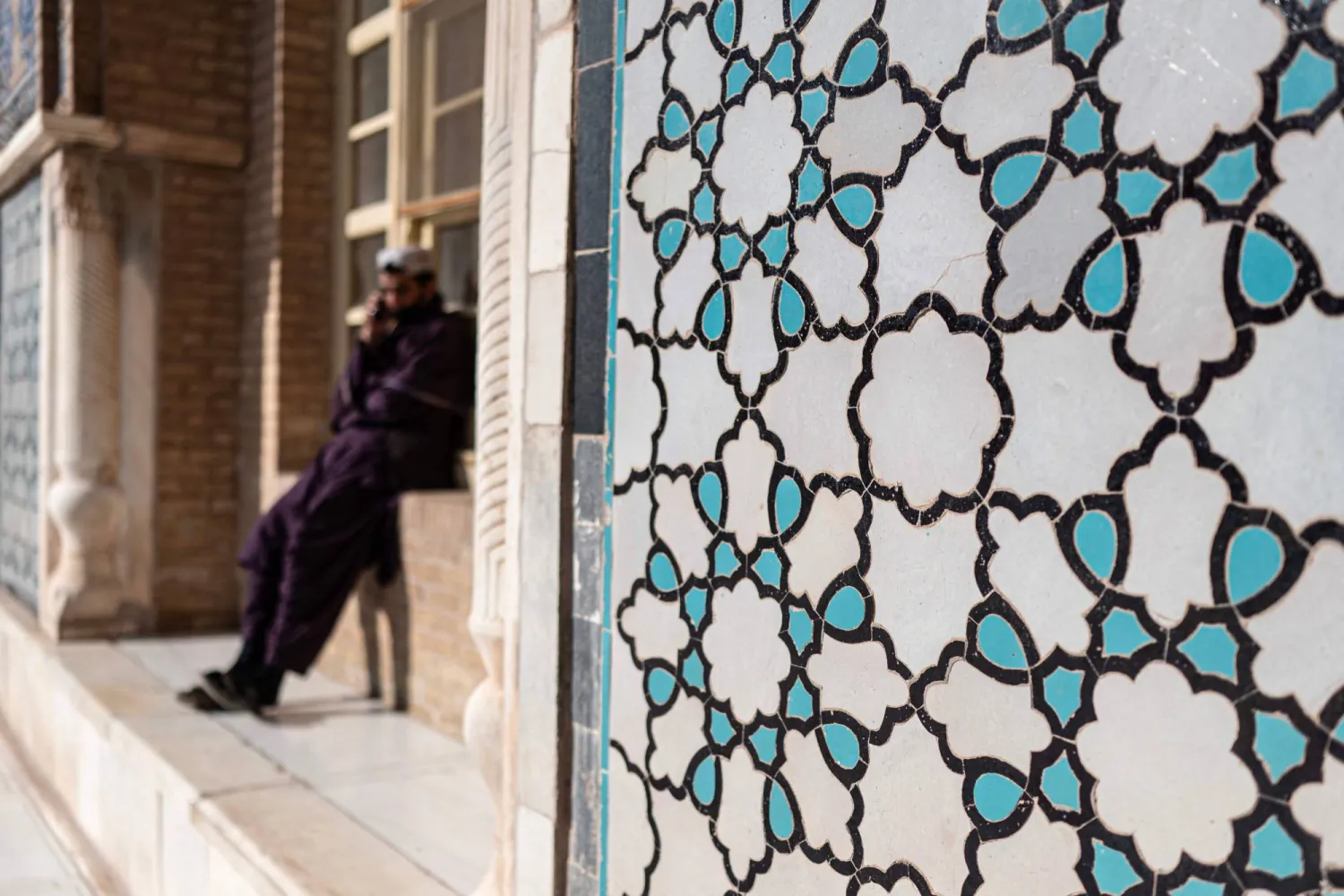
This picture taken on January 8, 2026 shows miniature art carved on the wall of Jami Masjid, also known as the Great Mosque of Herat in Herat. (AFP)
TT

UNESCO Recognition Inspires Hope in Afghan Artist’s City

This picture taken on January 8, 2026 shows miniature art carved on the wall of Jami Masjid, also known as the Great Mosque of Herat in Herat. (AFP)

Hundreds of years after the celebrated painter Kamal ud-Din Behzad roamed the streets of Herat, artists in the Afghan city are finding joy and hope in his recognition by UNESCO.

Sitting cross-legged on a red carpet, artist Mohammad Younes Qane uses an ultra-fine paintbrush to trace details such as a horse's mane or the beads of a necklace.

"When I paint, I'm taken back 500 years, to the streets of Herat back then," when the rulers of the Timurid empire were patrons of artists such as Behzad, Qane said with a smile.

Since he was a teenager, the 45-year-old has been practicing Behzad's celebrated miniature art style, which inspired French artist Henri Matisse.

A contemporary of Italian masters Leonardo da Vinci and Sandro Botticelli, Behzad brought a new style to Herat before settling in Tabriz, in modern-day Iran.

Celebrating his "vibrant cultural expression", the UN's cultural agency inscribed Behzad's style of miniature art on its list of Intangible Cultural Heritage of Humanity in December.

Such recognition was "truly joyful news", coming "at a time when we are in darkness and facing very difficult conditions", Qane said.

Since the Taliban authorities returned to power in 2021 and imposed their strict interpretation of religious law, many artists have left Afghanistan.

Qane has closed his gallery and works at home, with clients now rare and exhibitions non-existent.

He sometimes climbs the hill to a white tomb believed to be Behzad's, where he finds peace.

Taliban officials have banned music in public places, as well as the representation of living things.

- 'Proud of Behzad' -

Numerous residents pointed to the increasing enforcement of the ban on showing human faces, which are a common feature of Behzad-style artworks.

"It's very sad, because we are proud of Behzad in Herat," said one resident, speaking on condition of anonymity for security reasons.

Ahmad Jawid Zargham, the former head of the provincial arts and culture department, said paintings were "simple and without soul" before Behzad.

"He introduced scenes from people's everyday life. For example, ordinary people, passersby, dervishes, mullahs, scenes of teaching girls and boys, or groups of workers busy with architecture," Zargham told AFP.

At Herat's central mosque, which is covered in blue ceramic tiles, there are delicate floral and geometric motifs created by Behzad.

But his decorated manuscripts are kept abroad, at world-renowned institutions such as New York's Metropolitan Museum of Art, the British Library in London and the Topkapi Palace Museum in Istanbul.

Michael Barry, a leading specialist in miniature art, said that people being deprived of their cultural patrimony was "the height of injustice".

At the same time, he remained "very aware of the care that is required to maintain these delicate works", which can easily be damaged by light exposure.

Conscious of the difficulties of repatriating Behzad's artworks, Barry instead enlarged and reproduced them in 2017 for an exhibition at Herat's citadel.

But residents can no longer view the bright autumn colors of the tree of life, a symbol often painted by Behzad, as the wooden door has been padlocked shut.

Despite welcoming the UNESCO recognition, the provincial arts and culture department did not give an explanation for its closure.

Recalling Herat's importance, Barry said the city was the "world capital of painting, poetry, music, philosophy, mathematics. The Florence of the Islamic world".

"The most important center of Islamic civilization in the 15th century endorsed figurative art," he added.

But nowadays, at the citadel, faces shown on panels about the city's history have been painted black.

Despite such measures enforced by the Taliban government's morality police, Behzad is still inspiring young Afghans.

Around a dozen women gathered in a workshop to paint miniature art scenes on glass or paper, which they sell through social media or to acquaintances.

The UNESCO recognition is motivating, said Parisa Narwan, 24, who has been unable to participate in scholarships and exhibitions abroad because it has become practically impossible to get visas.

Artists need opportunities "including international exhibitions and financial support", she said.

One of the other artists contemplated how she would address Behzad today: "I wish he could have lived now -- I would ask him to improve the women's life in Afghanistan because it is really difficult."

Saudi Arabia: Hira Cultural District's Museum Displays World's Largest Quran Copy

The manuscript measures 312 by 220 centimeters and comprises 700 pages. SPA
TT

Saudi Arabia: Hira Cultural District's Museum Displays World's Largest Quran Copy

The manuscript measures 312 by 220 centimeters and comprises 700 pages. SPA

The Holy Quran Museum at the Hira Cultural District is showcasing a monumental handwritten copy of the Holy Quran, recognized as the largest Quran of its kind in the world, the Saudi Press Agency reported.

The manuscript measures 312 by 220 centimeters and comprises 700 pages, earning the museum recognition from Guinness World Records for displaying the world's largest Quran, SPA said.

The manuscript is a magnified reproduction of a historic Quran dating back to the 10th century AH (16th century CE). The original copy measures 45 by 30 centimeters with the chapters written primarily in Thuluth script, while Surah Al-Fatiha was penned in Naskh, reflecting the refined artistic choices and calligraphic diversity of that era.

The Quran is a unique example of Arabic calligraphy, gilding, and bookbinding, showcasing features of Islamic art through intricate decorations, sun-shaped motifs on the opening folio, and frontispiece and title pages, reflecting the high level of artistic mastery of that era.

The manuscript was endowed as a waqf in 1300 AH (1883 CE). Its original version is currently preserved at the King Abdulaziz Complex for Endowment Libraries, remaining a lasting testament to Muslims' enduring reverence for the Quran and the richness of the Islamic arts associated with it across the centuries.


Saudi Arabia's Ithra Launches iRead Marathon with Participation from 13 Arab Countries

The fifth annual iRead Marathon is taking place from February 5 to 7. (SPA)
TT

Saudi Arabia's Ithra Launches iRead Marathon with Participation from 13 Arab Countries

The fifth annual iRead Marathon is taking place from February 5 to 7. (SPA)

Saudi Arabia's King Abdulaziz Center for World Culture (Ithra) announced the launch of the fifth annual iRead Marathon, in collaboration with the Arab Federation for Libraries and Information (AFLI) and environmental partners, reported the Saudi Press Agency on Tuesday.

The event will witness the participation of 52 libraries from 13 Arab countries, including Saudi Arabia, the United Arab Emirates, Qatar, Oman, Egypt, Morocco, Tunisia, Algeria, Palestine, Jordan, Bahrain, Kuwait, and Iraq.

This year’s edition, taking place from February 5 to 7, has recorded a 235% increase in participation by Arab libraries compared to last year. It is an extension of a series of initiatives introduced by Ithra with aim of encouraging reading in society.

Ithra Library Head Abdullah Al Hawas explained that Ithra places great emphasis on reading and its promotion, adopting reading as a key priority for the next five years.

He noted its launch of the Arab Reading Index to monitor the state of reading across Arab countries. The iRead Marathon is in line with these efforts.


Trevi Fountain Fee Takes Effect as Rome Seeks to Manage Tourist Crowds

02 February 2026, Italy, Rome: First day of paid admission to the Trevi Fountain basin for tourists and non-residents of Rome. (dpa)
TT

Trevi Fountain Fee Takes Effect as Rome Seeks to Manage Tourist Crowds

02 February 2026, Italy, Rome: First day of paid admission to the Trevi Fountain basin for tourists and non-residents of Rome. (dpa)

Tourists hoping to get close to the Trevi Fountain had to pay 2 euros ($2.35) starting Monday as the city of Rome inaugurated a new fee structure to help raise money and control crowds at one of the world’s most celebrated waterworks.

The first tourists to pass through the new ticket check seemed unfazed by the tariff, noting it was a small price to pay for quality access to a fountain made famous by Federico Fellini’s movie “La Dolce Vita.”

“Before, there were problems accessing the fountain. There were a lot of people. Now, it’s very easy,” said Ilhan Musbah, a tourist from Morocco. “You can take photos, you feel good, you’re comfortable, and on top of that 2 euros is not much.”

The tourist fee was rolled out in conjunction with a new 5-euro (nearly $6) tourist ticket fee for some city museums. In both cases, Rome residents are exempt from the fees and the extra revenue will actually expand the number of city-run museums that are free for registered Roman residents.

It's all part of the Eternal City’s efforts to manage tourist flows in a particularly congested part of town, improve the experience and offset the maintenance costs of preserving all of Rome’s cultural heritage. Officials estimate it could net the city 6.5 million euros ($7.6 million) extra a year.

The city decided to impose the Trevi Fountain fee after seeing positive results already from a yearlong experiment to stagger and limit the number of visitors who can reach the front edge of the basin by imposing lines and pathways for entrance and exit.

“I think tourists were shocked by the fact that the city of Rome is only asking for 2 euros for a site of this level,” Alessandro Onorato, Rome’s assessor of tourism, said Monday. “I believe that if the Trevi Fountain were in New York, they would have charged at least $100.”

The fee follows a similar ticketing system at Rome’s Pantheon monument and the more complicated tourist day-tripper tax that the lagoon city of Venice imposed last year in a bid to ease overtourism and make the city more livable for residents.

The Italian fees still pale in comparison to the 45% price hike that French authorities announced for the Louvre Museum for most non-European visitors, where tickets can now run to 32 euros ($37) from 22 euros ($26).

The Trevi fee, which can be paid in advance online, enables tourists to get close to the fountain during prime-time daylight hours. The view for those admiring the late Baroque masterpiece from the piazza above remains free, as it is up close after hours.

The towering fountain features the Titan god Oceanus flanked by falls cascading down the travertine rocks into a shallow turquoise pool, where Marcello Mastroianni and Anita Ekberg famously took their nighttime dip in “La Dolce Vita.”

While bathing is prohibited nowadays, legend has it that visitors who toss a coin over their shoulders and make a wish will return to Rome.