


Archaeologists Forced by Middle East War to Cut Short Iraq Digs

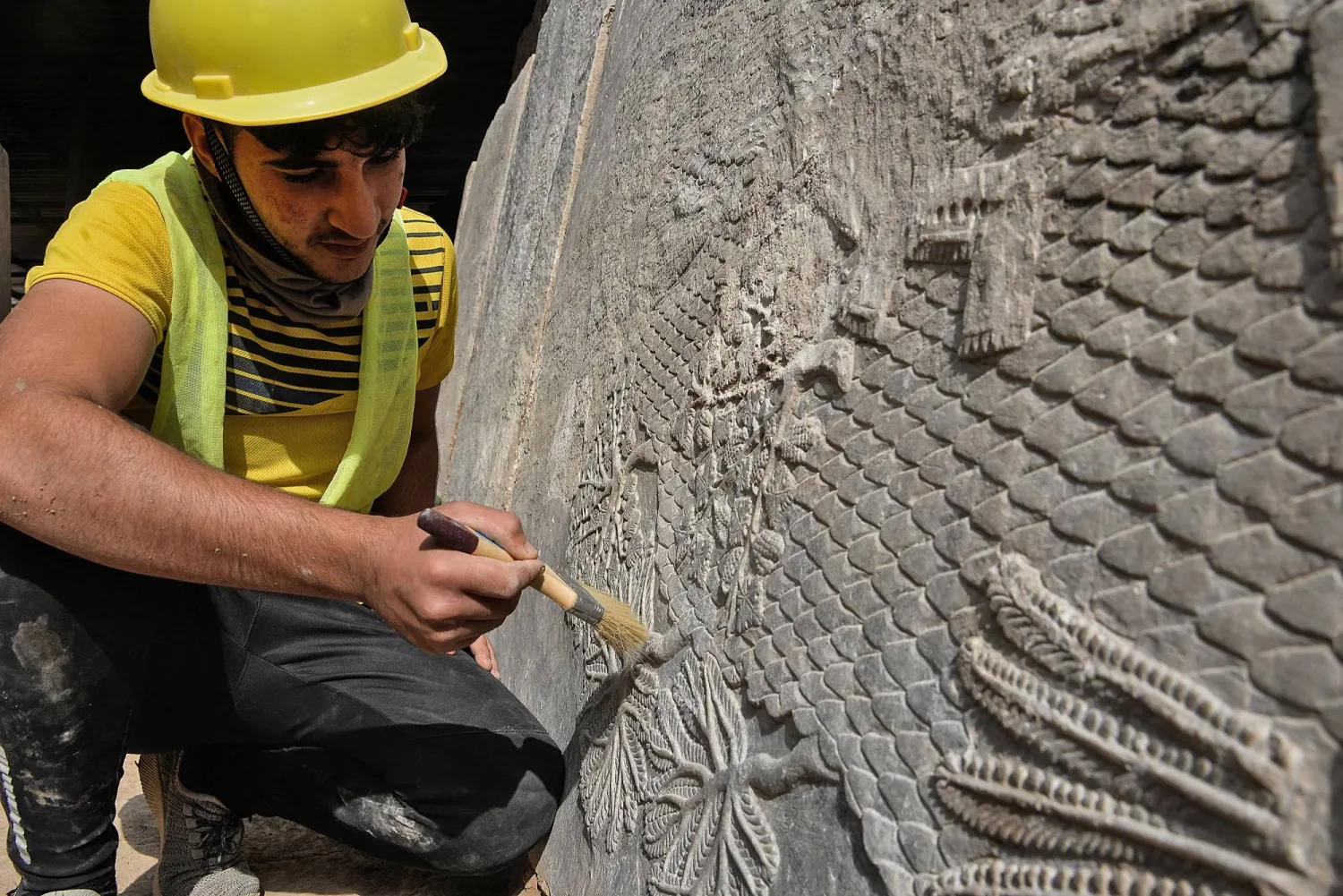
An Iraqi worker excavates a rock-carving relief recently found at the Mashki Gate, one of the monumental gates to the ancient Assyrian city of Nineveh, on the outskirts of what is today the northern Iraqi city of Mosul on October 19, 2022. (AFP)
TT

Archaeologists Forced by Middle East War to Cut Short Iraq Digs

An Iraqi worker excavates a rock-carving relief recently found at the Mashki Gate, one of the monumental gates to the ancient Assyrian city of Nineveh, on the outskirts of what is today the northern Iraqi city of Mosul on October 19, 2022. (AFP)

Iraq is home to ruins from some of the world's earliest civilizations, but teams led by international archaeologists have been forced by drone and rocket attacks in the Middle East war to cut short their expeditions.

Archaeologists told AFP that some of the projects interrupted by the war had been planned for years, but their teams have had to evacuate ancient sites since the United States and Israel attacked Iraq's neighbor, Iran.

Like other countries around the region, Iraq has become engulfed in the war, bringing to an abrupt end a period of nascent stability.

Iraq's precious archaeological sites, some dating back thousands of years, had for years faced threats ranging from climate change to successive conflicts.

Under normal circumstances, around 60 international teams would have been working on digs, a government official told AFP, but "all of these missions have left Iraq".

- 'Like a musician' -

Adelheid Otto of Germany's Ludwig-Maximilians-University started a long-planned dig at ancient Shuruppak, modern-day Tell Fara, on February 28.

That same day, Israel and the US launched strikes against Iran, sparking a war that has dragged Iraqi armed groups into the fray -- and cutting short Otto's work.

"We are Near Eastern archaeologists. So that is our work. That is like a musician who can no longer play an instrument," she told AFP.

Her team -- 18 German archaeologists, geologists, geophysical experts and students and seven Iraqi archaeologists -- initially stayed, reasoning travelling the 750 kilometers (460 miles) overland to Türkiye was more dangerous.

"After some days we got kind of used to the rockets and drones above our heads," she said.

But Iraqi officials repeatedly urged them to depart, despite their discovery of ancient cuneiform tablets.

"It is impossible" to leave, she told authorities, insisting on staying extra days. "We have to document it. We have to take photos of everything."

"I told the students you have to work on all the small finds that we have," said Otto, 59, who boasts four decades of experience.

"You never know in any of these countries if you will ever return," she said.

- 'Guarantors' -

Many German institutions had just started relaxing travel restrictions to Iraq after a succession of conflicts, including the 2003 US-led invasion and the extremist ISIS group.

Now, said Otto, archaeologists once again face being shut out.

Iraq's State Board of Antiquities and Heritage head Ali Obeid Shalgham told AFP Iraqi security forces were the sites' "true guarantors", especially as many are in remote rural areas.

He said the country is installing so-called protective "blue shields" -- nicknamed "the Red Cross of heritage" -- at archaeological sites.

The presence of foreign teams is "crucial", said Aqeel al-Mansrawi, an Iraqi landscape archaeologist.

"They work to protect heritage through conservation," he said.

He also emphasized the training Iraqi experts receive from foreigners, vital after years of isolation and war.

"We are always training a lot of Iraqi archaeologists and colleagues," said Otto, of the German institute.

"If it would be cut again, it would be terrible," she said.

Foreign digs must work with Iraqi archaeologists, bringing their international expertise.

Shalgham said the arrangement allows Iraqis "to keep up with global advancements in new technologies and state-of-the-art equipment".

- 'Can't catch a break' -

Chicago University professor Augusta McMahon was in southern Iraq, working at the 6,000-year-old Nippur site, when the war began.

Having worked in the Middle East for almost four decades, this was her third evacuation.

In 2024, she had to leave Iraq, while in 2011, she left Syria.

"We had pressure from a lot of different directions in terms of having to leave," she said, with her eight-person team departing under an Iraqi escort on March 10.

"It is quite frustrating, along with everything else, I feel terribly bad for [my] Iraqi colleagues," she said.

The war has also rippled beyond the immediate: an initiative to finally return the preeminent Rencontre Assyriologique Internationale (RAI) conference to Iraq was cancelled by the University of Baghdad.

The city last attempted to host the event in 1990, according to the university, but it was scrapped with the Gulf War.

"Now 36 years later, they finally pulled themselves together... and it's cancelled again," said McMahon, who was due to be presenting.

"It's like they can't catch a break."



Saudi Pavilion Highlights Cultural Exchange at Sarajevo Book Fair

The fair is held under the theme "Book Path" and features 200 exhibitors. SPA
TT

Saudi Pavilion Highlights Cultural Exchange at Sarajevo Book Fair

The fair is held under the theme "Book Path" and features 200 exhibitors. SPA

The Ministry of Islamic Affairs, Dawah and Guidance, represented by the King Fahd Cultural Center in Bosnia and Herzegovina, is participating in Saudi Arabia’s pavilion at the 37th Sarajevo International Book Fair held from April 22 to 27 at the Skenderija Center.

The fair is held under the theme "Book Path" and features 200 exhibitors from Bosnia and Herzegovina and around the world presenting their publications across an exhibition area of more than 10,000 square meters.

The pavilion, inaugurated in the presence of Saudi Ambassador to Bosnia and Herzegovina Anas Al-Wusaidi, showcases the center’s cultural programs, publications, and activities.

It includes a documentary highlighting the Kingdom’s civilizational progress and the achievements of Saudi Vision 2030, as well as films introducing Saudi cities and tourist landmarks.

The pavilion also features educational and training programs, a Saudi culture corner, a workshop on Saudi coffee preparation, an Arabic calligraphy corner, and a children’s area.

The ministry’s participation in the fair reflects Saudi Arabia’s leading role in serving Islam and Muslims inside and outside the Kingdom, its message of moderation and tolerance, and its commitment to strengthening cultural exchange.


Ithra Showcases Ithra Design Week at Milan Design Week 2026

Ithra Showcases Ithra Design Week at Milan Design Week 2026
TT

Ithra Showcases Ithra Design Week at Milan Design Week 2026

Ithra Showcases Ithra Design Week at Milan Design Week 2026

The King Abdulaziz Center for World Culture (Ithra), an initiative of Aramco, is participating in Milan Design Week, one of the world’s most prominent annual design events, taking place during April 20-26, 2026. This participation reflects the center’s aspirations to strengthen the role of design within the cultural landscape. As part of its presence, Ithra is presenting key features of Ithra Design Week (IDW)—announced last year as a dedicated platform supporting the design sector and designers, aimed at fostering collaboration, nurturing creativity, and advancing design content from the Arab world on the global stage.

As part of its participation, Ithra is presenting the exhibition “Default is Not Universal” at the Isola Design Festival, within the framework of Milan Design Week 2026. The exhibition represents the first tangible realization of Ithra Design Week as a regional platform for designers, showcasing their creativity and cultural narratives to international audiences while opening channels for global dialogue on the future of design, SPA reported.

Manager of Programs at Ithra Nourh Al-Zamil said: “Ithra’s participation in Milan Design Week; one of the most important global events in the field of design, reflects the Center’s mission to empower creative talent, strengthen cultural exchange, and support the growth of the creative economy at both regional and international levels. It also highlights Ithra Design Week 2026, that announced last year as a platform dedicated to supporting and advancing the future of Arab design.”

Al-Zamil added that Ithra’s international participation in leading design and creativity forums serves as an important platform for attracting designers from across the Middle East. She noted that the “Default is Not Universal” exhibition, presented in collaboration with Isola Design; a partnership spanning four years; aims to empower creativity and connect designers from around the world. She emphasized that the exhibition reflects Ithra’s continued efforts to build a year-round integrated ecosystem enabling designers to collaborate, grow, and thrive.

The “Default is Not Universal” exhibition features works by eight designers from across the Middle East and North Africa (MENA) region and includes seven interactive stations. Through the use of artificial intelligence, the exhibition collects visitor interaction data and transforms it into a dynamic map illustrating how cognitive patterns are shaped by diverse cultural influences. In an innovative step, this data will later be used to commission a designer to produce an entirely new piece reflecting the exhibition’s insights and outcomes.

The exhibition represents a collaborative experience between Ithra and Isola Design and is the outcome of a four-year partnership. Following its debut, the exhibition will be expanded and travel to Saudi Arabia, where it will serve as the anchor international exhibition of the main Ithra Design Week event scheduled to take place later this year.

The exhibition’s seven interactive stations include “The Collective Sofa,” a white seating installation by Studio Oblique (UAE) that transforms through visitor interaction into a shared archive reflecting their contributions; “Moments of Absence,” a sculptural installation featuring miniature ceramic chairs by Fajr Al-Basri (Bahrain) that invites visitors to select and sketch the chair they most identify with; and “Body Blocks,” an interactive game by Davina Atteya (Lebanon) inspired by Mesopotamian figurative forms, enabling users to assemble hybrid characters through modular components.

Additional stations include “Attar Al-Balad,” a sensory installation composed of sculptural blocks formed from traditional Saudi herbs and spices that re-evokes memory through scent; “Reflections,” a collection of mirrors by designers from Egypt, the UAE, and Morocco exploring visitors’ perceptions of color, form, and identity; “Majma,” an interactive musical instrument by digital artist Samit Rohila enabling visitors to collaboratively compose spontaneous collective soundscapes; and finally “Daughters of Berythus,” an installation embedding traces of craft traditions and everyday life that invites visitors to explore material memory through touch.


Saudi Culture Ministry Announces 'A Necessary Fiction: Maps, Art, and Models of Our World' Exhibition in Venice

The Saudi Culture Ministry will oversee the national pavilion with participation from several entities
TT

Saudi Culture Ministry Announces 'A Necessary Fiction: Maps, Art, and Models of Our World' Exhibition in Venice

The Saudi Culture Ministry will oversee the national pavilion with participation from several entities

The Ministry of Culture announced "A Necessary Fiction: Maps, Art, and Models of Our World," a new exhibition at the Abbazia di San Gregorio in Venice on view from May 6 to November 22, curated by an Arab and international team, SPA reported.

"A Necessary Fiction" is a journey through territories in constant flux, where historical maps—dating from the thirteenth century to the present—serve as a lens through which to examine the enduring need to create models of the world.

These models offer fantastic mythological visions and imaginative interpretations of scientific inquiry throughout the ages to the present day.

Early-modern maps, loaned from the collections of major global institutions, are placed in conversation with contemporary artworks. First-century CE historical artifacts such as incense burners and eighteenth-century decorative manuscripts from the Arabian Peninsula demonstrate the legacy of trade and multifaceted cultural interaction that has always shaped this region.

This exhibition is part of the cultural events organized by the Ministry of Culture in Venice, coinciding with the Kingdom’s participation in the 61st International Art Exhibition of La Biennale di Venezia, as part of its efforts to promote international cultural exchange as one of the goals of the National Culture Strategy under Saudi Vision 2030.