


Benin Leans into Painful Past to Attract Tourists

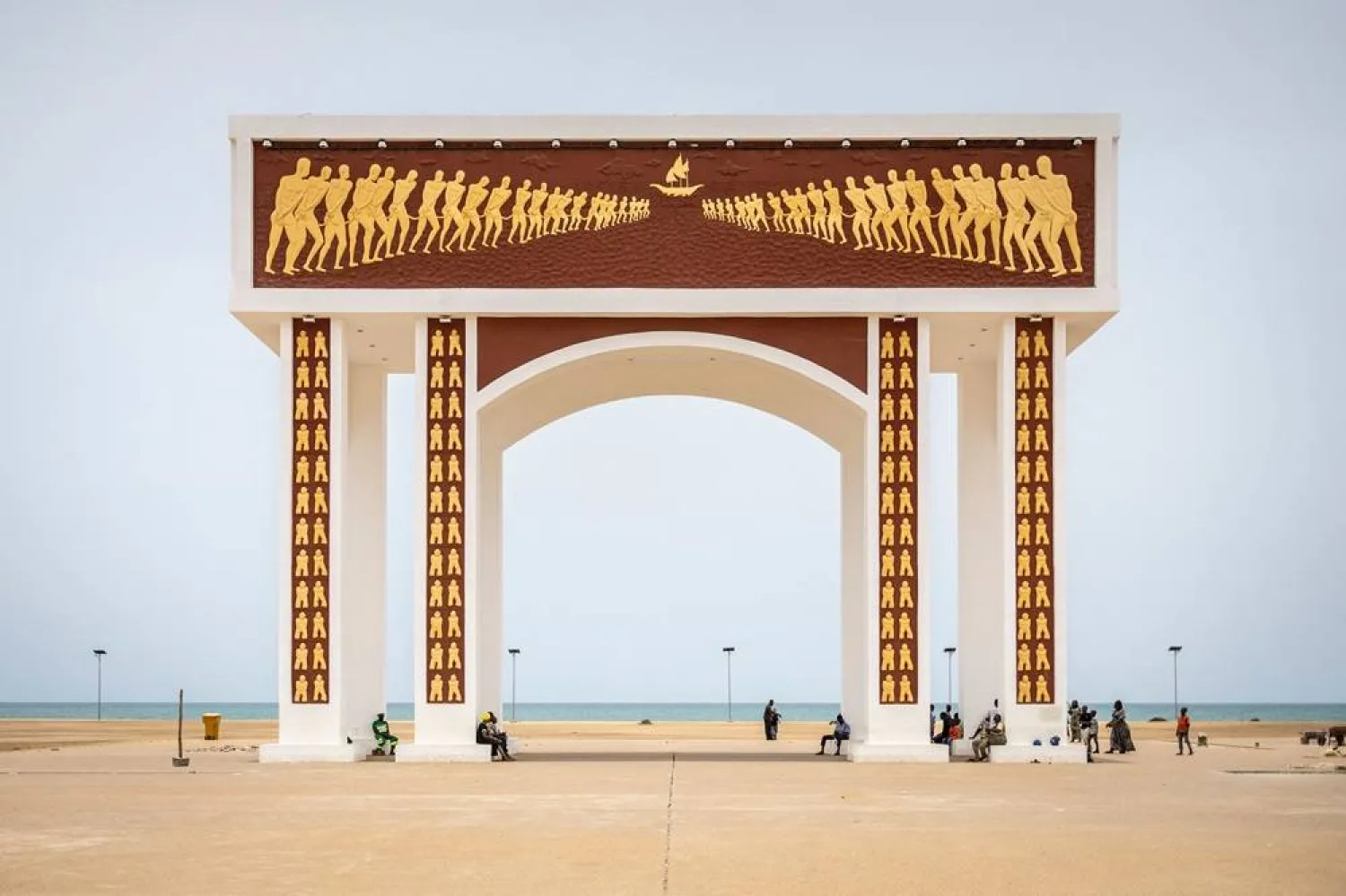
 A general view of the Door of No Return monument in Ouidah on April 7, 2026. (AFP)
A general view of the Door of No Return monument in Ouidah on April 7, 2026. (AFP)
TT

Benin Leans into Painful Past to Attract Tourists

 A general view of the Door of No Return monument in Ouidah on April 7, 2026. (AFP)
A general view of the Door of No Return monument in Ouidah on April 7, 2026. (AFP)

Tourists crowded beneath the Door of No Return, an arch built by the beach at Ouidah in southern Benin in memory of those crammed onto slave ships bound for the New World.

Benin, which holds a presidential election on Sunday, has in recent years leaned into its painful past to encourage tourism.

Once a key departure point in the transatlantic slave trade, the coastal town of Ouidah lies at the heart of the push to reclaim the country's history, culture and heritage.

Standing nearly 17 meters (56 feet) tall on the seafront, the Door of No Return has been fully restored, now a must-see landmark for visitors.

Its ochre-and-gold facade is carved with figures of chained slaves, frozen mid-stride towards the ocean.

Nearby, a life-size replica of L'Aurore -- one of the last three-masted ships to leave Ouidah for Cuba around 1860 -- is set to open soon as an immersive museum of the slave trade.

"It reminds us of where we come from. It's important to develop tourism around our history because it's very rich, little known, and we want to showcase it," said Arsene Ahounou, an engineer from the commercial capital Cotonou visiting for the day.

"For us natives, understanding our history matters," he added.

Pausing for selfies with friends visiting from Nigeria, Onyinye Anumba said that seeing the site with her own eyes was "awesome".

"As an African, I've read many things about this place... so just being here makes me proud about what Africa has," she said.

- 'Demystify Vodun' -

Elsewhere, tourists explored the 13th-century Python Temple to learn about Voodoo culture -- the popular animist religion rooted in Ouidah.

As many posed for photos with snakes draped around their shoulders, guides explained the reptile's spiritual significance in Voodoo (Vodun in the local Fon language) beliefs.

Having worked in Beninese tourism for more than 35 years, Modeste Zinsou, the temple's head guide, said the sector had evolved.

"This isn't mass tourism, it's cultural tourism. The sacred element remains. We're reconstructing our own history, in which we completely demystify Vodun and the cliches around it," he said.

Benin is the birthplace of Voodoo, which now has its own international festival, the Vodun Days.

The three days of dancing, mask parades and traditional ceremonies have become a major tourist attraction.

This year it drew around two million visitors, most of them Beninese.

"The government has worked to encourage domestic tourism, meaning Beninese people going out and reclaiming their identity," added Zinsou.

- 'Our Eiffel Tower' -

To boost tourism, Benin has launched major infrastructure projects, including road and hotel renovations.

A Club Med resort is planned for 2027 and visa procedures have been eased for many nationalities.

"We're not a country with mineral wealth, so we had to identify where our wealth lies," said Alain Godonou, an adviser to the president on heritage and museums.

"History shows that Benin is a land of great cultures and traditions, and a witness to a pivotal moment in human history -- the slave trade," he said.

Godonou hopes tourism will account for 10 to 15 percent of GDP within a decade, up from about six percent today.

Sunday's election in the west African country is to replace the architect of this tourism drive, outgoing president Patrice Talon, who is stepping down after two five-year terms.

The frontrunner to succeed him, Romuald Wadagni, the finance minister from the ruling party, has pledged to carry the projects forward.

Since 2024, Benin has allowed anyone with an African ancestor who was enslaved and shipped to the Americas to acquire Beninese nationality.

"It was important for Benin to do justice to this diaspora by granting the nationality that should have been theirs," Godonou said.

In the heart of Cotonou, the country's largest city, the Amazon Monument is now a major attraction.

The towering 30-meter metal statue depicts a warrior of the Dahomey kingdom, rifle at her side and dagger in hand.

On Easter Monday, a public holiday, crowds of Beninese visitors strolled through the plaza, snapping pictures of the statue.

"It's a source of pride! We don't have the money to go on holiday in France or elsewhere," said vendor Geraldine Sedami Yagbo.

"This statue is our Eiffel Tower."


Private Museums Bolster Cultural Tourism in Qassim Region

A prominent example is the private museum of Abdullah Al-Suhaibani, an expert with over 40 years of experience in gemstones and minerals - SPA
TT

Private Museums Bolster Cultural Tourism in Qassim Region

A prominent example is the private museum of Abdullah Al-Suhaibani, an expert with over 40 years of experience in gemstones and minerals - SPA

Qassim Region is witnessing a significant rise in private museums, as individual collectors transform personal passions into vital cultural projects. These museums serve as a living memory for the community, preserving rare artifacts, historical documents, antique weapons, and vintage collections that document critical stages of the region's history. By connecting the present with its roots, these sites strengthen national identity and provide essential research resources for scholars and tourists alike, SPA reported.

A prominent example is the private museum of Abdullah Al-Suhaibani, an expert with over 40 years of experience in gemstones and minerals.

His collection features rare agates, fossils from ancient geological eras, and unique rock formations discovered throughout the Kingdom.

The museum acts as a scientific platform, promoting geology and field research while educating the community on the Kingdom’s diverse natural resources and mineral wealth.

Located near Al-Khabra Historical Village, these private initiatives have become key cultural landmarks in Riyadh Al-Khabra Governorate. Their growth aligns with Saudi Vision 2030 goals to develop cultural and scientific tourism, support local content, and position the Kingdom’s heritage and natural sites as premier global destinations.


Saudi Arabia Showcases Literary Diversity at 2026 Rabat International Book Fair

‏The Saudi pavilion brings together a range of government entities and cultural institutions - SPA
TT

Saudi Arabia Showcases Literary Diversity at 2026 Rabat International Book Fair

‏The Saudi pavilion brings together a range of government entities and cultural institutions - SPA

The Literature, Publishing and Translation Commission launched the Saudi pavilion at the 2026 International Publishing and Book Fair in Rabat, which continues through May 10.

‏Commission CEO Dr. Abdullatif Alwasel affirmed that the Kingdom’s participation in the event embodies the deep historical ties between Saudi Arabia and Morocco while showcasing a diverse, contemporary cultural movement driven by Saudi Vision 2030.

“Saudi Arabia’s participation at the 2026 International Publishing and Book Fair emphasizes the Kingdom’s commitment to spotlighting publishers and the creative literary sector, which continues to go from strength to strength,” Alwasel said, SPA reported.

‏He added: “The Saudi pavilion is an opportunity to invite people from every corner of the world to experience Saudi culture and diverse literary works, showcase unique Saudi talent and creative thinking, while facilitating cultural exchange and engaging discussions.”

‏The Saudi pavilion brings together a range of government entities and cultural institutions, led by the Literature, Publishing and Translation Commission, highlighting the integrated approach of the Kingdom’s cultural environment.

‏As part of the pavilion, the commission has organized a series of topical panel discussions, poetry evenings, and workshops featuring Saudi writers and creative thinkers, encouraging discussions on key issues relating to the literature, publishing and translation sector and its impact on Arab and global conversations.

‏The participation at the 31st International Publishing and Book Fair event reaffirms the Kingdom’s efforts towards platforming local talent and enhancing collaboration and cultural exchange.


Georg Baselitz, the German Painter Who Turned Postwar Art Upside Down, Dies at 88

German artist Georg Baselitz attends the opening of his exhibition "The Heroes" (Die Helden) at the Staedel museum in Frankfurt, Germany June 29, 2016. (Reuters)
TT

Georg Baselitz, the German Painter Who Turned Postwar Art Upside Down, Dies at 88

German artist Georg Baselitz attends the opening of his exhibition "The Heroes" (Die Helden) at the Staedel museum in Frankfurt, Germany June 29, 2016. (Reuters)

Georg Baselitz liked to insist — sometimes as a taunt, ‌sometimes as a shield — that he did not know how to paint. That he had "no talent".

Rejected at 17 by the Dresden Academy of Fine Arts, he talked his way into an academy in East Berlin only to be expelled two semesters later for "sociopolitical immaturity".

"I was stupid," he recalled. "I was uneducated, but I was a rebel."

From that rebellion, Baselitz forged a career that made the child of Nazi Germany, schooled under Soviet communism, into one of the defining artists of postwar Germany.

The painter and sculptor, known for his depictions of raw bodies and inverted landscapes, has died at the age of 88, Germany's Die Welt newspaper reported on Thursday. No cause of death was given.

A REBEL SHAPED BY TWO DICTATORSHIPS

Georg Baselitz was born Hans-Georg Bruno Kern on January 23, 1938, in the Saxon village of Deutschbaselitz, a name he later adopted.

His father, a village schoolteacher and Nazi Party member, recorded Hans-Georg's birth in his diary. Inexplicably, he recorded the birth of none of his other four children, the Sächsische Zeitung daily reported in 2018.

After the war, ‌his father was ‌barred from teaching. Baselitz's mother took over his duties at the school.

Baselitz spent his childhood ‌amid ⁠the unforgiving discipline of ⁠Nazi Germany, and his adolescence amid the rubble and ideological re-education of the country's Soviet occupation zone.

"I was born into a destroyed order, a destroyed landscape, a destroyed people, a destroyed society," he later recalled. "And I didn't want to reestablish an order: I had seen enough of so-called order. I was forced to question everything, to be 'naive', to start again."

After he was expelled from the East Berlin academy, he moved to West Berlin, where he finished his studies and absorbed modernism in a way that felt, he said, like a sudden intake of oxygen.

He recalled the shock of first seeing works by Jackson Pollock and other abstract expressionists — evidence, in his telling, that ⁠the United States had a serious culture despite what he had been taught.

But rather than ‌imitate an American style, Baselitz turned back to German sources, drawing on expressionism, ‌folk traditions and imagery often dismissed by critics as ugly or even "degenerate".

SCANDAL AS A CALLING CARD

At a 1963 solo show in Berlin, authorities ‌seized two of his paintings on obscenity grounds. The episode made Baselitz famous.

The early pictures, marked by raw bodies, stunted masculinity and abrasive humor, were widely seen as provocation.

Supporters and museum curators have also framed them as a blunt report on postwar German life: damaged, compromised and struggling to find a new footing.

That sensibility carried into his mid-1960s "Heroes" paintings, which presented hulking, battered figures that looked less like victors than survivors ‌stumbling out of a defeated national myth.

But Baselitz's most recognizable works came in 1969, when he began painting motifs upside down.

After earlier experiments that fractured or partially inverted figures, he ⁠produced fully inverted works including "The ⁠Wood on Its Head" and "The Man by the Tree".

He did not simply flip finished images, he composed and painted them inverted from the start.

That approach altered how viewers read his works. By disrupting recognition, it forced attention onto the mechanics of painting — its color, balance and composition.

"An object painted upside down is suitable for painting because it is unsuitable as an object," Baselitz said.

The inversions made Baselitz an international figure in the 1970s and 1980s, as the market and institutions that once treated him as scandalous increasingly positioned him as a pillar of European postwar art.

His public reputation, however, did not settle into quiet respectability.

He repeatedly sparked backlash with remarks about female painters, including a widely reported claim that women "don't paint very well".

He also confronted the limits Germany's history places on gesture and imagery: a wooden sculpture shown at the 1980 Venice Biennale was widely read as evoking a Nazi salute, a reading he denied.

He was married to Johanna Elke Kretzschmar, known as Elke, with whom he had two sons.

In later life, Baselitz painted huge canvases from his wheelchair and moved his brushes and paints in a rolling cart.

"The sensible thing, in my situation, would naturally be to say: 'I stick to small formats'," he told Spanish newspaper El Pais at age 87. "But of course I don't do what's sensible. What's right for me is the nonsensical."
