
Lebanon’s Drug Empire Faces Beginning of Its End

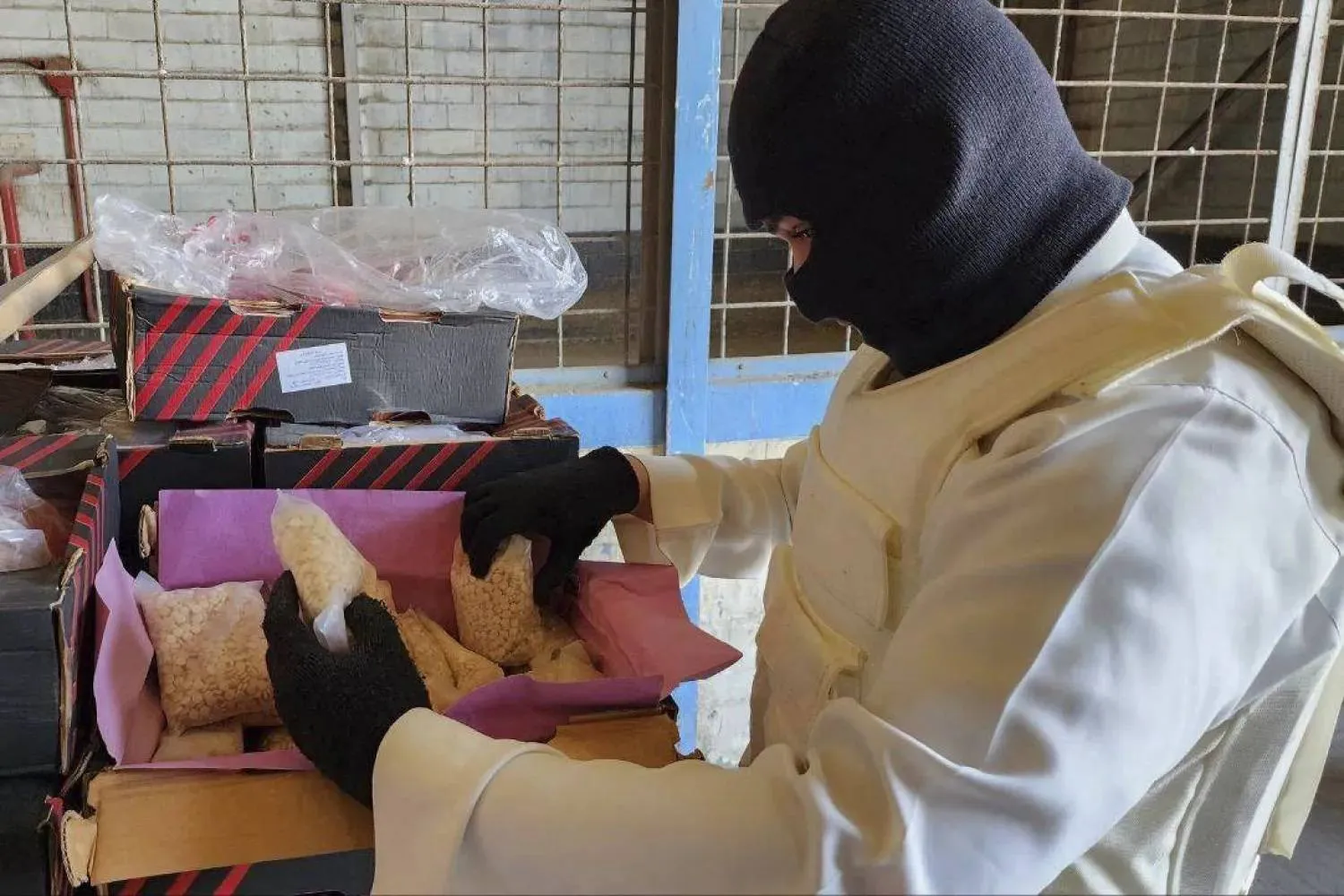
A Saudi Anti-Narcotics official displays bags of Captagon pills seized in Jeddah hidden inside a shipment of pomegranates, April 25 (AFP)
TT

Lebanon’s Drug Empire Faces Beginning of Its End

A Saudi Anti-Narcotics official displays bags of Captagon pills seized in Jeddah hidden inside a shipment of pomegranates, April 25 (AFP)

A sense of optimism is growing within Lebanon’s security establishment that 2026 could mark the end of the country’s “drug world,” a shadow economy born out of the Lebanese civil war and fueled by the conflicts that followed.

Those wars created an ideal environment for the trade to flourish, turning Lebanon and Syria into hubs for narcotics trafficking that spread across borders through Jordan and into the Gulf, particularly Saudi Arabia.

The Kingdom is a main target of traffickers who moved their illicit goods along smuggling routes known as “tracks,” amassing fortunes that went on to finance states and militias.

This optimism stems from major developments along the Lebanese-Syrian border following the fall of the previous Syrian regime and the withdrawal of the army’s elite Fourth Division, which had long maintained control there.

The departure of that force led to the expulsion of drug traffickers who had operated from what security officials called the “gray zone” inside Syrian territory.

A senior Lebanese security official told Asharq Al-Awsat that the war in Syria had been “the spark that ignited the drug trade,” while the war’s end has signaled “the beginning of its demise,” after coordinated operations struck the trade at every level, from production and storage to distribution.

The border areas on the Syrian side had served as a safe haven for drug traffickers between 2023 and 2024. Many had settled in villages, buying houses under the protection of Syrian security forces, particularly the Fourth Division, which acted as their commercial partner. With the regime’s collapse, the traffickers fled back to Lebanon, where they became easy prey for the Lebanese army. Military intelligence units pursued them relentlessly — arresting some, killing others.

Development as a Weapon

According to Lebanese security assessments, a lasting end to the drug trade will require not only security pressure but also “a dose of development” in Lebanon’s deprived regions, mainly the Bekaa Valley and Akkar.

Officials say development projects must complement the army’s and security forces’ relentless crackdowns by addressing the deep poverty that traffickers have long exploited to justify their activities and recruit locals.

For decades, the smuggling routes that run through these neglected areas have shaped livelihoods. Some traffickers built reputations as “Robin Hoods,” showering locals with gifts and grants in exchange for silence and loyalty. But their generosity comes at a price.

A Lebanese security source told Asharq Al-Awsat that one well-known drug lord, for example, had paid the tuition fees of several university students — only to later turn them into campus distributors.

The Boom Years and the Rise of ‘Robin Hood’

Before the Syrian crisis, Lebanon’s drug trade was estimated at around 1.3 million pills. That figure surged to three million during the war, before dropping to about 400,000.

“They were outlaws who rose to power — and we turned them back into outlaws,” a Lebanese security official said.

The “golden age” of drug traffickers in Lebanon’s Bekaa Valley returned after the country’s financial collapse in late 2019, which coincided with a crippling political paralysis following the end of former President Michel Aoun’s term and delays in electing his successor.

Traffickers seized on the despair of impoverished locals in regions long neglected by the state, especially in areas where chronic deprivation had persisted well before the currency crash. Residents say political leaders’ neglect had become a way of life.

Many young men fell into the grip of the trade, especially after the rise of the “new star” of the drug world — Captagon — which flooded Lebanon as both a manufactured and exported product after 2011, directly linked to the Syrian conflict.

Syrian traffickers and influential figures in government and security circles on both sides of the porous Lebanese-Syrian border played key roles.

The major dealers soon gained social, and at times political, influence. Some ran for or considered running in elections. Others portrayed themselves as benevolent outlaws, “Robin Hoods” who took from the rich and gave to the poor.

They funded irrigation and electricity projects, offered social assistance, mediated legal troubles for locals, and used their connections with politicians to secure jobs.

In effect, their mini-state kept expanding and benefiting from overlaps with powerful groups operating on both sides of the border.

The equation was simple: export drugs to the “enemy camp” to earn foreign currency, while the lucrative commissions from this trade helped finance a state — or a quasi-state.

As one trafficker boasted, “I only need one shipment out of ten to make it through — and I’m set.”

The Captagon Story

Captagon is often described as a “revolution” in the drug world. Unlike cannabis or opium, it needs no farmland. It is not bound by seasons, and its production, packaging, and smuggling are easy to conceal, often escaping traditional detection methods used by scanners and police dogs.

But while distribution and smuggling can be kept secret, production is harder to hide. Manufacturing Captagon requires specialized laboratories that emit strong, unpleasant odors during the process, making concealment difficult.

To overcome that, producers often lured powerful figures with money and convinced property owners in remote areas to rent out their buildings.

Traffickers also benefited from operating in what they called “the gray zone,” a loophole in countries that had not yet classified Captagon as an illegal narcotic, including Lebanon itself.

When security forces arrested traffickers, they often charged them with possessing other contraband items, such as weapons or different drugs, rather than Captagon itself.

The ‘Kings of the Tracks’ and the Secret Formulas

Captagon first spread in Iraq and Syria, where long-distance truck drivers used it to stay awake and alert during grueling journeys. By the early 2000s, it had gained recognition as a recreational drug. Between 2007 and 2011, a new class of traffickers emerged — the so-called “kings of the tracks” — who controlled the routes carrying Captagon from factories to consumers, particularly across the Gulf.

Production initially centered in border areas on the Syrian side. But as the Syrian conflict escalated, many traffickers relocated to Lebanon, setting up factories in partnership with local counterparts.

Interestingly, the Syrian traffickers guarded their manufacturing secrets closely, never sharing the exact formula with their Lebanese partners. Lebanese military intelligence — which spearheaded operations in the Bekaa Valley and border regions — later obtained confessions from captured dealers confirming this. Some Lebanese producers eventually discovered the formula, or came close enough to replicate it, leading to a surge in “knockoff” pills of lower quality.

The profits were enormous. A single pill costing less than 20 cents to make could sell for $20 — and up to $50 at retail prices. The huge margins drew new players into the trade.

When the war broke out in Syria, extremist groups took over border zones and destroyed the factories. Many traffickers fled to government-held areas or to Lebanon. But between 2012 and 2014, those same groups realized the profit potential and turned to Captagon as a major source of funding.

The years 2012 to 2023 marked the height of Captagon’s boom. Production and trafficking flourished, dominated by four or five top smugglers who monopolized the Gulf trade. Rivalries grew, with some traffickers roasting the pills to resemble desert sand, while others added logos and colors to give their products distinctive “brands.”

The Syrian Regime’s Entry — and Wagner’s Role

By mid-2012, influential figures within the Syrian regime had entered the Captagon trade. They did not take part directly in production or distribution but facilitated the movement of shipments across Syrian territory by issuing “permits” that allowed trucks to pass in exchange for fixed fees per crate.

At the time, Captagon traffickers traveled freely around the world, yet Beirut remained their favorite destination. Many opened restaurants and cafés in the Lebanese capital that served as perfect fronts for laundering drug money.

The production and distribution process followed several stages, starting with the purchase of raw materials.

Most materials were legally available on the market because they had legitimate uses in medicine, cleaning agents, pesticides, and fertilizers.

Traffickers bought them through supermarket owners or importers, paying premium prices to ensure cooperation. Even the machinery required for production was easy to acquire, as it was commonly used by pharmaceutical and chemical companies.

Most factories were based in Syrian border regions, but during the war, some were moved into Lebanon’s rugged mountains.

Remote houses, abandoned workshops, and livestock farms were rented at high prices and converted into makeshift labs. Some Syrian villages, such as Jarmash, became known as safe havens for dealers fleeing Lebanese security forces.

During the Syrian war, the trade thrived as never before. The Lebanese-Syrian and Syrian-Jordanian borders slipped out of government control, and despite the fighting, traffickers maintained good relations with all sides.

Everyone profited — from local militias to the Syrian regime, Russia, Iran, and Hezbollah — all of whom were waging difficult battles and relied on the same smuggling routes used for narcotics to move weapons, equipment, and sometimes fighters into besieged areas.

Russia’s Wagner Group even established an air bridge to transport Captagon to Libya, charging around $5,000 per crate.

Between 2014 and 2020, many traffickers relocated to Lebanon, exploiting the turmoil in border areas seized by extremist factions and Lebanon’s own deep political divisions. With economic hardship spreading, more people turned to the trade, resulting in a flood of lower-quality products.

During that period, the Lebanese army’s grip on the border weakened, especially after it suffered losses and kidnappings at the hands of militant groups. Smugglers took advantage, carving out their own routes and, in some cases, buying influence in politics by financing or backing candidates in elections.

The Declaration of the War on Drugs

As Lebanon’s security situation began to stabilize and drug traffickers grew bolder, the Lebanese authorities declared war on narcotics.

In the Bekaa Valley and along the Syrian border, the Lebanese army took the lead, while the Internal Security Forces assumed responsibility for operations inside the country and at ports.

Army intelligence spearheaded the campaign in the Bekaa, raiding Captagon factories and dismantling production lines. But once-peaceful traffickers turned violent. Few raids ended without clashes between the army and drug gangs. The fugitives then retreated deep into the rugged mountain areas, where troops pursued them relentlessly.

A senior security official told Asharq Al-Awsat that traffickers had offered large bribes to officers and anti-narcotics officials to halt operations, especially after the first year of confrontations inflicted losses estimated at around $200 million.

To evade army raids, traffickers shifted to using mobile labs mounted on trucks that could be moved quickly between sites. Yet the design had a fatal flaw: once production began, the trucks became slow and vulnerable to detection.

The War on Kingpins and the Battle of Abu Sallah

Lebanon’s war on drugs soon evolved into a war on the kingpins themselves. The army began targeting major gang leaders, even carrying out drone and airstrikes against some of them.

One of the most dramatic operations was the raid targeting the country’s most notorious drug lord in the Bekaa Valley, known as Abu Sallah, whose real name is Ali Mounzer Zeaiter. The raid sent a clear message to the underworld, forcing many traffickers to disappear under mounting security pressure.

Zeaiter earned the nickname Abu Sallah early in his career, when he would lower a basket tied to a rope from his apartment balcony to collect cash and deliver drugs to customers — a primitive system that became his signature. Operating from Beirut’s eastern suburbs, he later built a vast network and amassed enough power to command what security sources described as a small private army of gunmen and dealers.

When army intelligence planned to capture him, they discovered he had set up 346 surveillance points to protect himself, a mix of cameras mounted on poles and disguised “express cafés” along every road leading to his residence, designed to alert him to any approaching force.

After eight months of planning, the army launched the operation during a dinner Abu Sallah was hosting for his associates. Intelligence officers managed to take control of some surveillance cameras and redirect them away from the target area. The head of army intelligence in the Bekaa even helped create a diversion by taking his wife to a restaurant in Beirut known to be monitored by Abu Sallah’s informants.

The operation was conducted under strict secrecy and only seven people knew of the plan. The target was code-named “Marlboro” to prevent any leaks.

Abu Sallah escaped the ambush by using his wife as a human shield, killing a soldier, and fleeing toward Syria. He later returned after the regime’s collapse, only to be tracked down by the army, which killed him in an airstrike on his vehicle.

According to Lebanese security assessments, Abu Sallah had been the country’s number one trafficker. He had extensive influence in universities and schools — his prime retail markets — where he paid tuition fees for students or enrolled his own associates to promote drugs among their peers.


Mass Wedding in Gaza Celebrates New Life After Years of War and Tragedy 

Palestinian couples participate in a mass wedding ceremony in Hamad City in Khan Younis, Gaza Strip, Tuesday, Dec. 2, 2025. (AP)
TT

Mass Wedding in Gaza Celebrates New Life After Years of War and Tragedy 

Palestinian couples participate in a mass wedding ceremony in Hamad City in Khan Younis, Gaza Strip, Tuesday, Dec. 2, 2025. (AP)

Eman Hassan Lawwa was dressed in traditional Palestinian prints and Hikmat Lawwa wore a suit as they walked hand-in-hand past the crumbled buildings of southern Gaza in a line of other couples dressed in exactly the same way.

The 27-year-old Palestinians were among 54 couples to get married Tuesday in a mass wedding in war-ravaged Gaza that represented a rare moment of hope after two years of devastation, death and conflict.

"Despite everything that has happened, we will begin a new life," Hikmat Lawwa said. "God willing, this will be the end of the war," he said.

Weddings are a key part of Palestinian culture that have become rare in Gaza during the war. The tradition has begun to resume in the wake of a fragile ceasefire, even if the weddings are different from the elaborate ceremonies once held in the territory.

As roaring crowds waved Palestinian flags in the southern city of Khan Younis, the celebrations were dampened by the ongoing crisis across Gaza.

Most of Gaza's 2 million residents, including Eman and Hikmat Lawwa, have been displaced by the war, entire areas of cities have been flattened and aid shortages and outbursts in conflict continue to plague the daily lives of people.

The young couple, who are distant relatives, fled to the nearby town of Deir al-Balah during the war and have struggled to find basics like food and shelter. They said they don’t know how they’re going to build their lives together given the situation around them.

"We want to be happy like the rest of the world. I used to dream of having a home, a job, and being like everyone else," Hikmat said. "Today, my dream is to find a tent to live in."

"Life has started to return, but it's not like we hoped it would," he added.

Palestinians watch and celebrate a mass wedding ceremony in Hamad City in Khan Younis Tuesday, Dec. 2, 2025. (AP)

The celebration was funded by Al Fares Al Shahim, a humanitarian aid operation backed by the United Arab Emirates. In addition to holding the event, the organization offered couples a small sum of money and other supplies to start their lives together.

For Palestinians, weddings are often elaborate dayslong celebrations, seen as both an important social and economic choice that spells out the future for many families. They include joyful dances and processions through the streets by massive families in fabric patterns donned by the couple and their loved ones and heaping plates of food.

Weddings can also be a symbol of resilience and a celebration of new generations of families carrying on Palestinian traditions, said Randa Serhan, a professor of sociology at Barnard College who has studied Palestinian weddings.

"With every new wedding is going to come children and it means that the memories and the lineages are not going to die," Serhan said. "The couples are going to continue life in an impossible situation."

On Tuesday, a procession of cars carrying the couples drove through stretches of collapsed buildings. Hikmat and Eman Lawwa waved Palestinian flags with other couples as families surrounding them danced to music blaring over crowds.

Eman, who was cloaked in a white, red and green traditional dress, said the wedding offered a small moment of relief after years of suffering. But she said it was also marked by the loss of her father, mother, and other family members who were killed during the war.

"It’s hard to experience joy after such sorrow," she said, tears streaming down her face. "God willing, we will rebuild brick-by-brick."


‘Some Took Part in Israeli Captive Handover’…How Hamas Fighters Hid in Rafah Tunnels ?

Israeli captive Avera Mengistu stands on the handover platform as part of a prisoner exchange agreement between Hamas and Israel in Rafah in February (Reuters)
TT

‘Some Took Part in Israeli Captive Handover’…How Hamas Fighters Hid in Rafah Tunnels ?

Israeli captive Avera Mengistu stands on the handover platform as part of a prisoner exchange agreement between Hamas and Israel in Rafah in February (Reuters)

A series of Israeli military statements reporting the killing or capture of members of Hamas’s Izz al Din al Qassam Brigades inside Rafah’s tunnel network has sharpened scrutiny of who these fighters were and how long they had remained hidden underground.

The operations targeted men who had spent months beneath a city Israel moved to occupy in May 2024 and later brought under full control.

For more than a month, indirect contacts had sought to arrange the fighters’ safe withdrawal from the tunnels unarmed, an effort that helped expedite the handover of the body of Israeli officer Hadar Goldin on November 9.

But Israel later backed away from informal understandings with the United States, which had been engaging on the issue with Türkiye, over allowing the fighters to exit safely.

As weeks passed, Israel began hunting them down, killing and capturing them in groups through airstrikes or direct pursuit once they emerged from tunnels or ambush positions.

The pressure mounted as the fighters became confined to the last pockets of tunnels in Rafah’s eastern al-Jneina neighborhood.

Eight months in tunnels and ambush positions

Field sources from Hamas told Asharq Al-Awsat that the fighters had spent most of the two year war inside the city’s tunnels despite the presence of Israeli forces above ground and despite Israel’s entry into many of the passageways.

The sources said the tunnels had been built in ways that made them difficult for Israel to uncover fully even now.

They said that during the first truce which lasted seven days in November 2023, the fighters surfaced, then returned underground when the fighting resumed.

They alternated between staying in the tunnels and emerging into ambush positions above ground. Communication with their commanders continued until a second truce was reached in January of this year which lasted until March 18.

One source said that before the fighting resumed, and despite Israel’s deployment in Rafah, the fighters managed to emerge above ground, reach Khan Yunis, meet their commanders and take part in the handover of Israeli captives.

Some participated in the February release of Avera Mengistu, who had been held in Gaza since the 2014 war.

After the war resumed and diplomatic efforts to halt it failed, Qassam fighters returned to Rafah through the tunnels and resumed their ambush positions above ground.

From late March until August, the fighters remained in touch with their command and carried out a string of attacks that inflicted casualties on Israeli forces even after Israel declared it had brought Rafah under full control.

The Qassam Brigades at the time launched a series of attacks named Gates of Hell that killed about six Israeli soldiers.

The attacks involved detonating military vehicles, booby trapped houses and tunnel openings. In one incident in May, Qassam fighters attempted to seize an Israeli soldier.

Hamas, which was then engaged in negotiations to halt the war, sought through these operations to show that the Rafah Brigade remained active at a time when Israeli military sources were claiming the brigade had been dismantled after its battalions were destroyed.

According to information obtained by Asharq Al-Awsat, Rafah fighters and their immediate commanders spent more than eight months inside tunnels and in above ground ambush positions.

How did they obtain food and water

Field sources in the factions told Asharq Al-Awsat that the tunnels had been stocked with limited supplies of food and water.

One source who had experienced a similar shortage in a previous Gaza war said the fighters had likely relied on whatever food they could find.

This included leftover supplies from Israeli soldiers in some of the houses they had occupied or food in homes of residents that had not been destroyed.

The source cited social media posts from months earlier showing handwritten notes left by Hamas and Islamic Jihad fighters apologizing to homeowners for taking food.

The sources said duties differed inside the Qassam Brigades. Some fighters handled logistics, others manned ambush positions and others moved between units while maintaining direct coordination with field commanders.

Senior commanders

Among those whose photos Israeli media circulated after they were killed were the commander of Rafah’s eastern battalion, Mohammad al-Bawab, and his deputy, Ismail Abu Labda. Al-Bawab was married to Abu Labda’s sister.

Another senior figure killed was Tawfiq Salem, commander of the battalion’s elite company, according to the sources.

Abu Labda appeared in the February handover of Mengistu and was in direct contact with the International Committee of the Red Cross during the transfer. The sources said al-Bawab monitored the process from a distance but did not take part directly.

The sources added that al-Bawab and Abu Labda were among those who oversaw the capture of Israeli officer Hadar Goldin during the 2014 war.

Israel also killed Abdullah Hamad, the son of senior Hamas political bureau member Ghazi Hamad and a member of the movement’s negotiating delegation.

Field sources said the younger Hamad had been active in the Qassam Brigades and had graduated from the Rabat Military College run by the Hamas government before the war, later becoming an instructor.

He was killed alongside his cousin Ahmed Saeed Hamad, the son of Ghazi Hamad’s brother, while they were in a tunnel with Qassam commanders and other fighters.

The sources said Saeed Hamad had lost three daughters in Israeli strikes on their homes. The daughters were killed after their husbands took part in the October 7, 2023 attack and in other operations during the war.


Israeli Settler Outposts Spread Among West Bank Villages and Fuel Fear of More Attacks

An Israeli settler outpost stands in the middle of a valley next to olive trees in the West Bank town of Turmus Ayya, Wednesday, Nov. 12, 2025. (AP)
TT

Israeli Settler Outposts Spread Among West Bank Villages and Fuel Fear of More Attacks

An Israeli settler outpost stands in the middle of a valley next to olive trees in the West Bank town of Turmus Ayya, Wednesday, Nov. 12, 2025. (AP)

The fear is palpable in this Palestinian village. It’s clear in how farmers gather their harvests quickly, how they scan the valley for movement, how they dare not stray past certain roads. At any time, they say, armed Israeli settlers could descend.

“In a matter of minutes, they get on their phones. They gather themselves, and they surprise you,” said Yasser Alkam, a Palestinian-American lawyer and farmer from the village of Turmus Ayya. “They hide between the trees. They ambush people and beat them up severely.”

In recent months, Alkam says Turmus Ayya has weathered near-daily attacks by settlers, especially after they set up an outpost that the anti-settlement watchdog group Peace Now says is on his village’s land.

Alkam says he can’t reach his own fields for fear of being assaulted. In a particularly gruesome attack, he watched a settler beat a Palestinian woman unconscious with a spiky club.

The fear is shared throughout the West Bank. During October's olive harvest, settlers across the territory launched an average of eight attacks daily, according to the United Nations humanitarian office, the most since it began collecting data in 2006. The attacks continued in November, with the UN recording at least 136 more by Nov. 24.

Settlers burned cars, desecrated mosques, ransacked industrial plants and destroyed cropland. Israeli authorities have done little beyond issuing occasional condemnations of the violence.

Prime Minister Benjamin Netanyahu described the attackers as a minority that did not represent most settlers in the West Bank, where settlements are considered illegal by most of the international community. But their continued expansion of outposts — conducted in public with seemingly few legal repercussions — and the violence have cemented a fearful status quo for their Palestinian neighbors.

A brutal assault on a grandmother

While driving in fields east of Turmus Ayya on Oct. 19, Alkam saw Afaf Abu Alia, a grandmother from a nearby village, harvesting a grove of olive trees. They were loaned to her after the Israeli military bulldozed her own 500 trees this year, she said.

She worked until she heard yelling in Hebrew. Settlers descended on the road nearby. Suddenly, one ran toward her with a club.

“The monsters started beating me,” she told The Associated Press three weeks after the attack. “After that, my memories get all blurry.”

Video of the attack obtained by the AP shows a settler beating Alia with the jagged club, even after she was motionless. She was hospitalized for four days, requiring 20 stitches on her head, she said.

Asked for comment on the attack, the military said its troops and police had “defused” a confrontation in which Israeli civilians were torching vehicles and using violence.

In rare move, Israel charges settler responsible Police arrested a man named Ariel Dahari for beating Abu Alia. An Israeli court charged him later with terrorism.

Dahari is being represented by Honenu, an organization that provides legal aid to settlers, who say the West Bank is part of the biblical Jewish homeland and often cast attacks as self-defense. According to an article about Dahari on the group's website, he has received at least 18 administrative orders since 2016 that included house arrest and confinement to his town in Israel.

He told the Israeli news site Arutz Sheva in 2023 that he had been kicked out of the territory twice. It is not clear how he was able to return.

Palestinians and human rights workers say Israeli soldiers and police routinely fail to prosecute attacks by violent settlers. Their sense of impunity has deepened under Israel's far-right National Security Minister Itamar Ben-Gvir, a settler, and Defense Minister Israel Katz, who in January released settlers from administrative detention, Israel’s practice of detaining individuals without charge or trial.

The number of investigations opened into settler violence since 2023, Ben-Gvir's first year in office, has plummeted, according to a report by Israel's Channel 12 TV that cited official police data. Police opened only 60 investigations into settler violence in 2024, compared with 150 cases in 2023 and 235 cases in 2022, the report said.

About 94% of all investigation files opened by Israeli police into settler violence from 2005 to 2024 ended without an indictment, according to Israeli rights group Yesh Din. Since 2005, just 3% of those investigations led to convictions.

Dahari told Arutz Sheva that he was determined to stay in the West Bank.

“We will not give up our grip on our land because of one order or another. We will continue to build it and make it flourish everywhere,” he said, adding that he hoped “the security establishment” would “invest all its resources in the war against the Arab enemy, who is the real enemy of us all.”

When reached by the AP, Dahari’s lawyer, Daniel Shimshilashvili, sent a statement from Honenu, saying there was “slim evidence” against Dahari.

Threats are reinforced by settler outposts

The villagers from Turmus Ayya say it's not enough to arrest one settler — the threat of violence is reinforced by the outpost in the nearby valley called Emek Shilo.

Emek Shilo was founded this year on private Palestinian land, according to Peace Now. It was started by a well-known settler named Amishav Melet, said three Palestinians living in Turmus Ayya and Yair Dvir, the spokesperson for Israeli rights group B'tselem. On his personal X account, Melet posted videos of the outpost’s construction.

Villagers alleged that Melet travels the valley in an all-terrain vehicle, surveilling their activities. He’s frequently armed, they said.

Usually little more than a few sheds and a pen for livestock, such outposts can impose control on nearby land and water sources. They often turn into authorized settlements, spelling the end of Palestinian communities.

Israeli police did not comment when asked about Melet.

Abdel Nasser Awwad had to halt construction of a new family home when the outpost was established. In security camera footage he shared with AP, masked figures showed up at the construction site, smashing his truck with a club and appearing to cut piping. He said they have stoned three of his workers.

When AP visited the village, groups of settlers were visible around the outpost and a settler tractor patrolled the area. Drones hummed in the air.

Melet was convicted of assaulting police in 2014, according to court records. In an interview with Israel's Ynet news in 2015, Melet said he had received administrative orders barring him from the West Bank.

In response to questions from the AP, Melet said he was a “peace activist.”

“Any claim against me that I am active or connected to violence or terrorism or any illegal action is a lie and a falsehood!” he wrote.

He called the AP’s questions “part of a cruel and false campaign” against Zionism that “reeks” of antisemitism.

In video from Oct. 20 shared with the AP by Alkam, a man who Alkam said was Melet was recorded telling a farmer picking olives to leave. The farmer responded, “The army allowed us to be here today.”

“Where is the army?” the man identified as Melet said. “I am the army.”

When settlers descend on Turmus Ayya, the mosque emits a loud siren. Young men dash quickly to the village entrance, forming a barrier between their families and the settlers.

During the harvest, many villagers brought cameras into the fields, hoping footage showing assaults would help hold settlers accountable.

It’s a far cry from past olive harvests, when families spent all day in the groves, picnicking beneath the trees.

Abu Alia, the grandmother, said nothing will prevent her from returning.

“I’ll be back next year.”