

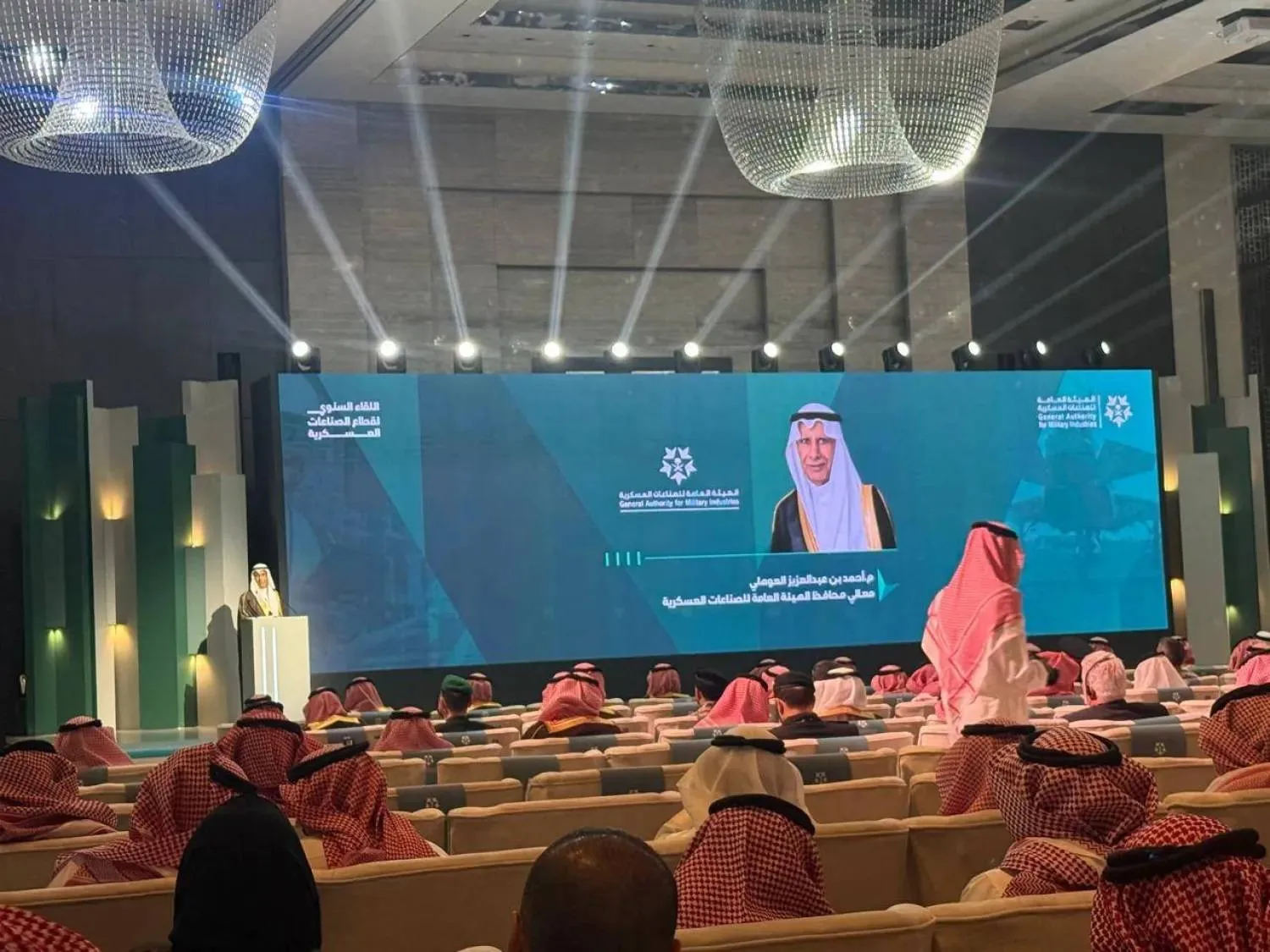

Saudi Arabia Raises Military Spending Localization to 24.89%

GAMI governor Ahmed bin Abdulaziz Al-Ohali during the annual meeting (Asharq Al-Awsat)
TT

Saudi Arabia Raises Military Spending Localization to 24.89%

GAMI governor Ahmed bin Abdulaziz Al-Ohali during the annual meeting (Asharq Al-Awsat)

The General Authority for Military Industries (GAMI) announced that Saudi Arabia has increased the localization of its military spending to 24.89% by the end of 2024, underscoring continued progress toward the Kingdom’s goal of exceeding 50 percent by 2030.

The announcement was made during the Annual Military Industries Sector Meeting in Riyadh, organized by GAMI under the patronage of its governor, Ahmad bin Abdulaziz Al-Ohali, with wide participation from government entities, private firms, and local and international defense companies.

Al-Ohali said in a speech that the achievement is a pivotal milestone in developing the Kingdom’s defense industries, made possible through the support of King Salman bin Abdulaziz Al Saud and Crown Prince Mohammed bin Salman, who also serves as prime minister and chairman of GAMI’s board.

He explained that the sectoral strategy prioritizes building a sustainable local sector with security, developmental, and economic impacts through unified governance, legislative enablers, investment incentives, empowerment of supply chains and small and medium enterprises, and development of national competencies.

He revealed the “National Platform for Military Industries” to provide easy access to sector programs and announced the launch of the “Localization Excellence Award” to encourage military and security entities and industrial companies to adopt best practices and increase local content.

The authority stated that activating the framework agreements for military procurement was introduced to enable beneficiary entities to purchase directly from industrial investors.

This mechanism aims to achieve spending efficiency, increase localization rates, improve product and service quality, unify prices, save time in procurement procedures, and issue direct purchase orders within a defined price range for periods of up to seven years.

According to information shared during the meeting, six framework agreements have been implemented with relevant entities, resulting in purchase orders worth 2.8 billion riyals ($746 million) over four years. These covered areas such as ammunition, systems, equipment, communications, and military devices.

To enhance transparency and accelerate procedural cycles, the authority has made available the “National Platform for Military Industries,” which provides programs, guides, and instructions for investors and suppliers.

It also announced the launch of the “Localization Excellence Award” to honor military entities and industrial organizations that make a significant contribution to local content and adopt best practices.



Saudi FM Receives Written Message from Russian Counterpart

Deputy Minister for International Multilateral Affairs and General Supervisor of the Economic and Development Affairs Deputyship Dr. Abdulrahman Al-Rassi meets with Russian Ambassador to Saudi Arabia Sergey Kozlov at the ministry’s headquarters in Riyadh on Tuesday. (SPA)
TT

Saudi FM Receives Written Message from Russian Counterpart

Deputy Minister for International Multilateral Affairs and General Supervisor of the Economic and Development Affairs Deputyship Dr. Abdulrahman Al-Rassi meets with Russian Ambassador to Saudi Arabia Sergey Kozlov at the ministry’s headquarters in Riyadh on Tuesday. (SPA)

Saudi Minister of Foreign Affairs Prince Faisal bin Farhan bin Abdullah received on Tuesday a written message from his Russian counterpart Sergei Lavrov covering issues of common interest between their countries.

Deputy Minister for International Multilateral Affairs and General Supervisor of the Economic and Development Affairs Deputyship Dr. Abdulrahman Al-Rassi received the message during a meeting with Russian Ambassador to Saudi Arabia Sergey Kozlov at the ministry’s headquarters in Riyadh.

The meeting included a review of bilateral relations and a discussion of regional and international issues.


Saudi Arabia, Arab and Islamic Countries Condemn Israeli Settlers’ Incursions into Al-Aqsa Mosque

 Muslim worshippers attend Eid al-Adha prayer at Al-Aqsa Mosque in Jerusalem, May 27, 2026  (Reuters)
Muslim worshippers attend Eid al-Adha prayer at Al-Aqsa Mosque in Jerusalem, May 27, 2026 (Reuters)
TT

Saudi Arabia, Arab and Islamic Countries Condemn Israeli Settlers’ Incursions into Al-Aqsa Mosque

 Muslim worshippers attend Eid al-Adha prayer at Al-Aqsa Mosque in Jerusalem, May 27, 2026  (Reuters)
Muslim worshippers attend Eid al-Adha prayer at Al-Aqsa Mosque in Jerusalem, May 27, 2026 (Reuters)

The foreign ministers of Saudi Arabia, Jordan, the United Arab Emirates, Qatar, Indonesia, Pakistan, Egypt, and Türkiye strongly condemned on Tuesday the continued incursions by extremist Israeli settlers, into the Al-Aqsa Mosque under the protection of the Israeli forces.

In a statement, they also condemned the raising of the Israeli flag within its courtyards. They stressed that these provocative and unacceptable actions are “a flagrant violation of international law, the relevant United Nations resolutions, and the historical and legal status quo at the holy sites in occupied East Jerusalem.”

The foreign ministers slammed “the continued and systematic violations and measures carried out by Israel, the occupying power, aimed at altering the historical, legal, and demographic character of occupied East Jerusalem and undermining the sanctity and status of its Islamic and Christian holy sites.”

They reaffirmed their “categorical rejection of any attempts to alter the historical and legal status quo in Jerusalem and its Islamic and Christian holy sites, stressing its preservation while recognizing the special role of the historical Hashemite custodianship in this regard.”

The ministers reiterated that “the entire area of Al-Aqsa Mosque, which amounts to 144 dunams, is a place of worship exclusively for Muslims, and that the Jerusalem Endowments and Al-Aqsa Mosque Affairs Department, affiliated with the Jordanian Ministry of Awqaf and Islamic Affairs, is the legal entity with exclusive jurisdiction to administer its affairs.”

The foreign ministers held Israeli authorities responsible for halting these escalatory actions and warned that repeated Israeli violations deepen tensions, fuel instability and extremism, undermine international efforts to achieve peace and are a clear breach of Israel’s obligations under international law.

They called for an immediate cessation of all such Israeli illegal and provocative practices and reaffirmed the need to respect the historical and legal status quo at Al-Aqsa Mosque in its entirety.

The foreign ministers underlined “their unwavering solidarity with the Palestinian people and their steadfast support for the realization of their legitimate and inalienable national rights, foremost among them their right to self-determination and the realization of an independent and sovereign Palestinian State on the 1967 lines, with East Jerusalem as its capital.”

They further voiced their support “for all efforts aimed at ending the Israeli occupation and achieving a just, lasting, and comprehensive peace based on the two-State solution in accordance with international law, the relevant United Nations resolutions, and the Arab Peace Initiative.”


Saudi Arabia's KSrelief, UNHCR Sign Agreement to Boost Protection, Healthcare Services in Yemen

Officials at the virtual meeting between KSrelief and UNHCR. (UNHCR Office in Riyadh)
TT

Saudi Arabia's KSrelief, UNHCR Sign Agreement to Boost Protection, Healthcare Services in Yemen

Officials at the virtual meeting between KSrelief and UNHCR. (UNHCR Office in Riyadh)

The United Nations High Commissioner for Refugees (UNHCR) and the King Salman Humanitarian Aid and Relief Center (KSrelief) signed a $3.1 million agreement to strengthen protection and healthcare services for forcibly displaced people in Yemen.

The agreement will provide nearly 45,000 people with access to essential services, including civil documentation, legal aid, voluntary refugee return support, and primary healthcare, helping vulnerable families maintain stability and dignity amid Yemen’s deepening humanitarian crisis.

Under the agreement, UNHCR and its partners will support thousands of internally displaced people and refugees in obtaining identity and civil registration documents, enabling them to regain access to basic rights, protection mechanisms, and public services. The initiative will also offer legal assistance to address displacement-related challenges, including eviction threats, housing and property disputes, and personal status issues.

The effort is particularly critical as many displaced families lost identification documents while fleeing conflict, preventing them from enrolling children in school, accessing public services, or securing livelihoods.

The agreement will also support Somali refugees seeking voluntary return to Somalia through counseling services, documentation assistance, and safe sea and air transportation, helping reduce reliance on dangerous irregular migration routes.

Funding will further support services at three healthcare centers in Sana’a, Aden, and Kharaz Refugee Camp in the Lahij governorate, providing medical consultations and essential medicines to refugees and vulnerable host communities.

The agreement was signed during a virtual meeting between Eng. Ahmed bin Ali Al-Baiz, Assistant Supervisor General for Operations and Programs at KSrelief, and Dr. Khaled Khalifa, Senior Advisor to the UN High Commissioner for Refugees and UNHCR Representative to the Gulf Cooperation Council countries.

Al-Baiz reaffirmed KSrelief’s commitment to continuing its strategic partnership with UNHCR to strengthen protection services and expand access to essential assistance for displaced families, refugees, and host communities in Yemen.

He said the project reflects Saudi Arabia’s broader humanitarian efforts to alleviate suffering and build sustainable resilience among vulnerable populations.

Khalifa described the agreement as evidence of the deep strategic humanitarian partnership between UNHCR and Saudi Arabia, represented by KSrelief.

The contribution would help thousands of vulnerable people gain access to protection services, healthcare, and legal assistance, enabling them to live with greater dignity and security, he added.

Armen Yedigarian, Acting UNHCR Representative in Yemen, stressed that the support from KSrelief demonstrates a strong commitment to protecting Yemen’s most vulnerable communities and helping displaced families rebuild their lives with dignity.