


From Ibrox Abuse to Sacking Lopetegui: Meet the Head of Spain's FA

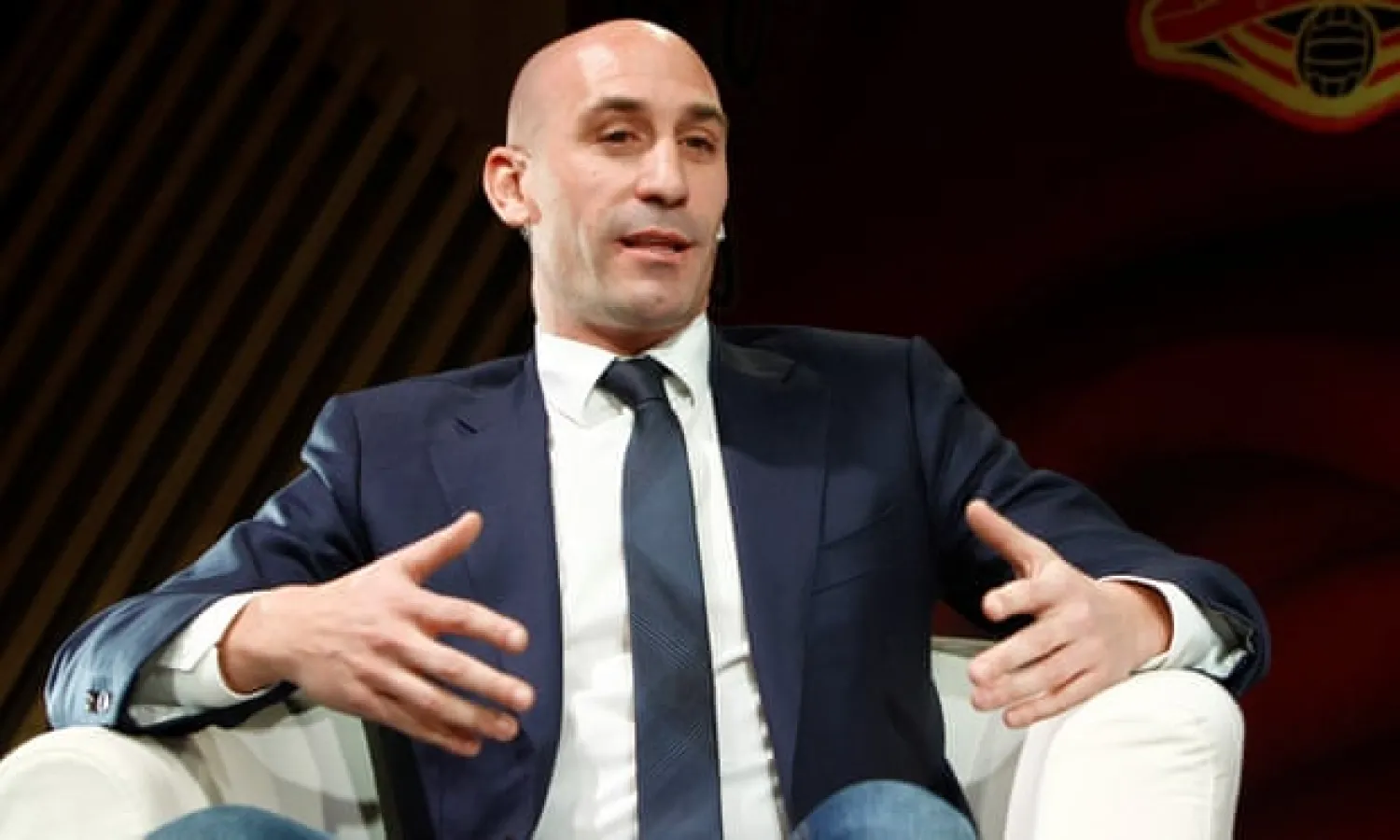
 Luis Rubiales says: ‘Football itself, the actual game, is a healthy sport. As for what’s around it, there are some elements I don’t like.’ Photograph: Alvaro Sanchez/EPA
Luis Rubiales says: ‘Football itself, the actual game, is a healthy sport. As for what’s around it, there are some elements I don’t like.’ Photograph: Alvaro Sanchez/EPA
TT

From Ibrox Abuse to Sacking Lopetegui: Meet the Head of Spain's FA

 Luis Rubiales says: ‘Football itself, the actual game, is a healthy sport. As for what’s around it, there are some elements I don’t like.’ Photograph: Alvaro Sanchez/EPA
Luis Rubiales says: ‘Football itself, the actual game, is a healthy sport. As for what’s around it, there are some elements I don’t like.’ Photograph: Alvaro Sanchez/EPA

The way Luis Rubiales remembers it, the last song dedicated to him in a football stadium ran: “Baldy bastard, what’s the score?” It was August 2009; the man who will be sitting at Wembley on Saturday night, president of the Spanish Football Federation, was playing at centre-back for Hamilton Academical; and the score, Ibrox knew, was 4-1. It was the third game of the season but at the end of it, Rubiales appeared in the press room – “wood panelled, smelling of football from another era” – and announced he was retiring.

It had nothing to do with the result, and he had enjoyed the afternoon. He already knew he was going, his father watching him for the last time from the stands, listening to the ‘serenade’. On the pitch, Rubiales Jr went off on a dribble, which wasn’t his thing but it was the last time, so why not? “I also had a set-to with their captain, which was fun,” he grins. “They named me Accies’ man of the match. And then I went into the press room, said I was retiring and everyone was like …”

Rubiales starts laughing. “They thought it was a bit weird.” He had played three league games and one in the cup; it was the day after his 32nd birthday; he was still in good shape and he had a contract. But he walked away, refusing to be paid beyond his last day, because calls from Spain asked him to help sought out a “mess”. Rubiales had been through bankruptcy and administration before, leading a Levante squad that had gone unpaid and unprotected; now all-too-many others were facing the same crisis and wanted his help.

He left having made less impact on Scotland than Scotland had on him, and he talks about “an atmosphere there that still reflects the roots of football”. In Spain the problems were serious; he returned and began a process that led him to the presidency of the Spanish Players’ Union. In May 2018 he won elections to the presidency of the Spanish FA, after almost 30 years under the former Fifa vice-president Ángel María Villar, who was arrested on suspicion of embezzlement. Villar denies wrongdoing.

Rubiales hadn’t even been in charge for a month when he was told that the Spain manager Julen Lopetegui was going to Real Madrid – five minutes before Madrid made the announcement public and two days before the World Cup. The following day, he sacked his coach. It was some start. “I tried to act with honesty, according to our ethics. There’s no point in going back over it; we’re in the Luis Enrique era, and I’m convinced that we’re going to be very proud of the team.”

It’s an era that begins at Wembley. Hours before the game, Rubiales will step on to the pitch right foot first and will cross himself just like he always did. “Football is the staging of a battle with rules and those of us who have been ‘warriors’ don’t like to lose the smell of that,” he says, so he maintains a player’s routine before heading to the directors’ box.

Theirs is an image that must change, he says. “A lot of damage has been done [by the former regime at Fifa and the RFEF]. The situation is difficult, but while we must distance ourselves from that we must also afford them the presumption of innocence. What we have done is impose new rules, external checks, audits, commissions, regulations to protect integrity and transparency.

“I’m in love with football and when you’re in love you tend to cover up defects but as a president you can’t. Football itself, the actual game, is a healthy sport. As for what’s around it, there are some elements I don’t like.”

Saturday’s visit to Wembley raises a contrast with Spain, where there is no national stadium. “It’s a lovely concept, but it’s not viable: we can’t spend hundreds of millions on a stadium like Wembley to use it so few times,” he says. “And there’s another question which is even more important: Spain belongs to all Spaniards; we have to take it all around the country.”

At least if there was a stadium, they wouldn’t have the tedious annual argument about where the Copa del Rey final is played. “We won’t anyway,” Rubiales shoots back. “We’re going to open up a bidding process so that stadiums over 45,000 can ask to hold it in two-year cycles.”

It would have helped too with this summer’s Spanish Super Cup, which the RFEF took to Tangiers. Some were angered but Rubiales claims he had little choice given the late obligation to play it over one leg, not two, and rejects comparisons to the league’s plan to take a match to Miami – announced without consultation with the federation, players’ union, clubs or fans’ groups.

“Javier Tebas [the president of La Liga] spoke to everyone except the people he had to speak to,” Rubiales says. “It’s a total lack of respect, unfaithful and incomprehensible. This president demands a lot from others when his own behaviour frankly leaves a lot to be desired. We’ve not had even a single call. I haven’t seen the contract, so I can’t say much but I will say this: the Fifa president protects domestic competition and taking competition somewhere else represents an invasion of that country. He has totally ignored the players and even the clubs, signing a contract with a private country for ten or fifteen years. His behaviour was terrible, but very much like Javier Tebas: very much lacking in respect.”

Tebas gave a six-point response in which he noted that non-US teams play in MLS, that this was a single game in 380 and that the agreement with Relevent Sports does not oblige the league to play a game in the US, only that it would attempt to do so and that no clubs would be forced to participate. “La Liga is perfectly conscious of that fact that to play in the US, it needs the authorisation of the US Federation,” Tebas said. “The RFEF president knows of our intention to play a game in abroad because we told him that as a result of the game in Tangier.”

Rubiales insists: “[Tebas] does this with everything. Put bluntly, he’s rude. He has signed an agreement that it is not up to him to sign. What he has signed is worthless. It means nothing without our authorisation, so we’ll see what happens to this game.”

The Guardian Sport


Shakhtar Boss Pays Ukrainian Racer $200,000 After Games Disqualification

Ukrainian President Volodymyr Zelenskiy holds helmet as he meets with a Ukrainian skeleton racer Vladyslav Heraskevych , who was disqualified from the Olympic skeleton competition over his "helmet of remembrance" depicting athletes killed since Russia's invasion and his father and coach, Mykhailo Heraskevych, amid Russia's attack on Ukraine, in Munich, Germany February 13, 2026. (Ukrainian Presidential Press Service/Handout via Reuters)
TT

Shakhtar Boss Pays Ukrainian Racer $200,000 After Games Disqualification

Ukrainian President Volodymyr Zelenskiy holds helmet as he meets with a Ukrainian skeleton racer Vladyslav Heraskevych , who was disqualified from the Olympic skeleton competition over his "helmet of remembrance" depicting athletes killed since Russia's invasion and his father and coach, Mykhailo Heraskevych, amid Russia's attack on Ukraine, in Munich, Germany February 13, 2026. (Ukrainian Presidential Press Service/Handout via Reuters)

The owner of ‌Ukrainian football club Shakhtar Donetsk has donated more than $200,000 to skeleton racer Vladyslav Heraskevych after the athlete was disqualified from the Milano Cortina Winter Games before competing over the use of a helmet depicting Ukrainian athletes killed in the war with Russia, the club said on Tuesday.

The 27-year-old Heraskevych was disqualified last week when the International Bobsleigh and Skeleton Federation jury ruled that imagery on the helmet — depicting athletes killed since Russia invaded Ukraine in 2022 — breached rules on athletes' expression at ‌the Games.

He ‌then lost an appeal at the Court ‌of ⁠Arbitration for Sport hours ⁠before the final two runs of his competition, having missed the first two runs due to his disqualification.

Heraskevych had been allowed to train with the helmet that displayed the faces of 24 dead Ukrainian athletes for several days in Cortina d'Ampezzo where the sliding center is, but the International Olympic Committee then ⁠warned him a day before his competition ‌started that he could not wear ‌it there.

“Vlad Heraskevych was denied the opportunity to compete for victory ‌at the Olympic Games, yet he returns to Ukraine a ‌true winner," Shakhtar President Rinat Akhmetov said in a club statement.

"The respect and pride he has earned among Ukrainians through his actions are the highest reward. At the same time, I want him to ‌have enough energy and resources to continue his sporting career, as well as to fight ⁠for truth, freedom ⁠and the remembrance of those who gave their lives for Ukraine," he said.

The amount is equal to the prize money Ukraine pays athletes who win a gold medal at the Games.

The case dominated headlines early on at the Olympics, with IOC President Kirsty Coventry meeting Heraskevych on Thursday morning at the sliding venue in a failed last-minute attempt to broker a compromise.

The IOC suggested he wear a black armband and display the helmet before and after the race, but said using it in competition breached rules on keeping politics off fields of play. Heraskevych also earned praise from Ukraine President Volodymyr Zelenskiy.


Speed Skating-Italy Clinch Shock Men’s Team Pursuit Gold, Canada Successfully Defend Women’s Title

 Team Italy with Davide Ghiotto, Andrea Giovannini, Michele Malfatti, celebrate winning the gold medal on the podium of the men's team pursuit speed skating race at the 2026 Winter Olympics, in Milan, Italy, Tuesday, Feb. 17, 2026. (AP)
Team Italy with Davide Ghiotto, Andrea Giovannini, Michele Malfatti, celebrate winning the gold medal on the podium of the men's team pursuit speed skating race at the 2026 Winter Olympics, in Milan, Italy, Tuesday, Feb. 17, 2026. (AP)
TT

Speed Skating-Italy Clinch Shock Men’s Team Pursuit Gold, Canada Successfully Defend Women’s Title

 Team Italy with Davide Ghiotto, Andrea Giovannini, Michele Malfatti, celebrate winning the gold medal on the podium of the men's team pursuit speed skating race at the 2026 Winter Olympics, in Milan, Italy, Tuesday, Feb. 17, 2026. (AP)
Team Italy with Davide Ghiotto, Andrea Giovannini, Michele Malfatti, celebrate winning the gold medal on the podium of the men's team pursuit speed skating race at the 2026 Winter Olympics, in Milan, Italy, Tuesday, Feb. 17, 2026. (AP)

An inspired Italy delighted the home crowd with a stunning victory in the Olympic men's team pursuit final as

Canada's Ivanie Blondin, Valerie Maltais and Isabelle Weidemann delivered another seamless performance to beat the Netherlands in the women's event and retain their title ‌on Tuesday.

Italy's ‌men upset the US who ‌arrived ⁠at the Games ⁠as world champions and gold medal favorites.

Spurred on by double Olympic champion Francesca Lollobrigida, the Italian team of Davide Ghiotto, Andrea Giovannini and Michele Malfatti electrified a frenzied arena as they stormed ⁠to a time of three ‌minutes 39.20 seconds - ‌a commanding 4.51 seconds clear of the ‌Americans with China taking bronze.

The roar inside ‌the venue as Italy powered home was thunderous as the crowd rose to their feet, cheering the host nation to one ‌of their most special golds of a highly successful Games.

Canada's women ⁠crossed ⁠the line 0.96 seconds ahead of the Netherlands, stopping the clock at two minutes 55.81 seconds, and

Japan rounded out the women's podium by beating the US in the Final B.

It was only Canada's third gold medal of the Games, following Mikael Kingsbury's win in men's dual moguls and Megan Oldham's victory in women's freeski big air.


Lindsey Vonn Back in US Following Crash in Olympic Downhill 

Milano Cortina 2026 Olympics - Alpine Skiing - Women's Downhill 3rd Official Training - Tofane Alpine Skiing Centre, Belluno, Italy - February 07, 2026. Lindsey Vonn of United States in action during training. (Reuters)
TT

Lindsey Vonn Back in US Following Crash in Olympic Downhill 

Milano Cortina 2026 Olympics - Alpine Skiing - Women's Downhill 3rd Official Training - Tofane Alpine Skiing Centre, Belluno, Italy - February 07, 2026. Lindsey Vonn of United States in action during training. (Reuters)

Lindsey Vonn is back home in the US following a week of treatment at a hospital in Italy after breaking her left leg in the Olympic downhill at the Milan Cortina Games.

“Haven’t stood on my feet in over a week... been in a hospital bed immobile since my race. And although I’m not yet able to stand, being back on home soil feels amazing,” Vonn posted on X with an American flag emoji. “Huge thank you to everyone in Italy for taking good care of me.”

The 41-year-old Vonn suffered a complex tibia fracture that has already been operated on multiple times following her Feb. 8 crash. She has said she'll need more surgery in the US.

Nine days before her fall in Cortina d'Ampezzo, Italy, Vonn ruptured the ACL in her left knee in another crash in Switzerland.

Even before then, all eyes had been on her as the feel-good story heading into the Olympics for her comeback after nearly six years of retirement.
