


King Salman: Saudi Arabia Launching Circular Carbon Economy National Program

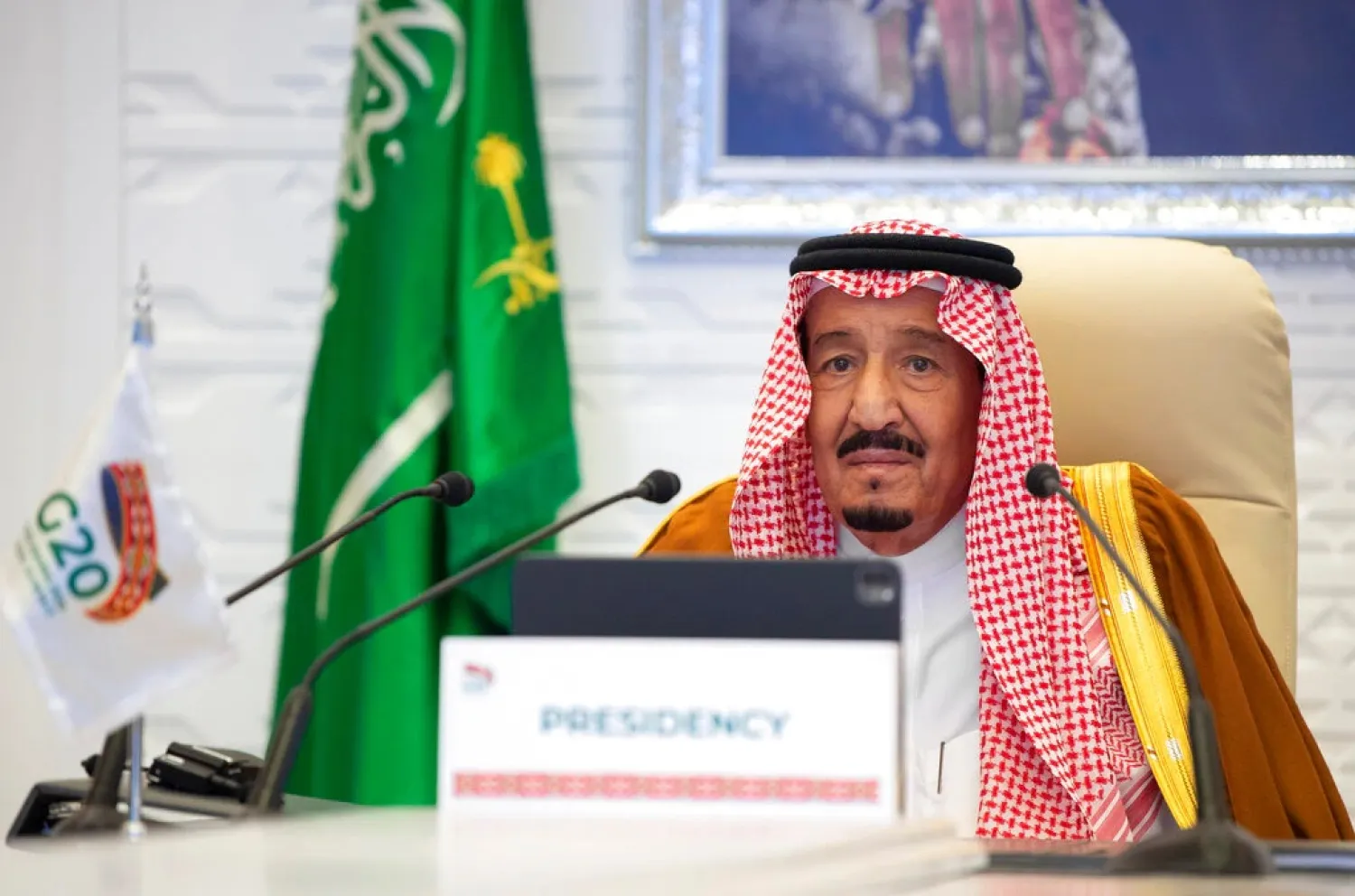
In this handout image from the Saudi Royal Palace, Saudi King Salman gives his opening remarks at a virtual G20 summit in Riyadh, Saudi Arabia, Nov. 21, 2020. (AP)
TT

King Salman: Saudi Arabia Launching Circular Carbon Economy National Program

In this handout image from the Saudi Royal Palace, Saudi King Salman gives his opening remarks at a virtual G20 summit in Riyadh, Saudi Arabia, Nov. 21, 2020. (AP)

Custodian of the Two Holy Mosques King Salman bin Abdulaziz revealed on Sunday that Saudi Arabia is formally launching a dedicated Circular Carbon Economy (CCE) National Program.

Speaking at a G20 Side Event on “Safeguarding the Planet: The CCE Approach”, he said the program “will consolidate and accelerate the current momentum toward sustainability in a historic manner.”

“We ask other nations to work with us to help achieve the goals of this program,” he said, stressing that “safeguarding the planet is of critical importance.”

“In 2012, we launched the Saudi Energy Efficiency program, a cornerstone of emission reduction within the framework of CCE. In the Kingdom we have many existing initiatives that capture carbon and turn it into valuable feedstock,” King Salman added during the virtual summit.

“This includes the world's largest CO2 purification plant built by the Saudi Basic Industries Corporation (SABIC) with a capacity of 500,000 tons per year and Saudi Aramco's enhanced oil recovery plan. Likewise, in NEOM we are developing the largest green hydrogen plant,” he continued.

Recognizing the important role of nature-based carbon sequestration, the Kingdom has been advocating the ambitious goal of conserving, restoring and sustainably managing 1 billion hectares of degraded land by 2040.

“In addition, we have great plans for renewables, including wind and solar which will generate 50 percent of the country's electricity by 2030,” stressed King Salman.

“The Presidency remains committed in its efforts to safeguarding the planet by preserving coral reefs, ocean ecosystems, and taking concrete actions to tackle land degradation and habitat loss. With a coordinated approach on environment, we ensure the G20 countries commitment to build a more inclusive, more sustainable and more resilient future,” read a statement released by the G20.

World leaders participating in the event included Italian Prime Minister Giuseppe Conte, Indian Prime Minister Narendra Modi, Chinese President Xi Jinping, Japanese Prime Minister Yoshihide Suga, Australian Prime Minister Scott Morrison and US President Donald Trump.

“The existential threat posed by climate change, land degradation and the decline of global biodiversity has already brought us to a crossroad, one that will determine whether we are able to safeguard our planet and a build a sustainable future. I am convinced the G20 can lead the world in the right direction,” said Conte, whose country will chair the G20 in 2021.

“We must preserve the majesty of God’s creation. Together, we can protect our environment, promote access to clean, affordable energy, and deliver a future of opportunity, prosperity, and hope for our nations all over the world,” remarked Trump.

“The G20 should continue to take the lead in tackling climate change. China supports deepening G20 coordination in reducing land degradation, conserving coral reefs, and cleaning up plastic from the ocean. Let us work together for a clean and beautiful world,” stated Xi.



Saudi Aramco Helicopter Crash Kills 14 Nationals

A Leonardo AW139 helicopter, the model operated in Aramco's aviation fleet, with a seating capacity of 14 passengers.
TT

Saudi Aramco Helicopter Crash Kills 14 Nationals

A Leonardo AW139 helicopter, the model operated in Aramco's aviation fleet, with a seating capacity of 14 passengers.

A helicopter belonging to Saudi oil giant Aramco crashed on Sunday in Ras Tanura on Saudi Arabia's eastern coast on the Gulf, west of the Strait of Hormuz, killing 14 nationals, the state news agency reported, adding that the cause was unknown.

"The relevant authorities have launched a full investigation to determine the cause of the crash," the state news agency added.

The incident took place at 6 a.m. local time (0300 GMT), the state agency said.


British Trade Minister to Asharq Al-Awsat: UK-GCC Free Trade Deal a ‘Landmark’ Moment

British Minister of State for Trade Chris Bryant and Gulf Cooperation Council Secretary-General Jasem AlBudaiwi at the signing of the UK-GCC Free Trade Agreement ceremony. (GCC)
TT

British Trade Minister to Asharq Al-Awsat: UK-GCC Free Trade Deal a ‘Landmark’ Moment

British Minister of State for Trade Chris Bryant and Gulf Cooperation Council Secretary-General Jasem AlBudaiwi at the signing of the UK-GCC Free Trade Agreement ceremony. (GCC)

British Minister of State for Trade Chris Bryant has described the free trade agreement between the United Kingdom and the Gulf Cooperation Council as a “landmark” deal, not only because of its economic value, but because it marks the first agreement of its kind between the GCC and a G7 country.

In an interview with Asharq Al-Awsat, Bryant said the agreement could enter into force “in maybe a year, 14 months maybe at most” after signature. London, he said, hopes to sign the agreement in September or October, once the legal review of the text has been completed.

Bryant said the deal would generate “around £3.7 billion” in additional trade for the UK economy, with “similar numbers for the Gulf.” He added that the agreement carried symbolic importance at a sensitive regional moment, following the war with Iran and the “completely appalling attacks from Iran” on Gulf allies.

The minister also praised the scope of the agreement, saying it went beyond cutting tariffs to cover services, the digital economy, artificial intelligence and measures to make it easier for companies on both sides to do business.

Signature expected in the autumn

Bryant said the two sides had so far concluded negotiations, agreed the key elements of the agreement and, in this case, “nearly all the text.”

“What we’ve done so far is we’ve concluded negotiations,” he said. “Now, we have to do what’s known as legal scrub. That will take a while before signature. I hope we’ll be able to do that in September or October.”

He pointed to the UK’s agreement with India, whose entry into force was announced less than a year after it was signed, as an indication of the timetable London hopes to follow with the Gulf deal.

“So I hope that in maybe a year, 14 months maybe at most, we would have entry into force of the deal with the Gulf,” he said.

Services at the heart of the partnership

Asked what distinguishes the UK from other Gulf partners, including the United States, China and the European Union, Bryant pointed to services.

He said Britain’s strengths in financial services, legal services, architecture, construction, creative industries, fintech and life sciences offered major opportunities for deeper cooperation with Gulf economies as they diversify away from hydrocarbons.

“We’re phenomenally good as a financial services center. Everybody knows that,” he said, adding that this was one reason why many Gulf economies were invested in the UK, listed on the London Stock Exchange, or had expanded their presence in the British economy.

Bryant also highlighted legal services as a central part of the UK offer, saying that “the rule of law is a very strong concept in British identity.” He referred to recent developments in Saudi Arabia, where British legal firms are now able to operate more easily.

The minister also pointed to advertising and creative services as another major British strength. He said UK exports in advertising services reached £19.4 billion last year, making Britain the second-largest advertising exporter in the world.

“Lots of people in the Gulf listen to our music, watch our films as well,” he said, adding that the wider services sector, together with creative tech, fintech and life sciences, offered significant scope for the UK-Gulf relationship to grow.

Tariff cuts on goods

Asked whether the real value of the free trade agreement lay more in services than in goods, Bryant said goods remained an important part of the deal.

He said tariffs would come down on 93 percent of UK goods entering the Gulf, with many of those reductions taking effect when the agreement enters into force.

“That will make a dramatic difference,” he said, adding that it would make foodstuffs and some British goods sent to the Gulf cheaper for consumers.

Bryant also said the agreement included a good deal on automotive exports and would save “several hundred million pounds” in tariffs every year.

“That’s really good for British businesses, but I think it’s also good for Gulf consumers,” he said.

Making business easier

Beyond goods and services, Bryant said the agreement would make it “so much easier” for British companies to operate in the GCC and for GCC-based companies to operate in the UK.

He said trade barriers were often understood through tariffs, because they were the most obvious, but other obstacles could be just as important.

“There are lots of other barriers like customs processes, paperwork that you need, licenses that you need, or data localization,” he said. “All of those kinds of issues can be just as important.”

Bryant said he was pleased that the GCC deal covered many of these issues, making it easier to reduce obstacles to trade and investment on both sides.

Artificial intelligence and the digital economy

On artificial intelligence, Bryant told Asharq Al-Awsat the agreement contains a dedicated section on the digital economy, reflecting the growing importance of digital trade to the future of the UK-Gulf relationship.

Most GCC countries are investing heavily in data centers, developing large language models and integrating AI into their wider economies. Bryant said the agreement responded to this shift by including commitments designed to support digital business.

“One of the commitments is a permanent commitment on both sides that we would not introduce tariffs on digital transmissions,” he explained.

He revealed that the agreement also covers ways to ensure it is easier for people to do business digitally, noting that many services are now delivered digitally.

Bryant described the UK as “probably the leading AI country” in Europe, not only because of data centers, but also because of its creative technology, fintech and other technology sectors that are well placed to benefit from new opportunities.

Education and training

Bryant also highlighted the education relationship between the UK and the Gulf, describing it as “really, really strong.”

He noted that even during the recent Iran war, the regional situation “didn’t impede” progress on the trade agreement.

Bryant stressed that the UK was keen to explore ways to train young people from the Gulf, particularly in sectors linked to economic diversification. He cited Saudi Arabia’s tourism ambitions as an example.

“Saudi Arabia is talking about having 600,000 people that it’s going to need for its tourism industry, which it is really trying to boost as part of that diversification of its economy,” he said.

“I know that we in the UK do some of that training well, and we want to look at ways in which we can expand that in a joint way.”

He also noted that many young Saudis, Emiratis and Bahrainis study either in the UK or on courses in the Gulf that lead to UK qualifications, while many schools in the region use British-based technology to run their operations.

A partnership beyond trade

Bryant said the free trade agreement takes the UK-GCC relationship “to the next level,” while stressing that Britain also maintains important bilateral relationships with individual Gulf states.

“In one sense we have our relationship directly with Kuwait or Oman or Bahrain,” he remarked, adding that the free trade agreement was about the Gulf as a whole.

He pointed to Saudi Arabia as an example of how the partnership extends beyond trade, saying the UK had been discussing how it could contribute to preparations for the Saudi Arabia hosting the FIFA World Cup in 2034.

He said British expertise could be useful in areas such as opening and closing ceremonies, fan zones, ticketing and security.

“When you arrive at a stadium, you want to know that it’s not just the police and the army providing security,” he explained, adding that stewards and event staff also needed to be focused on whether spectators were “going to have a good time.”

“That’s the kind of stuff that we’re really, really good at,” he said.

A decade after Brexit

The interview came as Britain marked 10 years since the Brexit referendum, in which voters chose to leave the European Union.

Bryant said that, as an EU member, the UK did not have the function of negotiating its own trade agreements with other countries, because trade policy was conducted collectively by the European Union.

But he rejected the idea that Britain’s ability to conclude its own trade deals should simply be described as a “Brexit benefit.”

“I don’t see it that way,” he said. “That’s like saying that when you get sacked, you’ve got more time to spend time with your family, even though you would probably prefer to stay in your job.”

Instead, Bryant said Britain was using the moment to “fill in the jigsaw puzzle of free trade around the world.”

He said the UK believed in “free and fair trade”: reducing tariff barriers so countries can prosper through trade, while also ensuring a level playing field.

He cited steel overcapacity as one example of an issue Britain takes seriously in that context.

Bryant said the UK was not focusing only on its relationship with the EU, pointing to trade agreements with India and Korea, negotiations with Türkiye, and the agreement with the Gulf.

He also noted that the EU had now reached an agreement with India, suggesting that it might later “be knocking at the door of the GCC as well.”

Continuity amid political turnover

The interview took place as Britain prepared for its seventh prime minister in a decade, following Keir Starmer’s resignation — a scene that underscored the unprecedented pace of change at 10 Downing Street and raised questions among London’s partners about the continuity of its foreign policy, trade commitments and defense relationships.

Asked about those concerns, Bryant stressed that the agreement was being concluded by the United Kingdom, not by one individual or a passing government.

“It’s the UK that’s doing this deal, not one individual person,” he said. “It’s not about me. It’s about the UK doing a deal with the Gulf Cooperation Council.”

He said that whoever the prime minister is in Britain, the agreement would remain a deal between the United Kingdom and the Gulf.

“You don’t need to worry about that,” he said.

Asked whether he expected to remain in his post in three weeks’ time — the expected timetable for a new prime minister to take office if no challenger emerges to the frontrunner, Andy Burnham — Bryant said the decision was “not up to me,” before adding in Arabic: “Inshallah.”


Saudi Arabia Strongly Condemns Iranian Drone Attacks on Bahrain

A view of the Saudi capital, Riyadh. (SPA file)
TT

Saudi Arabia Strongly Condemns Iranian Drone Attacks on Bahrain

A view of the Saudi capital, Riyadh. (SPA file)

Saudi Arabia strongly condemned on Saturday the Iranian drone attacks against Bahrain earlier in the day.

In a statement, the Foreign Ministry said that Saudi Arabia stresses its categorical rejection of these attacks as a violation of international law and the Charter of the United Nations.

It reiterates that such violations undermine international efforts to restore security and stability in the region.

The ministry added that Saudi Arabia further renews its solidarity with Bahrain and its full support for all measures it takes to safeguard its sovereignty, security, and stability.