Trips of Death from Horn of Africa to Yemen

African migrants in Lahj, Yemen. (Asharq Al-Awsat)
TT

Trips of Death from Horn of Africa to Yemen

African migrants in Lahj, Yemen. (Asharq Al-Awsat)

Three African refugees lie down to rest after washing their children's clothes near a shabby camp in Khur Maksar in Yemen. They laid out the clothes to dry on the street near the camp, the tents of which are made of tree branches and threadbare clothes.

Thousands of Ethiopian refugees live on a piece of land in Aden's Khur Maksar. The majority were forcibly displaced by the Iran-backed Houthi militias, who burned down their Sanaa detention center, which housed some 900 migrants. The migrants were held at the prison for refusing to fight for the militias in the ongoing conflict.

The refugees in Khur Maksar rely on donations from the residents and they have offered to wash cars. They complain of the meager donations provided by the International Organization for Migration (IOM) and United Nations High Commissioner for Refugees.

Conflict in Africa has pushed people to resume taking the trip of death from the continent across the Gulf of Aden to reach Yemen and eventually the Gulf countries. The illegal activity spiked in late 2021 after a notable dip.

One refugee, who identified herself as Mariam, angrily told Asharq Al-Awsat in broken Arabic that she was tired of journalists reporting on their plight. "We want money and food for us and our children," she said.

"Every day an organization comes to take our photos and promises to provide us with aid. It goes and never returns," she complained. She also complained of diseases spreading among the migrants.

At a nearby restaurant, refugees clamor for a meal paid for by a benevolent client.

One refugee told Asharq Al-Awsat that they are Oromo people and that they had fled death in Ethiopia where war was raging.

He demanded that the UNHCR transport them to a country that accepts them as refugees.

"Here, in Yemen, there is no work, but at least we are safe from death," he added.

Yemeni authorities have stressed that they were working with international organizations to combat human traffickers and smugglers.

The IOM in Yemen has said that in spite of the raging conflict there, the country is still a main crossing for migrants from the Horn of Africa. It registered the arrival of 27,693 migrants in Yemen in 2021. The main crossing points in Yemen are dotted along its southern coast in the provinces of Lahj, Shabwa, Hadhramaut and Taiz.

Migrants from Ethiopia, Djibouti and Somalia often risk death by riding in boats from their countries, seeking safer shores in Yemen. They begin their dangerous journey from Ethiopia, stopping in the port city of Obock in Djibouti before departing towards the Mandeb Strait and reaching the Lahj and Taiz shores.

A secondary route, crossing through Somalia, has emerged after patrols were intensified on the primary route between Djibouti and Yemen.

Migrants departing Somalia's Bosaso arrive on the coasts of Shabwa and Hadhramaut. The second route is longer but just as dangerous.

The majority of migrants are seeking safety in the Gulf countries, but often their journey - as observed by the IOM - ends in Yemen.

There, the migrants are the most vulnerable and marginalized segments of society. They are often exploited and abused. They live in dire conditions with limited access to the most basic services, such as shelter, food, water and healthcare.

Yemeni authorities have cracked down on human traffickers, who cooperate with smugglers in Africa to exploit the migrants and extort their families before being allowed to embark on their dangerous journey.

The Houthis, meanwhile, exploit the migrants for their war effort. They have forcibly recruited some migrants to their ranks and those who refuse are abused and detained. The situation came to a head with the arson of the detention center that housed some 900 refugees.

After the international outcry, the Houthis sent the migrants to areas held by the legitimate government. Herded like cattle in trucks, they were left at the edges of regions controlled by the government.



Nepal Floods Expose Risks to Hydropower in a Warming Himalayas

An undated handout photo of rescue workers taking part in a rescue operation near the tunnel of the Trishuli 3A Hydropower Project, following deadly flash floods and mudslides, in Rasuwa, Nepal. (Nepal Army/Handout via Reuters)
TT

Nepal Floods Expose Risks to Hydropower in a Warming Himalayas

An undated handout photo of rescue workers taking part in a rescue operation near the tunnel of the Trishuli 3A Hydropower Project, following deadly flash floods and mudslides, in Rasuwa, Nepal. (Nepal Army/Handout via Reuters)

Workers shoveled thick mud from a flood-ravaged power station in central Nepal this week, trying to restore electricity to more than 20,000 people.

The floods that swept through Nepal and China, killing hundreds and leaving thousands missing, have also overrun hydropower facilities, knocking out about 10% of Nepal’s power capacity.

Once the immediate aftermath of the disaster is dealt with, the question will be how to restore power plants, roads, bridges, schools and health facilities without exposing them to the same vulnerabilities, disaster experts said.

“Authorities have to take a hard look in the mirror now and ask how they will be rebuilding in these places. They will also have to take a close look at other projects in Nepal that have not been built yet, whether they’ll be approved after this event,” said Jakob Steiner, a geoscientist at the University of Graz in Austria, who is currently based in Dhaka, Bangladesh.

Rebuilding for resilience, not just replacement Hydropower projects that were operating or under construction were fully or partly destroyed across Rasuwa, Nuwakot and Dhading, among the worst-hit districts.

Hundreds of workers in Nepal are unaccounted for from a dozen hydropower projects, according to the Independent Power Producers’ Association, Nepal. Many had taken shelter in the tunnels but are stuck, waiting to be rescued, according to officials.

“The tunnels are built to access hydropower infrastructure and to divert water,” Steiner said, describing the tunnels as big enough for trucks to pass through.

Apart from the hydropower projects, tens of kilometers of roads, multiple bridges and essential buildings like schools and hospitals have been destroyed.

Ramraj Narasimhan, a senior director with the Coalition for Disaster Resilient Infrastructure, said rebuilding should focus on continuity of services rather than trying to make every structure indestructible.

“If it gets damaged, let it get damaged, but can we build in redundancy in the system?” he said.

That can mean choosing a better location for construction, alternate routes, backup power, improved early warning and financial tools such as insurance to speed recovery, Narasimhan said. Risk assessments should examine where a river bends, where slopes are unstable and where a single failure could cut off several communities.

Narasimhan’s organization estimates that $124 billion worth of Nepal’s infrastructure is exposed to climate-driven disasters, creating the potential for hundreds of millions of dollars in losses each year. A report by the coalition earlier this year found that Nepal’s average annual losses are nearly $760 million from various disasters, while the country’s national disaster funds is only a fraction of this amount.

Climate risks grow for Himalayan hydropower

Climate scientists said the Himalayan region, which is warming faster than many other parts of the world, is particularly at risk from increasing global warming as a result of human-caused climate change.

Climate experts said the flooding adds to evidence that infrastructure planning in the Himalayas should account for disasters that are increasing as the climate warms. Glaciers across the Hindu Kush Himalaya are losing ice at an accelerating rate, while permafrost degradation, unstable slopes, glacial lakes and increasingly erratic rainfall are raising the risks of floods, landslides and debris flows, according to reports by Kathmandu-based climate research group International Center for Integrated Mountain Development.

The stakes are particularly high for Nepal because hydropower is both a foundation of its electricity grid and an important source of economic growth and export revenue. Much of the country’s potential is run-of-river hydropower, Narasimhan said, meaning facilities are closely tied to steep river corridors where land is limited and hazards can cascade quickly.

Steiner said smaller floods can sometimes be managed with diversions that keep debris and high flows away from expensive infrastructure and tunnels. But for events as large as the latest flood, he said, physical defenses may be overwhelmed. In those cases, early warning becomes the critical protection for people.

He said the flood was detected at the China-Nepal border after moving rapidly from its source, leaving little warning time upstream. But there was still time as the flood traveled downstream toward hydropower sites, raising questions about whether warnings could have reached workers sooner.

The disaster is also likely to intensify scrutiny of where future projects are approved. Himanshu Thakkar, coordinator of the South Asia Network on Dams, Rivers and People, said environmental, social and disaster-risk assessments need to reflect the specific landscape and past hazards of each valley, backed by land-use rules and stronger accountability.

Hydropower projects can themselves become “force multipliers” when large structures, debris and altered river channels add to downstream damage, Thakkar said. He argued that Nepal should also consider more decentralized solar power as part of a broader energy mix.

Thakkar said the question now is not only how fast Nepal can rebuild, but what it chooses to put back in the path of the next flood.


72 Hours that Arranged the Succession: Khaddam Recalls What Happened after Hafez al-Assad's Death

Bashar al-Assad during his father’s funeral in June 2000. (AFP)
TT

72 Hours that Arranged the Succession: Khaddam Recalls What Happened after Hafez al-Assad's Death

Bashar al-Assad during his father’s funeral in June 2000. (AFP)

Former Syrian Vice President Abdul Halim Khaddam’s recent memoirs tackle the three days that followed the death of the late President Hafez al-Assad on June 10, 2000. He recalled the events from the perspective of someone who was inside the room where the succession was arranged.

The memoirs, edited and introduced by Ibrahim Hamidi, are due to be published in early September by Raff Publishing, a subsidiary of the Saudi Research and Media Group (SRMG).

Khaddam contacted Hafez al-Assad to ask permission to travel to Baniyas, leading to a lengthy conversation about health and age in which Assad said: "I have carried burdens beyond my capacity." He ended the conversation with a request: "Call me when you arrive."

Upon Khaddam's return to Damascus on Saturday, he was informed that the presidential palace was calling for him and that "Dr. Bashar" - Assad’s son - was waiting for him at home, at which point he realized that the president had died.

In the reception hall, he found the members of the Syrian command with Bashar and his brother-in-law Assef Shawkat with discussions focusing on how to announced the death. Minister of Defense General Mustafa Tlass informed him that the Regional Command had made two decisions: nominating Bashar for the presidency and amending Article 83 of the Constitution regarding the age of the President of the Republic since Bashar was 34 years old and the constitution required the minimum age to be 40. The People's Assembly was to meet in the evening to approve the amendment.

The memoirs are due to be published in early September by Raff Publishing, a subsidiary of the Saudi Research and Media Group (SRMG).

On the evening of Hafez’s death itself, Khaddam recalled that he met with Bashar at his home and suggested promoting him to the rank of general and appointing him Commander-in-Chief of the Army and Armed Forces, "so that he would have a legitimate status in the state" before a referendum.

Bashar asked him whether they should consult Tlass, and Khaddam replied that they would inform him of the decision rather than ask him.

The following day, the proposal was presented to Tlass in the presence of Bashar, whereupon the Defense Minister's face turned pale and he fell silent before stating that he would order the drafting of the decree.

Here, the memoirs record the most striking point of contention: the decree was delayed, and when the director of Tlass's office was asked about the reason, he replied that the General wanted to promote Bashar to the rank of "Lieutenant General" rather than "General", a proposal that would have kept the position of Commander-in-Chief of the Army within the reach of the Defense Minister.

Khaddam revealed his conviction was that Tlass "was not fit for this position," and that he had made a decision to support Bashar "to the end, even if it were at the expense of old comrades."

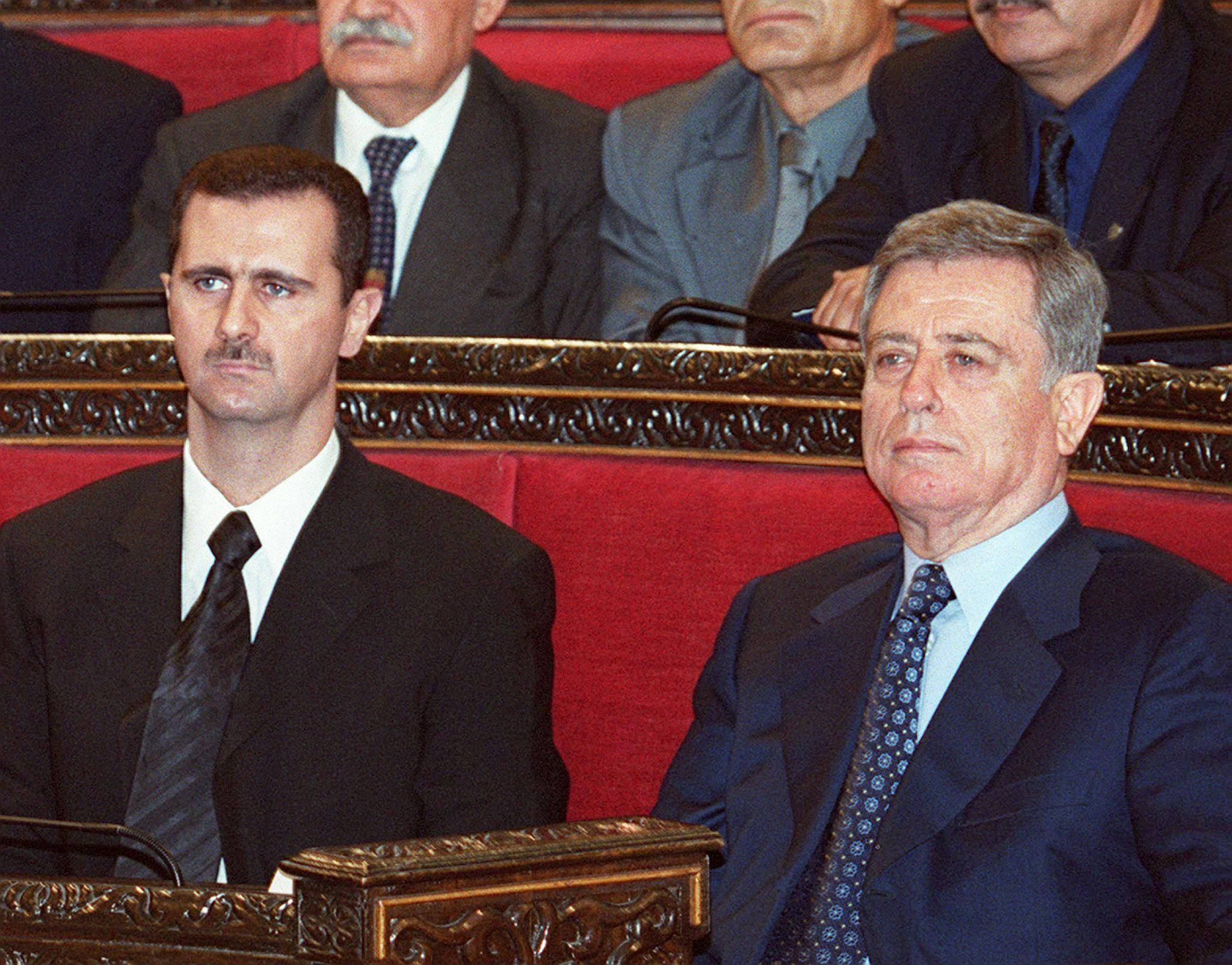
Bashar al-Assad and Abdul Halim Khaddam at the Syrian parliament in 2000. (AFP)

The memoirs reveal that Bashar’s path to the presidency began in 1994 with the death of his brother Bassel. Khaddam recalled that while everyone was in Qardaha for the burial, he learned that Anisa Makhlouf and her brother Mohammad Makhlouf had met and decided to terminate Bashar’s studies in London so that he could take his brother’s place as Hafez’s eventual successor.

Recalling that period, Khaddam said: "We must not forget that the elder Assad built a regime in which he placed Syrians before two choices: either to accept the regime with all its flaws, or civil war."

The issue is not merely a story of military protocol; it reveals the fragility of the moment of transition in a regime built for decades around a single individual, and how the party, constitution, army, and family intervened within a few short hours to produce a succession intended to appear natural. The details of those 72 hours appear in the book's chapter titled "The Death of Hafez al-Assad."


School Starts Soon in Lebanon but Thousands Still Shelter in Them During War

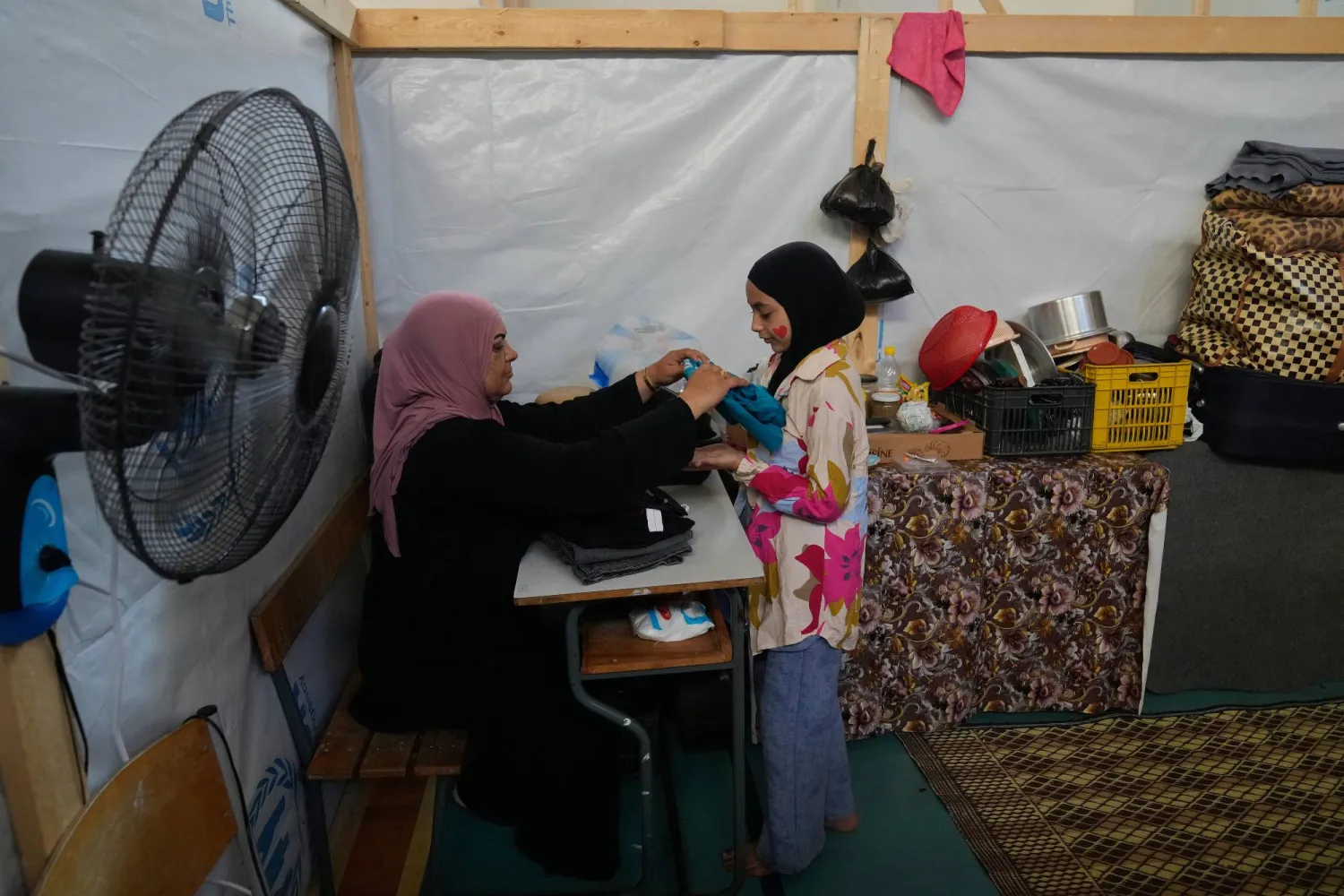
Displaced woman, Randa al-Taki, 51, and her daughter Fatima Haidar, 11, arrange their clothes inside their makeshift room that set on a basketball court inside a public school turned into a shelter for people whose villages in southern Lebanon were destroyed or occupied by Israeli forces, in Tyre, southern Lebanon, Thursday, Aug. 27, 2026. (AP)
TT

School Starts Soon in Lebanon but Thousands Still Shelter in Them During War

Displaced woman, Randa al-Taki, 51, and her daughter Fatima Haidar, 11, arrange their clothes inside their makeshift room that set on a basketball court inside a public school turned into a shelter for people whose villages in southern Lebanon were destroyed or occupied by Israeli forces, in Tyre, southern Lebanon, Thursday, Aug. 27, 2026. (AP)

Eleven-year-old Fatima Khashab helps her mother tidy the small area where their family sleeps, in a row of makeshift living quarters in a school gymnasium.

About 200 families are sheltering in the school in Lebanon’s southern coastal city of Tyre. Most are from villages farther south that have been destroyed in the latest war between Israel and the Iran-backed Lebanese group Hezbollah or are occupied by Israeli forces, like Fatima’s hometown of Mansouri.

The school year will start on Sept. 15, but thousands of displaced people still shelter in public schools. With negotiations between Israel and Lebanon — and between the US and Iran — stalled, there is no political solution in sight that would allow them to go home.

Education officials say they have a plan to reopen the schools while maintaining shelters for families with nowhere to go. But anxiety is high.

“We don’t know if we will be able to go back to our village or if the crisis will get even worse. Nobody except for God knows what’s going to happen," said Fatima’s mother, Randa al-Taki, 51.

On top of that, she said, “Our children are deprived of school, and we don’t know if they are going to learn this year or not.”

Education is again disrupted for children in Lebanon

Lebanon has traditionally prided itself on its education system. Its economy relies on sending educated young people abroad to work. They send remittances and make investments back home.

That system is in danger of crumbling.

Since 2019, Lebanon has been battered by an economic collapse, the COVID-19 pandemic, the 2020 Beirut port explosion and two wars. The current conflict has disrupted education for hundreds of thousands of children.

“There’s an estimated at least four years of learning loss now,” said Nora Ingdal, Lebanon country director for Save the Children, which has set up learning spaces for displaced children. “A sixth grader is actually on the level of a second grader.”

At the height of the current conflict, half of Lebanon’s public schools were used as shelters, disrupting education for more than 250,000 students, according to a report by the Arab Center for Research and Policy Studies, a Qatar-based think tank.

Nasser Yassin, the center’s director in Beirut and a former Lebanese government minister who was in charge of the crisis response during the 2024 war, said the government should have used other places for shelters whenever possible, not schools.

“We should not respond to a displacement crisis by creating a long-term education crisis,” he said.

About 350,000 people remain displaced

The latest conflict between Israel and Hezbollah began on March 2, when the group fired rockets across the border two days after Israel and the US launched a war on Iran.

At the height of the war, some 1.2 million people were displaced in Lebanon.

Since late June, a shaky truce has allowed most to return home. In Beirut, the displacement crisis is no longer visible the way it was early in the war, when tents lined the seaside corniche and families slept in their cars along main thoroughfares.

But the Israeli military still occupies large swaths of southern Lebanon and has said it won't withdraw before Hezbollah is fully disarmed, a prospect that appears unlikely. Israeli troops have demolished houses in areas they control and launched strikes that they say target Hezbollah militants.

“Every day we see how they are demolishing our village with bulldozers, and they’re either blowing up the houses or bombing them in front of our eyes, and we can’t do anything,” al-Taki said of Israel's military. She is unsure if their house is still standing. Lebanon's state news agency reported new airstrikes and shelling on their hometown over the weekend.

Around 350,000 people remain displaced, according to the UN humanitarian office. While most have rented apartments or moved in with relatives, some 21,000 still stay in collective shelters.

Some have been displaced since the previous Israel-Hezbollah conflict, which erupted into full-scale war in September 2024.

That’s the case for Malak Abu Sari, 11, whose home was destroyed. Her family is staying in the school in Tyre.

Fatima's family was displaced in 2024, too, but they were able to return home before fleeing in March, early in the current war, and again about a month ago after briefly going back.

‘We feel that we’re suffocating’

At the school, Fatima's family is surrounded by relatives and former neighbors. The familiar faces make them feel less alone. Humanitarian groups organize activities for the children. One woman brought her cockatiel when she fled, and children stop by to play with him.

But the families chafe at the lack of privacy.

“We have a place to stay in the school, and thank God for that, but to be honest, we feel that we’re suffocating between these tarps,” al-Taki said.

Before the war, the family made a living farming zaatar, a herb used in a popular Levantine spice mix. Her husband sold snacks from a tuk-tuk on beaches. Now they've missed the zaatar season, and there’s no work.

Fatima pines for her old life. She misses being in her own bed and not in a cramped room with tarps for walls.

“I miss a lot of things,” she said. “I want to go back to school and stay in our own house.”

Online learning poses a challenge

Georgia Hachem, adviser to Lebanon’s education minister, said around 80 schools are still serving as shelters, but many host a small number of families.

In some cases, those schools will reopen for classes while part of the facility continues as a shelter. In other cases, families will be consolidated in a single location. In Beirut, the ministry will move displaced families to unused buildings.

“We have a solution for every single shelter, and no student will be left without a seat,” Hachem said.

The bigger issue, she said, is the 340 schools damaged in the war, with some 30 of them destroyed and no funds to repair them. Other schools are inaccessible in occupied areas.

After the war began, the education ministry offered online classes to students whose schools closed, but families in shelters often have internet problems and limited resources, Ingdal said.

“Maybe there’s one device in the family and you have five kids who are going to learn,” she said.

Most students can return to school in person this year, Hachem said, but a handful of schools will remain online.