


Int’l Bodies Reject Houthi Militias in Yemen, Tighten Noose on Their Leaders

Houthi gunmen attend a funeral for the group's dead in Sanaa (AP)
TT

Int’l Bodies Reject Houthi Militias in Yemen, Tighten Noose on Their Leaders

Houthi gunmen attend a funeral for the group's dead in Sanaa (AP)

Seven years after terrorist Houthis waged a coup in Yemen and took over the Yemeni capital, Sanaa, on September 21, 2014, the group is facing military and political pressures, after the world became aware of its criminal behavior both locally and abroad.

In just two weeks, the group was dealt three successive blows, the first of which was from the UN Security Council (UNSC), which classified the group as a “terrorist organization” and imposed an arms embargo on it.

Houthis then faced a similar designation and blacklisting by the General Secretariat of the Council of Arab Interior Ministers and the European Union (EU).

“Houthis are now besieged and exposed, the world is fed up with them and their group’s maneuvers and gambling have reached a dead end. Their actions are moving towards maximizing the human tragedy and prolonging the war,” according to Najib Ghallab, Undersecretary of the Yemeni Ministry of Information.

In the face of mounting pressures, Houthis adopted a policy of fleeing forward as the group attacked several Saudi civilian facilities to disrupt global energy supplies. Their assaults against Saudi installations comes after the noose being tightened around them and their financiers in Tehran.

On March 1, the UNSC extended the arms embargo originally imposed on several Houthi leaders to include the entire Iranian-backed group.

The latest UN move looks to step up pressure on Houthis and to get them to stop their attacks against civilians and civilian facilities in Yemen, Saudi Arabia, and the United Arab Emirates.

The UNSC justified the imposition of a comprehensive arms embargo on the Houthis by pointing out the group’s engagement in actions that threaten peace, security, and stability in Yemen.

The international body condemned Houthis for having participated in “attacks to strike civilians and civilian infrastructure in Yemen. It also slammed Houthis for implementing a policy based on sexual violence and repression against professional and politically active women.

Other abhorrent actions committed by the Iran-backed group include the recruitment of child soldiers and incitement of racist and sectarian violence.

On March 13, the General Secretariat of the Council of Arab Interior Ministers decided to classify the Houthi group as a terrorist group and to include them in the list of terrorist entities on the Arab blacklist of perpetrators, masterminds and financiers of terrorist acts.

Meanwhile, the EU added the Houthi militias to its very own blacklist, freezing the militias' assets days after the Arab decision and a UN Security Council resolution.


Israel Tests Lebanon’s Internal Cohesion

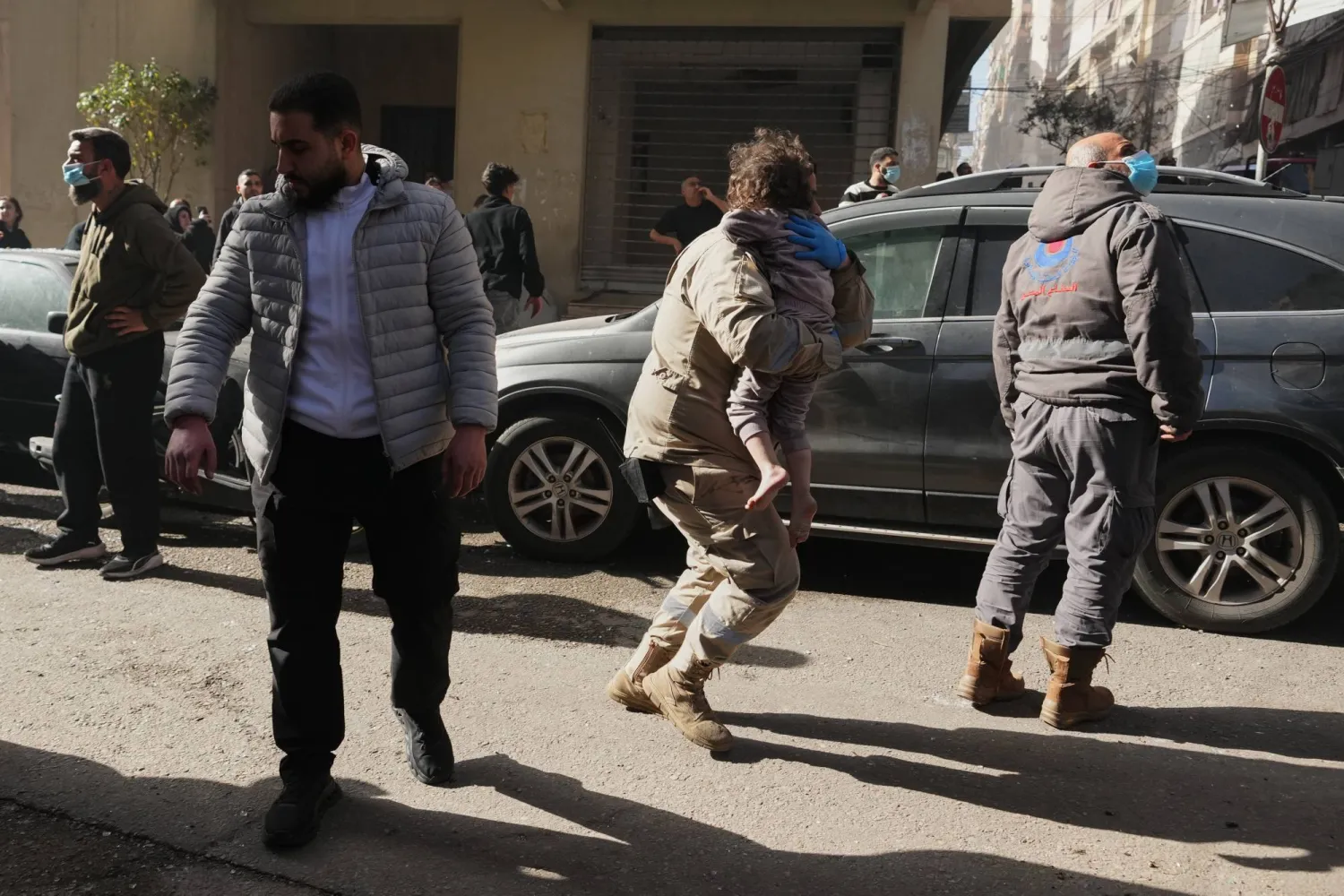
A rescue worker carries a child at the scene of an Israeli airstrike in central Beirut, Lebanon, Wednesday, March 18, 2026. (AP Photo/Hassan Ammar)
TT

Israel Tests Lebanon’s Internal Cohesion

A rescue worker carries a child at the scene of an Israeli airstrike in central Beirut, Lebanon, Wednesday, March 18, 2026. (AP Photo/Hassan Ammar)

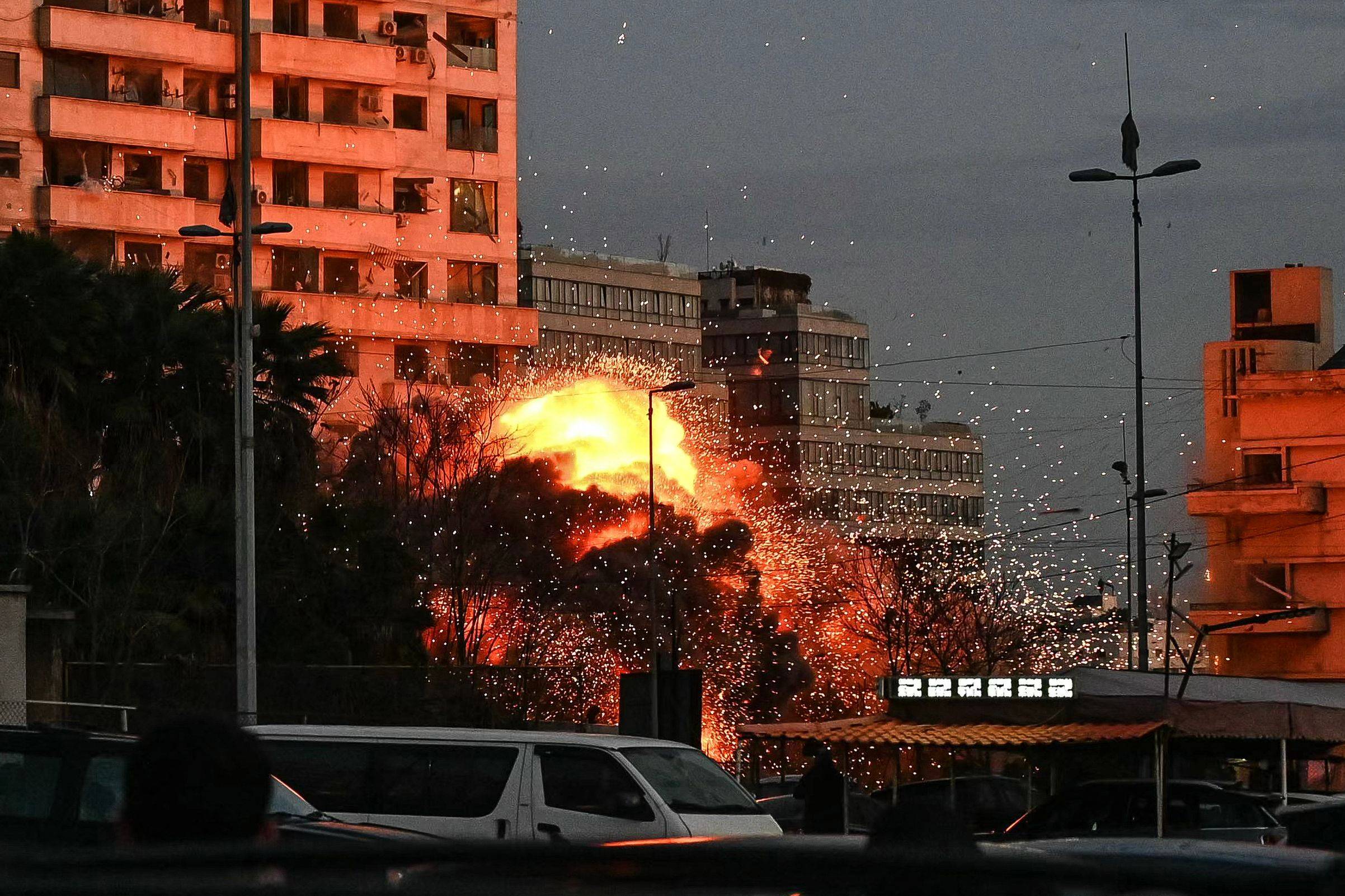
Israel has widened its campaign in Lebanon to include central Beirut, launching a series of pre-dawn airstrikes on Wednesday, followed hours later by a strike on a residential apartment in the Zoqaq al-Blat district.

The attacks mark a clear expansion of targets within the capital.

Lebanon’s Ministry of Public Health said strikes on the Basta and Zoqaq al-Blat neighborhoods killed 10 people and wounded 27 others. Four areas were hit, including Bashoura, Basta and Zoqaq al-Blat.

Several buildings that had been targeted in recent days were struck again, in what appears to be a deliberate escalation strategy aimed at repeatedly hitting the same sites until they are fully disabled.

The latest strikes signal the effective end of what had been known as the “Beirut exception,” with the capital directly drawn into the confrontation.

MP Mohammad Khawaja told Asharq Al-Awsat that Israel does not distinguish between areas within Lebanon.

“This strategy aims to create internal tensions, particularly in mixed areas, thereby increasing social pressure,” he stated.

He added that targeting civilians or civilian areas “has occurred in Beirut before, and may well be repeated.”

Khawaja said the attacks “directly target Lebanon’s social fabric by deepening divisions and creating tensions among the Lebanese,” adding that the most effective response is “to uphold national principles and strengthen internal unity.”


A fireball rises from the site of an Israeli airstrike that targeted a building in Beirut's Bashoura neighbourhood early on March 18, 2026. (Photo by FADEL itani / AFP)

For his part, MP Ibrahim Mneimneh said Israel is seeking to exert all-out pressure on Hezbollah, including by leveraging Lebanon’s internal situation as a tool of social pressure.

“Targeting Beirut is not limited to pursuing specific individuals,” he said. “It is also part of an attempt to create internal fractures and push Lebanese against one another, increasing pressure on Hezbollah’s support base.”

Beirut, he added, is bearing a double burden as a capital hosting displaced people while also facing mounting security pressure and direct targeting.

Mneimneh warned that Beirut is no longer exempt from escalation and that this pattern is likely to continue in the coming period. He stressed the need to control any elements that could be used as a pretext for further strikes, in order to protect civilians and reduce exposure to risk.

The deputy added that the confrontation appears open-ended, with both Israel and Hezbollah holding to their positions, placing Lebanon and its people among the primary victims.

Retired Brig. Gen. Bassam Yassin said Israeli strikes on Beirut “are not governed by geographic considerations or red lines.”

He described a policy of “open pressure,” with Israel striking “wherever it chooses, without distinction.”


Syria Unveils Plan to Eliminate Assad’s Chemical Weapons

Permanent Representative of Syria to the United Nations, Ibrahim Olabi (L), speaks during a Security Council meeting discussing Syria and the Middle East at United Nations headquarters in New York, New York, USA, 18 March 2026. (EPA)
TT

Syria Unveils Plan to Eliminate Assad’s Chemical Weapons

Permanent Representative of Syria to the United Nations, Ibrahim Olabi (L), speaks during a Security Council meeting discussing Syria and the Middle East at United Nations headquarters in New York, New York, USA, 18 March 2026. (EPA)

Syria on Wednesday launched a plan supported by Washington to rid the Middle Eastern country of legacy chemical weapons that were used against its people by forces under ousted leader Bashar al-Assad.

For decades, Assad ran a large-scale program for chemical weapons, the use of which killed and injured thousands during Syria's long-running civil war. Despite Damascus' signing onto the Chemical Weapons Convention in 2013 and declaring a 1,300-ton stockpile, prohibited use continued and the size of the program remains ‌unclear.

An international taskforce ‌backed by the United States, Germany, Britain, Canada and ‌France, ⁠among others, will ⁠track down all remaining elements of the program and destroy them under the supervision of the Organization for the Prohibition of Chemical Weapons, Syria's ambassador to the United Nations, Ibrahim Olabi, said in an interview.

As many as 100 sites in Syria need to be inspected to determine what toxic munitions remain and how they should be destroyed, OPCW experts have said. It will require a time-consuming and costly ⁠operation to prevent the proliferation of weapons of mass destruction ‌in a region fraught with conflict and ‌political turmoil.

The expanding US-Israeli war on Iran and broader regional security concerns will make the ‌timing of the mission uncertain, but all the more necessary to prevent ‌future use, officials said.

GOVERNMENT VOWS FULL ACCESS

Assad was overthrown in December 2024, and the new government under President Ahmed al-Sharaa has vowed to turn a page and eradicate banned chemical weapons and give inspectors full access.

The move shows that Syria has ‌shifted from a country that was once concealing chemical weapons use to one that is "leading the resolve" to do ⁠away with them, ⁠Olabi said.

Several international investigations concluded that the nerve agent sarin, as well as chlorine and sulfur mustard gas, was used by the Assad regime, but never revealed the full extent of the clandestine program.

"We don't know what's remaining. It was a secret program," Olabi said. "The job is on Syria to basically look for these things and then declare them."

A diplomatic source, who spoke on condition of anonymity to discuss the sensitive matter, said the 100 sites could be anything from military bases to laboratories or offices.

"It will probably take many months if not years to get it done, and of course the current situation in the Middle East doesn’t help the process to move forward to the actual destruction of any remnants of Assad‘s chemical weapons program," the source said.


Pro-Iran Iraqi Armed Group Says Will Stop US Embassy Attacks, Under Conditions

A fire burns outside the grounds of the US Embassy headquarters in Baghdad's fortified "Green Zone" on March 17, 2026 following a drone and rocket attack according to security officials. (AFP)
TT

Pro-Iran Iraqi Armed Group Says Will Stop US Embassy Attacks, Under Conditions

A fire burns outside the grounds of the US Embassy headquarters in Baghdad's fortified "Green Zone" on March 17, 2026 following a drone and rocket attack according to security officials. (AFP)

An influential pro-Iranian armed group in Iraq pledged early Thursday to stop attacking the US embassy for five days, subject to several conditions including that Israel stop strikes on parts of Beirut.

AFP reported no drone or rocket attacks so far on the US embassy in Iraq's capital Baghdad between Wednesday night and Thursday morning.

The country has been unwillingly drawn into the regional conflict triggered by the US-Israel attack on its neighbor Iran on February 28.

Strikes have targeted Iran-backed groups, which in turn have claimed near daily attacks on US interests in Iraq and across the region.

Kataib Hezbollah said the group's secretary-general had "issued orders to suspend operations targeting the US Embassy in Baghdad for a period of five days".

In a statement the Iran-backed group -- designated by Washington as a "terrorist organization" -- stipulated several conditions, including Israel "ceasing its bombardment" of southern Beirut suburbs, and "a commitment to refrain from bombing residential areas in Baghdad and other provinces".

Whenever "the enemy violates" the truce "the response will be immediate", it said, warning of an "escalation of strikes" after the five-day period.

The US embassy has been targeted by drone and rocket attacks several times in recent days, with air defenses intercepting most of the projectiles.

A US diplomatic and logistics center at Baghdad International Airport, which houses military personnel, has also been regularly targeted.

AFP journalists reported Wednesday morning at least four explosions in the city of Erbil, the capital of the Kurdistan region.

It was unclear what the target was and the projectiles were intercepted over the city, home to a major US consulate complex, while its airport houses US-led coalition troops.

And a strike near Iraq's western border with Syria on Wednesday killed three fighters from the Popular Mobilization Forces (PMF), the alliance said.

The fighters from the alliance -- now part of Iraq's regular armed forces -- were hit in a US or Israeli strike that targeted their main command center in Anbar province.

Pro-Iran factions also have brigades that operate within the alliance, but have a reputation for acting on their own.

- Gas stoppage -

The war has also battered Iraq's already fragile economy.

The country's gas imports from Iran were halted on Wednesday, authorities said, the cutoff coming as Baghdad barely had time to celebrate a deal to export a fraction of its oil production through Türkiye after disruptions to shipments through the Strait of Hormuz.

The electricity ministry's spokesperson Ahmed Moussa told the Iraqi News Agency (INA) that "due to regional developments, Iranian gas supplies to Iraq completely halted an hour ago," cutting about 3,100 megawatts of power, which will "certainly affect the grid".

He sought, however, to calm fears of more frequent blackouts, saying the ministry will instead use "alternative fuels and domestic gas reserves".

News of the gas stoppage came after Tehran denounced a US-Israeli strike on Iranian facilities exploiting the vast South Pars/North Dome gas field.

Despite its abundant oil and gas reserves, Iraq's power plants are highly dependent on gas imported from Iran, which supplies about a third of the country's needs.

Electricity shortages are already a frequent complaint in Iraq, which suffers from endemic corruption and dilapidated public infrastructure.

Most households rely on private generators to compensate for daily power cuts.

Early Wednesday, Iraq said it resumed oil exports from its fields in the northern province of Kirkuk in agreement with the autonomous Kurdistan Region, through which the pipeline to Türkiye’s port of Ceyhan runs.

But it will export 250,000 barrels per day, only a fraction of the 3.5 million before the war.

However, Iraq, whose crude sales make up 90 percent of its foreign revenue, had few options after Iran effectively shuttered the Strait of Hormuz, through which Iraq previously shipped most of its oil from the southern Basra fields.
