


Taiwan Condemns 'Evil Neighbor' China Over War Drills

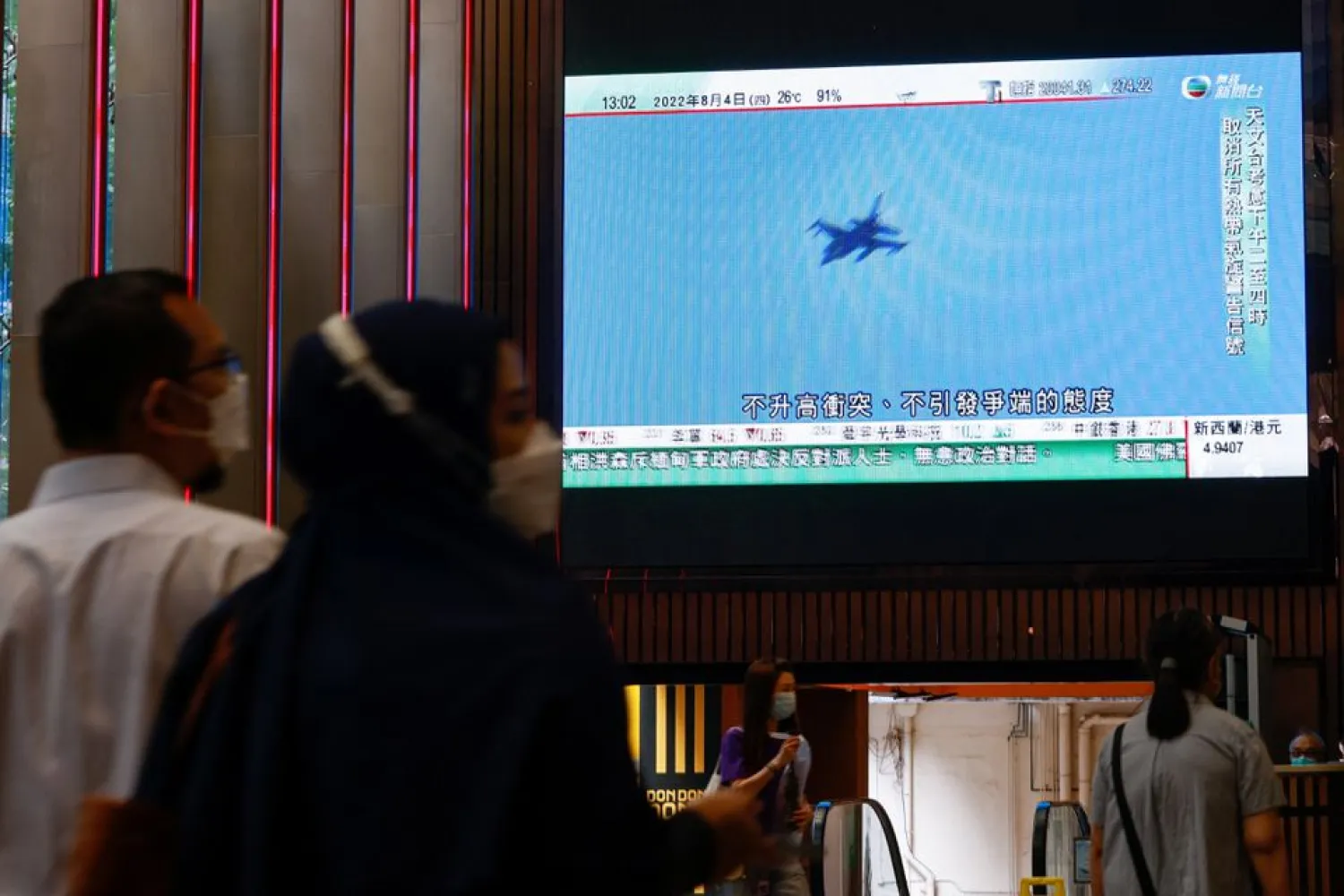
A TV screen shows that China's People's Liberation Army has begun military exercises including live firing on the waters and in the airspace surrounding the island of Taiwan, as reported by Chinese state television, in Hong Kong, China August 4, 2022. REUTERS/Tyrone Siu
TT

Taiwan Condemns 'Evil Neighbor' China Over War Drills

A TV screen shows that China's People's Liberation Army has begun military exercises including live firing on the waters and in the airspace surrounding the island of Taiwan, as reported by Chinese state television, in Hong Kong, China August 4, 2022. REUTERS/Tyrone Siu

Taiwan blasted its "evil neighbor next door" on Friday after China encircled the island with a series of huge military drills that were condemned by the United States and other Western allies.

During Thursday's military exercises, which continued Friday, China fired ballistic missiles and deployed both fighter jets and warships around Taiwan.

The People's Liberation Army declared multiple no-go danger zones around Taiwan, straddling some of the busiest shipping lanes in the world and at some points coming within 20 kilometers of the island's shores.

Beijing has said the exercises will continue until midday Sunday, and Taipei reported that Chinese fighter jets and ships crossed the "median line" that runs down the Taiwan Strait on Friday morning.

"As of 11am, multiple batches of Chinese warplanes and warships conducted exercises around the Taiwan Strait and crossed the median line of the strait," Taipei's defense ministry said in a statement.

The median line is an unofficial but once largely adhered-to border that runs down the middle of the Taiwan Strait, which separates Taiwan and China.

Chinese incursions have become more common since Beijing declared in 2020 that the unofficial border no longer existed.

Beijing has called its war games a "necessary" response to a visit to the self-ruled, democratic island by US House Speaker Nancy Pelosi, but Washington countered that China's leaders had "chosen to overreact".

Pelosi defended her visit Friday, saying Washington will "not allow" China to isolate Taiwan.

"We have said from the start that our representation here is not about changing the status quo here in Asia, changing the status quo in Taiwan," she told reporters in Tokyo on the final leg of an Asia tour.

Taiwan's premier Su Tseng-chang, meanwhile, called for allies to push for de-escalation.

"(We) didn't expect that the evil neighbor next door would show off its power at our door and arbitrarily jeopardize the busiest waterways in the world with its military exercises," he told reporters.

China's drills involved a "conventional missile firepower assault" in waters to the east of Taiwan, the Chinese military said.

The state-run Xinhua news agency said the Chinese army "flew more than 100 warplanes including fighters and bombers" during the exercises, as well as "over 10 destroyers and frigates".

State broadcaster CCTV reported that Chinese missiles had flown directly over Taiwan.

Japan also claimed that of the nine missiles it had detected, four were "believed to have flown over Taiwan's main island".

Taipei's military said it would not confirm missile flight paths, in a bid to protect its intelligence capabilities and not allow China "to intimidate us".

China's ruling Communist Party views Taiwan as part of its territory and has vowed to one day take it, by force if necessary.

But the scale and intensity of the drills have triggered outrage in the United States and other democracies.

"China has chosen to overreact and use the speaker's visit as a pretext to increase provocative military activity in and around the Taiwan Strait," John Kirby, a White House spokesman, told reporters.

"The temperature's pretty high," but tensions "can come down very easily by just having the Chinese stop these very aggressive military drills", he added.

Japan lodged a formal diplomatic complaint against Beijing, with five of the missiles believed to have landed in its exclusive economic zone.

Prime Minister Fumio Kishida called China's exercises a "serious problem that impacts our national security and the safety of our citizens" and called for an "immediate cancellation of the military drills".

But Chinese Foreign Minister Wang Yi said the "flagrant provocation" by the United States had set an "egregious precedent".

The maneuvers are taking place along some of the busiest shipping routes on the planet, used to supply vital semiconductors and electronic equipment produced in East Asian factory hubs to global markets.

Taiwan's Maritime and Port Bureau has warned ships to avoid the areas being used for the Chinese drills.

"The shutting down of these transport routes -- even temporarily -- has consequences not only for Taiwan, but also trade flows tied to Japan and South Korea," Nick Marro, the Economist Intelligence Unit's lead analyst for global trade, wrote in a note.

Taiwan said the drills would disrupt 18 international routes passing through its flight information region while several international airlines told AFP they would divert flights.

But markets in Taipei appeared to shrug off the tensions, with the Taiwan Taiex Shipping and Transportation Index, which tracks major shipping and airline stocks, up 2.3 percent early Friday.

And analysts broadly agree that despite all its aggressive posturing, Beijing does not want an active military conflict against the United States and its allies over Taiwan -- just yet.

"The last thing Xi wants is an accidental war ignited," Titus Chen, an associate professor of political science at the National Sun Yat-Sen University in Taiwan, told AFP.



Israeli Air Force Deploys First Laser Interception System

FILED - 26 March 2024, Israel, Jerusalem: Israel Katz attends a meeting at a hotel in Jerusalem. Photo: Christoph Soeder/dpa
TT

Israeli Air Force Deploys First Laser Interception System

FILED - 26 March 2024, Israel, Jerusalem: Israel Katz attends a meeting at a hotel in Jerusalem. Photo: Christoph Soeder/dpa

Israel's defense ministry said on Sunday it had deployed a new "Iron Beam" laser system for the air force to intercept aerial threats.

The laser system's main developers, the ministry's research and development department and defense contractor Rafael, delivered it to the air force at a ceremony in northern Israel.

"For the first time globally, a high-power laser interception system has achieved full operational maturity, successfully executing multiple interceptions," Defense Minister Israel Katz said at the ceremony, according to a statement.

"This monumental achievement... delivers a critical message to our enemies, near and far alike: do not challenge us, or face severe consequences," AFP quoted him as saying.

The handover marks a major milestone in a project more than a decade old.
"Israel has become the first country in the world to field an operational laser system for the interception of aerial threats, including rockets and missiles," said Yuval Steinitz, chairman of Rafael.

The laser system seeks to enhance and slash the cost of Israel's interception of projectiles, and will supplement other aerial defense capacities such as the more well-known Iron Dome.

Iron Dome offers short-range protection against missiles and rockets. The David's Sling system and successive generations of Arrow missiles are Israeli-American technology built to bring down ballistic missiles.

The defense ministry announced in early December that the laser system was complete, and would be deployed by the end of the month.

During the 12-day war launched by Israel against Iran in June, the country's missile defense system failed to intercept all the projectiles fired by Tehran toward Israeli territory.

Israel has since acknowledged being hit by more than 50 missiles during the war with Iran, resulting in 28 deaths.


Trump Says Had 'Productive' Call with Putin Ahead of Zelensky Meeting

US President Donald Trump takes part in a Christmas Eve dinner in the ballroom of his Mar-a-Lago club in Palm Beach, Florida, US, December 24, 2025. REUTERS/Jessica Koscielniak
TT

Trump Says Had 'Productive' Call with Putin Ahead of Zelensky Meeting

US President Donald Trump takes part in a Christmas Eve dinner in the ballroom of his Mar-a-Lago club in Palm Beach, Florida, US, December 24, 2025. REUTERS/Jessica Koscielniak

US President Donald Trump said he had a productive telephone call with his Russian counterpart Vladimir Putin on Sunday ahead of a planned meeting in Florida with Ukraine's leader Volodymyr Zelensky.

"I just had a very good and productive telephone call with President Putin of Russia" before the planned talks with Zelensky at Trump's Florida estate at 1:00 pm local time (1800 GMT), the US leader said on Truth Social.

Putin said Ukraine was in no hurry for peace and if it did not want to resolve their conflict peacefully, Moscow would accomplish all its goals by force.

Putin's remarks on Saturday, carried by state news agency TASS, followed a vast Russian drone and missile attack that prompted Zelensky to say Russia was demonstrating its wish to continue the war while Kyiv wanted peace.


Russia Sends 3 Iranian Satellites into Orbit, Report Says

In this photo released by Roscosmos space corporation on Thursday, Feb. 29, 2024, the Soyuz-2.1b rocket blasts off at the Vostochny cosmodrome outside the city of Tsiolkovsky, about 200 kilometers (125 miles) from the city of Blagoveshchensk in the far eastern Amur region, Russia. A Russian Soyuz rocket successfully put an Iranian satellite into orbit along with 18 Russian satellites on Thursday. (Roscosmos space corporation via AP)
TT

Russia Sends 3 Iranian Satellites into Orbit, Report Says

In this photo released by Roscosmos space corporation on Thursday, Feb. 29, 2024, the Soyuz-2.1b rocket blasts off at the Vostochny cosmodrome outside the city of Tsiolkovsky, about 200 kilometers (125 miles) from the city of Blagoveshchensk in the far eastern Amur region, Russia. A Russian Soyuz rocket successfully put an Iranian satellite into orbit along with 18 Russian satellites on Thursday. (Roscosmos space corporation via AP)

Russia on Sunday sent three Iranian communications satellites into orbit, the second such launch since July, Iranian state television reported.

The report said that a Russian rocket sent the satellites to circle the Earth on a 500-kilometer (310-mile) orbit from the Vostochny launchpad in eastern Russia. The three satellites are dubbed Paya, Kowsar and Zafar-2.

The report said that Paya, weighing 150 kilograms (330 pounds), is the heaviest satellite that Iran has ever deployed into orbit. Kowsar weighs 35 kilograms (77 pounds), but the report didn't specify how heavy Zafar-2 is.

The satellites feature up to 3-meter resolution images, applicable in the management of water resources, agriculture and the environment. Their life span is up to five years.

Russia occasionally sends Iran's satellites into orbit, highlighting the strong ties between the two countries. In July, a Russian rocket sent Iranian communications satellite Nahid-2 into orbit.

Russia, which signed a “strategic partnership” treaty with Iran in January, strongly condemned the Israeli and US strikes on Iran that came during a 12-day air war in June and killed nearly 1,100 Iranians, including military commanders and nuclear scientists. Retaliatory missile barrages by Iran killed 28 people in Israel.

As a long-standing project, Iran from time-to-time launches satellite carriers to send its satellites into space.

The United States has said that Iran’s satellite launches defy a UN Security Council resolution and called on Tehran to undertake no activity involving ballistic missiles capable of delivering nuclear weapons. UN sanctions related to Iran’s ballistic missile program expired in 2023.