
Rarely does the name of a city become so associated to the name of a man, like Dubai does to its Ruler, Sheikh Mohammed bin Rashid Al Maktoum, Vice President of the United Arab Emirates and its Prime Minister. It would not be exaggeration to say that the city of lights and towers holds the fingerprints of the man who was born in a house that lacked water and electricity. It is rare for him to sit for an interview, not because he boasts more than 9 million followers on Twitter, but because he prefers to leave the talking to Dubai itself that is teeming with tourists and investors.
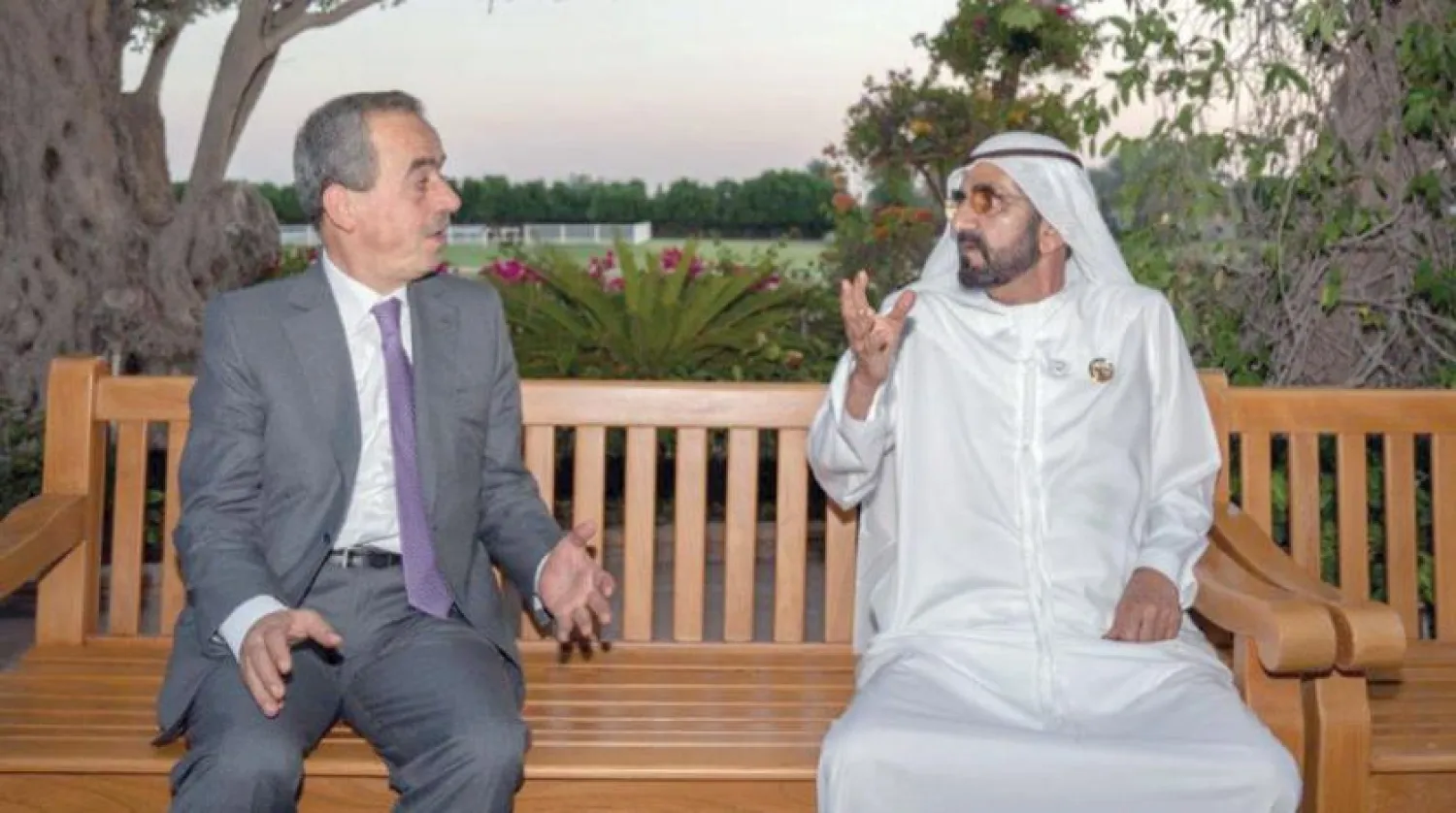
The driver took me to Sheikh Mohammed’s residence in the region of Al Marmoom outside of the city. I expected to see a spacious mansion, but I found myself dropped off in front of a modest residence that only had two bedrooms. The man loves the purity of the desert and he loves to stroll there. He is also keen on fighting it with agriculture, lakes and buildings. He says that he was inspired by two men, whom he learned a lot from: Sheikh Zayed bin Sultan Al Nahyan, the father of the UAE, and Sheikh Rashid Al Maktoum, Sheikh Mohammed’s father and mentor. Many do not know that the mother of the Ruler of Dubai hails from the Al Nahyan family and that he has always looked at Sheikh Zayed as the uncle and guide. This has led to a deep partnership with Sheikh Zayed’s sons.
Despite the storms that have lashed the region over the past four decades, Dubai clung to its dream and the challenges only made it more determined to achieve it. This was clear also when we asked Sheikh Mohammed about the possible repercussions of the re-imposed US sanctions against Iran. He implied that Dubai learned to make its way through turbulent waters, including global financial crises.
Sheikh Mohammed’s presence at the Riyadh-hosted Future Investment Initiative forum, held during the last week of October, was remarkable. He cut short a trip to Uzbekistan and made it a point to attend the forum because he sensed that some sides were seeking to exploit the murder of journalist Jamal Khashoggi to target Saudi Arabia and its stability. His position in this regard was unquestionable: “We refuse the targeting of Saudi Arabia and its stability is a vital necessity for the region and world.” “We stand by Saudi Arabia through thick and thin.” Given this stance, he took part in the forum and toured Riyadh. He mingled with the youth and met with them at department malls, restaurants or cafes.
A side story. In 2004 and after Libya disclosed of its nuclear program, Sheikh Mohammed received a telephone call from Moammar al-Gaddafi. The Libyan leader said: “I want Tripoli to become like Dubai. I want it to become the economic capital of Africa.” When the two men met in a tent in Sirte, Gaddafi told his guest: “I led a popular revolt and you led an economic one. I want an economic revolution to begin in Tripoli.”
Dubai indeed sent a team that conducted a study for Mitiga airport to become a new destination. Studies were made for schools, hospitals, a financial center and infrastructure projects. The Libyan regime, however, was not ready to welcome such a new experience. The fatal slowness in taking decisions and implementing them, the competition of committees and agencies and the seeds of corruption all prompted the Emirati team to quit Libya. The project that could have averted Libya its current fate was abandoned.
Sheikh Mohammed has faith in Arabs being able to overcome backwardness and join the scientific and technological revolution to compensate for their losses over the decades and centuries. He, as well as the people, often speak of competition, innovation and happiness. He is always concerned about those working for him. He always reminds them that no one remembers the name of the second man who walked on the moon. He always pushes them to aim for first place.
* Does the return of American-Iranian tensions affect foreign investment in the Gulf?
- Tensions in our region is nothing new. It is practically a constant that has existed for 40 years. Despite this, the cycle of construction and development has not stopped and neither have the investments.
There is no doubt that the tensions are a cause for concern and investors do take them into consideration. Their main concerns, however, are their investments. Tensions prompt investor concern, but they do not stop their work or their search for opportunities. There is no investment without risk. As they say: The greater the risk, the greater the rewards.
In our region, specifically the Gulf Cooperation Council, the incentives for foreign investment are growing, from Kuwait to Oman, passing through all Gulf countries. Moreover, investors know that effective investment is marked by sustainability and they are not simply swayed by moments of tension or a passing development.
* You took part last month in the Future Investment Initiative. You took a firm stance in solidarity with Saudi Arabia against the campaign that is targeting it after the murder of Saudi journalist Jamal Khashoggi. How do you assess the current transformation in Saudi Arabia according to Vision 2030?
- We always stand by Saudi Arabia, through thick and thin. Our bilateral ties are bolstered through the Saudi-Emirati Coordination Council. The council set a joint vision for a complimentary strategy between the two countries, on the economic, development and military levels, through 44 joint strategic projects. We look forward to building a complementary model that supports the GCC and joint Arab work.
I also look with optimism and hope at the massive development and modernization operation in the Kingdom. Vision 2030 demands our brothers to work around the clock to implement its projects and programs. They are capable of accomplishing it and they know that the goals of the plan are not a choice. They are necessary to confront current and future challenges. Saudi Arabia is a young society, more than half the population is under the age of 30. They need job opportunities. Above all, they need modern education and an environment that is open to change and modernity. Moreover, the developments and changes in the global economy demand the diversification of the economy and reducing dependence on natural resources. This is what Vision 2030 is preparing for.
* Do you share Crown Prince Mohammed bin Salman’s belief that the Middle East can become the new Europe if its countries adopted modernity and development, or do you think the Middle East will remain victim of its conflicts?
- Yes, and I do not see a relationship between conflicts and developments and modernization. I believe that conflicts offer further motivation to adopt modernization and development. Can you competently manage a crisis if you do not have the appropriate tools of the age? Can old circumstances, methods and ways of thinking produce anything else than the products that they had yielded before?
I will be honest with you, for over 20 years I have warned of the severity of the situation and the need for change and modernization, but some officials were shocked at the thought that problems in their countries could escalate. Indeed, they escalated until they reached a dead end. This culminated in the developments of the Arab Spring, that was falsely called so.
I am optimistic about the future. I always look as the glass as half full. I look forward to filling the empty part. As much as the “Arab Fall” was costly, its lessons were valuable. I believe that the majority of the leaderships in the Arab world have learned these lessons, which are that the winds of reforms, change and modernization are blowing through the majority of our Arab world. They hold a promise of a real spring.
* The Crown Prince said at the Future Investment Initiative that you lifted the bar high during the 1990s and many followed you. What is the bar that you raised and how did you do it?
- I did not think of raising the bar. I only sought to fulfill my duties as required of me. I was lucky to have been born and raised in the Sheikh Rashid school that set the foundation for the rise of Dubai. I worked with Sheikh Zayed, the founder of our union. I accompanied both Sheikhs from the very beginning when they laid the foundation of the union on February 18, 1968. I was there when they agreed to form a union between the emirates of Abu Dhabi and Dubai and called on other emirates to join them. I was there at the declaration of the United Arab Emirates on December 2, 1971. I have been involved since then in building our united state and building Dubai.
In the mid-1990s, my brother Sheikh Maktoum appointed me as Crown Prince. He gave me a great responsibility. I was aware of the reality in our country, region and Arab world. I saw that the gap was huge between this reality and the advanced world. It was clear to me and others that the Arab and Islamic worlds were incapable of handling the challenge of human civilization and its center in the western civilization.
Unfortunately, the prevalent mentality in the past centuries and the last one only saw human advancement as a threat to family and social bonds and a way towards moral degradation. They believed that Muslims will eventually inherit the earth. Such a mentality not only widened the gap with the advanced world, but also created backwardness that sought to search for the solutions of the present in the world of the past that is long gone.
In the UAE and Dubai, we have to boldly develop our reality from within and with all of its components. We had to change and modernize its ways of thinking and working. We had to build mechanisms that can meet the challenge of advancement in economy, culture and technology. We achieved accomplishments that we are proud of and recorded great successes. We have set in place the foundations for sustainability and we still have a lot of work ahead of us. Life does not stop and human advancement knows no boundaries.
* The region, UAE and Dubai witnessed several crises over the past two decades, including the Gulf war, Iranian-Iraqi war, September 11, US invasion of Iraq, the global financial crisis and “Arab Spring” revolts and their fallout. How do you assess the impact of these crises on the region and how can we benefit from them?
- Crises are in fact challenges that often carry risks and opportunities. If they surprise you, then you are vulnerable to dangers. If you are prepared for them, then you have the chance to seize opportunities. We believe that prevention is the best solution. We make sure to protect our country and people from the dangers of crises. We are also prepared to tackle their impact if need be.
In the Arab world, we say that the greater the crisis, the sooner it will be resolved. We hope that the crises have reached their peak. We hope that solutions are on the horizon. Arab countries and societies have seen enough and paid enough heavy prices. The losses of lives, funds and property have been devastating. Many years have been wasted. No one has any excuse not to learn from these lessons.
* Dubai has worked on diversifying sources of income, but the impact of global economic changes is still felt on the sectors in Dubai. How can the effect of these changes be eased on Dubai and the UAE’s economy?
- Your question assumes that current global economic changes have had a major impact on Dubai. Yes, Dubai is affected by global economic changes because it has an open economy. Specialized international reports said that it is the most open after Luxembourg and Hong Kong. The assessment of this impact differs from one person to the other, whether this person is an expert or a social media user.
I see the impact as part of the vision of the future and expertise derived from constant facts. Economy moves in rising and falling cycles. The Dubai and UAE economy has not witnessed negative growth in six years. It has recorded positive growth that has always been higher than global rates.
At any rate, our plan for 2021 is being implemented according to specific timeframes. With the help of God and our youth, they are likely to be achieved in time.
* Dubai relies on global trade, but challenges have emerged with the arrival of Donald Trump to power and through his protectionist policies that put restrictions on globalization. How can this model go forward to ensure the sustainability of global trade?
- The UAE and Dubai were not affected by American protectionism. The measures do, however, pose major challenges to the global trade system and the globalization. The irony is that the US was a main player in pushing for globalization. It is now seeking to introduce radical changes to the rules of international trade.
The US is a major player in global trade, but it is not the only one. Other important, influential and rising players are present. For us in the UAE, we enjoy a wide trade network that will allow it to overcome any possible repercussions of the US measures. Our main partners are the European Union, at 22 percent of our trade worth 1.612 trillion dirhams, Arab countries at 17 percent, India at 11.5 percent, China at 10 percent and Japan at 6.5 percent. Our trade with the US in 2017 reached 5.5 percent and was comprised of consumer goods and electronics.
* Dubai is preparing for a major event in two years, Expo 2020. What added value will the expo provide Dubai and what added value will Dubai offer the expo?
- Everyone knows the importance of the Expo. Its importance and fame have been growing ever since it was first held 167 years ago. A competition was held to host it and our victory embodies the prestigious standing our country enjoys in the world. I believe that Expo 2020 will further advance the standing of our country and region. This is the first time that the expo is being held in a region that includes the Middle East, Africa and western Asia.
The UAE, Dubai specifically, has a global reputation in hosting conferences and exhibits. The Expo will be a crowning achievement for this reputation.
* More than a year after the appointment of a Minister for Happiness and Minister for Artificial Intelligence, as well as Ministers of Youth, Food Safety and Advanced Sciences, have these portfolios yielded their desired results?
- Yes, and they have exceeded our expectations. We chose the youth to occupy these posts because they are competent and enjoy vitality and ambition. The future, after all, belongs to the youth.
We have learned from our own experience and the experience of others, that if you do not turn to the future, then you will always be surprised with it. It will trap you in a cycle of reactions and you will remain as a follower.
* You seek to spread the idea of happiness that is linked to a highly capable government. What are the links between happiness and a good government?
- Happiness is the loftiest goal that every human and society aim to meet. It should be the goal of every government. Achieving the happiness of Emirati society and its people and guests is the purpose of our vision, strategies and plans. If you ask ten people about the meaning of happiness, you will get ten different answers. I summarize the meaning of real happiness that is linked to a capable government to one word: Satisfaction. Satisfaction of government clients and the smoothness of procedures and ease in which they are completed. Satisfaction of employees with their work and their employment.
Satisfaction is achieved through collective work, the competency of the manager and success in building a work environment that motivates workers to improve and encourages initiatives. It opens the door for promotion for the innovative and hardworking employee. This is what we are keen on in our ministries and government circles.
* Dubai is forging ahead in building a new tower that rival Burj Khalifa in height. You are striving for a new record. Can the new tower steal the spotlight from Burj Khalifa?
- We are seeking to construct landmarks that set Dubai and the UAE apart. They could be towers, museums, libraries, opera houses, gardens, hotels or cultural events. These landmarks breathe with life. As for records, I am keen on recording them in the books of development, especially human development. The UAE is the greatest donor compared to GDP. It also boasts one of the highest number of female lawmakers and ministers in the world. The UAE’s economic performance jumped from 12th to fifth place in 2016. I can list more indicators for you where the UAE outranks other countries.
* What makes Dubai the first choice for global companies in wake of the competition with other Gulf states?
- First of all, we welcome competition because it motivates us to develop and refine our work. Dubai is among the world’s top financial centers. We harbor no ill will to those who follow our lead and copy our projects. We wish them luck as we believe the success of any brother as our own. Their success also strengthens us. I mean what I say because when someone fails, they may be pushed to take unprofessional choices that may impact everyone.
As for what makes Dubai the first choice for global companies, you can ask them and they will tell you that it is the quality of life in Dubai, the independence of its authority and the competencies of its workforce.
* If you were asked to summarize in a few words what has allowed Dubai to transform into an unrivaled site of constant developments and center for investment and tourists?
- Dubai’s success is the success of the UAE. We are one loving family in the UAE. The Emiratis are proud of their heritage and values of giving, loving the other, openness and tolerance. Our ties with our citizens are open and we meet them every day. We share their joys and they are the heart of the mission of development.
As for Dubai’s transformation, it has reached the entire UAE. The secret of its success is that it was based on a future vision that remains abreast the changes and developments of the advanced world. The plans and projects were led by the government and the people and residents of Dubai and the UAE took part in fulfilling them.
* Do you fear the day when Dubai could lose its luster due to regional tensions or competition?
- I suggest that you read the history of Dubai and the UAE to see that this luster is the product of an accumulation of generations of Dubai residents. Perhaps you do not realize that the roots of Dubai’s economic growth date back to over 110 years. Its free trade began when Sheikh Maktoum bin Hashr Al Maktoum, the Ruler of Dubai, ordered the elimination of customs fees. Over the years, Dubai became one of the most important trade centers in the region and the only stop for shipping vessels between Europe and India.
Our ancestors overcame major challenges, ever since the Portuguese came with their ships and cannons some 500 years ago. They were followed by the Dutch and the English. The challenges were many, but our ancestors overcame them.
As for competition, we are more than up for it. We do not compete on the local or regional levels, but the global one. We believe that without competition, then routine will take root, which will lead to complacency. This is a recipe for backwardness.
Dubai is also part of the UAE. Its luster adds to the luster of the UAE that boasts its achievements and is unique in its composition. We in the UAE are a united house that is built on solid foundations. If one of us falls ill, then it will be felt throughout the body.
* What is the new dream of the Ruler of Dubai?
- I look forwards to bolstering the rise in the UAE so that it can achieve the goals of its centennial. I look forward to seeing a “Dubai-20” in our Arab world and for the Arabs to enjoy what the Emiratis enjoy in terms of security, stability and prosperity.
I look forward to seeing the performance of Arab countries to rival and outshine our own. I look forward to them investing in their youth and rising generations and for them to invest more in education and scientific research. I have a dream where the Arab world could live in its age and for it to take part in building its civilization.
* How do you feel when you visit Arab capitals and see that they are still trapped in the past and unable to withstand the age of modernity and technology?
- I see that a lot of efforts are being exerted in most Arab countries for change and shedding the chains of backwardness. I see a growing realization that the solutions for problems and confronting challenges lie in the present and future. I see an interest in developing government work and services and reforming education. These efforts vary from one country to another, but regardless, they must continue. Whoever does not make it in the mission towards modernization is failing his people and himself.
* What do want from your recent Arab initiative? Do you see a point to it in this Arab world that is rife with problems and major crises?
- The greatest wealth we have in the UAE is our values, principles and morals. We are working while harboring goodwill towards others. Our commitment to Arabs is part of our Emirati identity. It was embodied by Sheikh Zayed and his stances, which is what we adhere to.
Yes, many countries of the Arab world have problems and crises and this is sufficient reason for us to be giving and help find ways to overcome them. Even if you were to look at it from an opportunistic perspective, each Arab country has a direct interest in seeing another enjoy security, stability and prosperity. This fact cannot be altered by temporary disputes.
The Emirati initiative in the Arab world have never ceased. They have always sought the interests of the people and stability and development of countries. My initiative focuses on the Arab youth and rising generations because they are the hope and future. I seek to empower them on the scientific, cultural and educational levels and encourage them to read in Arabic. I seek to motivate them to innovate and come up with new modern technologies. I am certain that the youths, whose ancestors built the greatest civilizations, are capable of changing the reality and reviving the Arab civilization. There are many examples throughout the world. China has resumed its civilization after a long halt. Japan has done so and Europe did so before that.
We need to give our youths and coming generations the chance. We need to open the widest of doors for them. We need to first arm them with knowledge and provide them with an environment that encourages them to think and search. We must encourage them to take the initiative, to innovate and to create. We must instill in them the values of tolerance, dialogue, accepting the other and respecting their culture.
* You seem optimistic over the future of the Arab world despite the fragmentation of some of its countries and political and economic crises in others. Are you optimistic? If yes, what is the secret of this optimism?
- I return to the glass half full. Some will only see the empty half, either because they are weak-sighted or for some other reason. Some will see the full part and think of how to fill the empty one. I am one of those. I see the full part as Arab countries that wield influence and enjoy stability, security and prosperity. They are helping fill the empty part. I see countries that have been visited by the “Arab Fall” rising and erasing the traces of the chaos and succeeding in confronting terrorism and walking strongly on the path of development.
On the general Arab scene, the “fall” led to inadvertent positive results, most important of which is resolving the discrepancy over such concepts like legitimacy, the national state and reform. Can anyone argue against the importance of the national state and the need to preserve its strength and efficiency of its institutions? Legitimacy, meanwhile, is the basis for security, stability and improving quality of life. Reform cannot be achieved in the absence of the capable national state. These are very important results and they need massive efforts in order to cement firm principles and deep values in the cultures and norms of certain societies. These efforts include serious work towards achieving development, reforming education and government work, combating corruption, focusing on and prioritizing youth.
* How do you want the history books to portray you? Do you want the image of a renaissance man? And what about your obvious passion for poetry?
- That is up to the historians. As for poetry, it is a friend that never leaves my side. In poetry, you find the epitome of knowledge and wisdom. Our language is manifested in it in the most beautiful of forms. It is an important partner in preserving heritage, writing down history and immortalizing prodigies.
In short, my poetry is my hobby and balcony from where I look onto my nation, people and the world.
* Can you tell us about the most difficult moment you faced in your career?
- I see difficulties as challenges. The moment a person is born, he is accompanied with challenges in all aspects of his life. The worth of a man lies in being able to rise to the occasion and confronting them. His reward lies in overcoming them and he sets himself apart by seizing the opportunities that come with them.
* Fear is a normal feeling. What scares you?
- I believe in what God has destined for me. Nothing will happen to us that has not been written by God… no, nothing scares me.
* Who is your favorite poet?
- Al-Mutanabbi is the greatest Arab poet of all. He is the master of the language and excelled at poetry. He was able to delve deep into the philosophy of life and the human spirit. As for his life story, his travels, aspirations and death, they are all close to a Greek odyssey. Dozens of his poems are still relevant to this day. I have memorized many of them.
* Do you have time for reading books? If you had the time, what topics would you like to read about?
- If you are good at managing your time, then you will find plenty of time for relaxation, reading, sports and hobbies. I read about many topics. I am interested in ancient and modern history, biographies of leaders and figures who made a difference in their societies or the world. My library also houses new releases on political, scientific and economic affairs.