

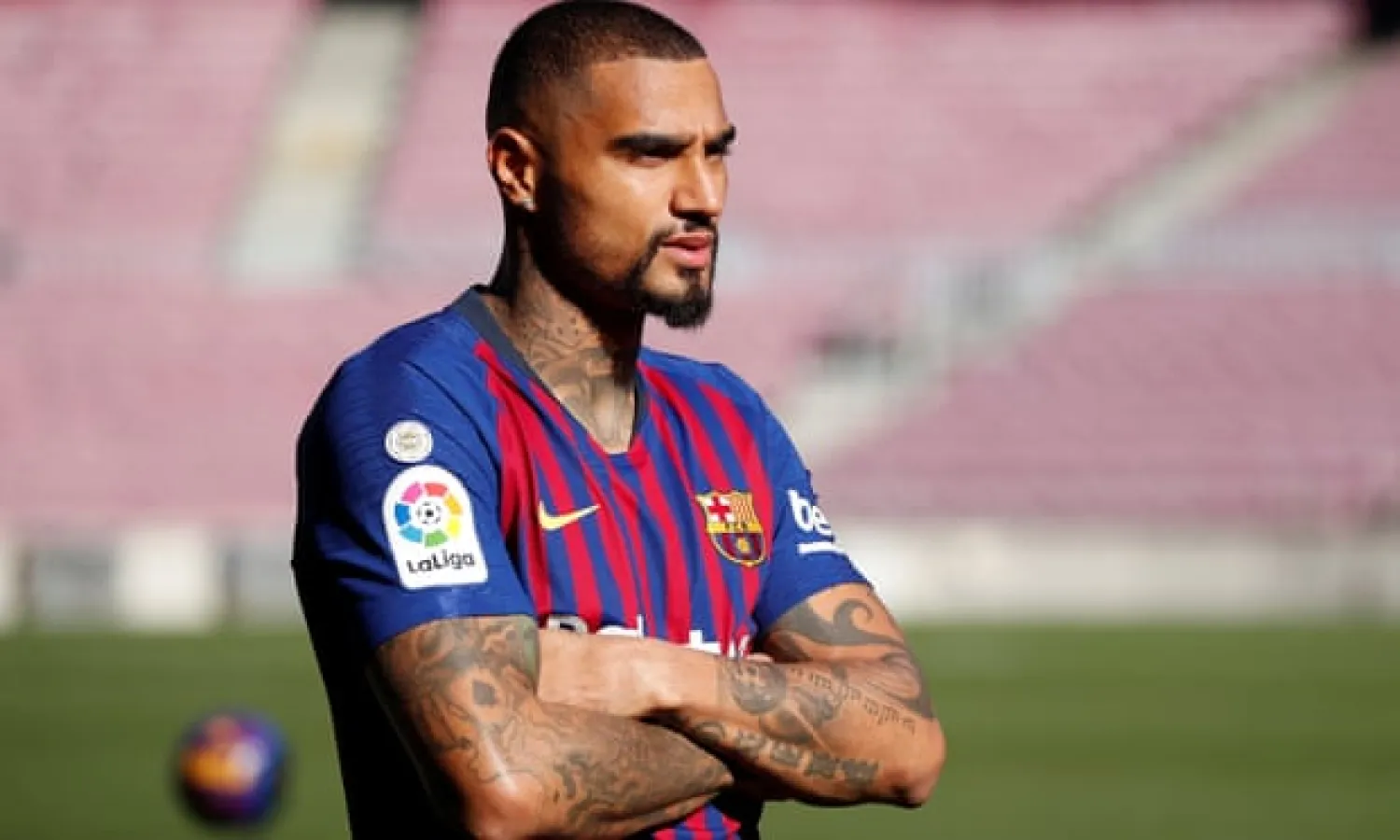

How Did Barcelona End up Signing Kevin-Prince Boateng?

 Kevin-Prince Boateng is Barcelona’s short-term solution to a specific problem up front. Photograph: Albert Gea/Reuters
Kevin-Prince Boateng is Barcelona’s short-term solution to a specific problem up front. Photograph: Albert Gea/Reuters
TT

How Did Barcelona End up Signing Kevin-Prince Boateng?

 Kevin-Prince Boateng is Barcelona’s short-term solution to a specific problem up front. Photograph: Albert Gea/Reuters
Kevin-Prince Boateng is Barcelona’s short-term solution to a specific problem up front. Photograph: Albert Gea/Reuters

Barcelona’s latest signing is football royalty, just not the way they expected. Late on Monday night, in the club store just across the concourse from the Camp Nou, closed to the public, he stood smiling and holding up his new shirt: “Prince, 19”. From Hertha to Tottenham, from Dortmund to Portsmouth and, five clubs and nine years later, from Sassuolo to Barcelona, Kevin-Prince Boateng’s 10th club is the biggest of them all. It was also the biggest surprise; their new centre-forward comes from leftfield, unforeseen by anyone.

Boateng described this as a huge “opportunity”. It is one he did not expect, echoes of the day that his agent told him he was going to Milan and Boateng thought he was joking. Some in Spain reacted similarly when the news broke with the deal already done. Boateng joins on loan, with an €8m optional purchase clause in the summer. The headlines in the Catalan papers came with exclamation marks. Boateng, the “hidden option”, “the surprise”, ran the front pages.

Barcelona had been searching for a back-up striker, someone to take some of the pressure, and the minutes, off Luis Suárez. The criteria was clear and it limited their options: they wanted a player with experience and the personality to contribute from the start, but prepared to be substitute. Someone cheap too, although the cumulative effects of hurried deals costs. And someone who could leave as easily, and fuss-free as he arrived. A short-term solution to a specific problem, which could have been foreseen in the summer. Perhaps it should have been. What they didn’t foresee then was Antoine Griezmann opting to stay at Atlético.

Last year’s Champions League defeat in Rome weighs on their minds, their great regret at the end of a season in which the won a domestic double which felt almost eclipsed by European failure. Suárez later admitted that he wished he had rotated more before that night and Barcelona have made no secret of the fact that they are desperate to win the Champions League. They felt they needed numbers, but also personality. When Munir El Haddadi departed, it underlined that they felt he was not the support striker they sought and so they turned to the market.

Álvaro Morata had been offered but the cost was high and they remained unsure about his mid- to long-term fit. Cristhian Stuani seemed a perfect solution but his buy-out clause is €15m. The idea of bringing Carlos Vela back from the United States was discussed. Sights were being lowered, it seemed. In the end, it was Boateng who arrived from Sassuolo. His last club in Spain was Las Palmas. Just the names of those two clubs raise questions and naturally there are some doubts about his level, even if there is a willingness to wait, an awareness that this is about resolving a specific, smaller issue.

Boateng comes as a centre-forward and he has played up front, although he is not a natural No 9. His arrival, while it makes some sense, hints at a certain improvisation, an uncertainty, in Barcelona’s planning. It also underlines some of the pressures placed upon that planning. This market is not one Barcelona and Madrid can dominate any more, and the Catalan club had to confront some of the consequences of their spending. Over the summer, Barcelona’s expenditure on salaries came down by €28m – because it had to. 70% of their budget went on salaries last season; it is down to 66%, but that remains high and there is still a need to cut costs.

A clear model can sometimes appear difficult to discern, and the departure of Neymar deepened that sensation, increasing the pressure on the board. Barcelona had expressed their certainty that he would stay but he did not. “If we said we had spent €270m on two players we would have to resign for [being] irresponsible,” said Albert Soler, the club’s director of sport. In total, they spent more than that on Ousmane Dembélé and on Philippe Coutinho, who they did not succeed in signing that summer. Face was lost. In the autumn, Soler departed.

There have been other changes in the structure of the sporting directorate. Robert Fernández has departed. Before him, there was Andoni Zubizarreta. Raul Sanllehi left just before Soler. The sporting manager is Pep Segura, Eric Abidal is the technical secretary, and Ramon Planes his assistant. Planes is considered the most capable, but does not carry great authority. There’s the president Josep Maria Bartomeu and his direct advisors too. Ernesto Valverde is the coach, not the manager, and his own future is far from secure. Ariedo Braida is reported to have been the key man in bringing in Boateng. He has long felt unheard at Barcelona, lost amidst may voices.

Robert Fernández signed Artur, one of the few players seen as a “Barcelona” style player, and at a time when fewer footballers are making it from the youth system. The signing of Paulinho surprised and didn’t exactly delight purists, seemingly a total rupture with the club’s identity, but he was successful – and then immediately returned to China. Arturo Vidal surprised too, although his signing was justified as being a player in the Paulinho mould. He is not really, just as Coutinho has not proven to be quite the “Iniesta” he was proclaimed to be.

After a difficult start, Dembélé is impressing greatly. Malcom was taken off Roma at the last minute, Barcelona leaping in on Monchi’s deal. The manager, though, did not really want him and a departure in this window is a possibility. And other pursuits are ongoing, from Adrien Rabiot to Frenkie De Jong. But it would be fair to suggest that some fans are lacking faith that they will be completed. Rodri, perhaps the most natural replacement for Sergio Busquets, joined Atlético. And Griezmann of course stayed there, when Barcelona were convinced they were getting him.

The Frenchman was a market opportunity: he might not have been a natural fit in the Barcelona first XI, but he was a player of the very highest level available for just €100m (£88.1m). Barcelona chased and thought they had closed a deal. They brief that it was done. But Griezmann announced that he was not going to Barcelona after all on a TV documentary, produced by the Barcelona defender Gerard Piqué. The president didn’t know and Barcelona didn’t have their striker. They do now.

The Guardian Sport



Tottenham Hotspur Sack Head Coach Thomas Frank

(FILES) Tottenham Hotspur's Danish head coach Thomas Frank gestures on the touchline during the English Premier League football match between Burnley and Tottenham Hotspur at Turf Moor in Burnley, north-west England on January 24, 2026. (Photo by Oli SCARFF / AFP)/
TT

Tottenham Hotspur Sack Head Coach Thomas Frank

(FILES) Tottenham Hotspur's Danish head coach Thomas Frank gestures on the touchline during the English Premier League football match between Burnley and Tottenham Hotspur at Turf Moor in Burnley, north-west England on January 24, 2026. (Photo by Oli SCARFF / AFP)/

Thomas Frank was fired by Tottenham on Wednesday after only eight months in charge and with his team just five points above the relegation zone in the Premier League.

Despite leading Spurs to the round of 16 in the Champions League, Frank has overseen a desperate domestic campaign. A 2-1 loss to Newcastle on Tuesday means Spurs are still to win in the league in 2026.

“The Club has taken the decision to make a change in the Men’s Head Coach position and Thomas Frank will leave today,” Tottenham said in a statement. “Thomas was appointed in June 2025, and we have been determined to give him the time and support needed to build for the future together.

“However, results and performances have led the Board to conclude that a change at this point in the season is necessary.”

Frank’s exit means Spurs are on the lookout for a sixth head coach in less than seven years since Mauricio Pochettino departed in 2019.


Marseille Coach De Zerbi Leaves After Humiliating 5-0 Loss to PSG 

Marseille's Italian coach Roberto De Zerbi looks on from the technical area during the French Cup round of 32 football match between FC Bayeux and Olympique de Marseille (OM) at the Michel-d'Ornano Stadium in Caen on January 13, 2026. (AFP) 
TT

Marseille Coach De Zerbi Leaves After Humiliating 5-0 Loss to PSG 

Marseille's Italian coach Roberto De Zerbi looks on from the technical area during the French Cup round of 32 football match between FC Bayeux and Olympique de Marseille (OM) at the Michel-d'Ornano Stadium in Caen on January 13, 2026. (AFP) 

Marseille coach Roberto De Zerbi is leaving the French league club in the wake of a 5-0 thrashing at the hands of PSG in French soccer biggest game.

The nine-time French champions said on Wednesday that they have ended “their collaboration by mutual agreement.”

The heavy loss Sunday at the Parc des Princes restored defending champion PSG’s two-point lead over Lens after 21 rounds, with Marseille in fourth place after the humiliating defeat.

De Zerbi's exit followed another embarrassing 3-0 loss at Club Brugge two weeks ago that resulted in Marseille exiting the Champions League.

De Zerbi, who had apologized to Marseille fans after the loss against bitter rival PSG, joined Marseille in 2024 after two seasons in charge at Brighton. After tightening things up tactically in Marseille during his first season, his recent choices had left many observers puzzled.

“Following consultations involving all stakeholders in the club’s leadership — the owner, president, director of football and head coach — it was decided to opt for a change at the head of the first team,” Marseille said. “This was a collective and difficult decision, taken after thorough consideration, in the best interests of the club and in order to address the sporting challenges of the end of the season.”

De Zerbi led Marseille to a second-place finish last season. Marseille did not immediately announce a replacement for De Zerbi ahead of Saturday's league match against Strasbourg.

Since American owner Frank McCourt bought Marseille in 2016, the former powerhouse of French soccer has failed to find any form of stability, with a succession of coaches and crises that sometimes turned violent.

Marseille dominated domestic soccer in the late 1980s and early 1990s. It was the only French team to win the Champions League before PSG claimed the trophy last year. It hasn’t won its own league title since 2010.


Olympic Fans Hunt for Plushies of Mascots Milo and Tina as They Fly off Shelves 

Fans take selfies with the Olympic mascot Tina at the finish area of an alpine ski, slalom portion of a women's team combined race, at the 2026 Winter Olympics, in Cortina d'Ampezzo, Italy, Tuesday, Feb. 10, 2026. (AP)
TT

Olympic Fans Hunt for Plushies of Mascots Milo and Tina as They Fly off Shelves 

Fans take selfies with the Olympic mascot Tina at the finish area of an alpine ski, slalom portion of a women's team combined race, at the 2026 Winter Olympics, in Cortina d'Ampezzo, Italy, Tuesday, Feb. 10, 2026. (AP)

For fans of the Milan Cortina Olympic mascots, the eponymous Milo and Tina, it's been nearly impossible to find a plush toy of the stoat siblings in Milan and Cortina d’Ampezzo.

Many of the official Olympics stores in the host cities are already sold out, less than a week into the Winter Games.

“I think the only way to get them is to actually win a medal,” Julia Peeler joked Tuesday in central Milan, where Tina and Milo characters posed for photos with fans.

The 38-year-old from South Carolina is on the hunt for the plushies for her niece. She's already bought some mascot pins, but she won't wear them on her lanyard. Peeler wants to avoid anyone trying to swap for them in a pin trade, a popular Olympic pastime.

Tina, short for Cortina, is the lighter-colored stoat and represents the Olympic Winter Games. Her younger brother Milo, short for Milano, is the face of the Paralympic Winter Games.

Milo was born without one paw but learned to use his tail and turn his difference into a strength, according to the Olympics website. A stoat is a small mustelid, like a weasel or an otter.

The animals adorn merchandise ranging from coffee mugs to T-shirts, but the plush toys are the most popular.

They're priced from 18 to 58 euros (about $21 to $69) and many of the major official stores in Milan, including the largest one at the iconic Duomo Cathedral, and Cortina have been cleaned out. They appeared to be sold out online Tuesday night.

Winning athletes are gifted the plush toys when they receive their gold, silver and bronze medals atop the podium.

Broadcast system engineer Jennifer Suarez got lucky Tuesday at the media center in Milan. She's been collecting mascot toys since the 2010 Vancouver Games and has been asking shops when they would restock.

“We were lucky we were just in time,” she said, clutching a tiny Tina. “They are gone right now.”

Friends Michelle Chen and Brenda Zhang were among the dozens of fans Tuesday who took photos with the characters at the fan zone in central Milan.

“They’re just so lovable and they’re always super excited at the Games, they are cheering on the crowd,” Chen, 29, said after they snapped their shots. “We just are so excited to meet them.”

The San Franciscan women are in Milan for the Olympics and their friend who is “obsessed” with the stoats asked for a plush Tina as a gift.

“They’re just so cute, and stoats are such a unique animal to be the Olympic mascot,” Zhang, 28, said.

Annie-Laurie Atkins, Peeler's friend, loves that Milo is the mascot for Paralympians.

“The Paralympics are really special to me,” she said Tuesday. “I have a lot of friends that are disabled and so having a character that also represents that is just incredible.”