
It Really Is Lionel’s World Now: Messi Has Remade Football in His Own Image

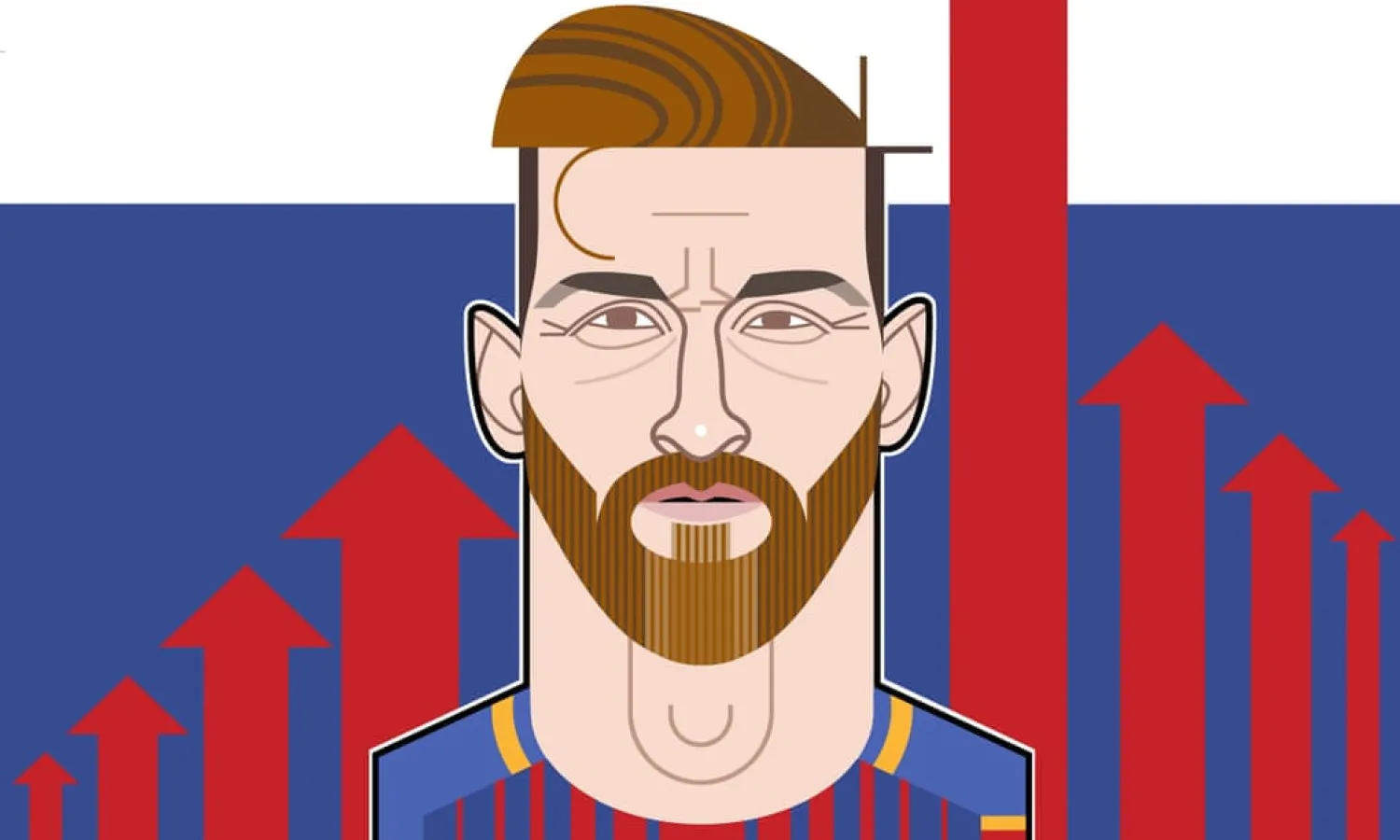
 Lionel Messi: has any other person had such a vast impact on a major sport? Illustration: David Lyttleton
Lionel Messi: has any other person had such a vast impact on a major sport? Illustration: David Lyttleton
TT

It Really Is Lionel’s World Now: Messi Has Remade Football in His Own Image

 Lionel Messi: has any other person had such a vast impact on a major sport? Illustration: David Lyttleton
Lionel Messi: has any other person had such a vast impact on a major sport? Illustration: David Lyttleton

There was some consolation this week for anyone feeling a little maxed-out by the relentless individual brilliance of Lionel Messi. We have at least found something he isn’t good at on a football pitch. It turns out Messi isn’t very good at punching Fabinho in the head.

Frankly, he’s terrible at it. The TV replays showed Messi doing something along these lines at the Camp Nou just before that mind-bending free-kick goal. Fabinho looked stunned at the time, but perhaps he was just shocked by the nature of the blow, a slappy, wristy thing executed with laughably poor technique, no follow through, no turn of the hips to engage the larger muscles, the kind of punch a cornered Jacob Rees-Mogg might throw fighting his way through an angry mob of undersized gingerbread men.

Other than that, well, it was more of the same from Messi against Liverpool. Unclosing like a hand, he gives forever. I make no apology for writing about him again here. Firstly, because Messi’s talent is endlessly divisible. You never get to the bottom of it. It is always surprising.

And secondly because it feels like something else is happening right now, too. After the Liverpool game Jürgen Klopp looked haggard, cap pulled down, tracksuit rumpled. Understandably so, as it must have cut him to the heart. Liverpool had played well. They didn’t shrink or lose track of the plan. They made chances and forced mistakes.

Everything was going fine, the fruits of a wonderfully patient piece of team-building all in evidence. Right up until the moment they lost 3-0 because one person decided to bend the night and the entire surrounding story to his own will.

Increasingly this all feels just a little bit strange, this one-man will to power; as though Messi is entering some other space beyond normal notions of sporting exceptionalism. We’ve had 15 years of this too, 15 years of interfering with history, a lesson in the way a single personality can affect so many other strands.

Step back and we are living in a kind of Messi-bizarro word, a Messi timeline. It is astonishing how many things flow from the brilliant accident of his talent. In a way this is a football version of the Great Man Theory, the idea that history is changed by individuals doing things, not by wider structural forces. Events are not inevitable. Instead talent and will intervene.

This is what Messi has done to modern football, our own Doctor Manhattan out there remaking the century in his own image. It goes right down to the roots of the sport. Watch a kids’ park game and you still hear dads shouting things like “Keep it!” And “Send it short!” and “Nigel, pressurise the transitions!” urging their under-nines to play more like something that is basically still Messi’s Barcelona.

Even the previously luddite English Football Association has a team and a system whose so-called “DNA” is Cruyffian, but given shape and legitimacy by Messi’s execution. That Barcelona model has won: history records this as fact. And yet by any cold application of facts it is Messi who made the details work, who vindicated the theory, who provided some brilliant teammates with an unanswerable cutting edge. Just ask Pep Guardiola how many Champions League finals he’s reached without him.

But then Messi also made Guardiola – just as Guardiola made him in turn, to a degree – or at least made Guardiola’s influence into an absolute thing. Even the tactical positions Guardiola made work for Messi, the false nine, the roving inside forward, have become a dominant methodology in every part of football from professional teams to academies.

Take Messi away from this and the fates change. Football itself would be different without Messi: closer to a game of team-hustle and athleticism, coloured less by individual flair.

Manchester City would be different, Pep’s star, his authority less all-pervasive, his presence seen as less of a catch-all plan. In a non-Messi timeline Manchester United might have won at least one more Champions League. David Moyes doesn’t get that job. José Mourinho takes a different turn into something other than the bruised and toxic defensive ultra, bent on defeating the possession game.

Similarly football’s obsession with star culture and individualism is in part a function of Messi-ism. We live in an age of GOATS, trailed by a global cloud of social media fandom, those who follow an individual, obsessing minutely over these lighted shapes on a screen. Messi makes this make sense, the one authentic genius in the world’s most popular pastime.

In this non-Messi timeline even Cristiano Ronaldo (who is also very good) doesn’t exist as CR7, isn’t propelled to a state of megastar equivalence by that 10-year rivalry. In some ways Messi also made Ronaldo into an icon, just as Usain Bolt made every other top sprinter richer and more famous just by giving them the chance to lose to him.

This is the wider point of the Age of Messi. No single person has such vast footprint in the modern history of any big sport – let alone the biggest one of all. There is of course an ongoing irony here. Messi the man remains a blank. He’s a bloke, an entirely everyday vessel to carry around this touch of the divine. Messi doesn’t seem to be driven by any great rapacious, vaulting ambition. He can barely even punch Fabinho in the head properly.

But this is to look for logic. As the joins begin to show a little, as the scale of his outsized talent becomes ever more striking, only one thing seems certain. This is – to a bizarrely disproportionate degree – Messi’s world. And we really are just living through it.

The Guardian Sport


Arbeloa Vows to ‘Fight for Everything’ as Real Madrid Manager

 Real Madrid new coach Alvaro Arbeloa attends a press conference at the club's Valdebebas training ground in Madrid, Tuesday, Jan. 13, 2026. (AP)
Real Madrid new coach Alvaro Arbeloa attends a press conference at the club's Valdebebas training ground in Madrid, Tuesday, Jan. 13, 2026. (AP)
TT

Arbeloa Vows to ‘Fight for Everything’ as Real Madrid Manager

 Real Madrid new coach Alvaro Arbeloa attends a press conference at the club's Valdebebas training ground in Madrid, Tuesday, Jan. 13, 2026. (AP)
Real Madrid new coach Alvaro Arbeloa attends a press conference at the club's Valdebebas training ground in Madrid, Tuesday, Jan. 13, 2026. (AP)

Real Madrid's new manager Alvaro Arbeloa pledged to fight for everything as he stepped into the role vacated by Xabi Alonso and said he would stay in post as long as he was needed.

Real announced Alonso had left the club by mutual agreement on Monday, following a poor run of form and reports of unrest with some of his senior players.

The 42-year-old Arbeloa stepped up in his place from reserve ‌team Real Madrid ‌Castilla and inherits a side ‌trailing ⁠Barcelona by ‌four points in LaLiga and reeling from a 3-2 defeat in Sunday's Spanish Super Cup final.

"Of course, I am aware of the responsibility and the task ahead of me, and I am very excited," Arbeloa told a press conference on Tuesday. "I've found a group of ⁠players who are really eager... They share my enthusiasm to fight ‌for everything and to win."

Arbeloa, ‍who has been part ‍of Real Madrid's coaching structure since 2020, faces ‍a swift baptism of fire with only one training session before Wednesday's Copa del Rey round of 16 clash against second-division Albacete.

The former right back, who played 238 matches for Real from 2009 to 2016 and won eight trophies, including two Champions League titles, ⁠was relaxed about how long he would serve as coach.

"I've been in this house for 20 years, and I'll stay as long as they want me to," he said.

Arbeloa's immediate goal is to bridge the gap with Barcelona in LaLiga while ensuring progress in the Champions League and Copa del Rey.

"The important thing is that the players are happy, enjoy themselves on the pitch, and honor the badge. Wearing this ‌badge is the best thing that can happen to you in life," he added.


Roma Takes the Dakar Lead in Saudi Arabia as Ford Goes One-Two

 Ford Racing's Spanish driver Nani Roma and Spanish co-pilot Alex Haro compete in Stage 8 of the 48th edition of the Dakar Rally 2026, in Saudi Arabia on January 12, 2026. (AFP)
Ford Racing's Spanish driver Nani Roma and Spanish co-pilot Alex Haro compete in Stage 8 of the 48th edition of the Dakar Rally 2026, in Saudi Arabia on January 12, 2026. (AFP)
TT

Roma Takes the Dakar Lead in Saudi Arabia as Ford Goes One-Two

 Ford Racing's Spanish driver Nani Roma and Spanish co-pilot Alex Haro compete in Stage 8 of the 48th edition of the Dakar Rally 2026, in Saudi Arabia on January 12, 2026. (AFP)
Ford Racing's Spanish driver Nani Roma and Spanish co-pilot Alex Haro compete in Stage 8 of the 48th edition of the Dakar Rally 2026, in Saudi Arabia on January 12, 2026. (AFP)

Spaniard Nani Roma led compatriot Carlos Sainz in a Ford one-two at the top of the Dakar Rally car standings on Tuesday after a tough ninth stage in the Saudi Arabian desert for some frontrunners.

Dacia's previous leader and five times winner Nasser Al-Attiyah slipped to third but still only one minute 10 seconds behind Roma, with Toyota's South African Henk Lategan fourth - and with a further five minutes to make up.

"I had three punctures today, but I think everyone had problems," said Roma, who last led the Dakar 12 years ago when he won. "We are positive to be here."

Sainz said it had been hard to find the way at one point, with the cars taking ‌a different route ‌to the bikes and no longer having tracks ‌to ⁠follow.

Lategan described it ‌as a "little bit of a disaster of a day" after getting lost, suffering a puncture, broken windscreen and loss of power steering.

"I was driving with no power steering, extremely difficult in these cars because the wheels are so big so you have to have massive power to even turn the wheels," he said.

"And then we had some more punctures, got lost and we hit that bush in Seb (Loeb)'s dust ⁠that broke the windscreen. So we had to stop and kick the windscreen out because I couldn't ‌see from inside the car, put some goggles ‍on and carry on going."

The 410km ‍stage from Wadi Ad Dawasir to the overnight bivouac, first half of a ‍marathon stage, was won by 21-year-old Polish non-factory Toyota driver Eryk Goczal.

He finished seven minutes ahead of his uncle Michal, also with the Energylandia team, while father Marek was in 31st position.

Australian Toby Price, a double Dakar winner on motorcycles, was third on the stage for Toyota.

Sainz, 63, was handed a one minute 10 second penalty for speeding and finished the stage seventh but ahead ⁠of most of his rivals, including Roma in eighth.

The four times Dakar winner is now 57 seconds behind Roma, who also won on a motorcycle in 2004.

Sweden's Mattias Ekstrom, who had been second overall for Ford, lost a lot of time with a navigation error and dropped to fifth and 11 minutes and 19 seconds off the pace. Dacia's nine times world rally champion Loeb was sixth.

Spaniard Tosha Schareina won the stage in the motorcycle category for Honda, with KTM's Argentine rider Luciano Benavides losing the way and his overall lead to Australia's defending champion Daniel Sanders.

Sanders, also on a KTM, led Honda's American Ricky Brabec by six minutes ‌and 24 seconds.

The race, which ends on Saturday on the Red Sea coast, is the first round of the World Rally-Raid Championship (W2RC) season.


Sinner Seeks Australian Open ‘Three-Peat’ to Maintain Melbourne Supremacy

13 January 2026, Australia, Melbourne: Italian tennis player Jannik Sinner in action during a practice session ahead of the Australian Open tennis tournament at Melbourne Park. (dpa)
TT

Sinner Seeks Australian Open ‘Three-Peat’ to Maintain Melbourne Supremacy

13 January 2026, Australia, Melbourne: Italian tennis player Jannik Sinner in action during a practice session ahead of the Australian Open tennis tournament at Melbourne Park. (dpa)

Jannik Sinner returns to the Australian Open targeting a third straight title as the Italian seeks to impose a level of supremacy reminiscent of Novak Djokovic's stranglehold on the year's ​opening Grand Slam.

The 24-year-old will arrive at Melbourne Park under vastly different circumstances from 12 months ago when his successful title defense was partly overshadowed by a doping controversy which saw him serve a three-month ban.

With that storm firmly behind him, Sinner steps onto the blue courts unencumbered and with his focus sharpened after an outstanding 2025 in which he was only seriously challenged by world number ‌one Carlos ‌Alcaraz.

"I feel to be a better player ‌than ⁠last ​year," Sinner ‌said after beating Alcaraz to win the season-ending ATP Finals with his 58th match victory of a curtailed campaign.

"Honestly, amazing season. Many, many wins, and not many losses. All the losses I had, I tried to see the positive things and tried to evolve as a player.

"I felt like this happened in a very good way."

Sinner now sets his sights ⁠on a third straight Melbourne crown - a feat last achieved in the men's game during ‌the second of Djokovic's "three-peats" from 2019 to ‍2021 - and few would bet ‍against him pushing his overall major tally to five.

That pursuit continues ‍to be built on a game as relentless as it is precise, a metronomic rhythm from the baseline powered by near-robotic consistency and heavy groundstrokes that grind opponents into submission.

Although anchored in consistency and control, Sinner has worked ​to add a dash of magic - the kind of spontaneity best embodied by Alcaraz - and his pursuit will add intrigue ⁠to a rivalry that has become the defining duel of men's tennis.

"It's evolved in a positive way, especially the serving," Sinner said at the ATP Finals of his game.

"From the back of the court, it's a bit more unpredictable. I still have margins where I can play better at times.

"It's also difficult because you have to give a lot of credit to your opponent. Carlos is an incredible player. You have to push yourself over the limits."

The "Sincaraz" rivalry has already lit up most of the biggest tennis tournaments but Melbourne remains the missing piece, ‌and all signs point to that changing this year with the Australian Open set for a blockbuster title showdown.