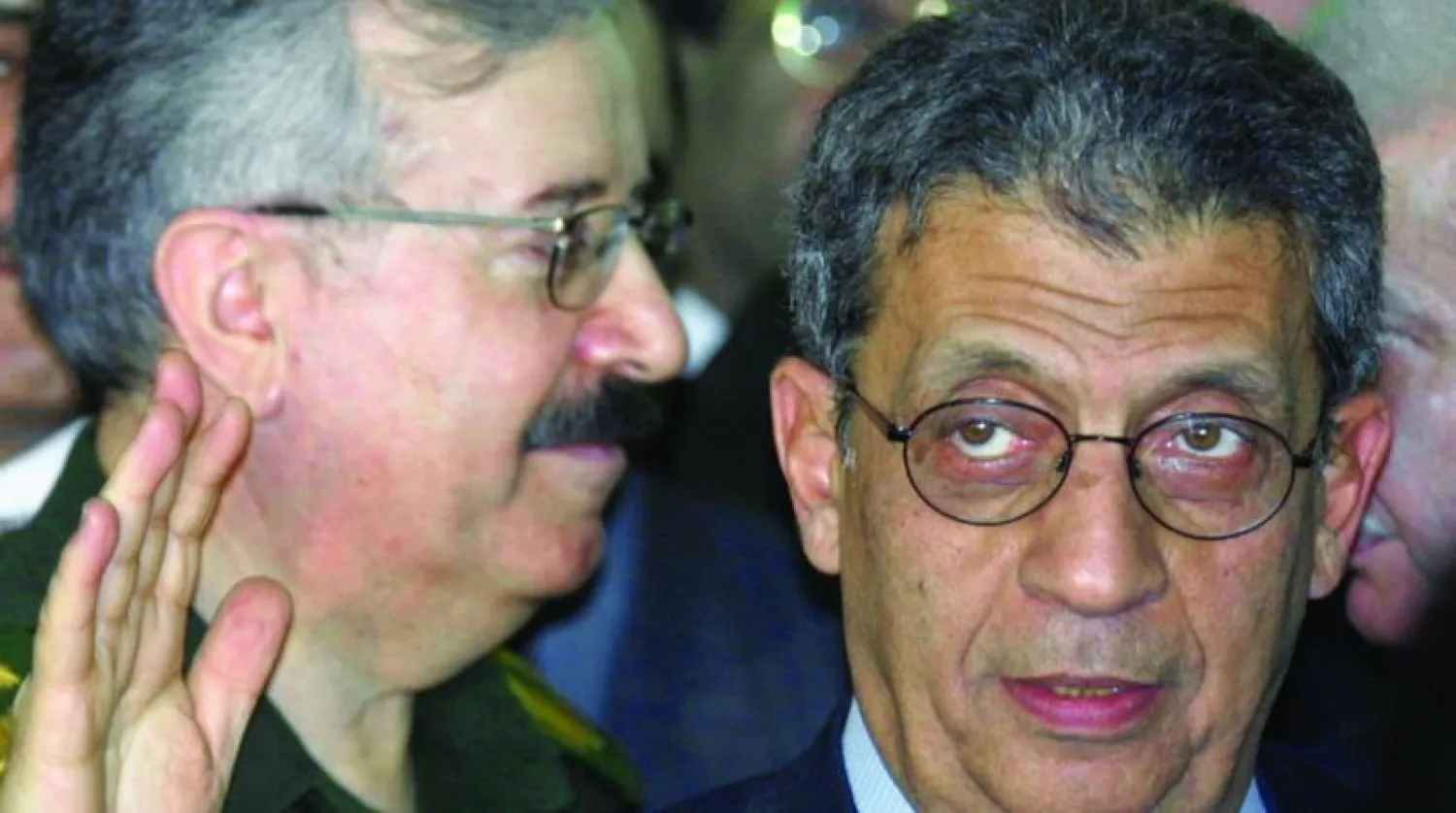

Former Iraqi Foreign Minister Naji Sabri al-Hadithi commented on the memoirs of former Secretary-General of the Arab League Amr Mouss that were published by Asharq Al-Awsat. Al-Hadithi clarifies in the below text a number of issues:
In the memoirs of the former Secretary-General of the Arab League Mr. Amr Moussa, published in your newspaper on Dec. 7, 2020, there were a number of misleading points regarding his visit to Iraq on January 18, 2002, and other matters related to the crisis in the relationship between Iraq and the United Nations at the time.
As I followed his visit from its beginning in New York and accompanied him until after his arrival in Baghdad, I would like to discuss the following points to clarify the truth:
First: In the memoirs, Mr. Moussa said that on his visit to New York to attend the General Assembly meetings, he met with the Secretary-General of the United Nations, Mr. Kofi Annan, and stressed the need to make “a clear effort to prevent an imminent war on Iraq.”
“I will visit the Iraqi president in January, he told him. I want a message that I can convey to him on your behalf to resolve the position over the resumption of the work of international inspectors.” Moussa said that secretary-general approved the request.
After that, the memoirs quoted Mr. Moussa as saying: “I arranged with the Iraqi Foreign Minister, Naji Sabri Al-Hadithi, my visit to Iraq.” This means that he decided on the visit, set its subject and date, and then met with me to arrange it...
In fact, I met Mr. Amr Moussa on the sidelines of the General Assembly, and talked with him about the crisis of the relationship between Iraq and the United Nations, and about the urgent need to seek a peaceful political solution that guarantees the sovereignty of Iraq, the security of its people and its national interests. I explained to him our keenness to build a positive relationship with the United Nations Secretariat and its agencies operating in Iraq, and our efforts to resume dialogue, negotiation and interaction with them, as the first essential step on the road to resolving the crisis.
I felt that he understood and supported our direction. So I suggested that the Arab League have a role in this endeavor. He showed willingness to do so. Here, I proposed that he visits Iraq to confirm this willingness. I told him it would provide a symbolic and effective evidence of the Arab League’s solidarity with the Iraqi people in the face of the siege and the continuous aggression against the country. He agreed, and an official invitation was sent to him at once. He contacted me after his return to Cairo to schedule the date of the visit. We set the visit on Jan. 18, 2002.
Therefore, Mr. Moussa’s visit to Iraq was my idea. He had no idea about it before our meeting. Moreover, it’s the first time that I hear that the Secretary-General of the United Nations has sent a message to the President of the Republic of Iraq through Mr. Amr Moussa. I don’t know how the person who wrote the memoirs (and I am not pointing to Mr. Moussa) has missed that the head of any international organization does not send messages to countries through people from outside his organization, let alone the head of the largest international organization in the world.
Second: The memoirs recount how Mr. Moussa went the next day to meet President Saddam Hussein, saying that he moved from his residence to a “military headquarters” and then to “a military unit headquarters”, providing a dramatic description of the president’s secretary...
In fact, Mr. Moussa, his assistants and I met at the National Council building in Karada Mariam before going to the place of the meeting with the president. Then the president’s secretary, Lieutenant General Abdel Hammoud, came and escorted us in his car to one of the presidential palaces in the Radwaniyah area. The National Council building is not a military barracks, as mentioned in the memoirs, but rather a large building with a beautiful classic urban style located on the Tigris River, less than 200 meters from the Republican Palace. It includes civilian offices of the Presidency of the Republic. It is usual for the building to be protected by an external fence, and for its external entrance gate to be guarded by a few security guards, like any building belonging to the Presidency of the State in any country in the world.
Third: The memoirs give a different version of the meeting with President Saddam Hussein. It claimed that Mr. Moussa was furious and talked to President Saddam in a tone as if he were shouting at him, and that the President addressed him with the title of Doctor… etc.! Everything that was mentioned about the meeting is absolutely untrue. The meeting began with Mr. Moussa’s talk about the Arab League’s position on the issue of Iraq and its keenness on the country’s sovereignty, independence, and territorial integrity, as well as its support in the face of violations and threats, and against the continued siege on its people.
Within the framework of the visit, which we have agreed upon in New York, Moussa touched on the importance of working for a peaceful political solution to the crisis with the United Nations by communicating and negotiating with its secretary-general on all pending issues between the two sides. He expressed the readiness of the Arab League General Secretariat to contribute to this endeavor.
President Saddam Hussein responded by explaining Iraq’s stance on the relationship with the United Nations, and reviewing the arbitrary decisions imposed by the United States and Britain on the Security Council, their violations of Iraq’s sovereignty, their attacks on its citizens and locations, as well as their insistence on maintaining the siege on its people.
He also talked about their threats to wage war against Iraq, and the practices of the United Nations inspection teams, which violated the country’s sovereignty and security. He expressed no objection to the resumption of negotiations with the UN General Secretariat.
The meeting ended with Mr. Moussa’s pledge to contact the UN Secretary-General to agree on arrangements for the resumption of comprehensive negotiations between Iraq and the United Nations at the earliest possible. Consequently, we agreed with Mr. Annan to start the negotiations on March 7, 2002 at the United Nations headquarters in New York.
However, what’s strange is the memoirs mentioning Mr. Moussa’s anger, his shouting at President Saddam Hussein, and other allegations. How did Brother Amr accept that the person, who wrote his memoirs, attributes this blatant lie to him and to the Egyptian diplomacy? This contradicts the simplest characteristics of a successful diplomat, which are graciousness, politeness and good speech.
Fourth: The memoirs quoted Mr. Amr Moussa as saying that his visit to Iraq was to persuade President Saddam Hussein to bring back the inspectors, and that the President had agreed and authorized Moussa to speak on behalf of Iraq.
The truth is that the return of the inspectors was not raised during the meeting. It was also not mentioned in the first round of negotiations with the United Nations, which was held at the headquarters of the international organization in New York on March 7, 2002.
Moreover, the issue was neither raised in the second round of talks, which took place on May 2, 2002, nor in the third meeting, which was held at the UN headquarters in Vienna on May 7, 2002, based on my request to avoid the US intelligence’s harassment of the members of the Iraqi delegation.
Before the end of the third round, Mr. Kofi Annan met with me privately, and told me that he needed a promise from us that the Iraqi government would consider the return of the inspectors, so that he could continue negotiations and agree with us on a fourth round. But I apologized as I did not have my government’s permission to do so. Therefore, how do the memoirs say that Mr. President has approved the return of the inspectors and authorized Mr. Amr Moussa to speak on behalf of Iraq?
On Sept. 9, 2002, I met President Saddam Hussein before I went to New York to attend the 57th session of the United Nations General Assembly. I asked him about any new position regarding the return of the inspectors, and he told me to wait, meaning that the refusal was still valid.
Upon my arrival at the United Nations, the Arab League General Secretariat called for a meeting of Arab foreign ministers in a hall in the building of the international organization on Sept. 15, 2002. Before entering the meeting room, I learned that US Secretary of State Colin Powell had begun consultations with his legal advisers to draft a Security Council resolution authorizing any country to launch war on Iraq under the pretext of its refusal to allow the return of the international inspectors. The draft-resolution imposes exorbitant demands on Iraq within short deadlines, which are impossible to meet even if the country desired to comply.
Thus, I was convinced that the inspectors should be returned. The focus of the Arab ministers meeting was the crisis between Iraq and the United Nations. The secretary-general and ministers called on Iraq to work on resolving the crisis and to deal flexibly with Security Council resolutions. One of my best memories is the moving appeal of His Highness the late Prince Saud Al-Faisal, Minister of Foreign Affairs of the Kingdom of Saudi Arabia.
After we left the meeting, Mr. Amr asked me what I would do. “We will allow the return of the inspectors,” I replied, and he welcomed that. I asked him to join me in arranging the matter with the Secretary-General so that the decision would guarantee the United Nations’ respect for Iraq’s inalienable rights to protect its sovereignty, the sanctity of its territories and the right of its people to lift the inhuman blockade in accordance with the UN Charter, the relevant Security Council resolutions and international law. He expressed his readiness for that.
I immediately sent an encrypted message to President Saddam Hussein, requesting his consent for the return of the inspectors unconditionally. Three hours later, I received the approval. This happened nine months after Mr. Amr Moussa’s visit to Baghdad, during which the memoirs claim that the President had informed him of his consent over the return of the inspectors!
I called Mr. Amr and we went together to Mr. Annan to inform him of the decision. Then, he joined me in all the necessary contacts until we put the final wording of the Iraqi decision, in coordination with Mr. Annan, and presented it to him in the evening of Sept. 16, 2002.
The good and friendly working relationship that brought me together with Brother Amr Moussa continued until the last Arab ministerial meeting I attended on March 25, 2003 at the Arab League’s headquarters after the start of the US invasion of Iraq. At the end of the meeting, Mr. Amr escorted me to the outside gate of the building on the main street to bid me farewell.
Naji Sabri al-Hadithi – Foreign Minister of Iraq (2001-2003)