Egypt, Ethiopia Exchange Accusations Over GERD Negotiations
AFP file photo of the Grand Ethiopian Renaissance Dam
Cairo and Addis Ababa have exchanged accusations over responsibility for the failure of negotiations on the Grand Ethiopian Renaissance Dam (GERD).
Egypt’s Foreign Minister Sameh Shoukry said that the GERD crisis depends on the extent of the project’s damage that will be inflicted on Egypt.
“If any harm is done, all state institutions will confront and remove it," Shoukry said. "The potentially huge harm will be in Sudan and we cannot accept that.”
Egypt’s FM said that initial technical assessments show his country would not be harmed by the second and much larger filling of the hydroelectric dam being built by Ethiopia on the Blue Nile.
He pointed out that the negotiations have reached a dead end, though he expressed Egypt’s willingness to solve the crisis through dialogue and understanding.
Shoukry also highlighted Egypt’s keenness to provide an opportunity for international mediators to resolve the crisis in a way that does not harm the interests of the two downstream countries, namely Sudan and Egypt.
“We continue our endeavor even if the time is narrowing in order to solve the crisis in a way that does not harm the interests of Egypt and Sudan, as the unilateral actions of Ethiopia harm the interests of the two downstream countries,” the minister said.
On Thursday, Ethiopia blamed Egypt and Sudan for the failure of the latest round of talks held in Kinshasa, capital of the Democratic Republic of Congo, the current chair of the African Union.
Spokesperson for Ethiopia’s Foreign Ministry Ambassador Dina Mufti said in a press conference in Addis Ababa that Egypt and Sudan “prevented reaching an agreement on the Renaissance Dam in the Kinshasa negotiations.”
He described as “disappointing” their efforts to refer the crisis to the UN Security Council.
Lebanon's Prisoners Continue Hunger Strike Over Suspension of Amnesty Lawhttps://english.aawsat.com/arab-world/5321076-lebanons-prisoners-continue-hunger-strike-over-suspension-amnesty-law
Lebanon's Prisoners Continue Hunger Strike Over Suspension of Amnesty Law
A sign held by a protester at Roumieh Prison calls for the implementation of the General Amnesty Law (Al-Markazia)
Inmates at Lebanon’s Roumieh Central Prison are on a hunger strike for a 10th day over an appeal to a general amnesty law, as warnings mounted that deteriorating conditions could trigger a broader humanitarian and social crisis.
Prisoners in Block B of Roumieh, Lebanon’s largest prison, have refused food, water and medication while awaiting a Constitutional Council ruling on the challenge to the law, which hundreds of inmates hope will secure their release.
The strike has coincided with protests outside prisons, including a demonstration Sunday that drew hundreds to Al-Nour Square in the northern city of Tripoli at the call of a committee representing prisoners’ families.
“The prisoners remain committed to the strike, but the situation is still under control and has not yet reached a highly dangerous stage,” a security source told Asharq Al-Awsat.
The main concern was for inmates with chronic illnesses, particularly those refusing medication, the source added. The prison doctor was examining strikers daily, prioritizing those with health conditions, while arrangements were in place to transfer any inmate whose condition deteriorated to hospital.
The source nevertheless warned that tensions could worsen if the Constitutional Council upheld the appeal and struck down the amnesty law, potentially prompting prisoners to escalate their protest.
Omar al-Atrash, spokesman for Lebanon’s prisoners, said the health of inmates had started to deteriorate “one after another,” adding that two prisoners were hospitalized Sunday.
Al-Atrash warned that the action could expand in the coming days into a general strike across Lebanon’s prisons.
He held Free Patriotic Movement leader Gebran Bassil and his political camp “morally and humanely responsible” because of its challenge to the amnesty law that was passed by parliament on Aug. 12.
Al-Atrash urged state institutions to implement the law, warning that further delays could lead to “a humanitarian catastrophe and an explosion inside the prisons” that could rapidly develop into a national and social crisis.
One Roumieh inmate told Asharq Al-Awsat that the strikers’ health was rapidly deteriorating and that prisoners with chronic illnesses were at particular risk.
The inmates “will not back down until the amnesty law is upheld and published in the Official Gazette,” he said.
A judicial source said prosecutors were monitoring the strikers’ health in coordination with Roumieh prison authorities.
Courts had already begun preparing cases to implement the amnesty should the Constitutional Council allow the law to stand, the source said, in an effort to avoid delays in releasing eligible prisoners.
Trump Praises Aoun’s Leadership During Critical Periodhttps://english.aawsat.com/arab-world/5321061-trump-praises-aoun%E2%80%99s-leadership-during-critical-period
Lebanon’s President Joseph Aoun holds a meeting with former head of the Progressive Socialist Party, Walid Jumblatt and his son, MP Taymour Jumblatt, at the Presidential Palace in Baabda on Monday (Lebanese Presidency)
Trump Praises Aoun’s Leadership During Critical Period
Lebanon’s President Joseph Aoun holds a meeting with former head of the Progressive Socialist Party, Walid Jumblatt and his son, MP Taymour Jumblatt, at the Presidential Palace in Baabda on Monday (Lebanese Presidency)
US President Donald Trump on Monday praised President Joseph Aoun’s leadership of Lebanon during this critical period, and acclaimed the shared commitment of both sides to peace, security, and prosperity around the world.
Lebanon is engaged in US-mediated direct negotiations with Israel, aimed at ending the war, securing an Israeli withdrawal from occupied Lebanese territory, facilitating the return of detainees, and enabling displaced residents to return to their homes.
The talks also seek to ensure that weapons across Lebanon are placed exclusively under the authority of the country’s official security and military forces.
Trump’s praise came in a letter sent to Aoun, in which he expressed his “honor” to welcome the President to the White House on July 21 for a “truly historic visit,” according to the Lebanese presidency said.
“It was an honor to welcome you to the White House for a visit that was historic in every sense of the word—the first visit by a Lebanese head of state in nearly two decades—at a time when the Middle East is experiencing conflict. I have admired your decisive leadership on behalf of Lebanon and its people,” the letter said.
Trump also thanked Aoun for awarding him the National Order of the Cedar, Grand Cordon, saying: “This initiative is an exceptional honor and embodies the proud Lebanese spirit. I will cherish this gesture as a symbol of our shared commitment to peace, security, and prosperity around the world.”
Unlike Hezbollah, the Lebanese state’s approach of negotiating with Israel enjoys the support of most major political forces.
Following a meeting with Aoun on Monday at the Presidential Palace, former head of the Progressive Socialist Party, Walid Jumblatt said he supports the negotiations and the ceasefire agreement if they lead to a gradual or complete Israeli withdrawal.
“If the framework agreement leads to a withdrawal and the demarcation of the border, then where is the problem? This is my personal point of view, no more and no less,” he noted.
Hezbollah has stepped up its criticism of Aoun over his decision to pursue direct negotiations with Israel under US mediation, putting the Lebanese president at odd with the Shiite movement.
Following a meeting with the President on Monday, MP Alain Aoun said the success of the president’s efforts to end the war and restore Lebanese sovereignty requires cooperation from all Lebanese parties and engagement with the process of placing weapons exclusively under state authority.
The deputy called on Hezbollah to engage in dialogue with the president at Baabda Palace to agree on a roadmap aimed at advancing negotiations, securing an Israeli withdrawal and enabling the Lebanese Army to deploy across the country.
What’s Left of Hezbollah Two Years after the War?https://english.aawsat.com/arab-world/5321030-what%E2%80%99s-left-hezbollah-two-years-after-war
A poster expresses gratitude to Iran for its support to Lebanon. (Asharq Al-Awsat)
The expanded war in Lebanon, which erupted with widespread Israeli bombardment on September 23, 2024, and led to intense clashes and battlefield shifts, has forced a new reality on Hezbollah.
The Iran-backed group's military capabilities, supply lines, and political influence have significantly declined following severe losses within its senior leadership ranks. Furthermore, Hezbollah's deployment on the ground and operations have fundamentally changed compared to its pre-war positioning.
Two years later, the group is navigating a far more complex military landscape. While the loss of a vast portion of its leadership, declining drone and missile capabilities, and shrinking supply lines through Syria have severely weakened its position, the party still retains enough military capacity to continue operating.
It is actively attempting to reorganize its ranks and adapt to an altered battlefield reality - one that stretches from north of the Litani River into broader territory across southern Lebanon and the Western Bekaa.
Speaking to Asharq Al-Awsat, security and defense expert Riad Kahwaji estimated that Hezbollah's capabilities have significantly declined between 2024 and today across its leadership, military structure, political influence, and supply lines, evaluating the scale of this drop to have "exceeded nearly half."
He explained that the group has lost the vast majority of its first- and second-tier leaders, while most of the leaders present today were classified within the third tier in 2024.
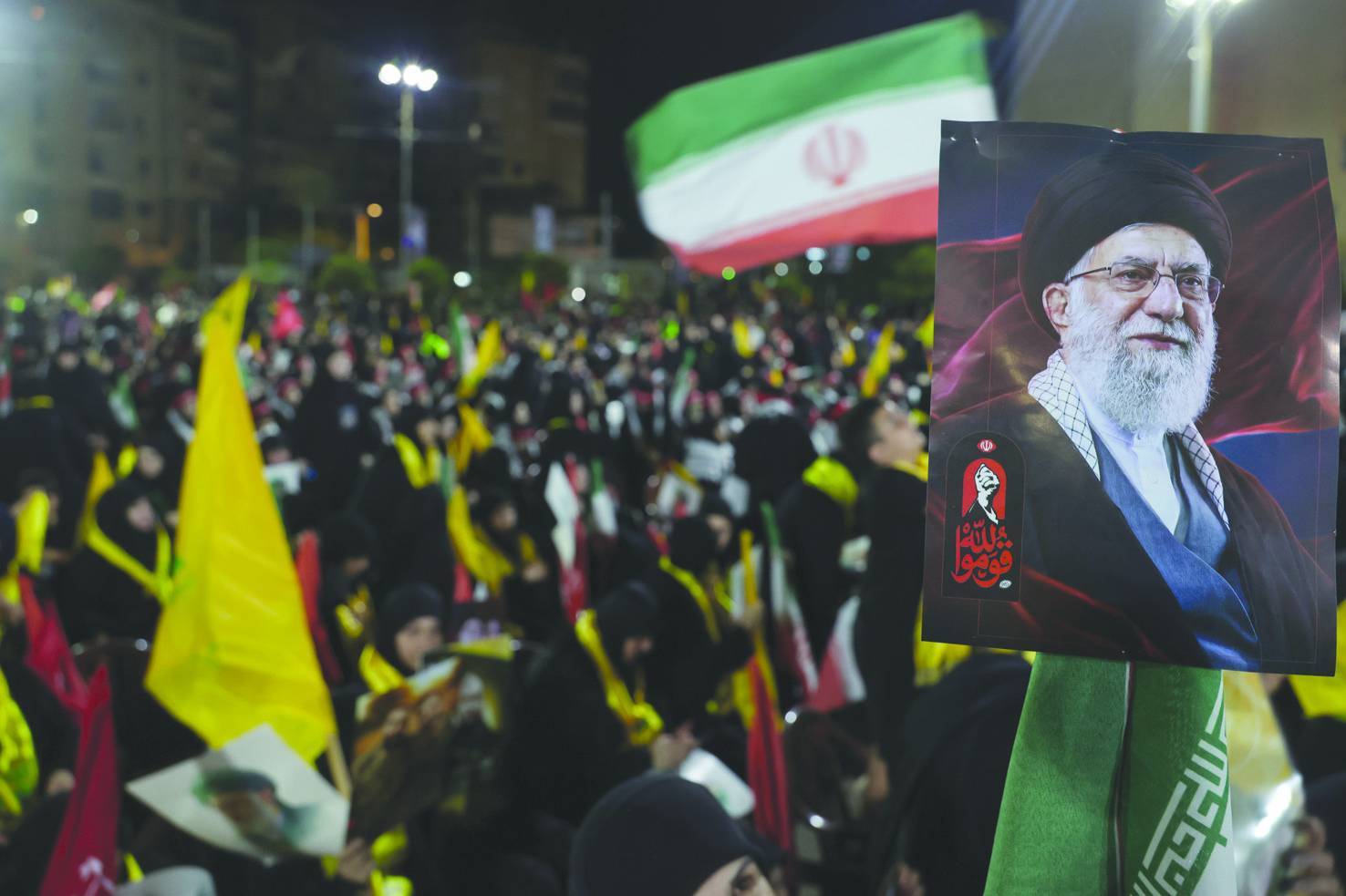
Hezbollah supporters carry posters of slain Iranian supreme leader Ali Khamenei during a rally coinciding with his funeral in Iran in Beirut's southern suburbs. (EPA file)
The nature of management within the group has also changed, as "management in 2024 was local under Iranian guidance, whereas today management and guidance have become directly Iranian," he added.
On the military level, Kahwaji said that "the party's forces have become stationed north of the Litani, after having previously been present directly on the border."
"Nabatieh has practically become the separation line of contact between the group's presence and the Israeli forces," he noted.
Regarding the military arsenal, he said that "missile and drone capabilities still exist, but they have become less than half of what they were before."
He added that Hezbollah's political influence within Lebanon has significantly weakened from its previous levels, noting that one of the most prominent shifts affecting the group is the severe disruption of its supply lines through Syria, which have now been largely cut off.
Since the November 2024 ceasefire up to the current stage, retired Brigadier General Dr. Khalil Helou told Asharq Al-Awsat that the party’s "capabilities have dropped compared to what they were before the war, but it has not lost its military capacity and still possesses capabilities that allow it to continue."
Its limited responses to Israel during the current stage may be a sign that it has entered a new "phase of reorganization and rebuilding of combat readiness," he added.
Helou explained that the period following the November 2024 ceasefire was marked by ongoing Israeli assassinations targeting Hezbollah operatives, while the group largely refrained from retaliating.
This pattern underscores a significant drop in Hezbollah's capabilities compared to its pre-2024 strength, while simultaneously indicating that the group has been undergoing a phase of reorganization, rearmament, and rebuilding of its combat readiness, he noted.
Helou stressed that the strategic landscape shifted following the outbreak of the US war on Iran at the end of February, which Hezbollah joined in early March.
"From that point until the second ceasefire on June 17, the party engaged in the fighting, launching effective retaliatory operations in certain areas and firing missiles into both the Israeli interior and Israeli-occupied territories," Helou said.
He remarked that during that phase, Israel "advanced, made incursions, and established its presence on the ground," while Hezbollah continued to carry out military responses, though the situation following the latest ceasefire has returned to a pattern similar to the period that followed November 2024.
"Today, we have virtually returned to the previous phase, as Hezbollah's responses to Israeli attacks have become almost nonexistent," he stated. "If we review operations over the past two and a half months since the ceasefire, the military operations carried out by the group against Israel are highly limited and can be counted on two hands. This stands in sharp contrast to dozens of daily Israeli operations, including airstrikes, shelling, and assassinations."
لم تشترك بعد
انشئ حساباً خاصاً بك لتحصل على أخبار مخصصة لك ولتتمتع بخاصية حفظ المقالات وتتلقى نشراتنا البريدية المتنوعة