Lavrov, Mangoush Stress Need to End Foreign Military Presence in Libya

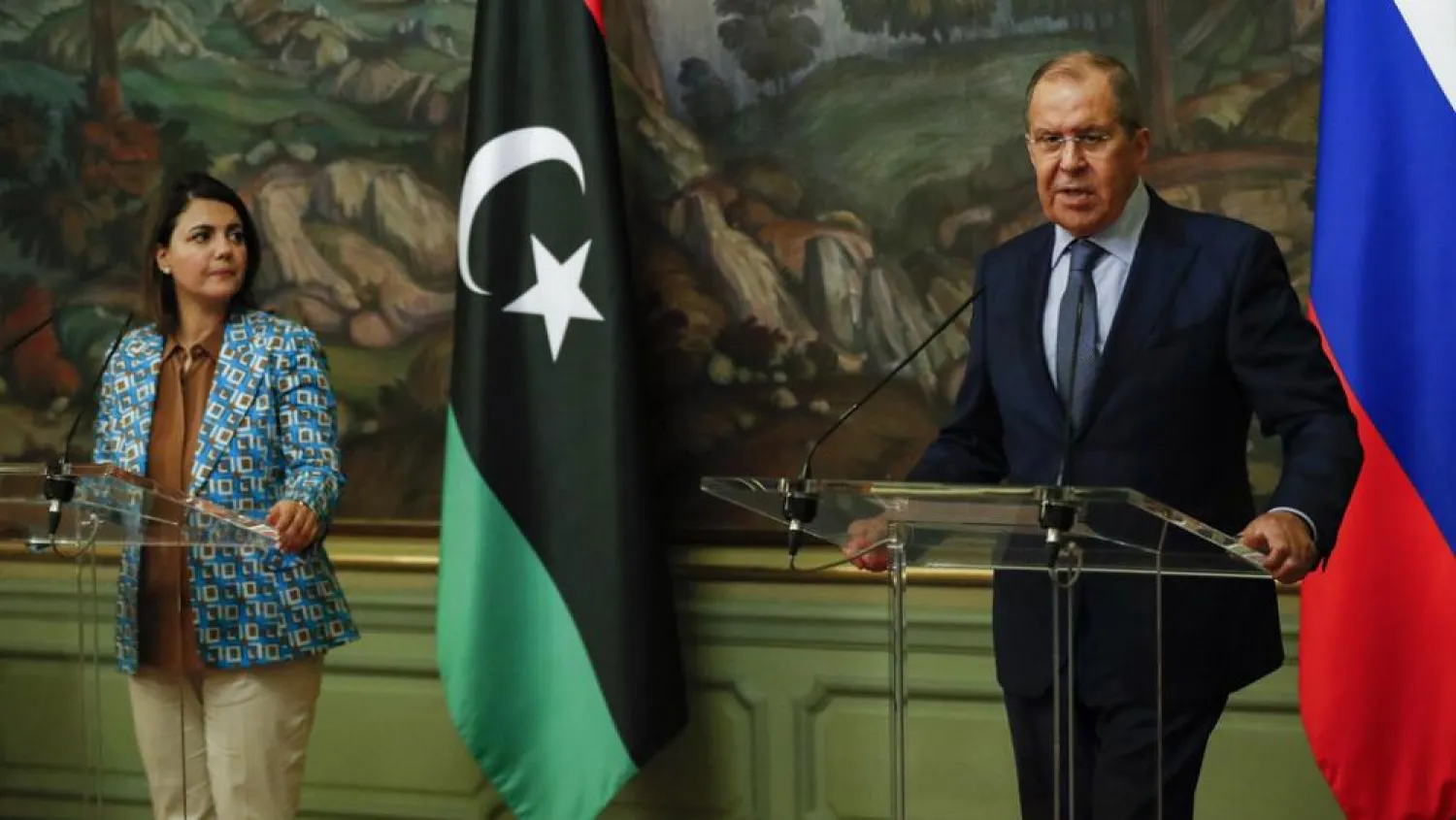
The Libyan and Russian FMs hold a press conference in Moscow on Thursday. (AP)
TT

Lavrov, Mangoush Stress Need to End Foreign Military Presence in Libya

The Libyan and Russian FMs hold a press conference in Moscow on Thursday. (AP)

Russian Foreign Minister Sergei Lavrov held talks in Moscow on Thursday with his Libyan counterpart Najla Mangoush.

They agreed on the mechanisms needed to push forward the political settlement in Libya and the need to bolster relations between Moscow and Tripoli.

Lavrov said he was honored to welcomed Libya’s first woman foreign minister.

A Russian foreign ministry statement has said Moscow was looking forwards to talks with Mangoush as it would mark a significant new step towards constructive cooperation between Russia and Libya.

The talks focused on developments in Libya and the comprehensive settlement amid the ongoing negotiations between the various Libyan parties.

The ministry said both sides have an important opportunity to increase the trade exchange and pave the way for more active cooperation and investment.

After talks with Mangoush, Lavrov said her visit took place at a “very critical” time when the fate of Libya was being decided.

With the strong backing of the international community, the Libyans have managed to take the first steps towards a final settlement that would end their country’s conflict through national reconciliation and building a stable and prosperous state, he added.

Lavrov said Moscow supports the decisions of the 5+5 military committee, stressing the need to end foreign military presence in Libya.

Moscow is ready to take part in working on and coordinating the withdrawal of the foreign troops, he stated.

The Russian official was also briefed on efforts to hold elections in Libya in December.

For her part, Mangoush underlined the role Russia has been playing in the Libyan political process.

She said the withdrawal of foreign troops and mercenaries demands a realistic approach, adding that Tripoli was looking forward to Moscow’s help in unifying the Libyan military.


Commander of Yemeni Coast Guard: Our Duties Are Continuing Normally and Our Morale Is High

Yemeni Coast Guard Commander Major General Khalid al-Qamli. (Saba)
TT

Commander of Yemeni Coast Guard: Our Duties Are Continuing Normally and Our Morale Is High

Yemeni Coast Guard Commander Major General Khalid al-Qamli. (Saba)

Yemeni Coast Guard Commander Major General Khalid al-Qamli stated that three Houthi missiles targeted coast guard positions in the interim capital of Aden, causing infrastructure damage. He stressed that the attack did not halt operations, which continue normally with high morale.

Al-Qamli told Asharq Al-Awsat: “Three Houthi missiles targeted the Yemeni Coast Guard Authority in Aden, resulting in infrastructure damage.”

The Interior Ministry said two missiles struck on Saturday the coast guard headquarters at the ministry’s offices, while a third hit the coast guard building in the Tawahi district.

It noted that the targeting of security and service facilities is an extension of previous assaults on civilian and vital infrastructure in Aden. This includes Aden International Airport, which has been subjected to ballistic missile and drone attacks on multiple occasions.

It added that the relevant authorities are continuing to gather information and evidence to assess the damage and are taking the necessary measures to boost security and protect both infrastructure and citizens.

The Coast Guard in the Gulf of Aden sector performs critical duties that include securing ports and their facilities, monitoring vessel traffic, maritime lanes, and the coastline, alongside escorting vessels when necessary and executing rescue operations.

These responsibilities carry heightened significance amid Yemen's ongoing efforts to bolster port security and streamline coordination among maritime security entities.

To that end, the International Maritime Organization (IMO) convened a workshop in Aden last August, drawing representatives from the Coast Guard, government bodies, and port authorities to address maritime security governance, information sharing, and the protection of port infrastructure.

In Shabwah, Governor Awadh Mohammed bin Al-Wazir praised a "qualitative security achievement" by the Rapid Intervention Forces, which dismantled a 13-member Houthi cell and seized a truck laden with weapons, ammunition, highly explosive improvised explosive devices (IEDs), and various projectiles.

The seized items included sniper rifles, ammunition, IEDs, and various projectiles. Preliminary investigations revealed the shipment was smuggled through a boat and received by members of the cell on the coast of the Radum district ahead of sending it to the Houthis.


Large Public and Official Turnout at Funerals of Jordan Church Attack Victims

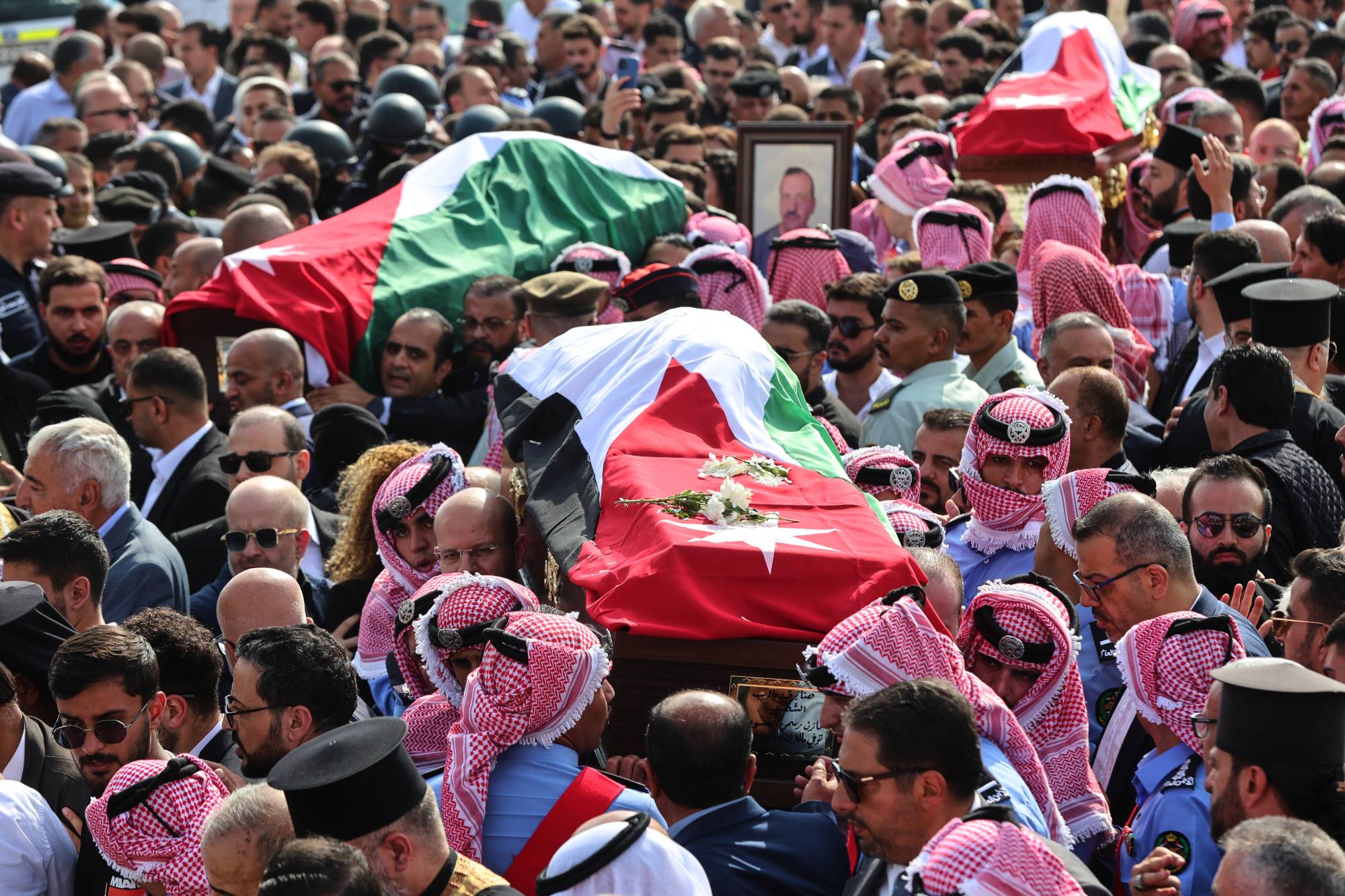
 Jordanian honor guards carry a flag-draped coffin of on of the victims killed in an attack on a Greek Orthodox church during their funeral procession in Karak, Jordan, Sunday, Oct. 25, 2026. (AP)
Jordanian honor guards carry a flag-draped coffin of on of the victims killed in an attack on a Greek Orthodox church during their funeral procession in Karak, Jordan, Sunday, Oct. 25, 2026. (AP)
TT

Large Public and Official Turnout at Funerals of Jordan Church Attack Victims

 Jordanian honor guards carry a flag-draped coffin of on of the victims killed in an attack on a Greek Orthodox church during their funeral procession in Karak, Jordan, Sunday, Oct. 25, 2026. (AP)
Jordanian honor guards carry a flag-draped coffin of on of the victims killed in an attack on a Greek Orthodox church during their funeral procession in Karak, Jordan, Sunday, Oct. 25, 2026. (AP)

Thousands of Jordanians on Sunday laid to rest eight of the nine victims killed on Friday in a terrorist attack that targeted the Hamoud Church in the southern governorate of Karak, amid a large public and official turnout that underscored the principles of coexistence.

On Friday, gunmen suspected of being "takfiris" opened fire on churchgoers, killing nine and wounding about 25 others. The ninth victim will be buried Monday in the Sahab cemetery south of Amman, AFP reported, citing the victim's family.

The funerals extended far beyond the immediate tragedy at the church, as the village of Hamoud witnessed a national consensus that underscored Christian-Muslim fraternity and cast the terrorist crime as a catalyst for solidarity rather than strife.

An official presence dominated the funeral, with the heads of the constitutional authorities leading the ranks of mourners. Most of the governorate’s prominent figures, both Muslim and Christian, stood alongside the families of the church victims to receive condolences.

Jordanian honor guards carry the flag-draped coffins of victims killed in an attack on a Greek Orthodox church during their funeral procession in Karak, Jordan, Sunday, Oct. 25, 2026. (AP)

By order of Jordanian King Abdullah II, the Royal Hashemite Court undertook the arrangements and protocols for the massive funeral service, which drew thousands of people from across the kingdom.

In a reflection of the area's deep-rooted coexistence, the Christian victims killed at the church included Dr. Mohammad Al-Qassous. A member of the Al-Halsa clan, his parents chose his Muslim name out of a profound conviction that no distinction exists between the residents of a shared village. Widely recognized in the community, Al-Qassous was known as the "doctor of the poor."

Among the wounded in the terrorist attack were four Muslims, two of whom had arrived to help upon hearing the sound of gunfire.

Informed sources stated that "the past hours witnessed a continuation of search operations on a broader scale" for the attackers, noting that investigators are close to mapping and tracking the communication networks of the terrorist cell behind the church massacre.

According to the sources, the delay in announcing preliminary investigation results stems from search and tracking operations navigating the mountainous terrain east of the Karak governorate. They noted that the challenging topography of the search sites demands caution, particularly amid concerns that the militants may have cached weapons for use in further operations. Authorities are continuing to raid locations where suspects are believed to be hiding.

Prime Minister Jafar Hassan stated Sunday, during a cabinet meeting that opened with a recitation of Al-Fatiha for the victims, that "all state agencies are working to apprehend the terrorists behind the Karak crime so they face the punishment they deserve."

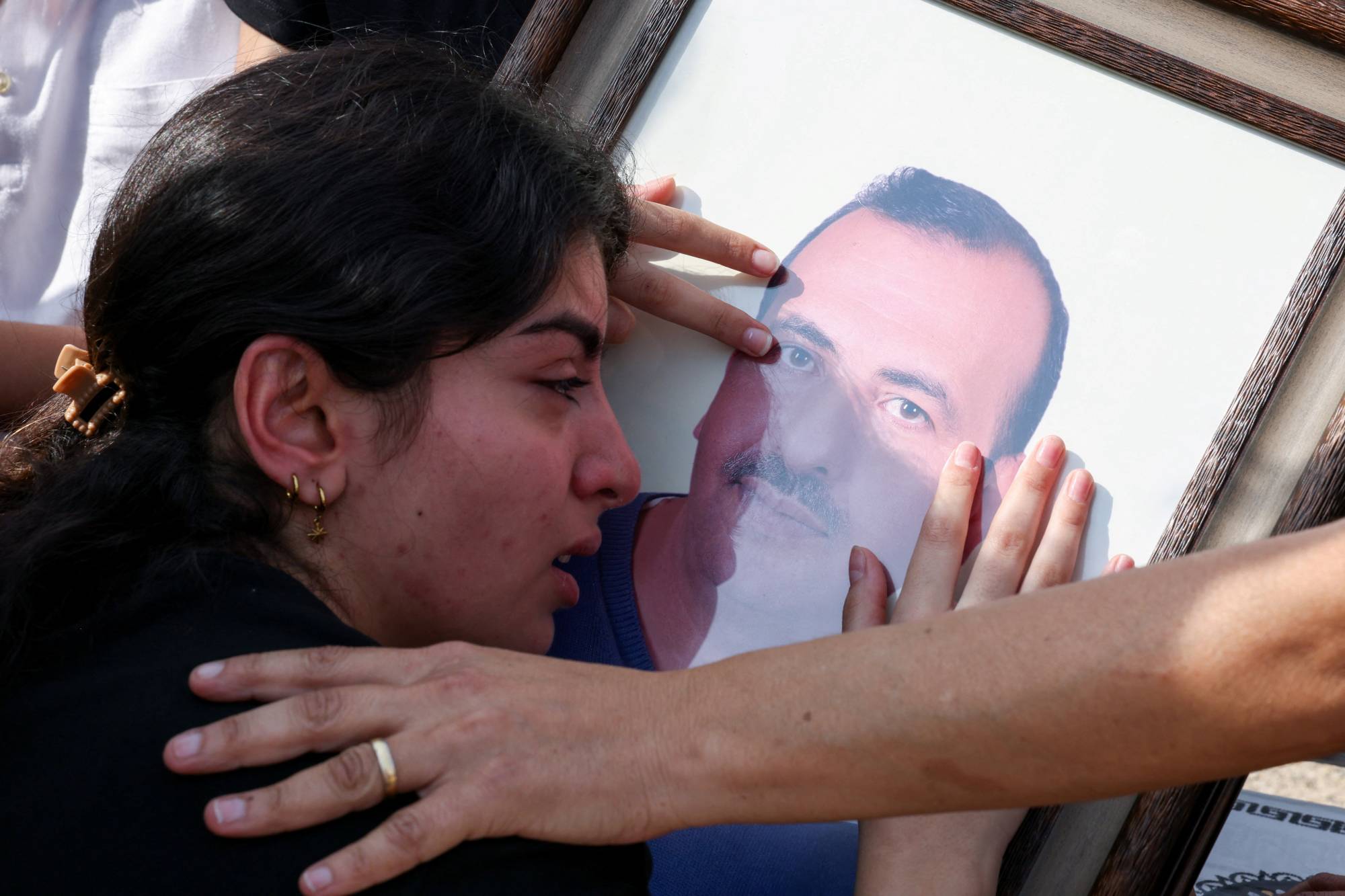
A woman reacts during the funeral of victims of a church shooting in Karak, Jordan, October 25, 2026. (Reuters)

"This is not merely a security battle; this is a battle of awareness and ideology. Nations and homelands collapse when strife, bigotry, racism, and extremism spread within their societies,” he added.

During the funeral ceremonies, Asharq Al-Awsat observed striking scenes that encapsulated feelings of grief, anger, and a commitment to national unity.

As Muslim clerics stood alongside Christian clergy around the church, the victims' coffins were placed at the beginning of the farewell ceremony on a white cloth bearing a message of peace and adorned with flowers, before being carried in a solemn military funeral on the shoulders of general security personnel, draped in Jordanian flags.

Another scene encapsulated the depths of anger, as young Jordanian men wore the Shemagh (a red Jordanian headdress) upside down - a tribal custom that symbolizes a demand for revenge - expressing their outrage over the crime.

Following the burials, the ululations of the victims' mothers, wives, daughters, and sisters filled the air, blending with the tears of farewell in a scene that united the pain of loss with immense pride in the departed.


Shock and Grief in a Jordanian Village after Church Attack

This handout picture released by the Jordanian Royal Palace on October 23, 2026, shows Jordan's King Abdullah II (R) visiting Prince Ali Military Hospital in Karak to check on those who were injured in the attack on a Greek Orthodox church in the village of Hammoud in Karak governorate. (Photo by Jordanian Royal Hashemite Court (RHC) / AFP)
TT

Shock and Grief in a Jordanian Village after Church Attack

This handout picture released by the Jordanian Royal Palace on October 23, 2026, shows Jordan's King Abdullah II (R) visiting Prince Ali Military Hospital in Karak to check on those who were injured in the attack on a Greek Orthodox church in the village of Hammoud in Karak governorate. (Photo by Jordanian Royal Hashemite Court (RHC) / AFP)

Workers were cleaning the last traces of blood from St George's Church in Jordan's Hammoud the day after a deadly attack, when visitors arrived to express their solidarity amid an atmosphere of shock and grief.

At noon on Saturday, the bells of the Greek Orthodox church in Jordan's Karak Governorate, south of Amman, rang in unison alongside churches across Jordan, mourning the victims of the unprecedented attack against Christians in the kingdom, which left nine dead and 25 wounded according to the latest toll from the authorities.

Sayel al-Khaitan, a doctor who was inside the church when the attack, which took place during a funeral, began, described what happened as a tragedy.

"It is a criminal, dark, spiteful, Daesh-style attack", he said, referring to the ISIS group, saying it targeted Jordanian society as a whole.

He described coming under heavy gunfire, saying, "It was likely that we would have fallen as martyrs in the massive attack, but, by a miracle, we survived".

Jordan's Interior Minister Mazen Al-Faraya said the attackers were extremists.

They are still on the run.

- 'Hunting people' -

Bullet holes marred the church's walls and wooden pews, with windows shattered and glass shards gathered into a pile outside.

Security forces have been deployed at the entrances and exits of the church in the small, predominantly Christian village.

Christians make up about three percent of the Muslim-majority kingdom.

On Saturday, preparations were underway for the victims' funerals the following day and church officials have dug a mass grave, which will become a memorial.

Father Yohanna Hamati told AFP about 170 to 200 people taking part in the funeral of a woman from his parish when the volley of bullets began outside shortly after 2 pm.

He said the mourners "at first did not grasp what was happening".

But as people fled into the church, "we began to realize there was an attack".

"They were hunting people," he said. "Nothing like it has ever happened, neither to a church nor to a mosque."

He said some of the wounded mourners were Muslim, adding "we make no distinction between Muslim and Christian" and stressing that what happened "does not reflect Jordanian morals".

In the village's guest hall, condolences were pouring in from clerics, military officials, the Vatican ambassador to Jordan and local dignitaries.

In the provincial capital Karak, dozens of people visited Prince Ali Military Hospital, where most of the wounded were taken, to donate blood or express solidarity.

Youth activist Murooj Al-Nuwaysa, wearing a pink hijab, said she came with about 25 young men and women, carrying a bouquet of flowers with a card reading, "Our loss is one".

- 'Shock and pain' -

Nuwaysa says she was at the hospital on Friday visiting a patient at the time of the attack.

"I didn't have my phone with me, and I didn't know what was happening."

"Ambulances were arriving in large numbers... It was very strange. Then there was the sight of the blood and the people... We later heard there had been an attack on a church," she said.

She said the youth delegation's visit on Saturday was an expression of "solidarity and our feeling of shock and pain."

"Our friends, colleagues and relatives, Muslims and Christians, live together and share each other's occasions. It is a huge shock."

Jordan's King Abdullah II visited the injured in the hospital, dressed in military fatigues and carrying a pistol on his hip.

"We will show them," he vowed to the victims.

Outside the hospital, Majed Jaafar, dressed in traditional Arab robes and the red-and-white Jordanian keffiyeh, said with a mix of sadness and anger: "We cried for them. Christians are cousins, neighbors and relatives. There is nothing between us but love."

"This is the first time something like this has happened in Jordan," he said.

Wisam al-Burqan, one of the villagers, said he arrived at the site of the attack minutes after the assailants fled.

"These people are not a danger to Christians alone... they are a danger to society as a whole," he said, demanding the government "strike with an iron fist, uproot them and show them no mercy".