


KAUST Announces Partnership with Ocean Aero for Autonomous Underwater Vehicles

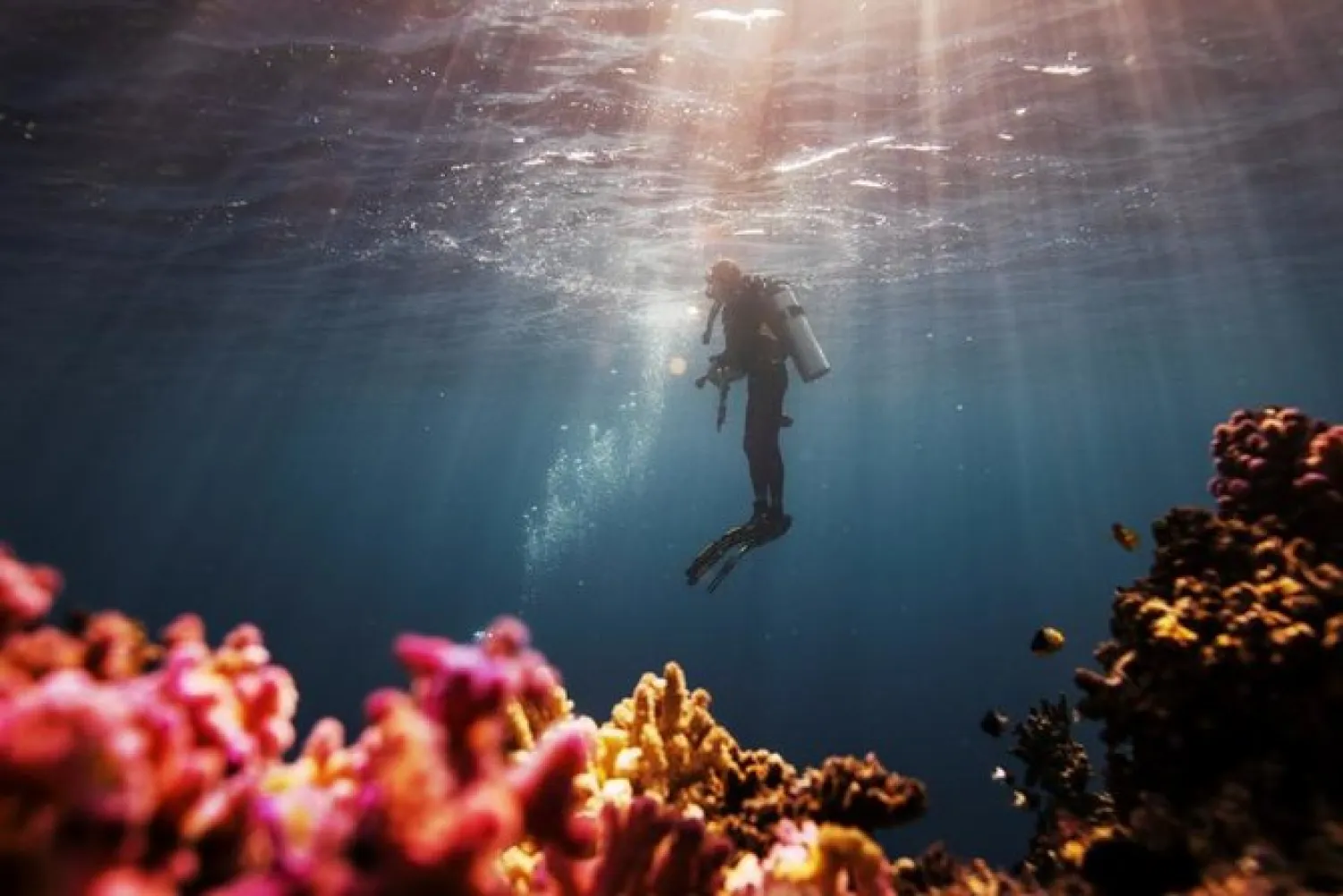
Diver during a research trip in the Red Sea offshore of the King Abdullah University of Science and Technology. (Reuters)
TT

KAUST Announces Partnership with Ocean Aero for Autonomous Underwater Vehicles

Diver during a research trip in the Red Sea offshore of the King Abdullah University of Science and Technology. (Reuters)

King Abdullah University of Science and Technology (KAUST) announced a new collaboration agreement with Ocean Aero, a manufacturer and service provider of ocean-going Autonomous Underwater and Surface Vehicles (AUSVs).

Ocean Aero and Shelf Subsea, a service company for the marine industry, will bring the AUSVs into Saudi Arabia, which will enhance KAUST research of the Red Sea.

Ocean Aero’s TRITON Generation III AUSV is the world's first and only autonomous, environmentally-powered ocean vehicle that both sails and submerges for persistent, long-range ocean observation and data collection missions.

The solar panels and batteries on this AUSV allow the vehicle to spend months at sea unattended, whereas comparable AUSVs cannot explore for more than a day without direct handling.

The collaboration will benefit knowledge of the Red Sea and KAUST research in many ways. By customizing the AUSVs with sensors, the KAUST Red Sea Research Center will acquire new data that will be instrumental in understanding special features of the Red Sea, such as its unusual currents and biodiverse habitats and species.

In addition, the collaboration will advance KAUST’s Coastal and Marine Resources Core Lab capabilities and knowledge in marine robotics design and operation, which will enable the future development of KAUST’s own Autonomous Underwater Vehicles.

Further, the KAUST Computer, Electrical and Mathematical Science and Engineering Division (CEMSE) is developing new features that integrate artificial intelligence (AI) and Internet of things (IoT) to the vehicles and sensors.

“In response to the United Nations Decade of Ocean Science for Sustainable Development (2021–2030) and Saudi Arabia’s Vision 2030, KAUST is further dedicating itself to Red Sea research.

The KAUST-Ocean Aero collaboration is one of many efforts that reflect this goal,” said Daniel Acevedo-Feliz, director of KAUST Core Labs and Research Infrastructure.

“We are excited to have Ocean Aero as partners, as not only their vehicles but also their shared expertise will significantly advance this project,” he added.

Ocean Aero CEO Kevin Decker said, “We couldn’t be happier to work alongside the oceanographers, researchers and marine scientists at KAUST. By providing a platform to delve deeper into data collection in the Red Sea than ever before, we’re able to do more science with less resources in a safe, consistent and reliable way.

“With Shelf Subsea’s expertise in maritime operations, we have the perfect partner to execute the launch, recovery, data processing and maintenance of the TRITON fleet.”

The collaboration kicked off immediately, with a number of TRITONs already stationed at KAUST, and more on the way.

The AUSVs, combined with training by Shelf Subsea on their operation, position KAUST and Ocean Aero to generate quick, meaningful results on the oceanography and marine biology of the Red Sea.



EU Monitor: El Nino Sets Temperature Record in Key Pacific Zone

The El Nino phenomenon triggers changes in weather that can exacerbate man-made global warming. Gerardo MENOSCAL / AFP/File
TT

EU Monitor: El Nino Sets Temperature Record in Key Pacific Zone

The El Nino phenomenon triggers changes in weather that can exacerbate man-made global warming. Gerardo MENOSCAL / AFP/File

An intensifying El Nino broke a temperature record in a key zone of the Pacific in September, the EU's climate monitor said Monday, in another sign the weather pattern is gaining exceptional strength.

Global forecasters have been warning for months that this El Nino would likely become the strongest ever observed, and the latest record has tumbled even before the episode's expected peak later this year.

The warming phase of a natural climate cycle, El Nino raises sea temperatures in the tropical Pacific, triggering changes in weather that can increase the risk of drought and flooding, and exacerbate man-made global warming.

The Copernicus Climate Change Service said sea surface temperatures in a tell-tale El Nino monitoring region of the Pacific, known as Nino3.4, had reached an "all-time high" of 29.70C last month.

This exceeded the peak temperatures of previously strong El Nino events of 1982/1983, 1997/1998 and 2015/2016, "underscoring the exceptional intensity of the current El Nino", the EU monitor said.

But in a statement to AFP, Copernicus said it "cannot yet say that the current El Nino is the strongest ever recorded".

As climate change raises ocean temperatures, it can make recent El Nino events appear stronger than past ones, complicating historical comparisons.

Copernicus said it had adopted a new index, which accounts for the warming of tropical oceans, that suggested the current event is not yet stronger than past ones.

But the values observed in September "point to an already exceptionally strong El Nino, especially given that the event has not yet reached its peak", Copernicus told AFP.

Not all forecasters use the same scale to interpret El Nino.

On Friday, Japan's weather agency said that El Nino conditions had reached their "strongest intensity on record", with temperatures in the phenomenon's monitoring area 4C above normal.

- Record ocean temperatures -

As El Nino gathers strength, global average sea surface temperatures hit a record 21.05C for September, topping the previous high of 20.92C for the same month in 2023, according to Copernicus.

Overall, the world experienced its second hottest September on record, with surface air temperatures averaging 16.27C, the EU service said.

September was 1.63C hotter than the pre-industrial average, a period defined as 1850-1900.

Nations agreed at the 2015 UN climate talks in Paris to keep global warming "well below" 2C above pre-industrial levels, while pursuing efforts to limit it to 1.5C, in order to limit the effects of climate change.

But the United Nations declared in September that the long-term 1.5C target would be missed in a matter of years.

"We are in a new run of months above 1.5C, and with a strong El Nino still intensifying it is likely to last into 2027," Copernicus director Carlo Buontempo said in a statement.

"Crossing the Paris Agreement's long-term limit is only a matter of time. How far we overshoot, and for how long, is still up to us," he said.

Scientists say it is crucial to reduce greenhouse gas emissions from fossil fuels to limit the period of "overshoot" above 1.5C and bring temperatures back down as quickly as possible.

Experts have warned that this El Nino would likely push global temperatures to a new record in 2027.

El Nino warms surface temperatures in the central and eastern equatorial Pacific Ocean, bringing worldwide changes in winds, pressure and rainfall patterns.

It typically takes place every two to seven years and lasts around nine to 12 months.


Indonesia Moves 8 Endangered Orangutans to Safety after Borneo Fires

A Borneo orangutan (Pongo pygmaeus) named Mama Lifa, along with her baby Lifa (unseen), who were rescued from an area affected by wildfires, leave the cage during translocation at Batu Nyambu protected forest area in Ketapang regency, West Kalimantan province, Indonesia, October 9, 2026. Muffidz Ma’sum/Yayasan Inisiasi Alam Rehabilitasi Indonesia (YIARI)/ Handout via REUTERS
TT

Indonesia Moves 8 Endangered Orangutans to Safety after Borneo Fires

A Borneo orangutan (Pongo pygmaeus) named Mama Lifa, along with her baby Lifa (unseen), who were rescued from an area affected by wildfires, leave the cage during translocation at Batu Nyambu protected forest area in Ketapang regency, West Kalimantan province, Indonesia, October 9, 2026. Muffidz Ma’sum/Yayasan Inisiasi Alam Rehabilitasi Indonesia (YIARI)/ Handout via REUTERS

Indonesian authorities and conservation workers successfully moved eight orangutans to a safe location after the endangered primates' homes were destroyed by wildfires in the forests of Borneo, they said on Sunday.

The Southeast Asian nation is battling its most intense wildfires in 11 years, mainly on Sumatra and Borneo islands, and the government has warned the blazes could continue until November, aggravated by the El Niño weather pattern.

Three mother-child pairs and two adolescent male orangutans were among those rescued between August and September from several locations, ⁠the Indonesian government ⁠and wildlife foundation, Yayasan Inisiasi Alam Rehabilitasi Indonesia (YIARI) said in a statement.

"Their relocation to Batu Nyambu protected forest is expected to give the eight orangutans a chance to return to living naturally," the statement read, according to Reuters.

Orangutans are critically endangered great apes found in the wild ⁠only on the Southeast Asian islands of Borneo and Sumatra, with Indonesia home to all three recognized species, according to the World Wildlife Fund. Populations have declined due to deforestation, wildfires and poaching.

The relocation operation took six hours by car, one hour on boats, and two more hours on foot, with the orangutans in cages carried on bamboo poles. Before they were moved, YIARI conservationists checked the animals' health.

Since August, the West ⁠Kalimantan Natural ⁠Resources Conservation Agency and YIARI have rescued 46 orangutans affected by fires, agency head Murlan Dameria Pane said.

From January to July this year, fires burned around 202,000 hectares (500,000 acres) in Indonesia. No official data for subsequent months has been released, but non-governmental organizations estimate fires have burned at least 600,000 hectares more since.

Haze from the fires has caused 175,000 cases of respiratory illness in Indonesia, with the smog affecting neighboring Singapore and Malaysia where many schools were closed on Friday as air quality deteriorated.


'No Divisions, No Borders', French Astronaut Says of Seeing Earth

European Space Agency (ESA) French astronaut Sophie Adenot cries while speaking to the media as she returns to Europe, following the return of NASA's SpaceX Crew-12 mission to Earth after nearly eight months in space, in Cologne, Germany, October 10, 2026. REUTERS/Thilo Schmuelgen
TT

'No Divisions, No Borders', French Astronaut Says of Seeing Earth

European Space Agency (ESA) French astronaut Sophie Adenot cries while speaking to the media as she returns to Europe, following the return of NASA's SpaceX Crew-12 mission to Earth after nearly eight months in space, in Cologne, Germany, October 10, 2026. REUTERS/Thilo Schmuelgen

French astronaut Sophie Adenot went through "all human emotions, from the most joyful to the hardest" during her eight months in space, she said back on solid ground on Saturday in Germany.

Adenot splashed down in the Pacific Ocean Thursday off the coast of California in the Dragon capsule that carried Crew-12, having returned to Earth from a mission on the International Space Station (ISS), Agence France Presse reported.

She had spent a total of 235 days in space, breaking the record for the longest uninterrupted orbital stay by a European astronaut.

At 400 km away from Earth, Adenot could see there are "no divisions, no borders" but "just a precious planet that we all share," she said Saturday on the tarmac of the European Space Agency (ESA) training center in Cologne, occasionally in tears.

The 44-year-old astronaut looked visibly weakened on her arrival in Germany and was assisted by two ESA physicians.

In space, the body adapts to the absence of gravity, which leads to bone loss, muscle wasting, cardiovascular deconditioning and even visual problems.

Adenot must now begin an intensive recovery program of about three weeks to regain her pre-flight condition.

"It's a cocktail of astonishing emotions, it's incredible. It's great to be back on Earth, but it also comes with its share of challenges, especially physiological ones," she told a press conference.

She also described the "difficult" moment of Thursday's splashdown, when the capsule bringing back the four astronauts on her team had to endure "a lot of waves for 25 minutes.”

"And when the commandos pulled me out of the capsule, the first thing I said to them was, 'Send me back to space, please!' It was much easier up there," she added.

During the mission, Adenot became the first French female astronaut to venture outside the space station for a spacewalk. In all, she undertook three spacewalks on August 18 and 25, and September 1.