
In Workaholic Japan, ‘Job Leaving Agents’ Help People Escape Awkwardness of Quitting

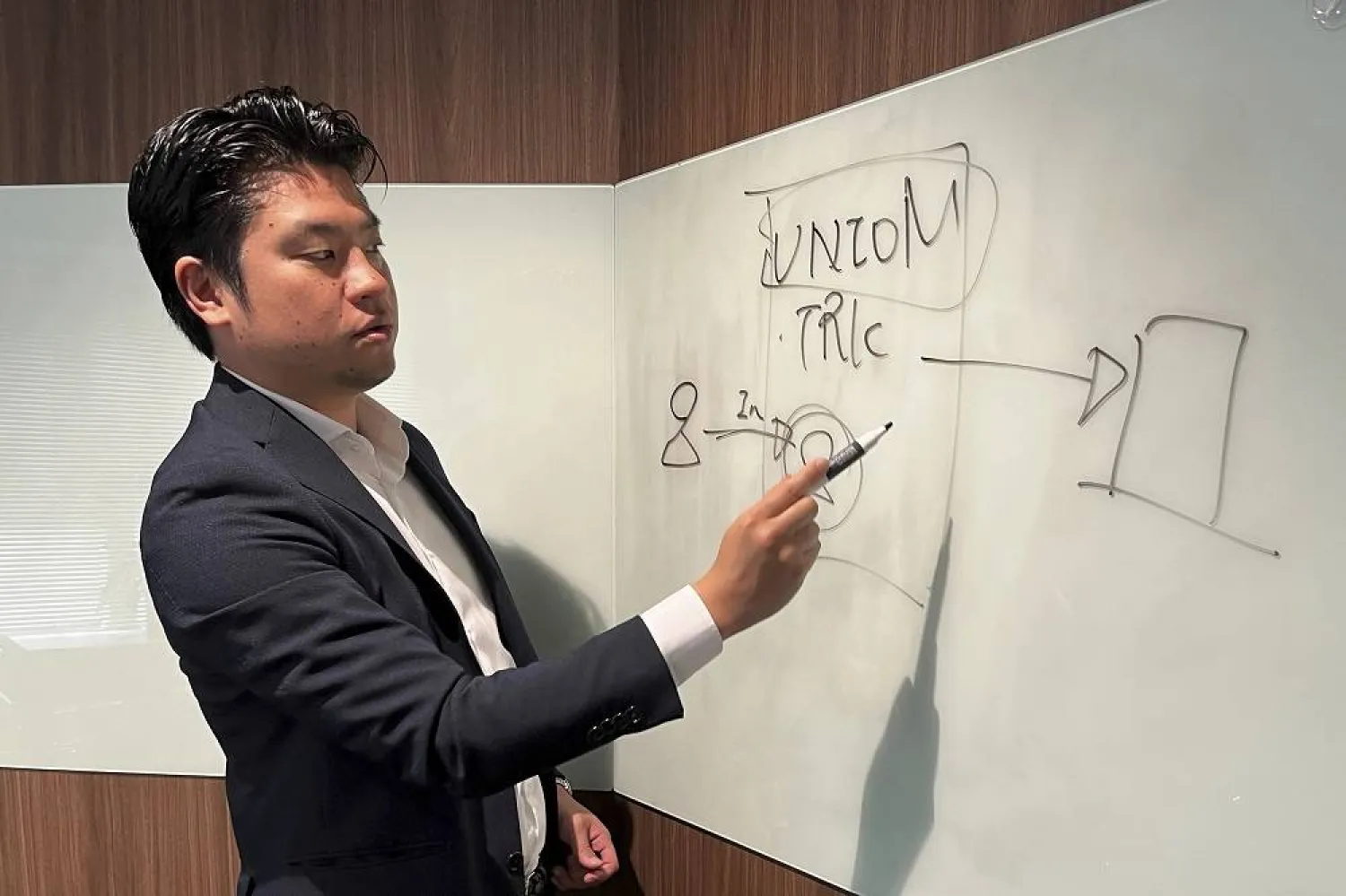
Yoshihito Hasegawa, who heads Tokyo-based TRK that runs a job-quitting service called Guardian, shows a diagram to explain what his service does at his office in Tokyo on June 21, 2023. (AP)
TT

In Workaholic Japan, ‘Job Leaving Agents’ Help People Escape Awkwardness of Quitting

Yoshihito Hasegawa, who heads Tokyo-based TRK that runs a job-quitting service called Guardian, shows a diagram to explain what his service does at his office in Tokyo on June 21, 2023. (AP)

In Japan, a nation reputed for loyalty to companies and lifetime employment, people who job-hop are often viewed as quitters. And that’s considered shameful.

Enter "taishoku daiko," or "job-leaving agents." Dozens of such services have sprung up in the last several years to help people who simply want out.

"Imagine a messy divorce," says Yoshihito Hasegawa, who heads Tokyo-based TRK, whose Guardian service last year advised 13,000 people on how to resign from their jobs with minimal hassles.

People often stick with jobs even when they're unhappy, feeling as if they are "kamikaze" sacrificing their lives for the greater good, he said, comparing his clients to pilots sent on suicide missions in the closing days of World War II.

"It’s the way things are done, the same way younger people are taught to honor older people," he said. "Quitting would be a betrayal."

Founded in 2020, Guardian, a taishoku daiko service, has helped various people, mostly in their 20s and 30s, escape less painfully from jobs they want to quit. That includes people who worked in a Shinto shrine, a dentist’s office and law firm to convenience store and restaurant staff.

Nearly half of Guardian's clients are women. Some work for a day or two and then discover promises of pay or work hours were false.

Guardian charges 29,800 yen ($208) for its service, which includes a three-month membership in a union that will represent an employee in what can quickly turn into a delicate and awkward negotiation process in Japan.

Generally, Guardian's clients have worked for the small and medium-sized businesses that employ most Japanese. Sometimes people working for major companies seek help. In many cases, bosses have a huge say over how things are run and sometimes simply refuse to let a worker leave, especially since many places are shorthanded to begin with, given the Japan's chronic labor shortage.

Japanese law basically guarantees people the right to quit, but some employers used to an old-style hierarchy just can’t accept that someone they have trained would want to walk away. Those tackling the quitting battle who were interviewed for this story used terms like "fanatics," "bullies" and "mini-Hitlers" to describe such bosses.

Conformist "workaholic" pressures in Japanese culture are painfully heavy. Workers don't want to be seen as troublemakers, are reluctant to question authority and may be afraid to speak up. They may fear harassment after they quit. Some worry about the opinions of their families or friends.

Although most of Guardian's clients prefer to be anonymous, a young man who goes by the online name of Twichan sought help after he was criticized for his sales performance and became so depressed he thought about killing himself. With Guardian's help he was able to quit in 45 minutes.

Taku Yamazaki, who went to a different taishoku daiko, said his former employer was a subsidiary of a major IT vendor and he knew his departure would be complicated and time-consuming because he was doing well there.

"I felt a certain amount of gratitude toward the place I was leaving, but I wanted to switch gears mentally and move forward as soon as possible," he said.

When people fill out taishoku daiko online forms, an automated reply comes within minutes, with a more personal reply promised within one working day.

Lawyer Akiko Ozawa, whose law firm advises job-leavers although usually it represents companies, acknowledged it may be hard to believe people can’t just pick up and leave.

"But switching jobs is a major challenge in Japan that requires tremendous courage," said Ozawa, who has written a book on taishoku daiko. Given the shortage of workers in Japan, finding and training replacements is tough and bosses sometimes erupt in outrage when someone resigns.

"As long as this Japanese mindset exists, the need for my job isn’t going away," said Ozawa, who charges 65,000 yen ($450) for her service. "If you are so unhappy that you’re starting to feel ill, then you should make that choice to take control over your own life."

Another quitting service, Albatross, offers a "MoMuri," or "can't stand it anymore" service, charges a 22,000 yen ($150) fee for full-time workers, and a bargain 12,000 yen ($80) fee for part-time workers.

Workplace problems have existed all along, but people now realize they can get help online, said its founder, Shinji Tanimoto.

"They tell us they couldn’t sleep at all before, but they can finally sleep all they want," he said of MoMuri's customers. "Users thank us all the time. Some cry tears of joy."

One person wanted to quit working at a pet salon where workers were secretly kicking the animals. Another wanted to quit job in a dental office where the staff weren’t using new gloves for each patient.

Many are women working as nurses or caretakers who are asked to stay until a replacement is found, but end up still working in the jobs a year later, he said.

Toshiyuki Niino founded Exit Inc., a frontrunner in the taishoku daiko sector, in 2018, after encountering a boss who constantly yelled at him. Another threatened to kill him.

He quit both jobs, and saw an opportunity.

"I am proud I started this genre of work," he said.

Exit charges 20,000 yen ($140). Now that employers understand what taishoku daiko is, it can be over in 15 minutes, once resignation papers are on their way.

Niino, who says he never once expressed an opinion in school, blames the Japanese educational system for turning out obedient workers who are unable to assert themselves.

He's thinking about branching out to include mental health counseling, job referrals and perhaps an overseas expansion.

Niino laughs, recounting how one of his own employees used a rival agency to resign and then went on to set up his own taishoku daiko company.

"It’s best if you yourself can say you want to quit," he said.


Picasso’s ‘Guernica’ at Heart of Battle in Spain Over Location

A visitor looks at Spanish painter Pablo Picasso's master piece "Guernica" during a press conference presenting the "Year of Picasso" events, marking the 50th anniversary of the painter's death, at the Reina Sofia museum in Madrid, on September 12, 2022. (Thomas Coex/ AFP)
TT

Picasso’s ‘Guernica’ at Heart of Battle in Spain Over Location

A visitor looks at Spanish painter Pablo Picasso's master piece "Guernica" during a press conference presenting the "Year of Picasso" events, marking the 50th anniversary of the painter's death, at the Reina Sofia museum in Madrid, on September 12, 2022. (Thomas Coex/ AFP)

Pablo Picasso's anti-war masterpiece "Guernica" is swept up in a conflict in Spain, where Basque leaders want the government in Madrid to move the painting to their region, whose 1937 bombing inspired it.

The mural-sized painting has been on display since 1992 at the Reina Sofia museum in the Spanish capital, and repeated requests for it to be moved to Spain's Basque Country have been refused.

The latest demand was made by the head of the regional Basque government, Imanol Pradales, during talks with Socialist Prime Minister Pedro Sanchez.

The Basque government wants the painting to be hung in the Guggenheim Museum in Bilbao to commemorate the 90th anniversary of the April 26, 1937, bombing, in which forces from Nazi Germany and Fascist Italy razed the town of Guernica to help General Francisco Franco in the Spanish Civil War.

Bringing the painting to Bilbao from October until June would be a form of "reparation and historical memory", the Basque government said.

Sanchez -- whose minority government depends on the support of two Basque parties in parliament to pass laws -- did not reject the proposal outright, instead referring it to the culture ministry.

The ministry asked the Reina Sofia museum for a technical report on the viability of the request, which once again "strongly advised" against moving the painting.

The report said the painting is too fragile to travel, citing risks of damage from vibration or movement.

Picasso's black-and-white masterpiece is the highlight of the Reina Sofia museum, which welcomed around 1.6 million visitors last year.

The outspoken head of the regional government of Madrid, Isabel Diaz Ayuso of the conservative Popular Party (PP), weighed in on Monday, calling the request to move the painting "provincial".

"It makes no sense for everything to be returned to its origin. In that case we should send all of Picasso's works to Malaga," she said, a reference to the southern Spanish city where Picasso was born.

- Return from New York -

Asked about the controversy on Tuesday, Spain's central government spokeswoman Elma Saiz said the government relies on the advice of "professionals", referring to the museum report, and "never resorts to insults".

Painted in 1937 in the aftermath of the bombing, "Guernica" debuted in Paris at the World's Fair, then was placed in the care of the Museum of Modern Art in New York.

When Franco's forces overthrew the Spanish republic, Picasso stipulated that the painting should not return to Spain until democracy had been restored.

The work was moved to Spain in 1981, six years after Franco's death.

It was first displayed at the Prado museum, then moved to the Reina Sofia in 1992.

Picasso, who died in 1973, never lived to see the painting on exhibit in Spain.

In 1995, Spanish authorities refused to lend it to the Pompidou Center in Paris, citing the damage the work could suffer during its transport.


Cultural Development Fund Reports Strong Q1 2026 Growth and Impact

Cultural Development Fund Reports Strong Q1 2026 Growth and Impact
TT

Cultural Development Fund Reports Strong Q1 2026 Growth and Impact

Cultural Development Fund Reports Strong Q1 2026 Growth and Impact

The Cultural Development Fund has announced its results for the first quarter of 2026, demonstrating significant growth in financial performance and developmental impact. This underscores the fund's role as a key financial enabler and center of excellence in developing a sustainable cultural sector, enhancing Saudi culture as a vital economic and social pillar, SPA reported.

Since its inception, the fund has provided over SAR770 million in financial support to 165 cultural projects across various sub-sectors and regions of the Kingdom. It has also benefited more than 1,630 creative individuals and entrepreneurs through developmental services aimed at building entrepreneurial capabilities.

The fund achieved a 30% increase in financial returns compared to the same period in 2025, contributing an estimated SAR4.1 billion to GDP and creating over 12,540 job opportunities.

Additionally, it has stimulated private sector involvement with approximately SAR1.1 billion in contributions, reflecting growing confidence in developing the cultural sector.

These figures highlight the fund's essential role in empowering the private sector and fostering innovative financial solutions that promote growth and enhance the quality of life, aligned with Saudi Vision 2030.


Historic Jeddah Showcases Cultural Heritage at Umrah and Ziyarah Forum

The pavilion highlighted the distinctive architectural features of Historic Jeddah - SPA
TT

Historic Jeddah Showcases Cultural Heritage at Umrah and Ziyarah Forum

The pavilion highlighted the distinctive architectural features of Historic Jeddah - SPA

Historic Jeddah participated in the Umrah and Ziyarah Forum to highlight its historical role as a key gateway for pilgrims to Makkah, while introducing visitors to its cultural status and the ongoing development projects that reinforce its status as a heritage destination, SPA reported.

The pavilion introduced visitors to the "Historic Hajj Trail" supported by the Ministry of Hajj and Umrah, designed as a sequential narrative that retraces the pilgrim’s journey from arriving at Bab Al-Bunt Port, now the Red Sea Museum, to Makkah Gate, passing through prominent historical sites that reflect Jeddah’s role in serving pilgrims.

The pavilion highlighted the distinctive architectural features of Historic Jeddah and its long-standing role as a major port for pilgrims since the 7th century CE and also featured interactive content showcasing the area’s cultural and social fabric.

This participation forms part of the "Revitalization of Historic Jeddah" project, led by the Ministry of Culture, within the framework of the National Culture Strategy and Saudi Vision 2030.