

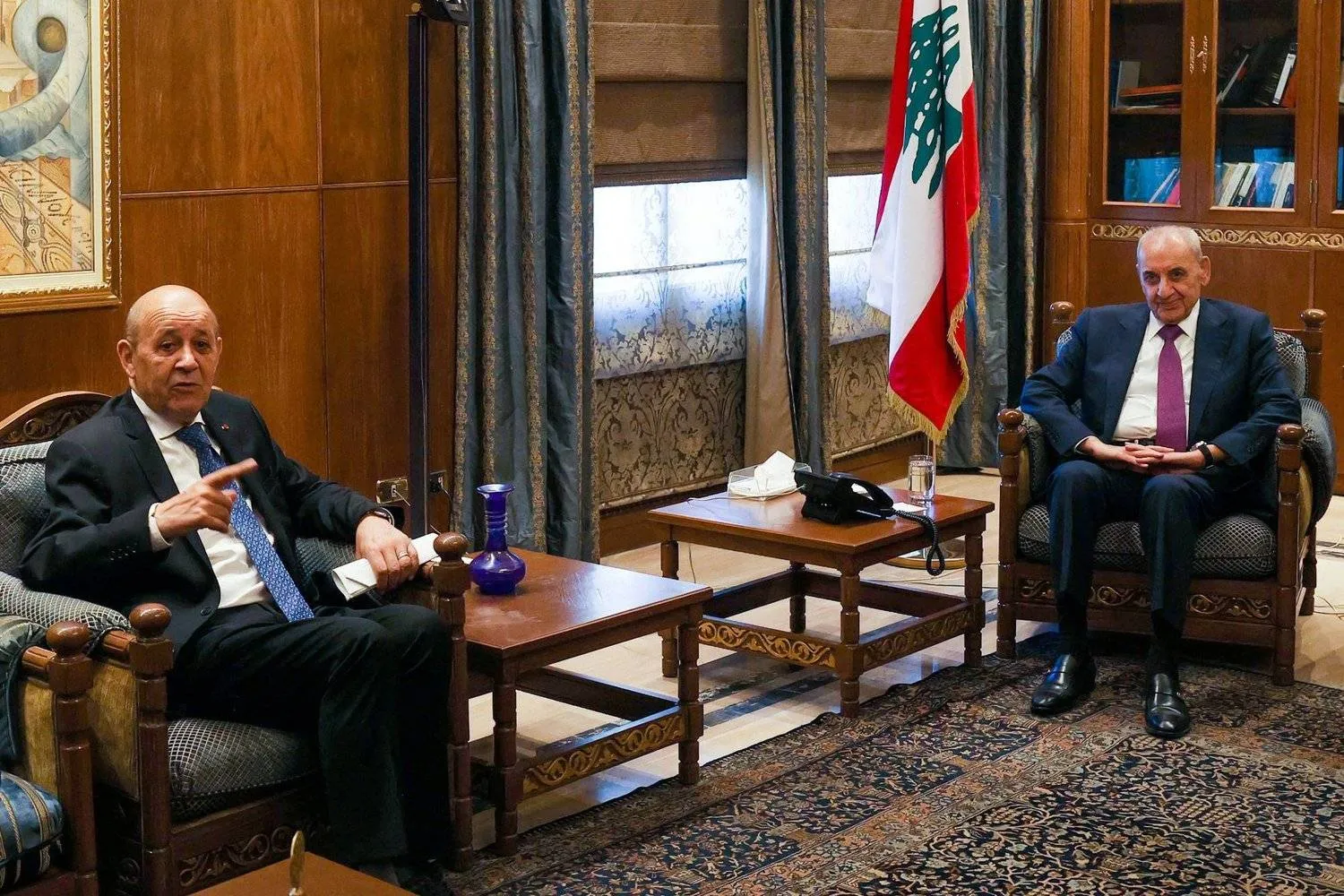

Le Drian Backs Berri’s Call for Dialogue, Says Will Help End Presidential Impasse in Lebanon

French special envoy Jean-Yves Le Drian (L) speaks during a meeting with Lebanon's Speaker of the parliament Nabih Berri in Beirut on September 12, 2023. (AFP)
TT

Le Drian Backs Berri’s Call for Dialogue, Says Will Help End Presidential Impasse in Lebanon

French special envoy Jean-Yves Le Drian (L) speaks during a meeting with Lebanon's Speaker of the parliament Nabih Berri in Beirut on September 12, 2023. (AFP)

French presidential envoy Jean-Yves Le Drian has expressed his support to Lebanese parliament Speaker Nabih Berri’s call to hold unconditional dialogue between rival political powers over the presidential deadlock.

Le Drian kicked off his latest tour to Lebanon on Tuesday by meeting Berri, who said they both agreed that dialogue was the only way forward.

The French official hoped that dialogue over the election of a president would pave the way for a solution to the crisis.

Sources monitoring his tour said he backed Berri's proposal because it was the “only viable initiative that could create a breakthrough in the impasse” as each political camp continues to remain unyielding in its demands.

The opposition has rejected the call for dialogue, instead demanding that parliament hold successive presidential elections until a head of state is elected.

The sources wondered if Le Drian was capable of persuading the opposition to join the dialogue. It also wondered if head of the Free Patriotic Movement MP Gebran Bassil would be persuaded to join the talks after he backed down from supporting them.

Le Drian supports holding dialogue that would go beyond discussing possible presidential candidates and cover “all files without any vetoes and preconditions,” said the sources.

Berri had invited the political powers to take part in the dialogue in August, setting their date for September.

Le Drian later met with caretaker Prime Minister Najib Mikati. He said he had returned to Lebanon “to complete his mission,” adding that he won’t declare his position until after he concludes his talks with all concerned parties.

For his part, Mikati stressed that the beginning of the solution lies in electing a new president and carrying out economic reforms.

Le Drian later met with army commander Joseph Aoun to discuss security in Lebanon and the challenges faced by the military, especially in regard to Syrian refugees and tensions between Palestinian factions.

The envoy said France will continue to support the army and boost its capabilities to help it carry out various duties.

Le Drian is expected to meet with opposition figures on Wednesday, starting with Lebanese Forces leader Samir Geagea.

“Bit by bit, the axis of resistance is running out of options in Lebanon,” said LF MP Fadi Karam on the X platform. “It has failed in imposing its presidential candidate” and dialogue is its way of trying to reach a settlement.



Egyptian Gaza Relief Group Says Israeli Strike on Photographers Was Deliberate

An aid distribution point in northern Gaza operated by the Egyptian Relief Committee (Egyptian Relief Committee)
TT

Egyptian Gaza Relief Group Says Israeli Strike on Photographers Was Deliberate

An aid distribution point in northern Gaza operated by the Egyptian Relief Committee (Egyptian Relief Committee)

The spokesperson for the Egyptian Relief Committee in Gaza, Mohamed Mansour, said Israel deliberately targeted three photojournalists while they were carrying out a humanitarian mission inside the Netzarim camp, an area located about six kilometers away from Israeli army forces.

Mansour told Asharq Al-Awsat that the attack was “a continuation of Israeli pressure on the committee’s work since it began operating, as part of the occupation’s efforts to tighten restrictions on anyone attempting to provide relief work and humanitarian services to the people of Gaza.”

The Israeli army killed three photojournalists on Wednesday who were working as a media team for the Egyptian Relief Committee for Gaza.

Field sources told Asharq Al-Awsat that the victims were Mohammed Salah Qashta, Abdul Raouf Shaat, and Anas Ghneim.

They were carrying out a filming mission using a small drone and cameras to document stages of work at camps that the Egyptian committee is helping to establish.

Mansour stressed that “the targeting of the photographers will only increase the committee’s determination to provide relief services and shelter to the Palestinian people.”

He said the committee would continue its work as usual to be “a genuine support for the people of the Strip, amid extremely complex security conditions.”

Israeli Army Radio reported, citing sources, that Egypt sent an angry message to Israel following the attack in Gaza in which Palestinians working for the Egyptian committee for the reconstruction were killed.

According to the radio report, Egypt expressed its protest that the attack took place outside the boundaries of the so-called yellow line, in an area that does not pose a threat to Israeli forces.

For its part, the Israeli army claimed it had targeted suspects operating a “Hamas-affiliated drone” in central Gaza.

In a statement on Wednesday, the army said: “Following the identification of the drone and due to the threat it posed to the forces, the Israeli army precisely struck the suspects who were operating the drone.”

The army said the details were under review.


Israel Launches Wave of Fresh Strikes on Lebanon

Smoke and sparks ascend from the site of an Israeli airstrike that targeted a building in the southern Lebanese village of Kfour on January 21, 2026. (AFP)
TT

Israel Launches Wave of Fresh Strikes on Lebanon

Smoke and sparks ascend from the site of an Israeli airstrike that targeted a building in the southern Lebanese village of Kfour on January 21, 2026. (AFP)

Israel launched fresh strikes on what it said were Hezbollah targets in south Lebanon after raids earlier Wednesday killed two people, the latest violence despite a year-old ceasefire with the group.

The state-run National News Agency said Israeli warplanes launched raids on buildings in several south Lebanon towns including Qanarit and Kfour, after the Israeli army issued evacuation warnings to residents identifying sites it intended to strike there.

An AFP photographer was slightly wounded along with two other journalists who were working near the site of a heavy strike in Qanarit.

The Israeli army said it was striking Hezbollah targets in response to the group's "repeated violations of the ceasefire understandings".

Under heavy US pressure and fears of expanded Israeli strikes, Lebanon has committed to disarming Hezbollah.

But Israel has criticized the Lebanese army's progress as insufficient and has kept up regular strikes, usually saying it is targeting members of the Iran-backed group or its infrastructure.

Earlier Wednesday, the health ministry said an Israeli strike on a vehicle in the town of Zahrani, in the Sidon district, killed one person.

An AFP correspondent saw a charred car on a main road with debris strewn across the area and emergency workers in attendance.

Later, the ministry said another strike targeting a vehicle in the town of Bazuriyeh in the Tyre district killed one person.

Israel said it struck Hezbollah operatives in both areas.

A Lebanese army statement decried the Israeli targeting of "civilian buildings and homes" in a "blatant violation of Lebanon's sovereignty" and the ceasefire deal.

It also said such attacks "hinder the army's efforts" to complete the disarmament plan.

This month, the army said it had completed the first phase of its plan to disarm Hezbollah, covering the area south of the Litani river, around 30 kilometers (20 miles) from the Israeli border.

Most of Wednesday's strikes were north of the river.

More than 350 people have been killed by Israeli fire in Lebanon since the ceasefire, according to an AFP tally of health ministry reports.

The November 2024 truce sought to end more than a year of hostilities, but Israel accuses Hezbollah of rearming, while the group has rejected calls to surrender its weapons.


Syria’s Rifaat Al-Assad, ‘Butcher of Hama’, Dies Aged 88, Say Sources

Rifaat al-Assad, uncle of deposed Syrian ruler Bashar al-Assad. (AP file)
TT

Syria’s Rifaat Al-Assad, ‘Butcher of Hama’, Dies Aged 88, Say Sources

Rifaat al-Assad, uncle of deposed Syrian ruler Bashar al-Assad. (AP file)

Rifaat al-Assad, uncle of deposed Syrian ruler Bashar al-Assad and dubbed the "Butcher of Hama" for suppressing an uprising in the 1980s, has died aged 88, two sources close to the family said Wednesday.

Once a pillar of the Assad family's dynastic rule, Rifaat "died after suffering from influenza for around a week", one source who worked in Syria's presidential palace for over three decades told AFP.

A second source, an ex-officer of Syria's army in the Assad era, confirmed the death, saying Rifaat had moved to the United Arab Emirates after his nephew's government was toppled by opposition factions in December 2024, without specifying if he died there.

Rifaat's role in a February 1982 massacre as part of a crackdown on an armed revolt by the Muslim Brotherhood earned him the nickname "the Butcher of Hama", referring to the central Syrian city.

His brother Hafez al-Assad, who ruled Syria at the time, launched the campaign, which government forces carried out under the command of Rifaat, who was the head of the elite "Defense Brigades".

The death toll from 27 days of violence, which took place under a media blackout, has never been formally established, though estimates range from 10,000 to 40,000.

Swiss prosecutors had accused Rifaat of a long list of crimes, including ordering "murders, acts of torture, inhumane treatment and illegal detentions" while an officer in the Syrian army.

He also served as vice president under his brother Hafez but went into exile in 1984 after a failed attempt to overthrow him, moving to Switzerland then France.

He later presented himself as an opponent of his nephew Bashar, who succeeded Hafez in 2000.

In 2021, he returned to Syria from France to escape a four-year prison sentence for money laundering and misappropriation of Syrian public funds.

Two years later, he appeared in a family photo alongside Bashar, the ruler's wife Asma and other relatives.

Shortly after Bashar's ouster, Rifaat crossed into Lebanon and then flew out of Beirut airport, a Lebanese security source said at the time, without specifying his final destination.