US Launches Airstrikes on Military Targets of Houthis in Yemen

Smoke rises after US strikes in Sanaa, Yemen, December 31, 2024. (Reuters)
TT

US Launches Airstrikes on Military Targets of Houthis in Yemen

Smoke rises after US strikes in Sanaa, Yemen, December 31, 2024. (Reuters)

The US military has launched airstrikes targeting military facilities belonging to Yemen's Houthi militias in capital Sanaa.

US Navy ships and aircraft targeted a Houthi command and control facility and advanced conventional weapon production and storage facilities that included missiles and uncrewed aerial vehicles, the Central Command said.

It said the facilities that were hit were used in attacks against US Navy warships and merchant vessels in the southern Red Sea and Gulf of Aden. US Navy and Air Force aircraft also destroyed a Houthi coastal radar site, seven cruise missiles and UAVs over the Red Sea, it said.

The Houthis have been firing drones and missiles at Israel, as well as attacking shipping in the Red Sea corridor — attacks they say won’t stop until Israel agrees to a ceasefire with Hamas in the Gaza Strip.

The Houthis' media office said Tuesday that 10 airstrikes hit the May 22 facility in Sanaa’s northern Thurah district and two more hit the Aradi facility, which houses the militias’ so-called defense ministry in central Sanaa.

Mohammed Abdul-Salam, the Houthi chief negotiator and spokesman, called the strikes “a gross violation of the sovereignty of an independent state.”


Arms Smuggling Attempt Foiled on Syria-Lebanon Border

Border guards in outskirts of Flita, west of Damascus, foil arms smuggling attempt on Syria-Lebanon border (SANA)
TT

Arms Smuggling Attempt Foiled on Syria-Lebanon Border

Border guards in outskirts of Flita, west of Damascus, foil arms smuggling attempt on Syria-Lebanon border (SANA)

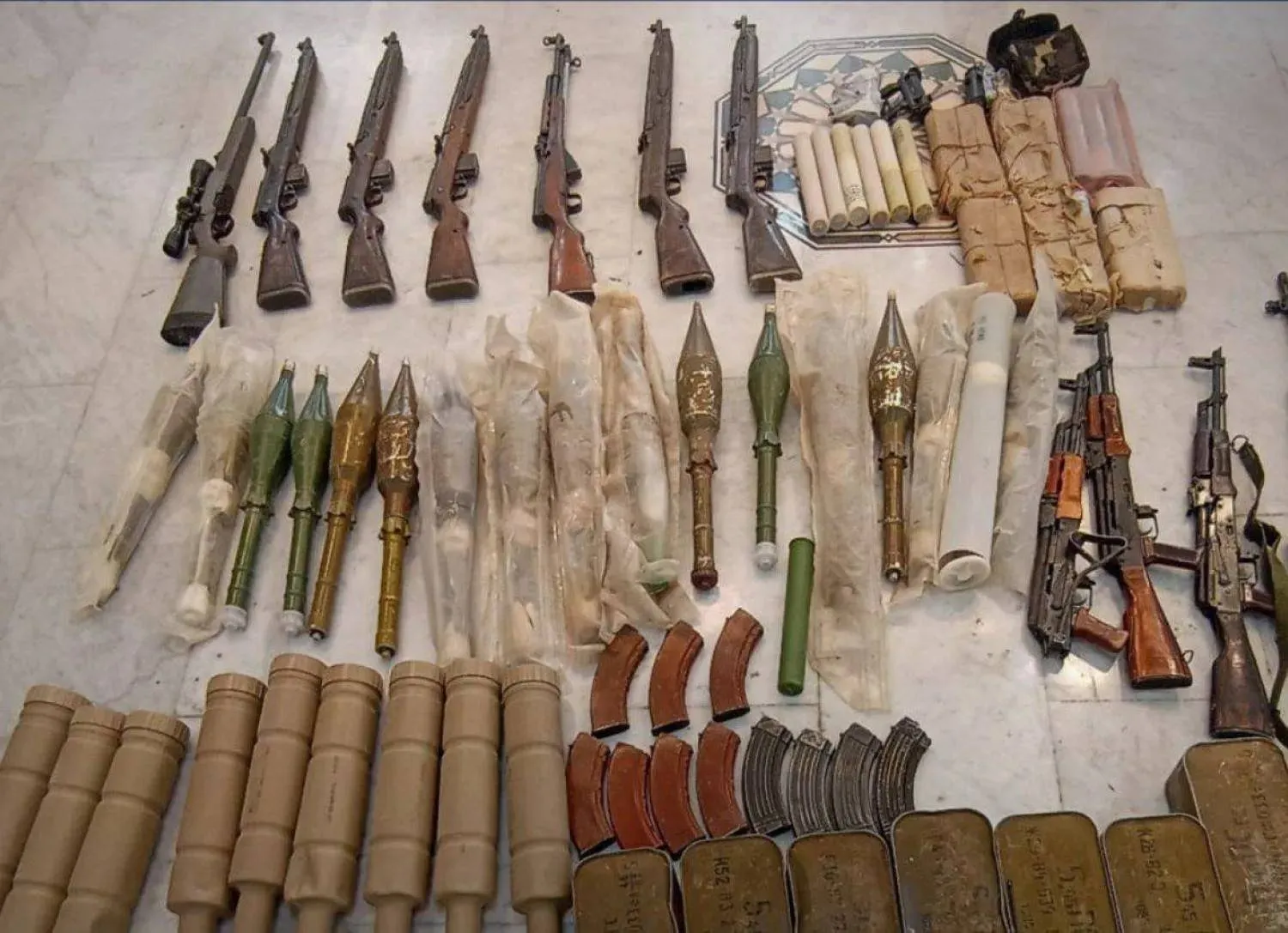
Syria’s defense ministry said border guard forces in the outskirts of Flita area west of Damascus had foiled an attempt to smuggle weapons across the Syrian-Lebanese border after what it described as a tightly executed ambush.

The ministry’s media and communications office said the operation led to the arrest of four people, including two Lebanese nationals, and the seizure of a quantity of weapons and ammunition.

It said the suspects had been referred to the relevant authorities for legal action.

The operation came amid growing tension and anxiety along the Syrian-Lebanese frontier after the Syrian army reinforced its deployment on the border with Lebanon, reviving memories of the Syrian military’s intervention in Lebanon in the 1970s.

Lebanese Foreign Minister Youssef Rajji said in a post on X that, on the sidelines of an emergency consultative meeting held in Riyadh, he had a brief conversation with his Syrian counterpart Asaad al-Shibani, who told him the deployment of Syrian forces on the border with Lebanon was aimed solely at protecting Syrian territory and securing the frontier against any security breach or smuggling activity.

Shibani stressed that Syria did not intend to enter Lebanon or interfere in its internal affairs in any way.

Syria’s border guard forces continue to work to secure the frontier and combat armed groups, drug and weapons smuggling, and other illegal activities that exploit security conditions in some border areas. They are also working to regulate movement along the border and monitor any activity that poses a security threat.

Earlier this month, the Rif Dimashq Media Directorate announced the seizure of a shipment of weapons prepared for smuggling across the Syrian-Lebanese border.

It said the shipment was found in the Nabek area of the Qalamoun region in the Damascus countryside and that the operation was part of efforts to combat organized crime and crack down on smuggling.

The Internal Security Directorate in the Zabadani area of Rif Dimashq also said it had foiled an attempt on Dec. 17 to smuggle a shipment of weapons into Lebanon.


Israel Targets Hezbollah-Linked Financial Interests

A man walks amid the rubble of buildings destroyed by Israeli bombardment in Beirut’s Zokak el-Blat district near the city center (Reuters)
TT

Israel Targets Hezbollah-Linked Financial Interests

A man walks amid the rubble of buildings destroyed by Israeli bombardment in Beirut’s Zokak el-Blat district near the city center (Reuters)

Israel has stepped up its operations against Hezbollah in recent days, escalating on multiple fronts in response to the group’s intensified attacks into Israeli territory and its use of precision and ballistic missiles that have reshaped the battlefield.

Tel Aviv has widened its targets to include civilian-linked interests tied to the group. After striking branches of Al-Qard Al-Hasan, a financial institution directly associated with Hezbollah, it launched a series of raids on gas stations operated by Al-Amana in several villages in southern Lebanon.

Israel says the company represents “a key economic infrastructure for Hezbollah, generating millions of dollars in profits,” adding that the stations’ accounts at Al-Qard Al-Hasan are used to finance its activities.

The Israeli military said in a statement that targeting the gas stations “deals a significant blow to Hezbollah’s military infrastructure in Lebanon and to the ability of its operatives to plan attacks.”

It added that the strikes are part of broader efforts to undermine “Hezbollah’s economic entrenchment within the civilian population.”

An escalating path

Ali al-Amin, editor-in-chief of Janoubia, said the targeting of civilian institutions linked to the group “reflects an escalating trajectory in Israel’s campaign against Hezbollah, after earlier strikes focused primarily on security and military targets.”

He said this falls within “Israel’s declared efforts to uproot and eliminate the party.”

Al-Amin told Asharq Al-Awsat that the gas station network is “one source of funding and a revenue-generating institution, but certainly not among the main sources.”

An economist, who declined to be named, said Hezbollah’s core funding has historically come from abroad, whether by land, sea, or air, as well as through financial transfers and intermediaries inside Lebanon and overseas.

He said that “with the fall of the regime in Syria, land routes for funds were cut, while US-Israeli maritime control reduced transfers by sea.”

“Funds were also transported by air through Iranian diplomatic missions and Iranian aircraft, whose access to Lebanon has been blocked,” he added.

The source said “institutions linked to the party are still operating, and there are attempts to circumvent circulars issued by Lebanon’s central bank and the Justice Ministry through various intermediaries,” noting that “some of the buildings currently targeted by Israel are used to store funds.”

Direct impact on Hezbollah’s base

Efforts to financially squeeze Hezbollah are directly affecting its support base, which Israel is seeking to pressure, according to Mona Fayad, a political writer and psychology professor at the Lebanese University in Beirut.

She said “Tel Aviv is exerting pressure on this environment through various means, betting on it to mobilize and speak out against Hezbollah.”

Fayad added that “the party’s failure to provide financial support and services to its fighters, their families and its broader base is pushing its leadership to try to turn them into a pressure tool against the state, leading to internal tensions and social unrest that Israel is seeking to fuel.”



Sources to Asharq Al-Awsat: Meshaal Contacts Gaza Factions on Fate of Weapons

Fighters from Hamas’ Al-Qassam Brigades in Rafah, southern Gaza. (Reuters, file)
TT

Sources to Asharq Al-Awsat: Meshaal Contacts Gaza Factions on Fate of Weapons

Fighters from Hamas’ Al-Qassam Brigades in Rafah, southern Gaza. (Reuters, file)

Hamas is holding internal talks and consulting Palestinian factions on the fate of weapons in Gaza, an issue central to US President Donald Trump’s plan, which calls for full disarmament and links it to reconstruction.

Talks have slowed in recent weeks amid the US-Israeli war on Iran. Still, Hamas and faction sources told Asharq Al-Awsat that Khaled Meshaal, head of Hamas’ political bureau abroad and a contender to lead the movement, has contacted leaders in Gaza to discuss the weapons file.

A Hamas source said most contacts took place before the war on Iran, as part of ongoing coordination to forge a unified Palestinian position on “resistance weapons,” their future, and how to preserve core Palestinian principles.

A source from a Gaza faction involved in the consultations said leaders told Meshaal there are no longer “heavy weapons” as defined by Israel, including long or short-range rockets.

Remaining capabilities are limited, including small numbers of anti-armor rounds, improvised explosive devices, and light arms such as Kalashnikov rifles, as well as some DShK machine guns mounted on pickup trucks, which they said do not pose a threat.

The source said factions proposed handing over a limited number of pickup trucks fitted with DShK weapons, which Israel classifies as heavy arms. They also suggested exploring mechanisms with mediators to allow the “resistance” to retain light weapons under guarantees, with mediators overseeing the process in exchange for a long-term truce.

On tunnels, sources said most have been targeted and largely destroyed by Israeli forces, with only a few remaining that do not affect Israel.

Both sources said the ideas remain at the consultation stage, adding the weapons issue has not been formally raised by mediators, though informal contacts have taken place.

Israel insists on the surrender of all weapons. Prime Minister Benjamin Netanyahu recently said he wants Hamas to hand over 60,000 Kalashnikov rifles.

Palestinian sources said such numbers are not available in Gaza, calling the demand unrealistic after a two-year war that devastated the enclave.

Palestinian factions and mediators are awaiting a formal US proposal outlining its disarmament vision, but it has been delayed by the war on Iran. Limited recent contacts with mediators on humanitarian issues could revive discussions.

Leaders and field commanders in Gaza factions insist on discussing any approach to the weapons file and reject imposing terms on the “resistance.” A Hamas source said factions cannot easily give up their weapons after decades of sacrifices.

A Hamas delegation has been in Cairo for about a week discussing ways to ease Gaza’s dire humanitarian situation amid ongoing Israeli breaches, with expectations that mobilization could resume on issues related to a Gaza administrative committee and an international stabilization force.