


US Congressman Discusses with Syrian President Return of Body of American Killed in Syria

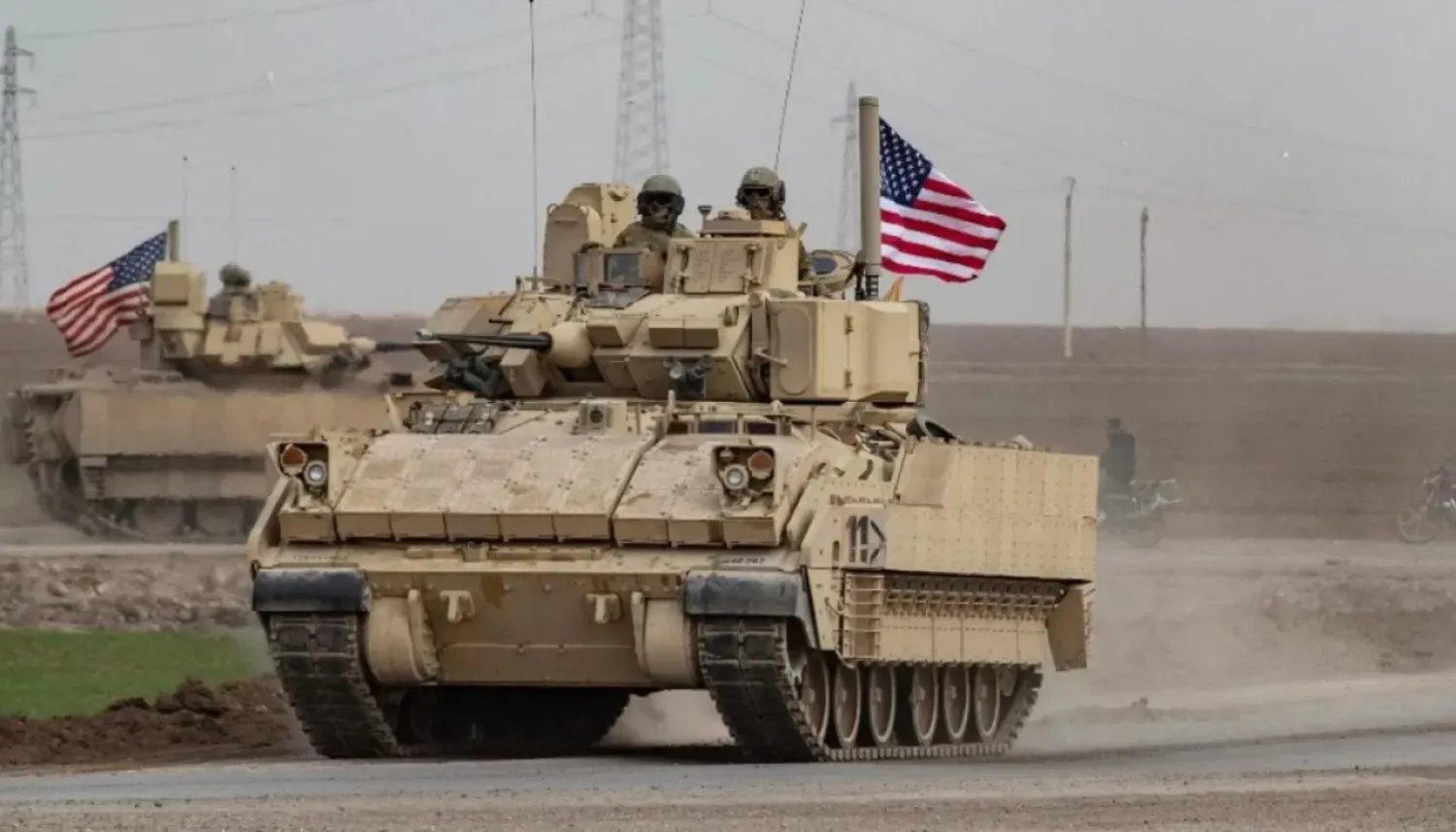
US forces patrol for children of suspected ISIS members in the town of Tal Maaruf in Syria's northeastern Hasakeh province, on 15 December 2022. Photo: AFP
TT

US Congressman Discusses with Syrian President Return of Body of American Killed in Syria

US forces patrol for children of suspected ISIS members in the town of Tal Maaruf in Syria's northeastern Hasakeh province, on 15 December 2022. Photo: AFP

US Congressman Abraham Hamadeh made a brief visit to Syria where he discussed with the country’s interim president the return of the body of an American aid worker who was taken hostage and later confirmed dead in the war-torn country, his office said Monday.

Hamadeh’s visit to Syria comes as a search has been underway in remote parts of the country for the remains of people who were killed by the ISIS group that once controlled large parts of Syria and Iraq before its territorial defeat six years ago, The AP news reported.

Kayla Mueller, 26, was captured in northern Syria in August 2013 and her family and US officials confirmed her death more than a year later. Hamadeh, an Arizona Republican, has vowed to return Mueller’s body — which has not yet been found — to her family.

Hamadeh’s office said he was in Syria for six hours to meet President Ahmad al-Sharaa to discuss the return of Mueller’s body to her family in Arizona. The statement added that Hamadeh also discussed the need to establish a secure humanitarian corridor for the safe delivery of medical and humanitarian aid to the southern province of Sweida that recently witnessed deadly clashes between pro-government fighters and gunmen from the country’s Druze minority.

Dozens of foreigners, including aid workers and journalists, were killed by ISIS militants who declared a so-called caliphate in 2014. The militant group lost most of its territory in Iraq in late 2017 and was declared defeated in 2019 when it lost the last sliver of land it controlled in east Syria.

Since then, dozens of gravesites and mass graves have been discovered in northern Syria containing remains and bodies of people ISIS had abducted over the years.

American journalists James Foley and Steven Sotloff, as well as humanitarian workers Mueller and Peter Kassig are among those killed by ISIS. None of the remains is believed to have been found.

Mueller, from Prescott, Arizona, was taken hostage with her boyfriend, Omar Alkhani, after leaving a Doctors Without Borders hospital in Aleppo, Syria, where he had been hired to fix the internet service for the hospital. Mueller had begged him to let her tag along because she wanted to do relief work in the war-ravaged country. Alkhani was released after two months, having been beaten.

In 2015, the Pentagon said Mueller died at the hands of ISIS and not in a Jordanian airstrike targeting the militant group as the extremists claimed earlier.


Hezbollah 'Addresses Its Supporters'...Reveals Using Surface-to-Air Missiles

An Israeli helicopter flying in Israeli airspace near the border with Lebanon (EPA)
TT

Hezbollah 'Addresses Its Supporters'...Reveals Using Surface-to-Air Missiles

An Israeli helicopter flying in Israeli airspace near the border with Lebanon (EPA)

Hezbollah has, in recent days, activated the use of surface-to-air missiles to target Israeli drones, in addition to firing them at helicopters and fighter jets, according to statements it issued. It reported the downing of several drones in southern Lebanon and damage to a helicopter, while experts say these announcements are “directed inward to suggest that Israel does not have air superiority over Lebanon’s skies, a claim that is illusory.”

While the group had used this type of missile in the previous war in 2024, it has recently intensified their use, with five such operations recorded last Wednesday, raising questions about the types of missiles it possesses and their ability to alter the course of the battle, given Israel’s air superiority, which remains a decisive factor in favor of Tel Aviv.

Notably, last week the group announced that it had engaged an Israeli warplane over Beirut using a surface-to-air missile, in the first operation of its kind over the capital. This raised concerns about civil aviation, as the launch took place from the vicinity of Beirut International Airport.

Hezbollah has focused on using surface-to-air missiles in the southern border area, specifically in attempts to target and down Israeli helicopters during the evacuation of dead or wounded Israeli soldiers.

A Hezbollah fighter carrying an air defense missile during a previous military exercise (file photo – Asharq Al-Awsat)

What Missiles Is the Group Using?

Regarding the type of missiles used, Dr. Riad Kahwaji, a researcher and writer on security and defense affairs, said: “These missiles are shoulder-fired and are of the Misagh type, a modified and upgraded model similar to the Russian SAM-7. Hezbollah used them in the previous war and downed a number of drones with them.”

He added that the group announces such operations to claim that Israel does not have air superiority and that it possesses air defenses capable of confronting aircraft, in order to create an illusion for its audience.

“In reality, the maximum capability of these missiles is limited to targeting some drones, nothing more, given that Israeli fighter jets have overcome the advanced Russian S-300 air defense system, which is a highly advanced system.”

Kahwaji told Asharq Al-Awsat that “the air defenses possessed by the group do not pose any threat whatsoever, near or far, to Israeli aircraft, which enjoy complete air superiority over the skies of Lebanon and Iran.”

Types of Surface-to-Air Missiles

Misagh-2 missiles are relatively modern and effective against low-altitude targets. They track the heat signature of an aircraft or helicopter engine and are fired from the shoulder by a single soldier, with a range of between 5 and 6 kilometers. By contrast, the Russian S-300 is an integrated air defense system and one of the most well-known and most powerful long-range systems in the world, with a range of between 75 and 200 kilometers. Iran possesses the Russian S-300 system as well as the long-range Bavar-373 system, but it has not succeeded in downing any fighter jet during the ongoing US-Israeli war.

Hezbollah Operations

Hezbollah announced last week that it had launched a surface-to-air missile toward an Israeli warplane over Beirut. It also said it targeted an Israeli helicopter on Tuesday over the town of Yaroun with two surface-to-air missiles, stating that its fighters “achieved a confirmed hit.”

The group also said on Wednesday that it had downed an Israeli military drone of the Hermes 450 (Zik) type over the town of Aita al-Shaab using a surface-to-air missile. It added that its fighters also engaged an Israeli warplane on Wednesday over the town of Jouaiya using a surface-to-air missile.


Syrian Troops Uncover Tunnel Network on Lebanon Border

Syrian soldiers inspect a tunnel on the Lebanon border in the Qusayr area © Bakr ALkasem / AFP
TT

Syrian Troops Uncover Tunnel Network on Lebanon Border

Syrian soldiers inspect a tunnel on the Lebanon border in the Qusayr area © Bakr ALkasem / AFP

In rugged terrain along the Syrian-Lebanese border, yellow bulldozers raised earthen berms in front of armoured vehicles while soldiers combed through tunnels they said were used by Hezbollah, as Syria reinforces its side of the border.

Syria is seeking to stay out of the regional war, whose flames have reached neighboring Lebanon, where Hezbollah is fighting a fierce conflict with Israel.

In rural Qusayr, Syrian soldiers showed an AFP photographer -- granted permission by the defense ministry to film the deployment for the first time since reinforcements were brought in a month ago -- several cross-border tunnels that the army has discovered in recent weeks.

Mohammad Hammoud, the official in charge of Syrian border posts facing Lebanon, told AFP the army discovered by "combing the border areas... a network of tunnels connecting the two countries that were used to smuggle weapons and drugs".

An AFP photographer saw at least five such tunnels, including one whose entrance was dug in the basement of a house, with concrete steps descending into narrow, dark passageways.

Other tunnels in the mountainous area were equipped with electrical wiring and ventilation systems.

In another house leading to a tunnel entrance, a picture of the late Hezbollah chief Hassan Nasrallah hung on the wall, alongside another of the late Iranian general Qasem Soleimani.

A Syrian army field commander said Hezbollah used the tunnels.

The rural Qusayr area serves as a crossroads linking Syria's western Homs province to the Lebanese Bekaa Valley.

- Coordinating with Beirut -

It became a bastion of Hezbollah influence after the Lebanese group's intervention in support of former ruler Bashar al-Assad in 2013 during Syria's civil war.

Since Assad's ouster in December 2024 by an alliance of factions led by new President Ahmed al-Sharaa, Hezbollah's supply lines from Syria have been cut off and the new authorities in Damascus say they are coordinating with Beirut to combat smuggling and to control crossings.

On March 28, Syrian authorities announced the discovery of a tunnel near a village in Homs province linking Syrian territory to Lebanon, saying that "Lebanese militias" used it for smuggling.

Israel has announced multiple times that it attacked border crossings, saying the aim was to prevent military supplies from reaching Hezbollah.

An AFP correspondent saw sites damaged by Israeli strikes, including destroyed buildings near one tunnel.

Nearby, Syrian soldiers were on foot patrol and one fighter stood watching a Lebanese army position from a distance.

On March 4, the Syrian authorities announced a reinforcement of the army on the border with Lebanon, deploying "armoured vehicles, soldiers, rocket launchers, and reconnaissance battalions to monitor border activities and combat smuggling".

The goal, it said, was "securing and controlling the border amid the escalation of the ongoing regional war".

According to a diplomatic source, "the Damascus government has been pressured to intervene in Lebanon to end (Hezbollah's) threat in the region, but it refused".

- No military action -

Syria dominated Lebanon for decades following a military intervention in the latter's 1975-1990 civil war, withdrawing only in 2005, making any new military involvement a fraught proposition.

But a Syrian military source told AFP on Wednesday that "the Syrian army has no intention of any military action, and its mission is currently limited to border control only".

Although Syria has not yet been dragged into the regional conflict, on March 10 Damascus accused Hezbollah of shelling Syrian army positions near Serghaya, west of Damascus.

On the same day, Sharaa and Lebanese President Joseph Aoun, in a telephone call, stressed the need to "control the border" and prevent "any security breakdown".

Sharaa reiterated on Tuesday that his country wanted to remain out of the conflict, in a discussion with the Chatham House think tank during a visit to Britain.

"So long as Syria is not directly targeted by any party, it will remain outside this conflict," he said.

"Fourteen years of war in Syria are enough. We have paid a very heavy price, and we are not ready to go through a new experience."


Sudan Appoints Yassir al-Atta Armed Forces Chief of Staff

A man walks while smoke rises above buildings after aerial bombardment, during clashes between the paramilitary Rapid Support Forces and the army in Khartoum North, Sudan, May 1, 2023. REUTERS/Mohamed Nureldin Abdallah/File Photo
TT

Sudan Appoints Yassir al-Atta Armed Forces Chief of Staff

A man walks while smoke rises above buildings after aerial bombardment, during clashes between the paramilitary Rapid Support Forces and the army in Khartoum North, Sudan, May 1, 2023. REUTERS/Mohamed Nureldin Abdallah/File Photo

Sudan has appointed General Yassir al-Atta, a member of the country's Sovereign Council and assistant to the commander-in-chief Abdel Fattah al-Burhan, chief of staff of the country's Armed Forces, a military spokesman told Reuters on Thursday.

The move is the most significant personnel shift since the Sudanese army's war with the Rapid Support Forces three years ago, and could lead to shifts in strategy as a new front opens in the war in the southeastern Blue Nile state.

Al-Atta takes over the role of chief of staff from career soldier Othman al-Hussein, giving him less of a political role but tighter control of the armed forces.