

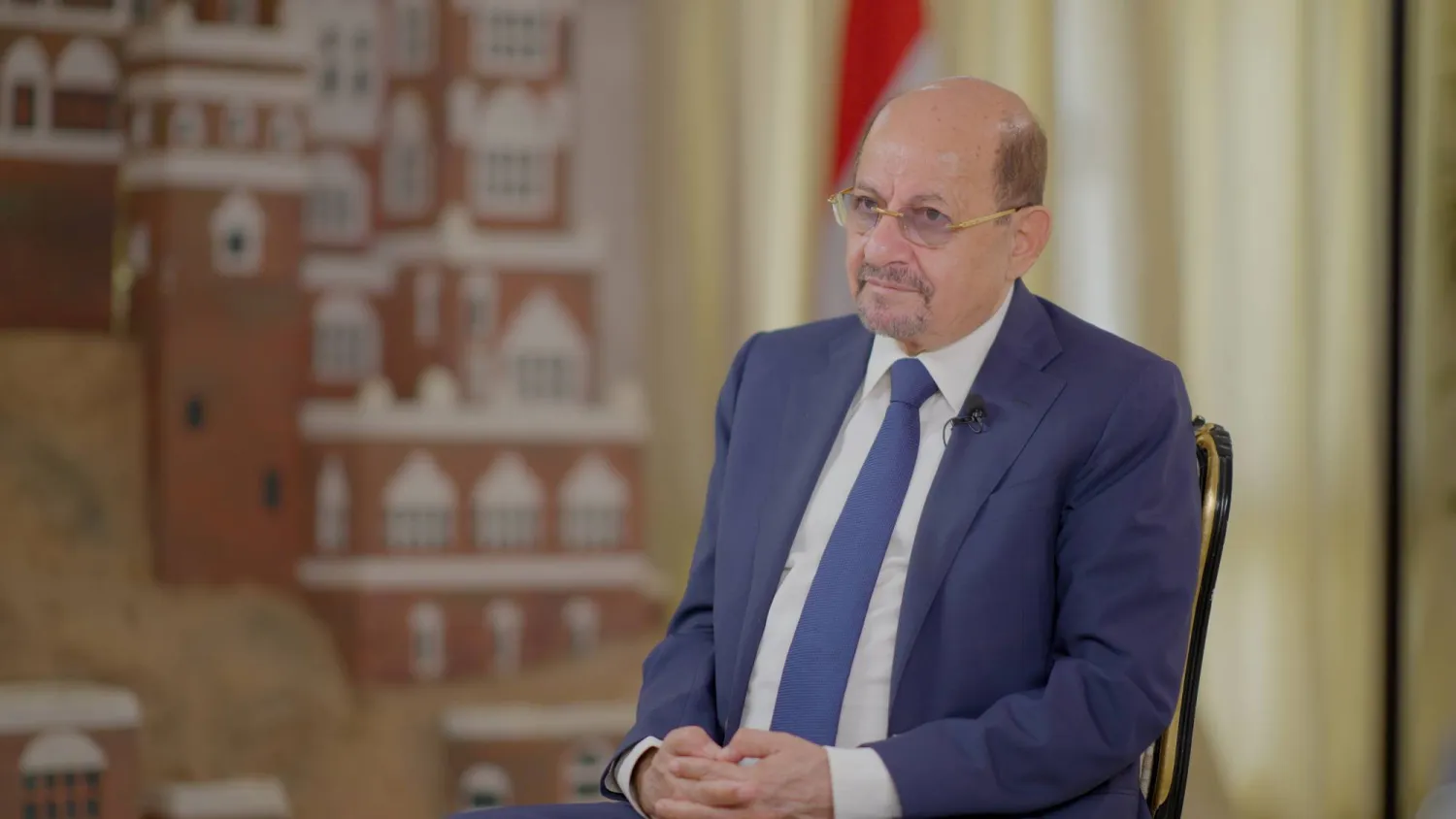

Yemen FM to Asharq Al-Awsat: Iran Encouraging Houthis to Prolong War, Reject Peace 

Yemeni Foreign Minister Dr. Shaya al-Zindani. (Turki Al-Aqaili)
TT

Yemen FM to Asharq Al-Awsat: Iran Encouraging Houthis to Prolong War, Reject Peace 

Yemeni Foreign Minister Dr. Shaya al-Zindani. (Turki Al-Aqaili)

Yemeni Foreign Minister Dr. Shaya al-Zindani accused the Iran-backed Houthi militias of obstructing the efforts of United Nations envoy Hans Grundberg to achieve peace in the country.

In an interview with Asharq Al-Awsat, he said the militants were seeking to stoke chaos in Yemen, while the peace process is effectively frozen because Iran is pushing the Houthis to reject peace and prolong the war.

“Unfortunately, as part of the government, we do not sense that the Houthis have a desire to achieve peace and end the war. They live for war,” he added.

The legitimate government “has agreed to all initiatives that have been presented by friends and brothers, but the Houthis have not been receptive to them.”

He blamed Iran for encouraging the Houthis to maintain their intransigence.

On reports about an attempt on Grundberg’s life, Zindani said: “There are efforts to thwart his work and plunge us in chaos.”

This all benefits the Houthis, he went on to say. “We, on the other hand, believe that the envoy represents the voice of international legitimacy and UN Security Council resolutions. It is in our interest to support him despite his shortcomings in some areas,” the minister stated.

Asked if the Security Council was preparing a resolution on Yemen, he replied that he had no information about that yet. He acknowledged, however, that some parties are starting to believe that resolution 2216 was no longer applicable.

Media sources have said that the US and Britian were seeking to issue two Security Council resolutions on Yemen in the coming weeks.

Zindani remarked that based on his experience, resolutions are rarely amended; rather, new ones are adopted.

“The government, in line with international, regional and national legitimacy, is showing openness and being reasonable with all efforts aimed at resolving Yemen’s plight,” he stressed.

The new resolutions, he said, will likely complement resolution 2216 and take measures against the Houthis because they have ignored other resolutions.

“The Houthis don’t believe in peace or national partnership; they don’t even have a political platform,” he charged.

“They are a close-minded group that operates according to its sectarian ideology, and it believes it has the right to rule the Yemeni people,” the FM told Asharq Al-Awsat.

The military option against the Houthis will “always remain on the table” as long as Yemen continues to be threatened, he added.

Arms smuggling

On Iran’s role in Yemen, Zindani lamented that the international community “had not seriously dealt with the issue of arms smuggling to the Houthis.”

Security Council resolutions have been clear about this, but not a single measure has been taken since 2016, he noted.

This has allowed Iran to deliver drones, ballistic missiles and even hypersonic missiles to the Houthis, he added.

“One can smuggle a rifle undetected, but sending rockets and drones without detection is suspicious,” Zindani said.

He said that some form of leniency in dealing with this issue allowed Iran to continue to support the Houthis.

“Should Iran fail in changing its policies and outlook and agree to establishing good ties with its neighbors and concern itself with its own people, then it will continue to meddle with Yemen’s internal affairs, which will only harm it and countries in the region,” he warned.

On the recent seizure weapons off the coast of Aden, he said the government “will not stand idle.” It will uncover the source of these weapons and act on the diplomatic level as soon as it has evidence.

Reports have said that authorities busted a shipment of drones and advanced equipment from China.

The FM said Yemen and China enjoy “historic and close ties” and that his country will bring up the issue with it should it receive any confirmed information related to the shipment.

“We know that it isn’t easy for any company to export military gear without the knowledge of the Chinese government,” he explained.

“We are keen on our relations with Beijing and we will bring up this issue with our friends there if we receive any evidence that connects the shipment to China,” Zindani said, revealing that the issue was already brought up with Chinese Charge d’Affaires.

On relations with Saudi Arabia, the FM said the Kingdom is Yemen’s main backer. Its support extends to all Yemeni sectors, such as development, reconstruction and humanitarian work through the King Salman Humanitarian Aid and Relief Center.

He also noted Saudi Arabia’s ongoing financial deposits and grants, stressing that the Kingdom is a “priority in our foreign policy. We are keen on excellent ties we share with it and we constantly aspire to coordinate our efforts on the international arena.”



Video Shows Masked, Armed Men Beating a Palestinian in the Occupied West Bank

 01 January 2026, Palestinian Territories, Nablus: Israeli forces raid shops in the central market and opened fire toward a residential building, detaining several Palestinians in the Old City of Nablus in the West Bank. (dpa)
01 January 2026, Palestinian Territories, Nablus: Israeli forces raid shops in the central market and opened fire toward a residential building, detaining several Palestinians in the Old City of Nablus in the West Bank. (dpa)
TT

Video Shows Masked, Armed Men Beating a Palestinian in the Occupied West Bank

 01 January 2026, Palestinian Territories, Nablus: Israeli forces raid shops in the central market and opened fire toward a residential building, detaining several Palestinians in the Old City of Nablus in the West Bank. (dpa)
01 January 2026, Palestinian Territories, Nablus: Israeli forces raid shops in the central market and opened fire toward a residential building, detaining several Palestinians in the Old City of Nablus in the West Bank. (dpa)

Dozens of masked men armed with sticks attacked a plant nursery and beat and injured a Palestinian in the occupied West Bank, according to people who saw the attack and video footage obtained by The Associated Press.

Video filmed by security cameras shows men dressed mostly in black, faces covered, with several hitting and kicking a man on the ground.

Two people who witnessed the attack and are members of the family that own the facility said Israeli settlers beat 67-year-old Basim Saleh Yassin as he was trying to flee the nursery located in the northern West Bank village of Deir Sharaf. Both spoke on condition of anonymity for fear of reprisal.

They said Yassin is in the hospital and has broken bones in his hand and other injuries on his face, chest and back. Four cars were burned and destroyed at the nursery.

The attack is the latest in rising settler violence in the West Bank. Settler attacks ramped up during the Palestinian olive harvest season in October and early November and have continued since.

Israeli Prime Minister Benjamin Netanyahu has called the perpetrators “a handful of extremists” and urged law enforcement to pursue them for “the attempt to take the law into their own hands.” But rights groups and Palestinians say the problem is far greater than a few bad apples, and attacks have become a daily phenomenon across the territory.

Israel's army said that it dispatched soldiers to the Shavei Shomron junction — close to the area of the attack — following reports of dozens of masked Israelis vandalizing property. The army said it apprehended three suspects who were transferred to the police station for questioning. It said security forces condemn violence of any kind.

According to one of the family members that owns the German-Palestinian run nursery, it was the third time in a year that the facility was attacked.

The previous incident was in September and cost the business more than $600,000 as offices and facilities were damaged, he said.

When workers saw the settlers coming on Thursday, they fled, but as Yassin is deaf he couldn't hear people warning him to leave, said the family member.

In the video, Yassin runs from a group of masked people before falling to the ground.

One man kicks him and another hits him twice with what appears to be a stick. Yassin stays on his knees as he's struck again and then places his hands on the ground on all fours. As the men are leaving, one kicks him in the head while others strike him again until he's seen lying on the pavement.


Unified Arab, Islamic Stances ‘Tighten the Noose’ on Israel’s Moves in Somaliland

Somalis demonstrate in support of their country’s territorial unity in Mogadishu on January 7, 2026. (AP)
TT

Unified Arab, Islamic Stances ‘Tighten the Noose’ on Israel’s Moves in Somaliland

Somalis demonstrate in support of their country’s territorial unity in Mogadishu on January 7, 2026. (AP)

Arab and Islamic positions continued to express a firm rejection of Israel’s recognition of Somaliland as an independent state, reaffirming Somalia’s unity and territorial integrity.

This wave of coordinated diplomacy coincides with heightened engagement within international and UN-affiliated bodies, raising questions about the extent to which such positions can effectively constrain Israel’s recent moves, most notably the visit by Israeli Foreign Minister Gideon Saar to the self-declared breakaway region.

On Friday, Arab and Islamic states issued strong condemnations of what they described as Saar’s illegal visit to Somaliland earlier in the week, saying it constituted a blatant violation of Somalia’s sovereignty and territorial integrity and undermined established international norms and the UN Charter.

The condemnation came in a joint statement by the foreign ministers of Saudi Arabia, Egypt, Algeria, Bangladesh, Comoros, Djibouti, Gambia, Indonesia, Iran, Jordan, Kuwait, Libya, the Maldives, Nigeria, Oman, Pakistan, Palestine, Qatar, Somalia, Sudan, Türkiye and Yemen, along with the Organization of Islamic Cooperation (OIC).

The ministers reiterated their unwavering support for Somalia’s sovereignty and territorial integrity and rejected any encouragement of separatist agendas, warning that such moves risk exacerbating tensions in an already fragile region.

They stressed that respect for international law, non-interference in the internal affairs of sovereign states, and adherence to diplomatic norms are essential pillars of regional and international stability.

The statement came on the eve of an emergency ministerial meeting of the OIC on Saturday at the organization’s headquarters in Jeddah, aimed at forging a unified Islamic position in response to Israel’s recognition of Somaliland.

Analysts told Asharq Al-Awsat that coordinated collective action could “tighten the noose” around Israel’s recent steps in the breakaway region, discouraging other countries from following Israel’s lead and seeking to isolate Israel internationally. Such pressure, they said, could also create space for possible measures by the Somali government or open the door to intra-Somali dialogue.

Since Israel announced its recognition of Somaliland on Dec. 26, Egypt, Türkiye, Djibouti and Somalia have acted collectively, issuing a joint statement condemning the move and rejecting any unilateral measures that undermine Somali sovereignty or promote parallel entities that threaten the unity of the Somali state.

The following day, 21 Arab and Islamic countries, together with the OIC, warned that recognizing the independence of parts of sovereign states sets a dangerous precedent and threatens international peace and security.

Egyptian diplomat Salah Halima said the unified Arab and Islamic positions are active and effective, aligning with stances taken by the Arab League, the African Union, the European Union and the United Nations.

He noted that while the United States has expressed support for Somalia’s unity, its position on Israel’s step remains ambiguous, raising concerns about the possibility of further recognitions.

Former Egyptian assistant foreign minister for African affairs Mona Omar noted that Israel has a record of disregarding international appeals and resolutions, but broad collective opposition deepens its isolation and complicates efforts to advance its plans in Somaliland.

She added that stronger US backing for Somalia’s unity would leave Israel facing genuine isolation in the region, even if it does not ultimately reverse its recognition.

African affairs expert Rami Zahdi stressed that unified positions can have tangible impact if embedded in a comprehensive strategy to counter Israeli moves, protect stability in the Horn of Africa, and prevent the fragmentation of national states.

He described the explicit demand for Israel to withdraw its recognition as a form of measured, escalatory diplomacy that moves beyond symbolic condemnation toward organized political and legal pressure.


Israel Scales Back from ‘Major Strike’ on Hezbollah, Opts for ‘Limited Attacks’

The Israeli flag, with part of the Israeli settlement of Ma’ale Adumim visible in the background in the occupied West Bank on August 14, 2025. (Reuters)
TT

Israel Scales Back from ‘Major Strike’ on Hezbollah, Opts for ‘Limited Attacks’

The Israeli flag, with part of the Israeli settlement of Ma’ale Adumim visible in the background in the occupied West Bank on August 14, 2025. (Reuters)

Informed sources in Tel Aviv said the Israeli strike on Lebanon on Friday was the response chosen by the military following remarks by Prime Minister Benjamin Netanyahu, who praised what he described as the Lebanese army’s “insufficient” efforts to disarm Hezbollah.

The strikes also followed a statement by the Lebanese government announcing the completion of the first phase of that mission.

Military sources, quoted across Israeli media, said Hezbollah “remains present in southern Lebanon and is seeking to restore its strength, reinforce its positions, resupply its forces with weapons, and maintain its tunnel network.”

These claims were used to justify a series of Israeli air strikes targeting southern and eastern Lebanon on Friday.

Despite Israel’s official skepticism toward the Lebanese army’s declaration that it had achieved the “objectives of the first phase” of disarming Hezbollah south of the Litani River — an announcement the Israeli military dismissed as “inaccurate and not reflective of the security reality on the ground” — Israeli thinking about launching a large-scale military response has cooled.

Political and military sources said Israel has “begun to retreat, for now, from the idea of a major strike and decided to settle for intense but limited attacks.”

Those same sources had previously said Netanyahu agreed with US President Donald Trump during a meeting in Florida last week to carry out a major strike against Hezbollah, in exchange for Netanyahu’s acceptance of most US demands regarding Gaza and Syria.

The rationale for striking Hezbollah is said to be ready and enjoys near consensus in Israel, with opinion polls showing 57 percent of the public in favor of an immediate attack.

On Wednesday, Netanyahu’s office issued an official statement asserting that the US-brokered ceasefire agreement between Israel and Lebanon “clearly stipulates the complete disarmament of Hezbollah,” describing this as “essential for Israel’s security and Lebanon’s future.”

According to Israel’s Haaretz newspaper, army sources say Hezbollah’s presence in the area “has not ended” and that the military “continues to monitor the group’s activities even now.”

While Israel views positively the Lebanese army’s acknowledgment that “tasks remain unfinished,” it doubts the army’s “ability to carry them out in practice.”

An Israeli military source said Tel Aviv’s assessment of the disarmament file “is not based on statements, but on operational data and results,” stressing that “as long as Hezbollah’s military infrastructure south of the Litani remains, there can be no talk of real disarmament.”

According to military sources cited by the Walla news site, Hezbollah has smuggled large quantities of weapons and bags containing millions of dollars across the Turkish border to rebuild its power and bolster its popular support.

While this underscores, in Israeli eyes, the inevitability of a major strike, the tone has shifted in recent hours.

Sources say Netanyahu fears such an operation now could divert attention from dramatic developments in Iran, where Israel, keenly interested in the regime’s collapse, does not want to distract from ongoing protests.