


Saudi Arabia, US, UAE, Egypt Propose 3-Month Truce in Sudan

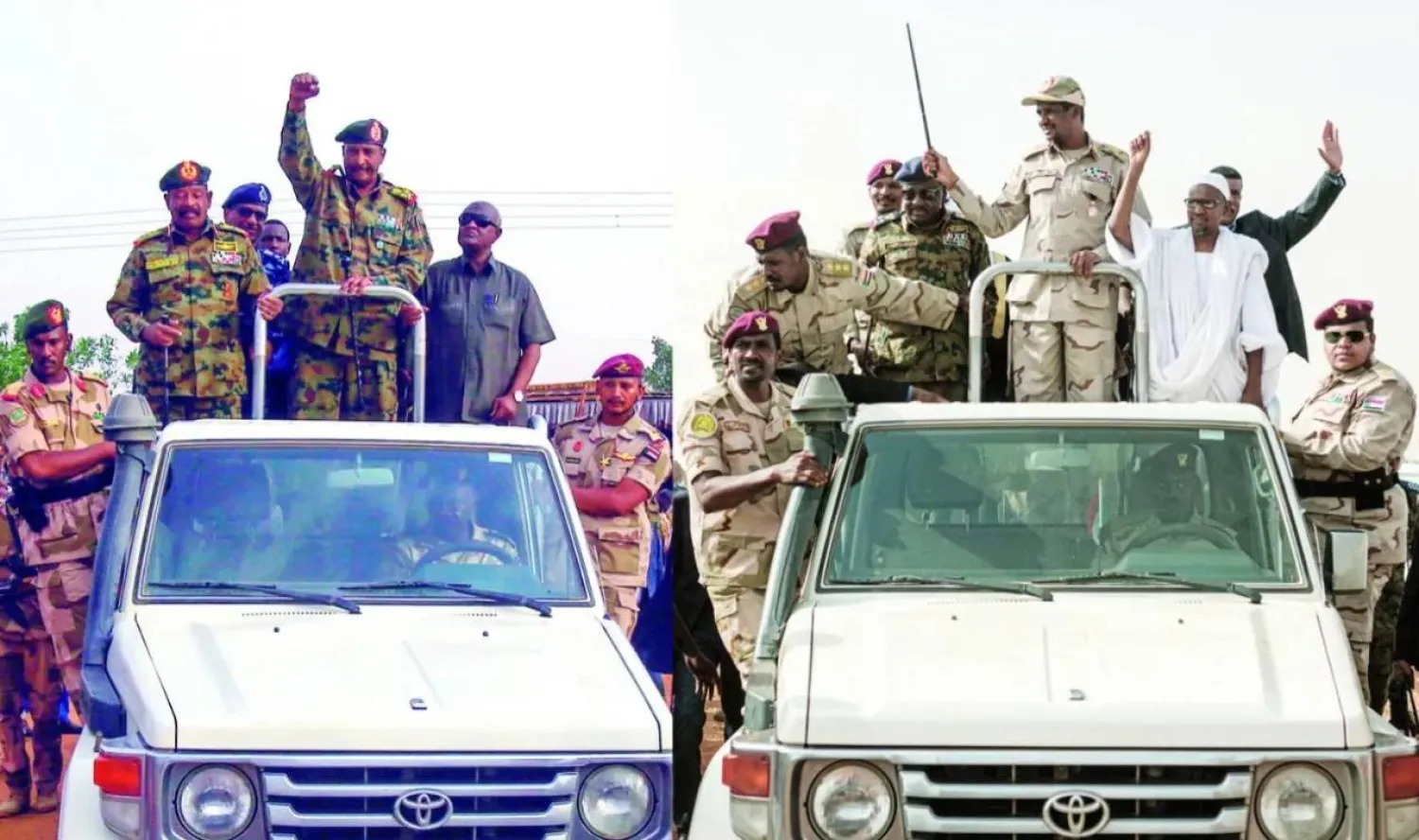
The leaders of the army, Abdel Fattah al-Burhan (left), and the Rapid Support Forces, Mohamed Hamdan Dagalo (Hemedti), in April 2023. AFP file photo
TT

Saudi Arabia, US, UAE, Egypt Propose 3-Month Truce in Sudan

The leaders of the army, Abdel Fattah al-Burhan (left), and the Rapid Support Forces, Mohamed Hamdan Dagalo (Hemedti), in April 2023. AFP file photo

Saudi Arabia, the United States, the United Arab Emirates and Egypt called on Friday for a three-month humanitarian truce in Sudan followed by a permanent ceasefire, the countries said in a joint statement.

Foreign ministers of the so-called “Quad” countries said the conflict in the country between the Sudanese Armed Forces (SAF) and the Rapid Support Forces (RSF) has provoked the world’s worst humanitarian crisis and poses grave risks to regional peace and security.

They noted that there is no viable military solution to the conflict, and the status quo creates unacceptable suffering and risks to peace and security.

Also, the ministers said Sudan’s future governance is for the Sudanese people to decide through an inclusive and transparent transition process, not controlled by any warring party.

The Quad, which met at the invitation of the US, said all parties to the conflict must facilitate rapid, safe, and unhindered humanitarian access and assistance throughout Sudan and through all necessary routes, protect civilians and refrain from indiscriminate aerial and ground attacks on civilian infrastructure.

The ministers called for a humanitarian truce, for an initial three months, to lead immediately to a permanent ceasefire, then an inclusive and transparent transition process within nine months to smoothly establish an independent, civilian-led government with broad-based legitimacy and accountability.

They also urged an end to all external military support to the conflict parties in Sudan as essential to end the conflict.

The Quad, therefore, pledged to exert all efforts to support a negotiated settlement of the conflict with the active participation of SAF and RSF and to press all parties to the conflict to protect civilians and civilian infrastructure and ensure humanitarian assistance reaches those in need.

They noted that Sudan’s future cannot be dictated by violent extremist groups part of or evidently linked to the Muslim brotherhood, whose destabilizing influence has fueled violence and instability across the region.

Ministers also expressed support to efforts by the Kingdom of Saudi Arabia and the US, through the Jeddah process to achieve a permanent ceasefire in Sudan, as well as the efforts by Egypt with regards to the Sudanese civil and political forces forum which held its first round in Cairo during July 2024.

They agreed to continue their consultations in this regard during the Quad ministerial meeting in September 2025.

The Quad statement rejected any role for the Muslim Brotherhood or affiliated groups in Sudan.


Iraq Seeking New Oil Export Routes after Hormuz Disruption

FILE PHOTO: Tankers are seen off the coast of Fujairah, as Iran vows to fire on ships transiting the Strait of Hormuz, amid the US-Israel conflict with Iran, in Fujairah, United Arab Emirates, March 3, 2026. REUTERS/Amr Alfiky/File Photo
TT

Iraq Seeking New Oil Export Routes after Hormuz Disruption

FILE PHOTO: Tankers are seen off the coast of Fujairah, as Iran vows to fire on ships transiting the Strait of Hormuz, amid the US-Israel conflict with Iran, in Fujairah, United Arab Emirates, March 3, 2026. REUTERS/Amr Alfiky/File Photo

Iraqi authorities are exploring alternative routes to export oil after transit through the Strait of Hormuz was disrupted by the Middle East war, an oil ministry spokesperson told AFP Tuesday.

Saheb Bazoun said that "much like other countries in the region, oil production and marketing have been severely impacted, leaving the government no choice but to seek alternative" export routes.

Iraq has several oil shipments stuck at sea, he said.

Iraq is a founding member of the OPEC cartel, and crude oil sales make up 90 percent of the country's budget revenues.

Before the war, it was exporting more than 3.5 million barrels per day.

The Strait of Hormuz remains closed to almost all oil tankers, and Iran has vowed that not one litre of oil would be exported from the Gulf while its war with the United States and Israel continues.

Iraq's oil production and exports have sharply decreased, Bazoun said.

Iraqi authorities are considering several options for exports, including a pipeline which runs thought Iraq's northern Kurdistan region to the port of Ceyhan in Türkiye.

They are also considering transporting oil by land, but many plans will require time to be implemented, according to Bazoun.

A senior official in Iraq's Kurdistan region told AFP talks are underway to facilitate oil exports from federal Iraq.

He said that Baghdad had requested to "export 200,000 bpd" via the Ceyhan pipeline, which has a capacity of 700,000 bpd.

But regional authorities asked for several measures in return, including that Baghdad facilitates the region's access to US dollars through banks.

"We have made it clear to Baghdad that the relief on dollars should happen first," the Kurdish official said, claiming that there is a "100 percent dollar embargo on Kurdistan."

Since the start of the year, Iraq has been dealing with a US dollar liquidity shortage that has affected many sectors across the country.

Oil production has also been disrupted in the Kurdistan region since foreign oil companies have halted production as a precautionary measure since the start of the war.


Syria Appoints Kurdish YPG Commander Sipan Hamo Deputy Defense Minister

Sipan Hamo, the commander of the Kurdish People's Protection Units (YPG)
TT

Syria Appoints Kurdish YPG Commander Sipan Hamo Deputy Defense Minister

Sipan Hamo, the commander of the Kurdish People's Protection Units (YPG)

Syria's defense ministry said on Tuesday that Sipan Hamo, commander of the Kurdish People's Protection Units (YPG), had been appointed deputy defense minister for the country's eastern territories.

The move is seen as part of implementing a US-brokered integration agreement signed on January 29 between Syrian Democratic Forces (SDF) commander Mazloum Abdi and Syrian President Ahmed al-Sharaa.

"Sipan Hamo has been appointed Assistant Minister of Defence for the eastern region," a defense ministry official said in a statement.


UN: Almost 700,000 Displaced, 84 Children Killed after Israeli Strikes on Lebanon

An explosion erupts following an Israeli airstrike on the village of Abbasiyeh in southern Lebanon on March 10, 2026 -  (Photo by KAWNAT HAJU / AFP)
An explosion erupts following an Israeli airstrike on the village of Abbasiyeh in southern Lebanon on March 10, 2026 - (Photo by KAWNAT HAJU / AFP)
TT

UN: Almost 700,000 Displaced, 84 Children Killed after Israeli Strikes on Lebanon

An explosion erupts following an Israeli airstrike on the village of Abbasiyeh in southern Lebanon on March 10, 2026 -  (Photo by KAWNAT HAJU / AFP)
An explosion erupts following an Israeli airstrike on the village of Abbasiyeh in southern Lebanon on March 10, 2026 - (Photo by KAWNAT HAJU / AFP)

The humanitarian crisis in Lebanon has deepened amid the wider Middle East war, with 84 children killed and more than 667,000 people displaced, two UN agencies said on Tuesday, as lives are upended on a massive scale across the country.

A total of 486 people have been killed in the war so far and 1,313 injured, of which 259 are children, according to the World Health Organization.

"This is only seven-days conflict, and we are already seeing that almost 100 children that have lost their lives," said Abdinasir Abubakar, WHO representative in Lebanon.

"One reason why we have a high number of children is that most of the attacks that we see actually is, it's urban centers, like in Beirut," he said, adding that Israel's airstrikes, which it says target Hezbollah infrastructure, are putting civilian lives at risk.

The current rate of displacement in Lebanon is outpacing levels seen during the 2023-24 war between Hezbollah and Israel, the UN Refugee Agency said on Tuesday. During that conflict, 886,000 people were internally displaced in Lebanon, while tens of thousands of Israelis were evacuated from northern towns near the Lebanese border.

ISRAEL ORDERS EVACUATION

Lebanon's sharp rise in displacement this week stems from large-scale evacuation orders issued by the Israeli army for southern Lebanon and Beirut's densely populated southern suburbs, which the UN human rights chief said on Friday raised serious concerns under international law.

The WHO warned that Lebanon's hospitals and frontline responders were under "extraordinary strain" trying to manage the rising number of patients.

Five hospitals are now out of service, four partially damaged, and 43 primary healthcare centers are closed - mostly in the south, which has been largely evacuated, Abubakar said.

"Many of the people fleeing were also fleeing back in 2024. We met many who then had their homes completely destroyed, family members killed and so on. So this means that people are not waiting to see what will happen next. They leave immediately," said Karolina Lindholm Billing, UNHCR representative in Lebanon.

Some 120,000 people are staying in government-designated shelters, while others are still looking for somewhere to stay, the UNHCR said, citing government figures.

"Many others are staying with relatives or friends or still searching for accommodation, and we see cars lined along the street with people sleeping in them and also on the sidewalks," Billing said.
