
Saudi Diriyah Art Futures Launches CONTINUUM ’25 Exhibition for Emerging New Media Artists

Curated by Irini Papadimitriou, the exhibition features 13 diverse artworks, including immersive installations, audiovisual pieces, virtual reality works, and AI-generated art. (SPA)
TT

Saudi Diriyah Art Futures Launches CONTINUUM ’25 Exhibition for Emerging New Media Artists

Curated by Irini Papadimitriou, the exhibition features 13 diverse artworks, including immersive installations, audiovisual pieces, virtual reality works, and AI-generated art. (SPA)

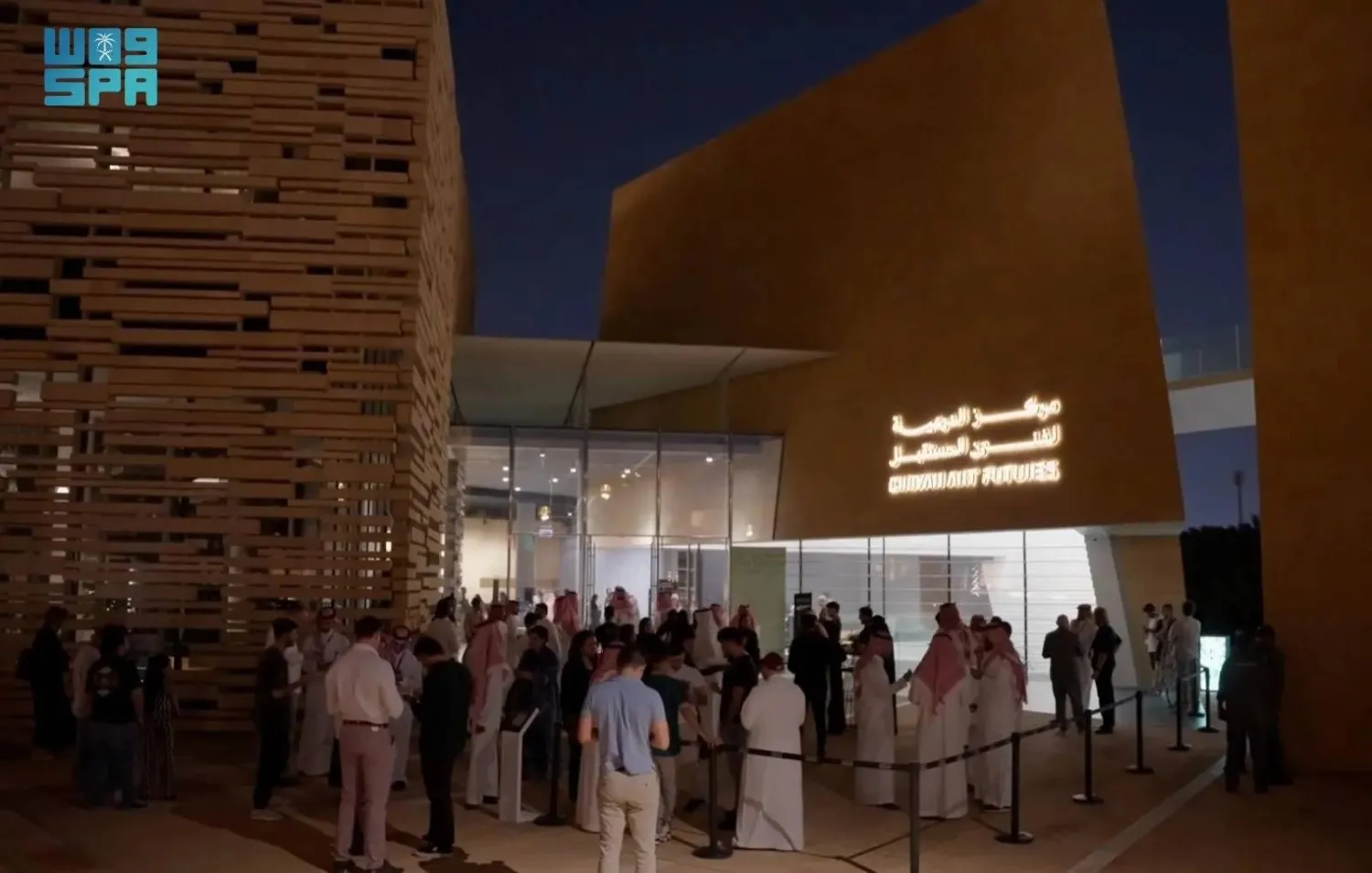
Saudi Arabia’s Diriyah Art Futures (DAF), the first hub for New Media Arts in the Middle East and North Africa, has launched its latest exhibition CONTINUUM ’25, showcasing works by the first cohort of emerging artists in new media arts at its headquarters in Diriyah, in the presence of several cultural leaders, intellectuals, and art enthusiasts.

Curated by Irini Papadimitriou, the exhibition features 13 diverse artworks, including immersive installations, audiovisual pieces, virtual reality works, and AI-generated art, created by 11 emerging artists and developed under the supervision of a select group of international artists, including Anna Ridler and Karen Palmer (who also contributed their own works), as well as Madeline Gannon.

The themes of the creative works range from memory, identity, and displacement to environmental and ethical concerns and even the power of algorithms.

These contemporary approaches blend the real and the virtual, human and machine, reflecting the essence of the exhibition’s title, “CONTINUUM ’25”, and the spirit of ongoing exploration and creativity underpinning the Emerging New Media Artists Program.

The exhibition kicked off with a panel conversation between curator Irini Papadimitriou, Director of Education at DAF Tegan Bristow, and emerging new media artists Khaled Makhshoush, Dhia Dhibi, and Samia Dzair.

Wejdan Reda moderated the discussion, focused on the fascinating and ever-evolving ways in which new media artists use technology to expand their creative practices, while also highlighting the power of multidisciplinary collaboration between artists, researchers, and technologists.

Developed in collaboration with Le Fresnoy - Studio National des Arts Contemporains in France, the Emerging New Media Artists Program gives emerging artists access to cutting-edge professional equipment, a production budget, and a wide range of multidisciplinary learning opportunities.

It featured artists from Saudi Arabia, Egypt, Algeria, Jordan, Tunisia, Morocco, Bahrain, Republic of Korea, the United Kingdom, and South Africa.

The exhibition marked the inaugural event in a series organized by DAF, aiming to highlight the diverse voices shaping the future of new media arts in the region and globally.

CONTINUUM ’25 is open to the public at Diriyah Art Futures and runs from September 13 to November 15. The exhibition is accompanied by a rich public program of workshops, talks and other activities spanning AI, VR, and digital photography.

DAF will host a workshop on September 19, titled “Stories of Home: Digital & Hand Embroidery,” in both Arabic and English. Participants will explore the concept of homeland through regional embroidery traditions and media arts, using digital techniques to design personal symbols that are then translated into hand-embroidered works.

Iran Says Museums and Historic Sites Damaged in War

FILED - 10 March 2026, Iran, Tehran: A member of the Iranian Red Crescent Society (IRCS) rescue teams works at the site of a building damaged in a US-Israeli airstrike in Resalat Square. Photo: -/ZUMA Press Wire/dpa
TT

Iran Says Museums and Historic Sites Damaged in War

FILED - 10 March 2026, Iran, Tehran: A member of the Iranian Red Crescent Society (IRCS) rescue teams works at the site of a building damaged in a US-Israeli airstrike in Resalat Square. Photo: -/ZUMA Press Wire/dpa

Iran's cultural heritage and tourism ministry said Saturday at least 56 museums and historic sites across the country have been damaged, as the Middle East war entered its 15th day.

In Tehran, US-Israeli strikes damaged the UNESCO-listed Golestan Palace in the early days of the conflict, local media reported.

The palace complex is one of the oldest sites in the Iranian capital and once served as the residence of the Qajar dynasty.

The ministry said Tehran has recorded the highest number of damaged monuments, with 19 suffering varying levels of harm.

The vast Naghsh-e Jahan Square, a 17th-century architectural jewel in the heart of the central Iranian city of Isfahan, has also been damaged.

In the port of Siraf, in Bushehr province, several houses were hit in the historic quarter, home to many century-old buildings.

UNESCO, the UN's culture agency, told AFP on Friday it was concerned about hundreds of historic sites in Iran, Israel and Lebanon that have been damaged or threatened by the war.


Ukraine's 'Origami Deer' Sculpture Rescued from Frontline Tours Europe

Ukrainian artist Zhanna Kadyrova (R) and Ukrainian curator of the 'Security Guarantees' project Leonid Marushchak pose in front of the 'Origami Deer' sculpture in Prague on March 12, 2026. (Photo by Michal Cizek / AFP)
TT

Ukraine's 'Origami Deer' Sculpture Rescued from Frontline Tours Europe

Ukrainian artist Zhanna Kadyrova (R) and Ukrainian curator of the 'Security Guarantees' project Leonid Marushchak pose in front of the 'Origami Deer' sculpture in Prague on March 12, 2026. (Photo by Michal Cizek / AFP)

An "Origami Deer" statue rescued from a Ukrainian city destroyed and occupied by Moscow's army is touring six European countries before featuring at the 61st Venice Biennale, which has sparked outrage over the inclusion of Russian artists.

Ukrainian artist Zhanna Kadyrova created the concrete work with her colleague Denys Ruban in 2019 for a park in the eastern city of Pokrovsk to replace a Soviet-era military plane displayed there.

In 2024, Kadyrova and historian Leonid Marushchak removed the deer, shaped like a paper origami, as Russian troops closed in and then occupied Pokrovsk.

The sculpture will be the main feature of the Ukrainian pavilion, named Security Guarantees, at the Venice Biennale.

It will feature alongside Russian exhibits at the event that started in 1895 and comprises festivals, art and architecture exhibitions running from May 9 to November 22.

The decision to invite Russian artists, banned from the 2022 and 2024 editions after Moscow's full-scale invasion of Ukraine, has sparked international uproar with the European Union threatening to cut funding for the Biennale.

"It's very important for us to see how the entire world reacts to the situation, supporting us and opposing Russia's participation," Marushchak told AFP.

"If the Russians want to show their culture, they might as well organize a biennale in Pokrovsk which they have destroyed," he added.

En route to Venice, the deer has been exhibited in Warsaw, Vienna and Prague and will continue on to Berlin, Brussels and Paris.

Displaced from its pedestal, the deer symbolizes "millions of Ukrainians who have lost their home" and moved abroad, Kadyrova told AFP during a stopover in Prague.

The resemblance to paper origami refers to the Budapest Memorandum of 1994 which saw Ukraine yielding its nuclear arsenal to Russia in exchange for security guarantees that did not materialize.

"So it's no more than paper," Kadyrova said.

Marushchak has been evacuating works of art from eastern Ukraine since the war started.

He has saved scores of objects, often taking huge risk with his team, to protect them from looting or theft.

One of the most dramatic rescue operations involved a 700-year-old stone lion statue evacuated from a museum in Bakhmut in 2023, just before the Russian army took the city, as Marushchak's car was hit by a shell on the way out.

"Other evacuations were difficult in that we didn't succeed as much as we wanted because the front line was too close and the danger was too big," Marushchak told AFP.

The Venice Biennale typically attracts more than 600,000 visitors to pavilions set up by participating countries.

Kadyrova said the Ukrainian team was not planning any protest over Russia's participation as "it's up to politicians".

"But I hope that some community will gather to pressure the Biennale, pressure Italy, and I hope that it will not happen."


'Talking Drum' Looted by France in 1916 Back in Ivory Coast

A crate containing the Djidji Ayokwe drum, at the airport in Abidjan, Ivory Coast. (Photo by Issouf SANOGO / AFP)
TT

'Talking Drum' Looted by France in 1916 Back in Ivory Coast

A crate containing the Djidji Ayokwe drum, at the airport in Abidjan, Ivory Coast. (Photo by Issouf SANOGO / AFP)

The Djidji Ayokwe "talking drum", which was looted by French colonial troops in 1916 and taken to France, arrived back in Ivory Coast Friday, in the latest repatriation of stolen artifacts.

The wooden drum, more than three meters (10 feet) long and weighing 430 kilos (950 pounds), was used by the Ebrie tribe to transmit messages.

It was officially handed over on February 20 after France's parliament approved removing the artifact from the national museum collections to enable its return.

Ivory Coast had asked in late 2018 for the return of the Djidji Ayokwe among 148 works of art taken during the colonial period.

It arrived aboard a specially chartered plane at Ivory Coast's main city Abidjan and remained inside a huge wooden crate stamped "fragile", AFP journalists saw.

"It's an historic day and I feel deep emotion," Culture Minister Francoise Remarck said, welcoming its arrival at the airport, where the Ebrie community also sang and played drums.

"We are living a moment of justice and remembrance," the minister added.

French President Emmanuel Macron promised in 2021 to send the drum and other artifacts back home to the west African country.

It is one of hundreds of objects France is preparing to send back to Africa, with the efforts set to be accelerated by the passing of a new law to authorize mass repatriations.

"We are happy and relieved to know that this sacred piece of our culture is back on its native land," Aboussou Guy Georges Mobio, an Ebrie village chief, told AFP.

The drum will initially be held in a "safe space" to allow it to acclimatize, the culture minister said.

It is due to go on display at the Museum of Civilizations in Abidjan which has been specially renovated.

The "talking drum" was used by the Ebrie community to warn of danger, mobilize for war or call villagers to ceremonies.

It was seized by colonial authorities in 1916 before being shipped to France in 1929 and exhibited in Paris.

Senegal and Benin have also asked for the repatriation of their treasures.

In late 2020, the French parliament adopted a law providing for the permanent return to Benin of 26 artifacts from the royal treasures of Dahomey.

The return of cultural artifacts taken from ex-colonies in Africa and elsewhere has become a sensitive issue, with museums, institutions and collectors in Europe and the United States facing pressure to give them back.