


Macron Hopes His Recognition of a Palestinian State Will Be Landmark Contribution to Mideast Peace

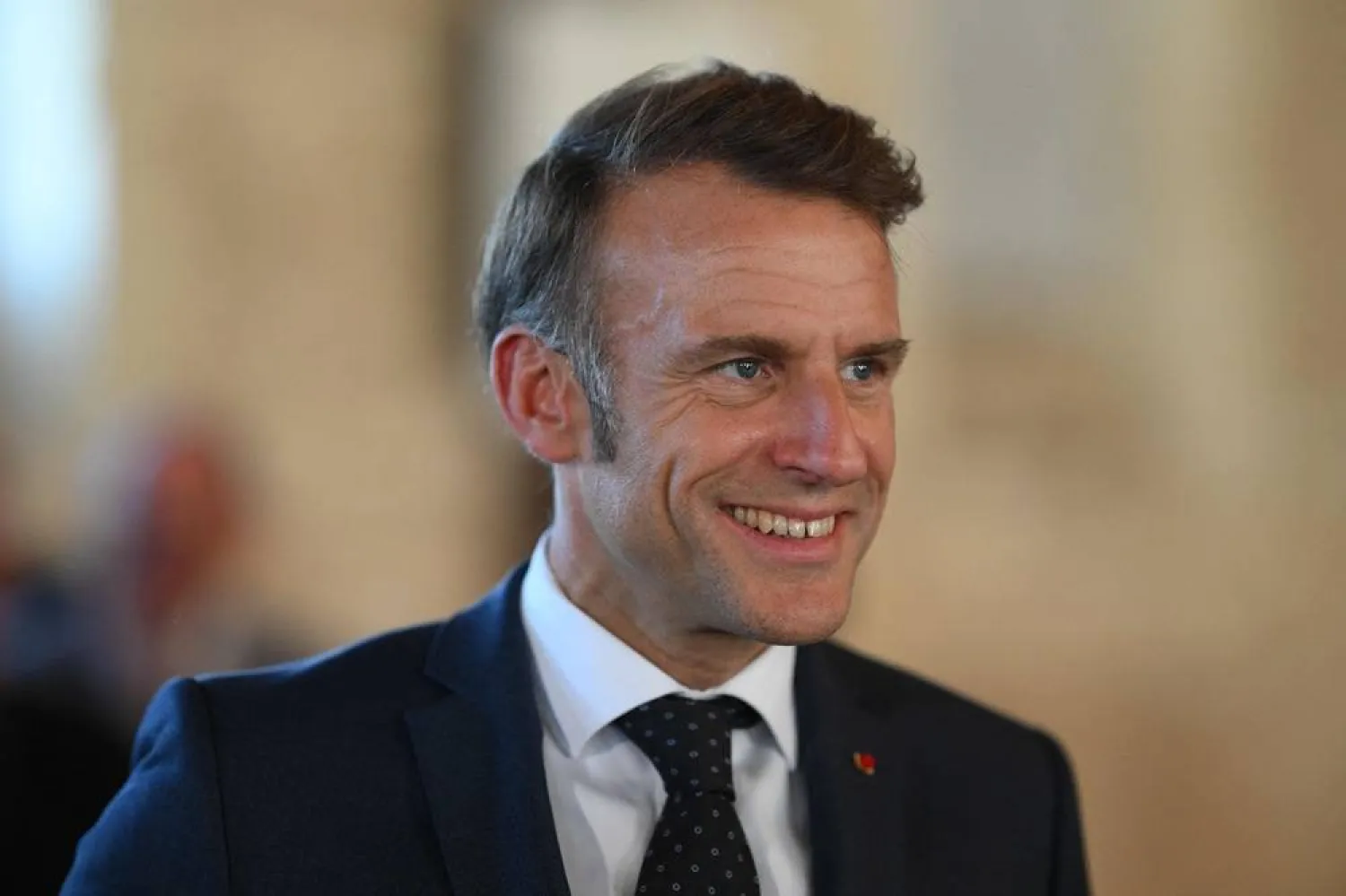
 France's President Emmanuel Macron looks on during a visit to the Benedictine abbey of Pontlevoy, as part of the 42nd edition of the European Heritage Days, in Pontlevoy central France, on September 19, 2025. (AFP)
France's President Emmanuel Macron looks on during a visit to the Benedictine abbey of Pontlevoy, as part of the 42nd edition of the European Heritage Days, in Pontlevoy central France, on September 19, 2025. (AFP)
TT

Macron Hopes His Recognition of a Palestinian State Will Be Landmark Contribution to Mideast Peace

 France's President Emmanuel Macron looks on during a visit to the Benedictine abbey of Pontlevoy, as part of the 42nd edition of the European Heritage Days, in Pontlevoy central France, on September 19, 2025. (AFP)
France's President Emmanuel Macron looks on during a visit to the Benedictine abbey of Pontlevoy, as part of the 42nd edition of the European Heritage Days, in Pontlevoy central France, on September 19, 2025. (AFP)

A moment of truth: that’s how French President Emmanuel Macron sees the recognition of a Palestinian state by France and other Western nations, with the hope to make it a landmark step in his push for peace in the Middle East as the devastating war in Gaza continues.

Weakened and unpopular at home, Macron is more than ever taking center stage in international talks. He is to formally declare France’s recognition of a Palestinian state on Monday at a United Nations conference in New York co-chaired with Saudi Arabia, as the UN General Assembly starts.

“We have to recognize the legitimate right of Palestinian people to have a state,” Macron said in an interview broadcast Thursday on Israeli television Channel 12. “If you don’t give a political perspective, in fact you just put them in the hands of those who are just proposing a security approach, an aggressive approach.”

The move comes as Israel this week launched its ground offensive in Gaza City which Macron denounced as “absolutely unacceptable” and “a huge mistake.”

It has angered Israel and the United States, which say it emboldens extremists and rewards Hamas, the group that led the Oct. 7, 2023 attacks.

Other countries expected to follow Macron argues the move is the only way to bring peace and stability to the region as it puts back on the table a two-state solution, in which a Palestinian state would be created alongside Israel in most or all of the West Bank, Gaza Strip and east Jerusalem — territories Israel seized in the 1967 Mideast war.

More than 145 countries already recognize a Palestinian state, including more than a dozen in Europe.

The UK, Canada, Malta, Belgium and Luxembourg, among others, are expected to follow Macron’s lead in recognizing Palestinian statehood in the coming days.

The move aims to prompt “tangible, irreversible progress within a time frame that allows for a return to the two-state solution,” according to a top French diplomat. The official spoke anonymously in line with the French presidency’s customary practices.

“Our analysis shared by regional players, starting with Saudi Arabia, is that this (peace) process can only resume with the creation of a Palestinian state,” the official said.

Macron announced his decision at the end of July, arguing there's no time to wait. “The urgent thing today is that the war in Gaza stops and the civilian population is saved,” he wrote on social platform X.

Dismantlement of Hamas

France insists the creation of a Palestinian state implies the dismantlement of Hamas. In July, Arab League nations agreed that “Hamas must end its rule in Gaza and hand over its weapons to the Palestinian Authority” as part of the New York Declaration at the UN

Macron insisted that he wasn't acting to meet Hamas' expectations.

"Hamas is just obsessed by destroying Israel,” Macron told US television network CBS in an interview recorded on Thursday. “But I recognize the legitimacy of so many Palestinian people who want a state ... and we shouldn’t push them toward Hamas.”

On Friday, French Foreign Minister Jean-Noel Barrot tied Macron’s diplomatic efforts to the arrest of a key Palestinian suspect in a 1982 terror attack in Paris, adding the recognition of a Palestinian state “will allow us to seek the extradition.”

Macron’s push has contributed to a sharp souring of his relationship with Israel's Prime Minister Benjamin Netanyahu and US President Donald Trump’s ambassador to France, Charles Kushner, who accused him of fueling violence.

Macron, with UK Prime Minister Keir Starmer, is also spearheading a diplomatic drive to increase support for Ukraine. They joined President Volodymyr Zelenskyy for talks with Trump last month.

The French leader recently announced that 26 of Ukraine’s allies have pledged to deploy troops as a “reassurance force” for the war-torn country once fighting ends in the conflict with Russia.

Strong reactions in France

The move to recognize a Palestinian state has prompted waves of reaction in France, which is home to Europe’s largest Jewish and Muslim populations.

The Representative Council of Jewish Institutions in France (CRIF) called it “a moral failing, a diplomatic error, and a political danger,” fearing it would further fuel antisemitism amid a sharp rise in reported incidents since the Oct. 7 attacks and ensuing war in Gaza.

Weekly pro-Palestinian protests are being staged in Paris and other French cities.

Far-right leader Marine Le Pen, whose National Rally party is leading the polls, accused Macron of “doing it purely for electoral reasons.”

France’s left-wing opposition welcomed Macron’s move. The head of the Socialist Party, Olivier Faure, suggested mayors should raise the Palestinian flag over town halls on Monday.

On Friday, Interior Minister Bruno Retailleau asked prefects, who represent the government locally, to oppose such a gesture, invoking the principle of neutrality of public services.

“There are enough divisive issues in the country without importing the conflict in the Middle East,” Retailleau wrote on X.

With less than two years left in office, Macron also has his legacy in mind.

International politics has become his main focus since prospects at home turned gloomy after he dissolved the National Assembly last year, leading to a hung parliament.

The French leader's name has been the focus of angry slogans in anti-government protests, with many pointing to him as responsible for France’s political instability, rising prices and spiraling deficit.



Jordan Says King Abdullah Received Invitation to Join Gaza Peace Board

Palestinian girls walk past the rubble of residential buildings destroyed during the war, in Gaza City, January 16, 2026. REUTERS/Dawoud Abu Alkas
TT

Jordan Says King Abdullah Received Invitation to Join Gaza Peace Board

Palestinian girls walk past the rubble of residential buildings destroyed during the war, in Gaza City, January 16, 2026. REUTERS/Dawoud Abu Alkas

Jordan's foreign ministry said on Sunday that King Abdullah received an invitation from ‌US President ‌Donald ‌Trump ⁠to join ‌the so-called "Board of Peace" for Gaza.

The foreign ministry said it was ⁠currently reviewing ‌related documents ‍within ‍the country's ‍internal legal procedures.

The board is set to supervise the temporary governance of Gaza, ⁠which has been under a shaky ceasefire since October.

On Friday, the White House announced some members of a so-called "Board of Peace" that is to supervise the temporary governance of Gaza, which has been under a fragile ceasefire since October.

The names include US Secretary of State Marco Rubio, President Donald Trump's special envoy Steve Witkoff, former British Prime Minister Tony Blair and Trump's son-in-law, Jared Kushner. Trump is the chair of the board, according to a plan his White House unveiled in October.

The White House did not detail the responsibilities of each member of the "founding Executive board." The names do not include any Palestinians. The White House said ⁠more members will be announced over the coming weeks.

The board will also include private equity executive and billionaire ‌Marc Rowan, World Bank President Ajay Banga and Robert Gabriel, ‍a Trump adviser, the White House ‍said, adding that Nickolay Mladenov, a former UN Middle East envoy, will be the ‍high representative for Gaza.

Army Major General Jasper Jeffers, a US special operations commander, was appointed commander of the International Stabilization Force, the White House said. A UN Security Council resolution, adopted in mid-November, authorized the board and countries working with it to establish that force in Gaza.

The White House also named an 11-member "Gaza Executive Board" that will include Turkish Foreign Minister Hakan Fidan, the UN special coordinator for the Middle East ⁠peace process, Sigrid Kaag, the United Arab Emirates minister for international cooperation, Reem Al-Hashimy, and Israeli-Cypriot billionaire Yakir Gabay, along with some members of the executive board.

This additional board will support Mladenov's office and the Palestinian technocratic body, whose details were announced this week, the White House said.


Türkiye’s Kurdish Leader Calls Syria Clashes 'Sabotage'

American soldiers from the U.S.-led coalition against the ISIS organization stand on alert during a meeting with the Syrian Democratic Forces in Deir Hafir, Syria, the day before yesterday (AP).
TT

Türkiye’s Kurdish Leader Calls Syria Clashes 'Sabotage'

American soldiers from the U.S.-led coalition against the ISIS organization stand on alert during a meeting with the Syrian Democratic Forces in Deir Hafir, Syria, the day before yesterday (AP).

Recent deadly clashes in Syria between government forces and Kurdish fighters seek to "sabotage" the peace process between Türkiye and the Kurdistan Workers' Party (PKK), the jailed leader of the Kurdish militant group said.

Abdullah Ocalan, who has led the unfolding Turkish peace process from prison, "sees this situation (in Syria) as an attempt to sabotage the peace process" in Türkiye, a delegation from the pro-Kurdish DEM party said after visiting him in jail on Saturday.

The PKK leader last year called for the group to lay down its weapons and disband, after more than four decades of conflict that claimed at least 50,000 lives.

The delegation that visited him at Imrali prison island near Istanbul, where he has been held in solitary confinement since 1999, said he had "reaffirmed his commitment to the process of peace and democratic society" and called to "take the necessary steps to move forward".

The PKK made a similar warning earlier this month, saying the Syria clashes "call into question the ceasefire between our movement and Türkiye ".

The clashes in Syria erupted after negotiations stalled on integrating the Kurds' de facto autonomous administration and forces into the country's new government, which took over after the fall of longtime ruler Bashar al-Assad in 2024.

The Syrian army has seized swathes of the country's north, dislodging Kurdish forces from territory where they had held effective autonomy for more than a decade.

Türkiye, which views Kurdish fighters in Syria as a terror group affiliated with the PKK, has praised Syria's operation as fighting "terrorist organizations".


Aidarous al-Zubaidi Faces Corruption, Land-Grabbing Investigations

 Aidarous al-Zoubaidi (AFP) 
 Aidarous al-Zoubaidi (AFP) 
TT

Aidarous al-Zubaidi Faces Corruption, Land-Grabbing Investigations

 Aidarous al-Zoubaidi (AFP) 
 Aidarous al-Zoubaidi (AFP) 

Yemen’s Attorney General, Qaher Mustafa, has ordered the formation of a judicial committee to investigate allegations of corruption, illicit enrichment, and related crimes attributed to Aidarous al-Zubaidi, according to a decision issued on Saturday. The committee has been instructed to proceed in accordance with the law.

The probe will examine accusations including abuse of power, land seizures, illicit oil trading, and involvement in commercial companies. Observers say these practices have deepened political and social divisions in Yemen’s southern governorates, fueling public anger over financial and administrative corruption.

Dr. Fares al-Bayl, head of the Future Center for Yemeni Studies, told Asharq Al-Awsat that al-Zubaidi “lacks political capital and administrative experience,” but rose to senior positions amid Yemen’s worst economic and political crisis. He alleged that al-Zubaidi exploited these posts to seize public funds, undermine state institutions, and conspire with external actors.

Al-Bayl said al-Zubaidi diverted large budgets - estimated at 10 billion Yemeni riyals monthly - under the name of the Southern Transitional Council, without legal authorization. He accused him of withholding revenues from the Port of Aden, customs, and taxes from the Central Bank, and channeling funds to armed formations outside state control.

Additional claims include the imposition of illegal levies on traders and citizens, the creation of multiple revenue-collection checkpoints, and the failure to transfer taxes on qat, fuel, cement, transport, tourism projects, and private investments to the state treasury.

Administratively, al-Bayl alleged that al-Zubaidi dismantled state institutions, replaced qualified personnel with loyalists, paralyzed essential services such as electricity, water, and the judiciary, and established parallel security bodies, creating administrative chaos and a lack of accountability. He also cited documented allegations of secret prisons, torture, enforced disappearances, and unlawful detentions of political opponents and journalists.

Security analyst Ibrahim Jalal described the alleged corruption as a reflection of power dominance and the monopolization of wealth and authority, often through illegal means and at the expense of citizens’ livelihoods.

Economist Adel Shamsan said the swift move by the Attorney General to open investigations carries important political and legal implications, reinforcing accountability and the rule of law. He noted that the action could help contain political fallout, ease polarization, and reassure markets and donors, supporting financial stability and reducing uncertainty.

According to documents reviewed by Asharq Al-Awsat, al-Zubaidi allegedly seized vast tracts of land in Aden. Many of these properties were reportedly registered in the names of relatives or close associates.

Additional allegations include oil shipments through Qena Port in Shabwa and corruption cases involving exchange and furniture companies based in Aden.