


A Postman, a Family, and an Overlooked Chair: Van Gogh Museum’s Surprising Reunion

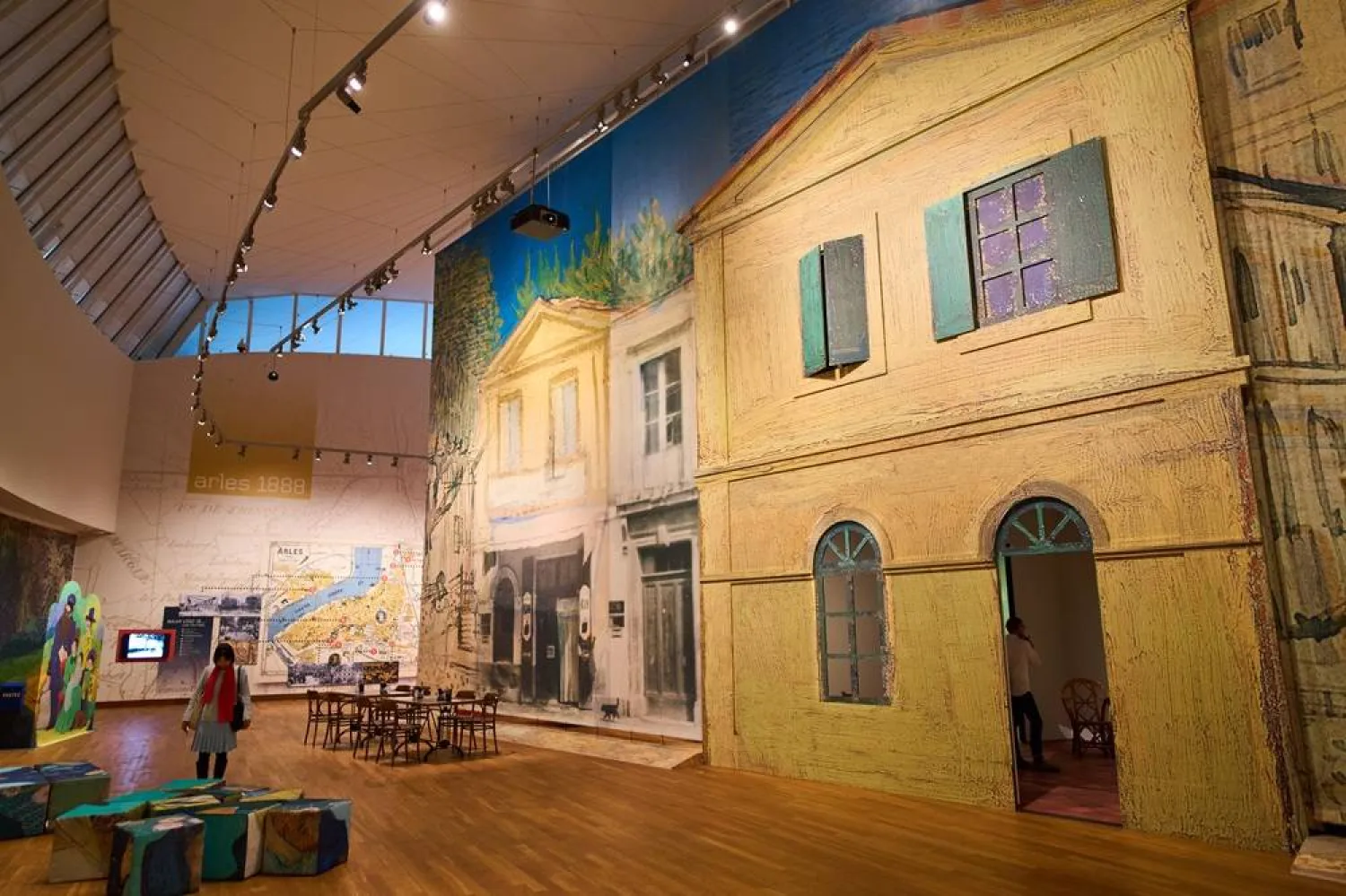
 A life-size facade of the yellow house that Vincent Van Gogh used as his studio in Arles was recreated at the Van Gogh Museum in Amsterdam, Netherlands, Wednesday, Oct. 1, 2025. (AP)
A life-size facade of the yellow house that Vincent Van Gogh used as his studio in Arles was recreated at the Van Gogh Museum in Amsterdam, Netherlands, Wednesday, Oct. 1, 2025. (AP)
TT

A Postman, a Family, and an Overlooked Chair: Van Gogh Museum’s Surprising Reunion

 A life-size facade of the yellow house that Vincent Van Gogh used as his studio in Arles was recreated at the Van Gogh Museum in Amsterdam, Netherlands, Wednesday, Oct. 1, 2025. (AP)
A life-size facade of the yellow house that Vincent Van Gogh used as his studio in Arles was recreated at the Van Gogh Museum in Amsterdam, Netherlands, Wednesday, Oct. 1, 2025. (AP)

The Van Gogh Museum is bringing a scattered family back together this fall to honor a postal worker, his wife and their children who sat as models for the Dutch master at time when he was struggling to make friends in a French town.

Portraits of the expansively bearded postman Joseph Roulin, his wife, two sons and baby daughter have been brought together for an exhibition titled "Van Gogh and the Roulins. Together Again at Last." The show collects paintings of the family from museums around the world and even features an armchair from the artist's studio in Arles in the southern region of Provence.

The show is in Amsterdam after a run at the Museum of Fine Arts in Boston, which provided one of the centerpieces of the exhibition, a portrait of the postman (he was actually a postal clerk) resplendent in his blue uniform with gold buttons and trim sitting in an armchair made of local willow from Provence.

While preparing the show, the Van Gogh Museum found the very chair featured in the portrait in its storerooms and is exhibiting it for the first time. It was deemed too fragile to be sent to Boston for the show there.

"As it turns out, we have this chair in our collection, but we have never shown it before," said Van Gogh Museum Director Emilie Gordenker. "And it just shows you when you start to work on a topic — in this case, the Roulin family portraits — all kinds of things you might never have thought about before come up and it’s really exciting to rediscover, as it were, your own collection."

Vincent van Gogh created a total of 26 portraits of the family in a burst of creative activity from July 1888 to April 1889. There are 14 on show at the museum alongside works by his friend and fellow painter Paul Gauguin and by Dutch Golden Age masters Rembrandt van Rijn and Frans Hals, whose works were major sources of inspiration.

"Many people consider his Arles period really his peak," Gordenker said. "I’m not sure we totally agree with that, but it is definitely a moment when he turns a corner ... his power as an artist really comes out."

In an upstairs room, the museum has created a life-size facade of the yellow house that Van Gogh used as his studio in Arles, where Roulin became more than just a model to Van Gogh.

"While Roulin isn't exactly old enough to be like a father to me, all the same he has silent solemnities and tenderness for me like an old soldier would have for a young one," the artist wrote in a letter to his brother, Theo, in April 1889.

Nienke Bakker, who curated the show along with Katie Hanson from the Boston Museum of Fine Arts, said the Arles period was crucial to Van Gogh's artistry.

"He literally says painting people brings out the best in me, but also makes me feel part of humanity. So it’s a very important thing," Bakker said.

She said that the chair went into storage after Van Gogh left Arles and was then passed to the artist's relatives and ultimately to the museum.

The museum is now displaying the chair alongside the painting from the Boston museum that features Roulin and the chair.

"It’s quite moving to have of course this fantastic portrait here, but also to to be able to show the actual chair he was sitting in and to realize that it was quite a simple small chair," Bakker said.

The exhibition opens Friday and runs through Jan. 11.


Diving Robot Explores Mystery of France's Deepest Shipwreck

Marine Sadania, a maritime archaeologist in charge of scientific and heritage management for the PACA Coastal Observatory, observes the “ROV C 4000,” a remotely operated vehicle manufactured by the French company LD Travocean and designed for seabed exploration,  during its launch aboard the Jason (BSAA), chartered for an archaeological mission on the wreck of the CAMARAT 4 off the coast of Ramatuel, in southeastern France on April 7, 2026. (Photo by Thibaud MORITZ / AFP)
Marine Sadania, a maritime archaeologist in charge of scientific and heritage management for the PACA Coastal Observatory, observes the “ROV C 4000,” a remotely operated vehicle manufactured by the French company LD Travocean and designed for seabed exploration, during its launch aboard the Jason (BSAA), chartered for an archaeological mission on the wreck of the CAMARAT 4 off the coast of Ramatuel, in southeastern France on April 7, 2026. (Photo by Thibaud MORITZ / AFP)
TT

Diving Robot Explores Mystery of France's Deepest Shipwreck

Marine Sadania, a maritime archaeologist in charge of scientific and heritage management for the PACA Coastal Observatory, observes the “ROV C 4000,” a remotely operated vehicle manufactured by the French company LD Travocean and designed for seabed exploration,  during its launch aboard the Jason (BSAA), chartered for an archaeological mission on the wreck of the CAMARAT 4 off the coast of Ramatuel, in southeastern France on April 7, 2026. (Photo by Thibaud MORITZ / AFP)
Marine Sadania, a maritime archaeologist in charge of scientific and heritage management for the PACA Coastal Observatory, observes the “ROV C 4000,” a remotely operated vehicle manufactured by the French company LD Travocean and designed for seabed exploration, during its launch aboard the Jason (BSAA), chartered for an archaeological mission on the wreck of the CAMARAT 4 off the coast of Ramatuel, in southeastern France on April 7, 2026. (Photo by Thibaud MORITZ / AFP)

Deep below the surface of the Mediterranean off the French coast, the pincer of a remotely guided underwater robot delicately closes around a centuries-old jug lying near a 16th-century shipwreck.

"You have to be extremely precise so as not to damage the site, so as not to stir up sediment," says navy officer Sebastien, who cannot give his second name for security reasons.

A two-hour journey from the French Riviera, Sebastien is overseeing the first of several archaeological missions on the deepest shipwreck in French territorial waters.

A routine army survey of the seabed uncovered the 16th-century merchant ship by chance last year in waters off the coast of Ramatuelle, close to Saint-Tropez.

Archaeologists believe the ship was sailing from northern Italy loaded with ceramics and metal bars before it sank.

Now the French navy and the culture ministry's underwater archaeology department are back to inspect the surviving artifacts lost more than 2,500 meters (1.5 miles) below sea level.

- Cannon, piles of jugs -

The navy is keeping secret the location of the wreckage site, which they have dubbed "Camarat 4" -- even if most people would unlikely have the means to reach a site so deep.

The sun has barely risen when the mission's navy tugboat arrives on site, carrying an underwater robot and two large containers acting as makeshift offices for marine archaeologists.

Its crew lower the robot -- which is equipped with cameras as well as pincers -- into the water.

A navy officer guides the robot down, linked to the ship through a long cable, as experts monitor its slow descent on screens.

An hour later, the device -- which is designed to plunge as deep as 4,000 meters -- is gliding over piles of round pitchers on the sea floor.

Slowly, through its cameras, it reveals the wreck to the team sitting on deck, AFP reported.

It captures footage of a cannon, as well as hundreds of pitchers and plates, decorated with floral motifs, crosses and fish.

The robot shoots eight pictures per second for three hours, grabbing more than 86,000 images that will then be used to create a 3D model of the site.

Archaeologist Franca Cibecchini is delighted the water is so clear.

"The visibility is excellent. You almost can't tell it's so deep," she says.

"It is most likely a merchant ship carrying glazed pottery from Liguria," a region in the northwest of Italy, Cibecchini adds.

She says it could have been loaded on to the ship in the ports of Genoa or nearby Savona.

- 'Valuable information' -

Marine Sadania, the lead archaeologist on the underwater dig, says findings will be key to understanding trade routes at the time the ship sank.

"We don't have very detailed texts about merchant ships in the 16th century, so this is a valuable source of information on maritime history," she says.

The experts hold their breath as the robot lowers a pitcher into a case as gently as possible, so as not to break it.

A third of all ceramics extracted from sea digs end up breaking, Sadania says.

In total, the team hauls up several jugs and plates.

Back on land, in a laboratory in the southern port city of Marseille, Sadania runs water over one of the jugs.

Dark blue lines run across its rounded side, creating rectangles, some of which are colored in with turquoise blue or decorated with saffron-yellow symbols.

"It's one of the deepest objects ever recovered from a wreck in France," she says.


Philippine Museum Brings Deadly, Lucrative Galleon Trade to Life

This photo taken on April 23, 2026 shows visitors under the Galeon Espiritu Santo, a full-scale representation of a 17th century galleon, on display at the Museo del Galeon in Manila. (Photo by Jam STA ROSA / AFP)
TT

Philippine Museum Brings Deadly, Lucrative Galleon Trade to Life

This photo taken on April 23, 2026 shows visitors under the Galeon Espiritu Santo, a full-scale representation of a 17th century galleon, on display at the Museo del Galeon in Manila. (Photo by Jam STA ROSA / AFP)

A full-size replica of a Spanish galleon stares out into Manila Bay, the centerpiece of a museum that will transport visitors back to the 17th century, when conscripted Philippine mariners birthed the era of globalization.

The Museo del Galeon, which focuses on the hulking Espiritu Santo, aims to tell the story of Spain's 250-year-long Pacific galleon trade from the perspective of the Filipinos who built and crewed the towering vessels.

"This is a land with a great tradition of seafaring, but often under inhumane and degrading conditions," the museum's executive director Manuel Quezon told AFP, noting Filipinos still make up a quarter of the world's sailors.

"And it is one that we don't flinch from telling."

Built with forced labor in 1603, the Espiritu Santo was one of 181 treasure ships that made hundreds of trips between Manila and the Mexican port of Acapulco between 1565 and 1815 under harrowing conditions that historians say killed one in three crewmen.

"It was the first global trade, connecting three continents," said Francis Navarro, director of archives at the Ateneo de Manila University.

"It made the world smaller."

This photo taken on April 21, 2026 shows an interior view of the Galeon Espiritu Santo, a full-scale representation of a 17th century galleon, on display at the Museo del Galeon in Manila. (Photo by Jam STA ROSA / AFP)

Sailing west across the Pacific for three months, the ships brought silver coins from Spain's American colonies to Manila, where they would be exchanged for luxury goods like silk, porcelain and jade from China.

The return voyage lasted as long as a year, with cargo then transported across Mexico by mule before heading to Spain, completing a trade loop between the old and new worlds.

The galleons brought more than silver to the Philippines. They brought ideas, disease, food, religion, fashion and more -- the things that "made us who we are", Quezon said.

The colonial trade also ravaged the archipelago's forests and wrecked communities, with able-bodied men required to offer 40 days of unpaid service to fell trees and build ships under Spanish foremen.

Others were forced into service as sailors for up to 10 years at a time.

Cramped inside vessels overladen with precious cargo, crewmembers subsisted on a miserable diet of hardtack, an unleavened bread, and salted meat and fish that routinely spoiled and left many gravely ill.

"You had an astounding mortality rate of about 30 percent per voyage," Quezon said.

Deadly rebellions were sparked in some areas where galleons were built, Navarro added, including on the Cavite coast along Manila Bay.

The multi-continent trade would only end with Mexico's fight for independence from Spain.

Fourteen years after its conception, museumgoers will starting May 1 be able to walk the replica ship's decks, immersed in a giant, wrap-around LED display of star-studded night skies.

Artifacts from voyages line exhibits surrounding the vessel, including part of a Chinese tomb that once served as ballast in the hold of a galleon.

"We're filling the blanks in with this museum," Quezon told AFP on a tour ahead of its opening.

"The child who comes through, we want them to realize that many of the things that they take for granted have absolutely amazing stories behind them."

Funding for the "billion-peso" ($16.5 million) project came from the Philippines' wealthiest families after bids to secure financing from the government and a Mexican billionaire faltered.

But while the Espiritu Santo is a physical marvel, it will never set sail.

Early in the process, Quezon, a historian and grandson of a former Philippine president, learned to his dismay that the local hardwood and water-resistant species used to build the galleons had long been wiped out.

A wooden galleon of Espiritu Santo's size would have required 800 trees that could now only be found in the forests of Myanmar, said Quezon.

While the museum representation is scrupulously faithful to what is known of the original vessel's design and dimensions, it was built largely with fibreglass and other man-made materials.

"In those days, you would have levelled entire forests just to be able to produce a single galleon," he said.

"That would have been irresponsible, particularly because it wasn't meant to float."


Over 90 Countries Participate in the 5th Edition of Peoples’ Heritage Festival in Saudi Arabia

The cultural event reflected the diversity of global heritage and promoted cultural and knowledge exchange among peoples. SPA
TT

Over 90 Countries Participate in the 5th Edition of Peoples’ Heritage Festival in Saudi Arabia

The cultural event reflected the diversity of global heritage and promoted cultural and knowledge exchange among peoples. SPA

The fifth edition of the Peoples’ Heritage Festival, organized by Qassim University at the King Khalid Cultural Center in Buraidah, witnesses broad participation from more than 90 countries worldwide over six days, in a cultural event that reflects the diversity of global heritage and promotes cultural and knowledge exchange among peoples.

The festival presents live folkloric performances and traditional costumes that reflect the cultural identity of the participating countries, alongside international pavilions showcasing their most prominent popular heritage.

The scene blends authenticity with cultural diversity and features numerous events, including a children’s theater offering educational and entertaining shows, a classic car exhibition, and falconry displays that highlight an aspect of genuine Arab heritage.

Meanwhile, the Saudi pavilion illustrates the three stages of the Saudi state – first, second, and third – through informative content that sheds light on its history, development, and civilizational and cultural achievements.
