


IMF Chief Says Global Economy Doing ‘Better than Feared,’ Risks Remain

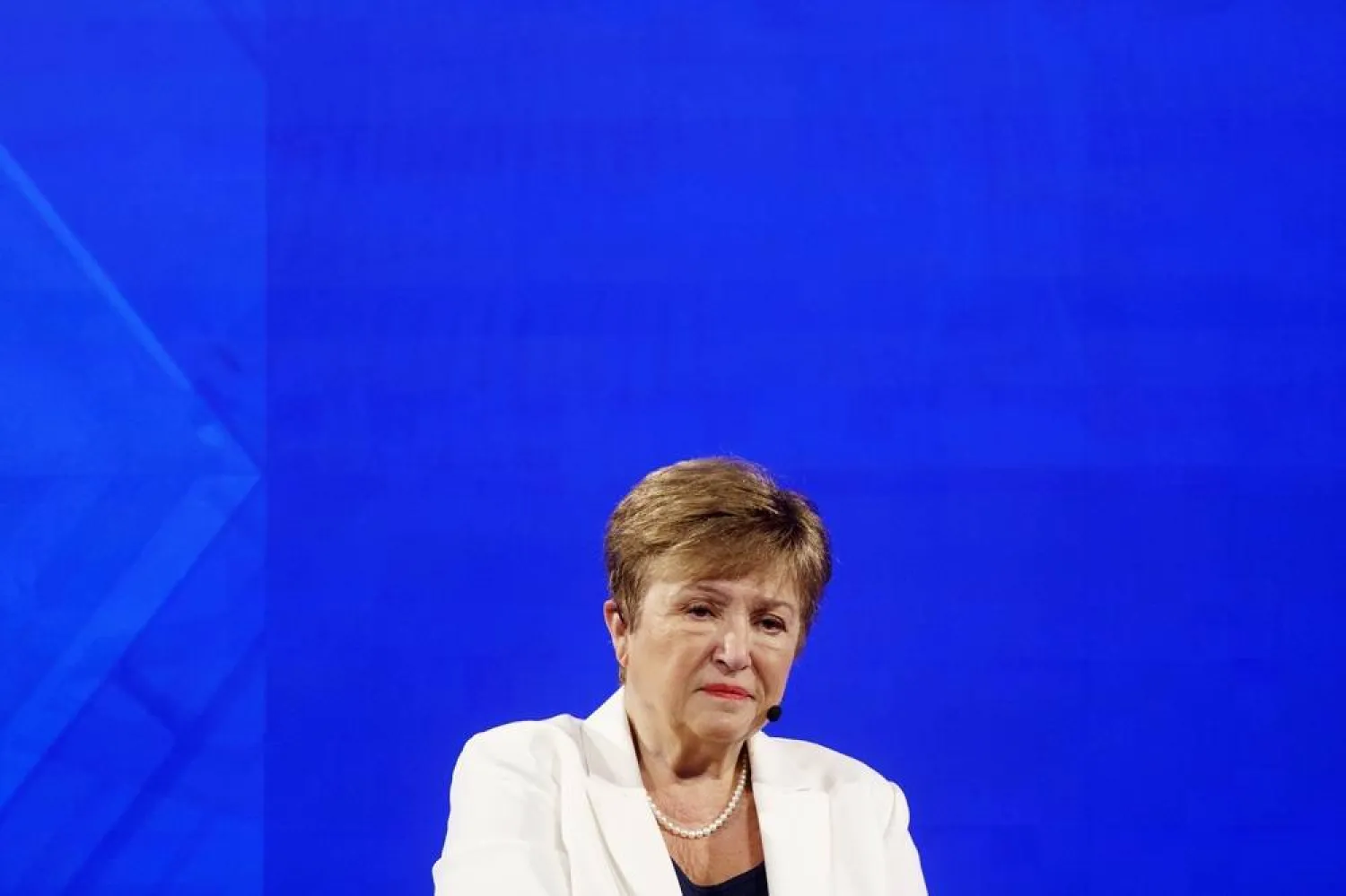
International Monetary Fund (IMF) Managing Director Kristalina Georgieva delivers a speech at the Milken Institute in Washington, DC USA, 08 October 2025. (EPA)
TT

IMF Chief Says Global Economy Doing ‘Better than Feared,’ Risks Remain

International Monetary Fund (IMF) Managing Director Kristalina Georgieva delivers a speech at the Milken Institute in Washington, DC USA, 08 October 2025. (EPA)

The world economy has proven more resilient than expected despite acute strains from multiple shocks, the head of the International Monetary Fund said on Wednesday, forecasting only a slight slowing of global growth this year and in 2026.

IMF Managing Director Kristalina Georgieva said the US economy had dodged a recession feared by many experts just six months ago.

The US economy and many others had held up, given better policies, a more adaptable private sector, less severe import tariffs than feared - at least for now - and supportive financial conditions, according to a text of her remarks to an event at the Milken Institute in Washington.

"We see global growth slowing only slightly this year and next. All signs point to a world economy that has generally withstood acute strains from multiple shocks," Georgieva said in a preview of the IMF's upcoming World Economic Outlook.

In July, the IMF raised its global growth forecast by 0.2 percentage point to 3.0% for 2025 and by 0.1 percentage point to 3.1% for 2026. It will release a fresh outlook next Tuesday during the annual meetings of the IMF and World Bank in Washington.

The gathering takes place at a time when US President Donald Trump has upended global trade with steep tariffs and cracked down on immigration, and artificial intelligence is rapidly transforming technology and the outlook for labor.

The world economy is doing "better than feared, but worse than needed," Georgieva said, noting that the IMF was forecasting global growth of roughly 3% over the medium-term, well below the 3.7% forecast before the COVID-19 pandemic.

Georgieva cited deep undercurrents of marginalization, discontent and hardship around the world, and said the global economy faced an array of risks.

Uncertainty is at exceptionally high levels and continuing to climb, while demand for gold - a traditional safe-haven asset for investors - is surging, Georgieva said, adding that holdings of monetary gold now exceeded 20% of the world's official reserves.

The US tariff shock has been less severe than initially announced in April, with the US trade-weighted tariff rate now around 17.5%, down from 23% in April, and countries largely skipping retaliatory tariffs.

But US tariff rates keep changing, and US inflation could rise if companies started to pass through more of the cost of tariffs, or if a flood of goods previously headed for the US triggered a second round of tariff hikes elsewhere.

Financial market valuations are also heading toward levels last seen during the internet-related bullishness 25 years ago, she said. An abrupt shift in sentiment - such as what happened during the dot.com crash of March 2000 - could drag down world growth, making life especially tough for developing countries.

"Buckle up," Georgieva said, adding, "Uncertainty is the new normal and it is here to stay."

GEORGIEVA WARNS ON DEBT LEVELS

The IMF chief urged countries to durably lift growth by boosting private-sector productivity, consolidating fiscal spending and addressing excessive imbalances, allowing them to rebuild their buffers to prepare for the next crisis.

Global public debt is expected to exceed 100% of GDP by 2029, Georgieva said.

Competition is key, along with free-market-friendly property rights, rule of law, strong financial sector oversights and accountable institutions.

In Asia, countries need to deepen trade and carry out reforms to strengthen the service sector, Georgieva said. A push to lower non-tariff barriers and boost regional integration could lift gross domestic product by 1.8% in the long run.

In Sub-Saharan Africa, business-friendly reforms could boost the real GDP per capita of the median African country by more than 10%. Europe should forge ahead with building a single market, which could help it catch up with the dynamism of the US private sector, she said.

The US should take "sustained action" to lower its federal debt, with the debt-to-GDP ratio on track to exceed its all-time high after World War Two, Georgieva said. It should also work to boost household saving, such as through favorable treatment of retirement savings.

China also has work to do, including boosting fiscal spending on social safety nets and property sector clean-up, while cutting spending on industrial policy initiatives, she said.



Morocco to Open Two Deepwater Ports in 2026 and 2028, Minister Says

A general view of Tanger Med Port, on the Strait of Gibraltar, east of Tangier, Morocco June 6, 2024. (Reuters)
TT

Morocco to Open Two Deepwater Ports in 2026 and 2028, Minister Says

A general view of Tanger Med Port, on the Strait of Gibraltar, east of Tangier, Morocco June 6, 2024. (Reuters)

Morocco will open a new deepwater Mediterranean port next year and another on the Atlantic in 2028, Equipment and Water minister Nizar Baraka said, as the North African country aims to replicate the success of Africa's largest port, Tanger Med.

Nador West Med, under construction on the Mediterranean, is scheduled to be operational in the second half of 2026, Baraka told Reuters in an interview.

It will offer 800 hectares for industrial activity, with plans to expand to 5,000 hectares, surpassing Tanger Med's industrial zones, he said.

The port will also host Morocco's first liquefied natural gas (LNG) terminal - a floating storage and regasification unit (FSRU) - linked by a pipeline to industrial hubs in the northwest, as Morocco pushes investments in natural gas and renewable energy to reduce dependence on coal.

Further south on the Atlantic coast, Morocco is building a $1 billion port in Dakhla, in the disputed Western Sahara region.

The facility will be surrounded by 1,600 hectares for industrial activities and 5,200 hectares for farmland irrigated by desalinated water, Baraka said.

"The port will be ready in 2028 and will be Morocco's deepest at 23 meters," Baraka said. Such depth would support heavy industries focused on processing raw materials from Sahel countries, he said.

Officials have marketed Dakhla as a gateway for landlocked Sahel nations to global trade.

Both Nador and Dakhla ports will include quays dedicated to exporting green hydrogen once production begins, Baraka said.

Nador and Dakhla would be Morocco's third and fourth deepwater ports after Tanger Med and Jorf Lasfar, an energy, bulk cargo and phosphates exports port on the Atlantic.

By 2024, industrial zones near Tanger Med hosted 1,400 firms employing 130,000 people across sectors including automotive, aeronautics, textiles, agri-food and renewable energy, official figures show.

Morocco is also considering building a port in Tan-Tan on the Atlantic in partnership with green hydrogen investors, Baraka said. "We are conducting studies to decide the appropriate size of the port," Baraka said.


Saudi Arabia, Qatar Sign High-Speed Railway Project Implementation Agreement

The project is slated for completion in six years, utilizing the latest railway technologies and smart engineering to ensure safe and seamless operation and to adhere to the highest international standards of quality and safety - SPA
TT

Saudi Arabia, Qatar Sign High-Speed Railway Project Implementation Agreement

The project is slated for completion in six years, utilizing the latest railway technologies and smart engineering to ensure safe and seamless operation and to adhere to the highest international standards of quality and safety - SPA

Prince Mohammed bin Salman bin Abdulaziz Al Saud, Crown Prince and Prime Minister, and Emir of the State of Qatar Sheikh Tamim bin Hamad Al Thani witnessed the signing of an agreement to implement a high-speed electric passenger railway project connecting the Kingdom of Saudi Arabia and the State of Qatar, a step reflecting the deep-rooted fraternal and historical relations between the two countries.

The agreement was signed by Minister of Transport and Logistic Services Saleh Al-Jasser and Minister of Transport of Qatar Sheikh Mohammed bin Abdulla bin Mohammed Al Thani within the framework of the Saudi-Qatari Coordination Council, representing a strategic step aimed at enhancing cooperation, developmental integration, and sustainable development, and demonstrating a shared commitment to regional prosperity, SPA reported.

The high-speed railway line spans 785 kilometers, strategically connecting the capital cities of Riyadh and Doha, and will pass through key stations including Hofuf and Dammam, while also linking King Salman International Airport and Hamad International Airport.

The train will form a new artery for rapid and sustainable transportation, improving the regional travel experience with speeds exceeding 300 kilometers per hour, reducing travel time between the two capitals to approximately two hours, significantly enhancing mobility, boosting trade and tourism, and improving quality of life.

The project is slated for completion in six years, utilizing the latest railway technologies and smart engineering to ensure safe and seamless operation and to adhere to the highest international standards of quality and safety.

It is expected to have an economic impact of nearly SAR115 billion on the GDP of both countries, serve over 10 million passengers annually, and create more than 30,000 direct and indirect jobs.

The high-speed railway will also contribute to environmental sustainability by reducing carbon emissions and supporting the transition to more efficient and innovative transportation patterns for smart and sustainable mobility in the region.

This makes the rail line one of the most important strategic projects supporting regional development and strengthening connectivity and integration among the Gulf Cooperation Council countries.


Türkiye's Pegasus Airlines Acquires Biggest Czech Airline, Smartwings, in a Deal Worth $180 million

A passenger plane of the ‘Pegasus’ airline lands at the ‘Stuttgart Airport’ in Stuttgart, Germany, Wednesday, May 3, 2023. (Bernd Weissbrod/dpa via AP, File)
TT

Türkiye's Pegasus Airlines Acquires Biggest Czech Airline, Smartwings, in a Deal Worth $180 million

A passenger plane of the ‘Pegasus’ airline lands at the ‘Stuttgart Airport’ in Stuttgart, Germany, Wednesday, May 3, 2023. (Bernd Weissbrod/dpa via AP, File)

Türkiye's Pegasus Airlines said on Monday it has signed an agreement to acquire the biggest Czech airline, Smartwings, along with its owner, Czech Airlines, from Prague City Air.

Pegasus said the deal, which is worth 154 million euros (almost $180 million) was a “step forward in our continued global growth journey,” Reuters reported.

The process of transferring the ownership of Czech Airlines should be completed in 12 months, Smartwings spokeswoman Vladimíra Dufková said.

Smartwings currently operates regular, charter and private flights to some 80 destinations with almost 50 planes. The airline previously negotiated a takeover by Polish national carrier LOT but that fell through over the weekend after Pegasus filed a rival bid.

Pegasus, a low cost carrier, that was established in 1990. It says it operates flights to 153 destinations in 54 countries.