
'Time Runs Away': Japan's City with a Two-hour Cap on Phone Use

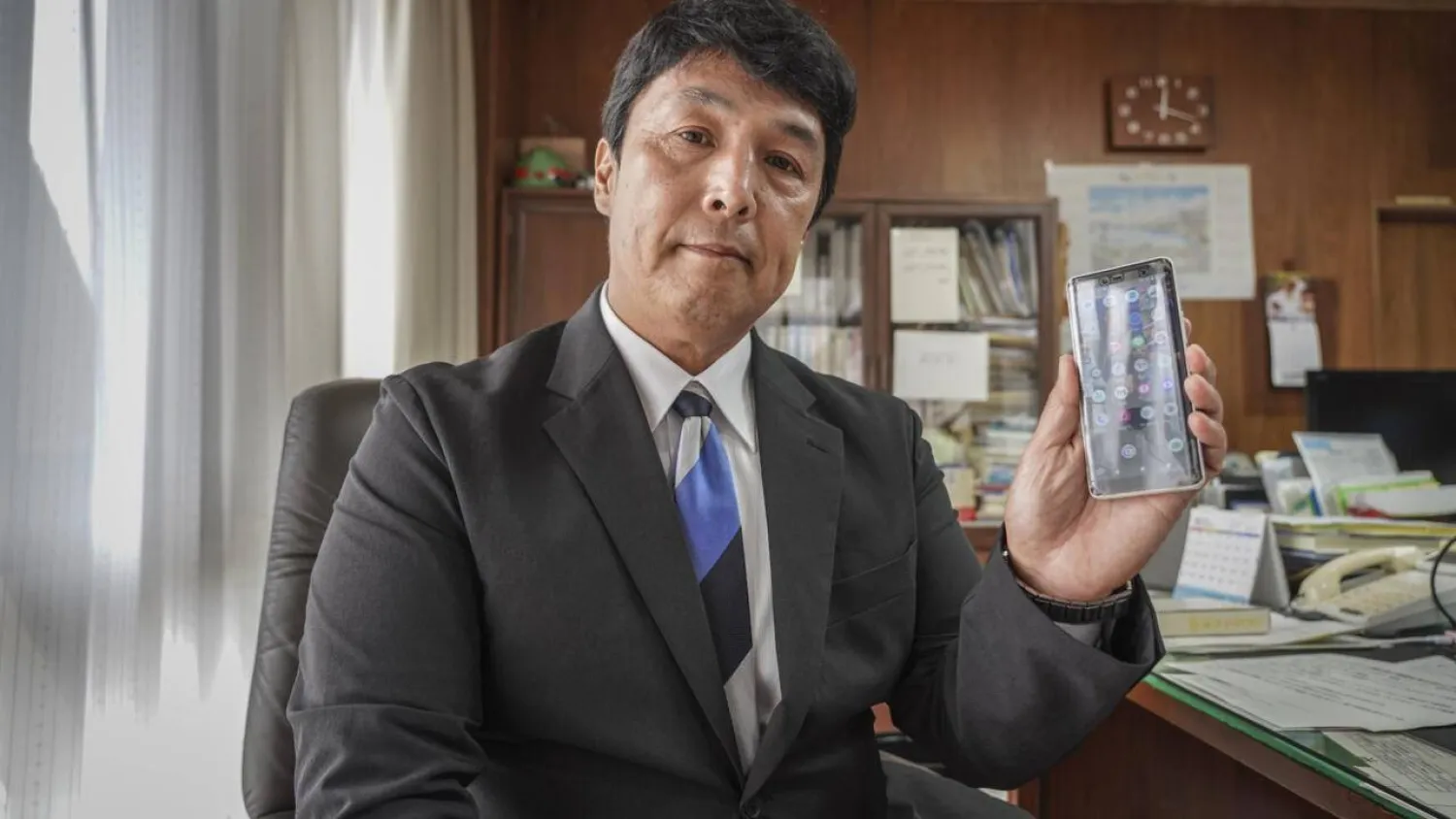
Mayor Masafumi Kouki says he worried for many months about the "negative effects of excessive smartphone use, especially the sharp decrease in direct human communication". Caroline GARDIN / AFP
TT

'Time Runs Away': Japan's City with a Two-hour Cap on Phone Use

Mayor Masafumi Kouki says he worried for many months about the "negative effects of excessive smartphone use, especially the sharp decrease in direct human communication". Caroline GARDIN / AFP

Police won't be rounding up people glued to phones in Japan's Toyoake, but the mayor believes his two-hour limit can help residents find a healthier relationship with their screens.

Masafumi Kouki told AFP he has worried for many months about the "negative effects of excessive smartphone use, especially the sharp decrease in direct human communication".

"Even on trains, everyone just stares at their phones, and no one talks anymore," he said.

"I don't believe this should be considered normal, so I wanted to create an opportunity for our residents to reflect on whether they might be overusing their smartphones."

A local ordinance on the appropriate use of phones, laptops and tablets came into force last week in Toyoake, a largely grey, concrete suburb of the industrial metropolis Nagoya.

There are no penalties for exceeding its recommended two-hour limit, which applies to adults and children alike and was approved by the city council in a 12-7 vote.

Instead, the aim is to encourage self-regulation.

"It's certainly a rare step -- we know that," said the 56-year-old Kouki, whose own phone screen has multiple cracks.

When the ordinance was first proposed, "opposition was almost universal".

But many citizens came round to the idea, he said, when they learned that the daily cap does not include work or study time and is meant as a guideline, not a strict rule.

'Overreach'

Among Toyoake's population of nearly 68,000, not everyone is convinced.

"Nowadays... we do everything -- studying, hobbies, communication -- through a single smartphone," said 22-year-old law student Shutaro Kihara.

So the ordinance is "rather meaningless or ineffective" for young people, he said.

City lawmaker Mariko Fujie, 50, voted against Kouki's decree.

Excessive smartphone use is a social problem that needs addressing, she told AFP.

But "I feel a strong resistance to regulating people's personal free time through an ordinance", she said.

"It feels like an overreach."

Ikka Ito, a middle school student playing a video game near a local station, uses his phone for four to five hours a day.

"I've been voluntarily cutting back compared to before the ordinance was announced," without his parents telling him to, he said.

But there are downsides, too.

"If you reduce smartphone time, you can't stay in touch" with friends, Ito said.

One goal is to improve citizens' health by helping them get more sleep.

Toyoake's ordinance urges elementary school students to avoid smartphones after 9 pm, while junior high students and older are advised not to use them after 10 pm.

Sleepy citizens

Surveys have found that people in Japan get less sleep than those in other developed economies, often due to long working hours.

Toyoake resident Kokuka Hirano, 59, said she is "sleep-deprived" because of her phone.

"I want to research various things I don't understand, so I end up watching news from different countries," she said.

"Time runs away from me."

Hirano wants to limit her smartphone use to devote more time to exercise and cooking.

But "three or four hours would be more reasonable... two hours feels too strict".

Studies show that as well as smartphones interfering with sleep, which can affect mental health, heavy use of social media is linked with loneliness, depression and anxiety.

Global efforts to limit potential harm to children include an upcoming Australian ban on social media for under-16s.

Mayor Kouki has two children aged 10 and seven who don't own smartphones, although the 10-year-old borrows his wife's without permission.

Kouki said he likes using his phone to watch Japanese baseball highlights, but the family now shuns screens during mealtimes.

Yumi Watanabe, a 36-year-old mother-of-three in Toyoake, said most parents she knows let their children explore freely online, which is "scary".

Even so, the ordinance "wasn't really necessary", she said.

"It's something each person can judge for themselves as they go."


Nobel Laureates Arrive for a Week of Events and Awards in Stockholm and Oslo

The Nobel medal in physiology or medicine presented to Charles M. Rice is displayed, Tuesday, Dec. 8, 2020, during a ceremony in New York. (AP)
TT

Nobel Laureates Arrive for a Week of Events and Awards in Stockholm and Oslo

The Nobel medal in physiology or medicine presented to Charles M. Rice is displayed, Tuesday, Dec. 8, 2020, during a ceremony in New York. (AP)

Nobel week was underway in Stockholm and Oslo with laureates holding news conferences and lectures before they will be awarded the prestigious prizes.

Hungarian László Krasznahorkai, who won the Prize in literature for his surreal and anarchic novels that combine a bleak world view with mordant humor, was expected to give a lecture in Stockholm on Sunday in one of his rare public appearances.

When the Nobel judges announced the award in October, they described the 71-year-old as “a great epic writer” whose work “is characterized by absurdism and grotesque excess.”

“Krasznahorkai’s work can be seen as part of a Central European tradition," the Nobel Prize organization said. “Important features are pessimism and apocalypse, but also humor and unpredictability."

Last year’s winner was South Korean author Han Kang. The 2023 winner was Norwegian writer Jon Fosse, whose work includes a seven-book epic made up of a single sentence.

Meanwhile, the director of the Norwegian Nobel Institute, Kristian Harpviken, said Saturday that Venezuelan Peace Prize laureate and opposition leader María Corina Machado will come to Oslo this week to receive her award in person.

The 58-year-old, who won for her struggle to achieve a democratic transition in the South American nation, has been hiding and has not been seen in public since January.

Harpviken told Norwegian public broadcaster NRK that Machado was expected to personally pick up the prize on Wednesday.

“I spoke with the Peace Prize winner last night, and she will come to Oslo,” Harpviken said, according to NRK.

Nobel Prize award ceremonies are held on Dec. 10, the anniversary of Alfred Nobel’s death in 1896. The award ceremony for peace is in Oslo and the other ceremonies are in Stockholm.


Bethlehem Lights up Christmas Tree for First Time Since Gaza War

People gather during the lighting of the Christmas tree ceremony at the Manger Square, next to the Church of Nativity in the background, in the West Bank city of Bethlehem, 06 December 2025. (EPA)
TT

Bethlehem Lights up Christmas Tree for First Time Since Gaza War

People gather during the lighting of the Christmas tree ceremony at the Manger Square, next to the Church of Nativity in the background, in the West Bank city of Bethlehem, 06 December 2025. (EPA)

Christmas cheer returned to the traditional birthplace of Jesus Christ on Saturday as Bethlehem in the occupied West Bank lit up a tree for the first time since the war in Gaza began over two years ago.

Covered in red and gold baubles, the Christmas tree standing meters away from the Church of the Nativity on Manger Square has become a symbol of hope.

At the end of a two-hour ceremony, the tree was illuminated to cheers, its yellow lights twinkling and a bright red star on top shining against the clouded night sky irradiated by a luminescent, almost full moon.

It is the first time the city has held the usual celebrations since the outbreak of the war in Gaza following Hamas’s attack on Israel in October 2023.

“It’s like a symbol for resilience,” said 27-year-old Abeer Shtaya, who works at Al-Zaytoonah University of Science and Technology in Salfit in the West Bank.

She had traveled 100 kilometers (60 miles) with a group of the university’s students because “we want to celebrate and be with our brothers and sisters in Bethlehem to enjoy this day.”

“It’s a message for the world that it’s calm,” Mike Shahen, 43, said at his ceramic store on the square, after a handful of visitors came in for purchases.

Thousands of people attended, including Christians and Muslims, and many who traveled from Palestinian territories and Israel -- some from even further afield -- to enjoy the festive spirit return.

Nuns could be seen watching from one roof, while many families including small children filled balconies and roofs to catch a glimpse of the tree lit up.

Sounds of laughter filled the air as many could not help but smile despite moments of rain.

“This event didn’t happen for the last two years because of the war and it’s quite emotional after two years of nothing but war and death,” said 50-year-old Liyu Lu, who had traveled from northern Israel, close to the border with Lebanon.

Originally from China but now living in Israel for decades, she was with a group including Gary Lau, a traveling businessman and Christian staying in Jerusalem for the past couple of months.

“Being here, with the festivities, is something very nice and special,” Lau, 51, said, adding he was “taking in the atmosphere.”

For the past two years, Bethlehem has celebrated Christmas in a more somber manner, with no major public festivities.

Tentative return

Christian pilgrims, especially from Asia, South America and eastern Europe have, however, slowly returned in the past few months.

Fabien Safar, guide and director of Terra Dei which organizes pilgrimages to the Holy Land, said a few small groups would come for Christmas this year and he already saw some bookings for 2026.

Safar expected a real recovery in 2027 but “this obviously depends on how the situation evolves” in Gaza and Lebanon.

Despite a November 2024 ceasefire that was supposed to end more than a year of hostilities between Israel and militant group Hezbollah, Israel has kept up strikes on Lebanon.

Pilgrims “remain afraid because there’s no official end to the war” in Gaza, Safar said, adding they were also worried about the situation in Lebanon.

‘Worse than COVID’

But it has all taken a toll on Bethlehem, which had only just cheered the return of tourists in 2022 after the COVID-19 pandemic, before the war in Gaza broke out.

Bethlehem’s economy relies almost completely on tourism.

“Covid was bad but nothing like the last two years,” said Shahen from the ceramic store.

Many visitors from Israel and the Palestinian territories spent hours on the road to reach Bethlehem including musician Lu.

She woke up at 6 am to get a bus at 7 am with a large group. They arrived at 12:30 pm, she said, without any trouble.

War isn’t the only reason for Bethlehem’s woes.

Since the 2023 Hamas attack, it is more difficult to travel around the West Bank with long queues on the roads with Israeli military checkpoints.

Violence in the West Bank, which Israel has occupied since 1967, has also surged since the Gaza war. It has not stopped despite the fragile truce between Israel and Hamas that began this October.


Number's Up: Calculators Hold Out against AI

Calculators are more affordable than phones, and run on batteries and solar power. Lillian SUWANRUMPHA / AFP
TT

Number's Up: Calculators Hold Out against AI

Calculators are more affordable than phones, and run on batteries and solar power. Lillian SUWANRUMPHA / AFP

The humble pocket calculator may not be able to keep up with the mathematical capabilities of new technology, but it will never hallucinate.

The device's enduring reliability equates to millions of sales each year for Japan's Casio, which is even eyeing expansion in certain regions.

Despite lightning-speed advances in artificial intelligence, chatbots still sometimes stumble on basic addition.

In contrast, "calculators always give the correct answer," Casio executive Tomoaki Sato told AFP.

But he conceded that calculators could one day go the way of the abacus.

"It's undeniable that the market for personal calculators used in business is on a downward trend," Sato said in Tokyo.

Smartphones and web browsers can handle everyday sums, while AI models achieved gold-level scores for the first time this year at a prestigious global maths contest.

But calculators are more affordable than phones, and run on batteries and solar power -- a plus for schools in developing countries, a potential growth area for Casio, Sato said.

And people who do buy calculators prefer the way they feel, he argued.

Thitinan Suntisubpool, co-owner of a shop selling red bags and beckoning cats in Bangkok's Chinatown, said she loves how durable her big calculator is, having dropped it several times.

"It's more convenient in many ways," the 58-year-old told AFP.

"We can use it to press the numbers and show the customer," avoiding language-barrier misunderstandings.

But at a nearby street stall selling clocks, torches and calculators, the vendor, who gave her name as Da, said calculator sales were "quiet".

'Optimised tools'

At a Casio factory in Thailand, assembly line workers slotted green circuit boards into place and popped cuboid buttons labelled "DEL" from a plastic tub onto pastel-blue calculator frames.

"Calculators are still in demand," said Ryohei Saito, a general manager for Casio in Thailand.

"Not everywhere in the world has smartphone connectivity, and calculators are optimised tools focused on necessary functions," he said.

In the year to March 2025, Casio sold 39 million calculators, general and scientific, in around 100 countries.

That compares to 45 million in 2019-20, but is still up from the 31 million that sold the following year after the Covid-19 pandemic hit.

The company has come a long way from the 1957 invention of the desk-sized "14-A", which it says was the first compact all-electric calculator.

Calculator history even made headlines recently when Christie's suspended the Paris sale of an early calculating machine, "La Pascaline", after a court said it could not be taken abroad.

The auction house called the ebony-decorated 1642 device "the first attempt in history to substitute the human mind with a machine".

Those attempts have accelerated with AI.

Scoring gold

In July, AI models made by Google, OpenAI and DeepSeek reached gold-level scores at the annual International Mathematical Olympiad (IMO).

But neither attained full marks at the annual contest for under-20s, unlike five human participants who achieved perfect scores.

IMO president Gregor Dolinar called the progress of artificial intelligence in the field "fascinating".

"When we talk about scientific calculators, in the past you needed them, but nowadays it's easier to just ask AI," he told AFP.

"If you pose the question in the right way," artificial intelligence can crunch abstract, logical questions and show how it reached its conclusion, Dolinar said.

Dolinar, a professor in engineering at the University of Ljubljana, thinks physical calculators are likely to "slowly disappear".

Something that has already happened for his students.

"They can calculate everything on a phone," he said.