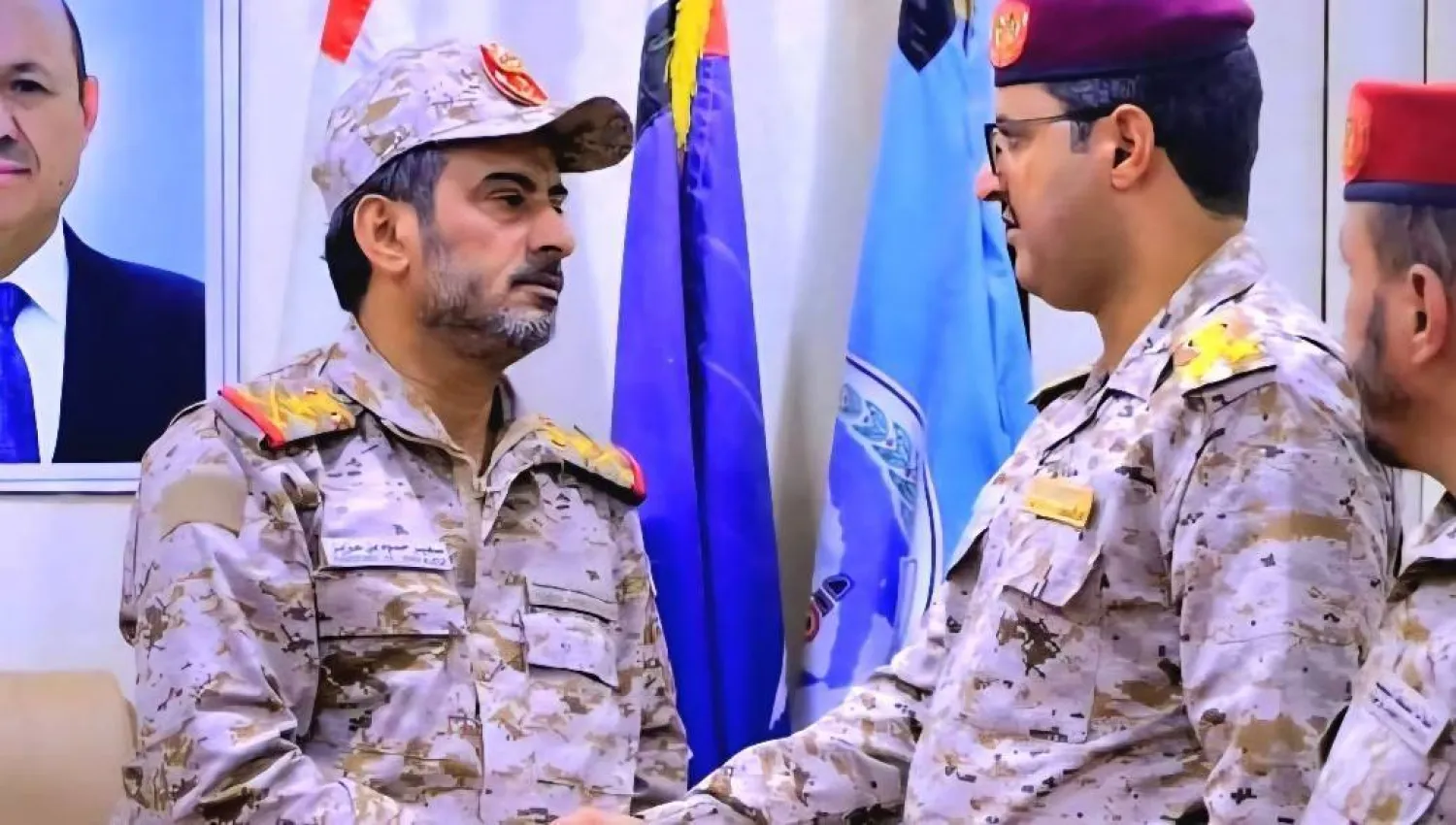
Yemeni Army Announces More Defections in Houthi Ranks

Chief of Staff of the Yemeni armed forces Sagheer bin Aziz receives defected Houthi commander Salah al-Salahi. (Yemeni armed forces)
TT

Yemeni Army Announces More Defections in Houthi Ranks

Chief of Staff of the Yemeni armed forces Sagheer bin Aziz receives defected Houthi commander Salah al-Salahi. (Yemeni armed forces)

The Yemeni military of the legitimate government announced its success in breaching the Iran-backed Houthi militias. It revealed that several of its leaderships “are ready to jump ship” and abandon the militias.

Yemen Armed Forces Spokesman Brig. Gen. Abdo Majali told Asharq Al-Awsat the breach has created “disarray within the Houthi leadership and mistrust among its ranks.”

He confirmed that several Houthi leaders have indeed defected and joined the legitimate army.

They joined army ranks in Marib, national forces on the west coast and the Giants Brigades in the South. Among them was Salah al-Salahi, leader of the Houthis’ so-called “Tenth Sammad Brigade”.

Majali revealed that the defectors had expressed their joy in returning to legitimate ranks and they were in turn warmly welcomed.

They stressed that they have chosen the right path, that of the republic, state and legitimacy, he added.

The Houthis, explained Majali, are “in a state of collapse due to the breaches, divisions and defections.”

The legitimate authorities have succeeded in infiltrating the Houthis’ security agencies, leaving the militias vulnerable and several of their leaders ready to “jump ship. The Houthis are a sinking ship,” he went on to say.

In previous remarks to Asharq Al-Awsat, Yemen’s Interior Minister Ibrahim Haidan said the “terrorist Houthis have never been weaker.” The Houthis themselves have acknowledged the success of government and military operations against them.

The operations were a “powerful and critical” blow that have led to divisions within the Houthis, he added.

Majali stressed that “returning to the state fold is a step forward in liberating the nation from the Houthi filth.”

He listed Houth crimes, violations, kidnappings, forced disappearances, looting of public funds, confiscation of employee salaries and corruption, saying they have led to a state of outrage that has driven several people to defect from the militias.

The army believes that the recent defections have dealt a blow to Houthi morale and bolstered the people’s faith in the legitimate authorities.

Moreover, the defectors have given the legitimate authorities a wealth of intelligence and security information, such as information on the Houthi leadership structure, the readiness of their forces, combat tactics and knowledge about weak points and loopholes that can be exploited.

The new information will help improve planning and combat operations, making them more decisive and deadly, Majali told Asharq Al-Awsat. It will help in breaking up Houthi alliances with tribes and clans and create mistrust among the militia ranks.

The legitimate armed forces, meanwhile, enjoy high morale and are in constant combat readiness, he declared. They are capable of achieving a decisive military victory and ridding the people of the terrorist Houthis


Lebanon, Israel Hold US-Brokered Talks in Rome to Implement Framework Deal

 A motorcade arrives at the United States' Embassy in Rome, Italy, where ambassadors-level talks between Israel and Lebanon are expected to take place, Tuesday, July 14, 2026. (AP)
A motorcade arrives at the United States' Embassy in Rome, Italy, where ambassadors-level talks between Israel and Lebanon are expected to take place, Tuesday, July 14, 2026. (AP)
TT

Lebanon, Israel Hold US-Brokered Talks in Rome to Implement Framework Deal

 A motorcade arrives at the United States' Embassy in Rome, Italy, where ambassadors-level talks between Israel and Lebanon are expected to take place, Tuesday, July 14, 2026. (AP)
A motorcade arrives at the United States' Embassy in Rome, Italy, where ambassadors-level talks between Israel and Lebanon are expected to take place, Tuesday, July 14, 2026. (AP)

Lebanon and Israel resumed talks on Tuesday in the Italian capital, with Beirut hoping for progress towards securing an Israeli withdrawal from south Lebanon under a US-brokered deal, although expectations for swift progress were low.

US-led diplomacy has emerged since Hezbollah and Israel returned to war on March 2 amid the wider regional conflict, moving forward despite strong objections from the Iran-backed group, which believes only Iranian pressure on Washington can secure an end to the war and Israeli withdrawal.

Iran demanded an end to the war in Lebanon as part of its interim deal with Washington signed last month, but the agreement has been shaken over the last week by renewed US-Iranian hostilities in the Gulf.

Israel's military is occupying what it describes as a "buffer zone" about 10 km (6 miles) into Lebanon along the entire length of the ‌Israeli border. Israeli ‌officials say the zone is necessary to protect northern Israeli communities from attacks launched ‌by ⁠Hezbollah.

A meeting in ⁠Washington on June 26 produced an agreement that called for an end to the Lebanon conflict, the disarmament of armed groups - an apparent reference to Hezbollah - as well as the deployment of Lebanese troops to the south and the progressive withdrawal of Israeli forces.

But deadly Israeli strikes have continued and Hezbollah has rejected the agreement as well as efforts to disarm it. Israel, meanwhile, has said its troops would remain in southern Lebanon as long as Hezbollah remained armed.

Lebanese and Israeli officials will meet at the US embassy in Rome on Tuesday and Wednesday to set out how to implement the framework deal, Lebanese officials ⁠told Reuters.

One of the officials said moving the talks to Rome would make ‌it easier for both countries' delegations to consult their governments for guidance as ‌they negotiated.

Italian Foreign Minister Antonio Tajani said on Monday that Italy had offered to host the talks to continue work towards ‌a genuine ceasefire in Lebanon.

"We are also very pleased that Rome can serve as the venue for these meetings. In ‌this way, our capital becomes a capital of peace," Tajani said ahead of a European Union meeting in Brussels on Monday.

PILOT ZONES ON THE TABLE

In comments published by his office on Monday, Lebanese President Joseph Aoun said he hoped the Rome meeting would yield "tangible and practical steps on the ground" to implement the agreement and that it would see Israel begin its troop pull-out so ‌that the Lebanese army could deploy to the south.

One of the Lebanese officials said the country's delegation to Tuesday's talks would seek the gradual and sequential withdrawal of ⁠Israeli troops "one zone after another," ⁠referring to the "pilot zone" project under which Hezbollah would disarm, Israeli forces would withdraw and Lebanese troops would deploy area by area in southern Lebanon.

The June 26 agreement said two zones had been identified as a starting point. A US official said last week that the US military's Central Command (CENTCOM) was coordinating with both Lebanon and Israel to launch the pilot zones.

A US military delegation was in Lebanon at the weekend to discuss the plan in detail with Lebanon's army, sources told Reuters.

Israel's military has forced the local Lebanese population from their homes and carried out controlled explosions of entire villages. It says it is destroying infrastructure, including underground tunnels, used by Hezbollah.

More than 4,000 Lebanese have been killed and more than a million displaced by Israel's campaign in Lebanon since March, according to Lebanon's health ministry. The toll does not say how many combatants may be among the dead and Hezbollah has not disclosed figures on its war dead. Reuters reported on May 3 that several thousand Hezbollah fighters had been killed.

At least 32 Israeli soldiers and four Israeli civilians have been killed by Hezbollah, most of them in southern Lebanon since the latest fighting erupted.


Trump Rolls Out the White House Welcome Mat for New Iraqi PM

Iraqi Prime Minister Ali al-Zaidi departs on his visit to the US. (INA)
TT

Trump Rolls Out the White House Welcome Mat for New Iraqi PM

Iraqi Prime Minister Ali al-Zaidi departs on his visit to the US. (INA)

President Donald Trump is welcoming Iraq's new prime minister to the White House on Tuesday after strongly backing the political neophyte in his bid for office.

Ali al-Zaidi, a businessman with no political background, emerged as a consensus candidate in Iraq after months of deadlock over the premiership following last year’s parliamentary elections.

When al-Zaidi was formally installed as prime minister-designate in April, Trump said in a social media post that it was the “beginning of a tremendous new chapter between our Nations — Prosperity, Stability, and Success like never seen before.”

But Trump’s interest and involvement in the next leadership in Iraq began long before that statement.

Iraq’s dominant parliamentary bloc, the Coordination Framework — a coalition of Shiite parties allied with Iran — initially said it would back former Prime Minister Nouri al-Maliki, whom the Trump administration views as too close to Tehran.

The US president publicly announced his opposition to al-Maliki and threatened to cut off aid to Iraq if he was appointed, adding that “if we are there to help, Iraq has ZERO chance of Success, Prosperity, or Freedom.”

The issue of Iran is likely to loom large in the discussions Tuesday.

Iraq has been under pressure to disarm a network of Iran-backed armed factions operating in the country, some of which launched attacks on US bases and diplomatic facilities after the US and Israel launched their war against Iran in February.

Officially, the Iraqi government has given non-state armed groups until the end of September to disarm, but some of the most powerful factions have said they have no intention of doing so.

A Trump administration official said ahead of the Oval Office meeting that the US will make “informed” decisions based on Iraq’s efforts to disarm Iranian-backed factions inside its borders. The official was granted anonymity to discuss the administration’s strategy ahead of al-Zaidi’s visit.

Renad Mansour, director of the Iraq Initiative at the Chatham House think tank, said he expects that “the US will put significant pressure on al-Zaidi” to move ahead with disarmament during his Washington visit “and al-Zaidi will respond by saying, ‘But I need support — intelligence support, technical support, armed support.’”

“There is a scenario in which, if the Iraqi government starts going after these groups, they will also go after the government,” Mansour said. “And this is a scenario that I think that the Iraqi government is apprehensive about.”

Al-Zaidi received Trump’s blessing, despite the fact that he was chairman of a bank — Al-Janoob Islamic Bank — that was among the financial institutions banned by Iraq’s central bank in 2024 from dealing in dollars amid pressure from the US to crack down on money laundering and funneling of funds to Iran.

Since taking office, al-Zaidi has made a public show of cracking down on corruption. His government has conducted raids and arrested dozens of current and former lawmakers and government officials accused of corruption, including a number affiliated with former Prime Minister Mohammed Shia al-Sudani.

The Iraqi premier’s delegation to Washington includes a number of Iraqi businessmen as well as government officials, and al-Zaidi’s office said in a statement that the aim of the visit is to “strengthen economic and development partnerships, attract investment, and expand the role of US companies in implementing infrastructure projects” and to further develop the oil-rich country’s energy sector.


Lebanese President Pins Hopes on Rome Talks to Secure Israeli Withdrawal

Aoun receives former UN Special Coordinator for the Middle East Peace Process Sigrid Kaag and a delegation from the University of Balamand. (Lebanese Presidency)
TT

Lebanese President Pins Hopes on Rome Talks to Secure Israeli Withdrawal

Aoun receives former UN Special Coordinator for the Middle East Peace Process Sigrid Kaag and a delegation from the University of Balamand. (Lebanese Presidency)

Hours before the sixth round of Lebanese-Israeli negotiations in Rome on Tuesday, Lebanese President Joseph Aoun hoped that the two-day talks will produce tangible progress on the ground, starting with an Israeli withdrawal from Lebanese territory and the deployment of the Lebanese Army to areas vacated by Israeli forces.

The Lebanese delegation heads into the talks seeking to move from the framework agreement with Israel to the implementation phase, while Hezbollah has intensified its criticism of both the government and the accord, saying it undermines Lebanon’s sovereignty and targets the party itself.

Lebanon is pressing for the prompt launch of the “pilot zones” outlined in the agreement. Sources familiar with the negotiations told Asharq Al-Awsat that US-led efforts, through a delegation that arrived in Beirut from Israel on Saturday, to initiate an Israeli withdrawal from pilot areas remain active and should not be considered stalled.

“We are still awaiting signs that such a step can be achieved before Tuesday’s talks in Rome,” the sources said, adding that contacts are continuing until the last minute in hopes of securing an Israeli withdrawal from one or two villages before negotiations begin.

Two weeks ago, Prime Minister Nawaf Salam said that Israel would withdraw from Western Zawtar, Eastern Zawtar, and several other villages.

Ministerial sources said the Lebanese delegation includes Ambassador Simon Karam, Ambassador Nada Mouawad, and retired Brig. Gen. Ziad Haykal, a member of Aoun’s advisory team.

US Ambassador to Lebanon Michel Issa will not attend.

The talks will focus on mechanisms for implementing the framework agreement, establishing a timetable for an Israeli withdrawal, and launching the pilot zones through the deployment of the Lebanese Army as a prelude to reconstruction.

The framework agreement sets out broad principles for resolving the situation in southern Lebanon, including an Israeli withdrawal, the deployment of the Lebanese Army, and reconstruction. However, it does not include a binding implementation timetable, one of the main points of contention.

During meetings on Monday, Aoun said national unity was Lebanon’s “strongest weapon” and urged political leaders to “speak with one Lebanese voice,” stressing that loyalty should be to the nation rather than personal interests.

He vowed not to compromise on southern Lebanon or the country’s rights, saying the framework agreement calls for a full Israeli withdrawal from Lebanese territory and includes an Israeli commitment that it has no territorial ambitions in Lebanon.

Aoun argued that war had failed to bring security or stability and said diplomacy aims to achieve objectives broadly supported by Lebanese citizens, foremost among them an Israeli withdrawal, the return of displaced residents, the release of detainees and the remains of the dead, and the launch of reconstruction.

He said he would discuss ways to pressure Israel to implement the framework agreement during his upcoming meeting with US President Donald Trump in Washington.

As preparations for the Rome talks continued, Hezbollah stepped up its attacks on the Lebanese government and the framework agreement, arguing that it fails to safeguard Lebanon’s sovereignty, links ending the occupation to the issue of the group’s weapons, and grants Israel political gains it failed to achieve during the war.

MP Ali Al-Moqdad, a member of Hezbollah’s parliamentary bloc, called for the agreement to be abandoned, describing it as “an agreement of humiliation and disgrace” that betrays the sacrifices of those killed, wounded, and displaced.