

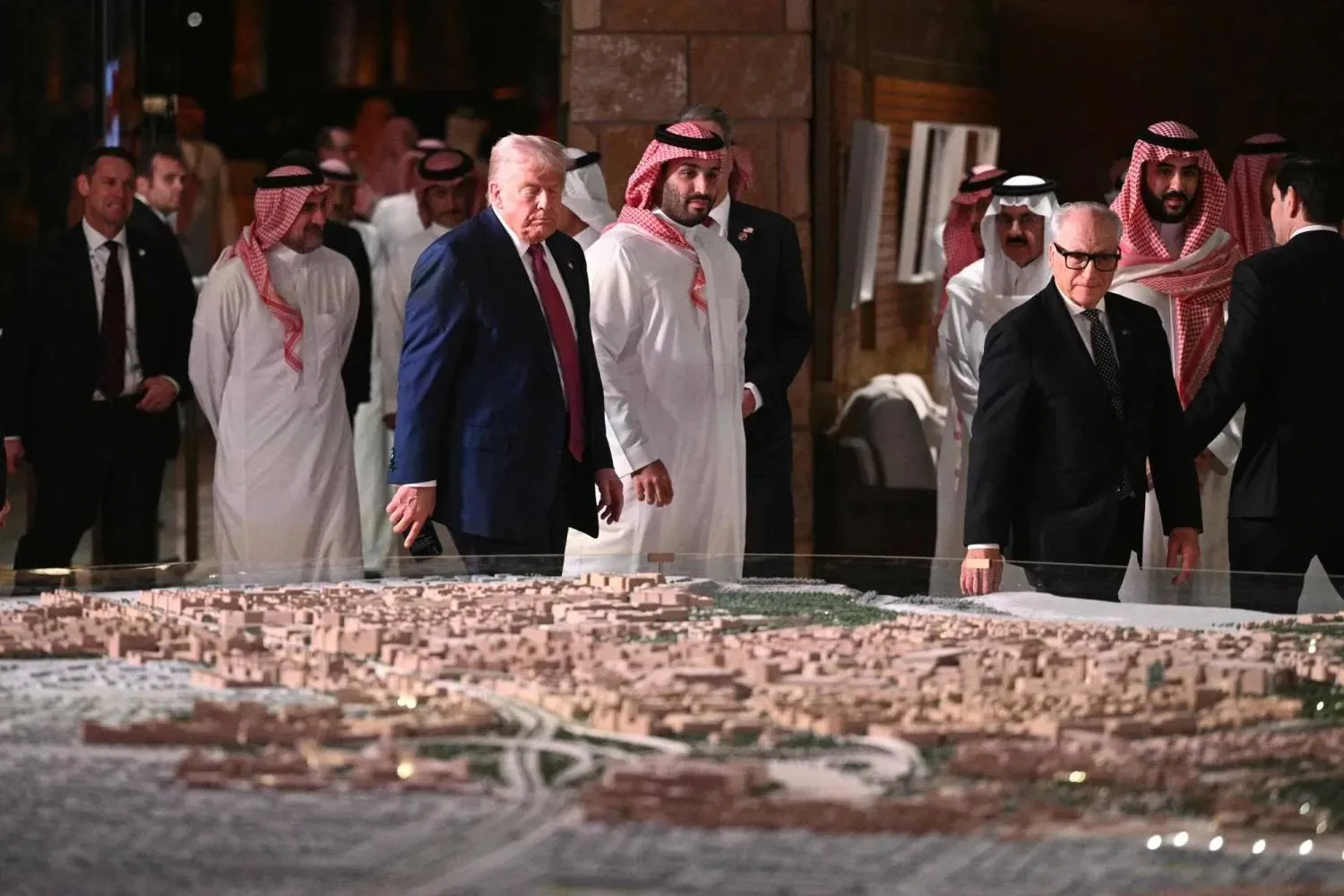

Crown Prince Mohammed bin Salman and the US: From ‘Briefing’ to Breakthrough

Prince Mohammed bin Salman, Crown Prince and Prime Minister, and US President Donald Trump during his visit to Riyadh in May. (SPA)
TT

Crown Prince Mohammed bin Salman and the US: From ‘Briefing’ to Breakthrough

Prince Mohammed bin Salman, Crown Prince and Prime Minister, and US President Donald Trump during his visit to Riyadh in May. (SPA)

During the Saudi-US summit held at the White House in September 2015 between Custodian of the Two Holy Mosques King Salman bin Abdulaziz and former US President Barack Obama, Prince Mohammed bin Salman delivered a briefing outlining Saudi Arabia’s vision for a 21st Century strategic relationship between the two countries.

At the time, the young prince appeared to carry a new outlook on Saudi-American relations, which had gone through phases and shifts for more than 80 years, and he seemed determined to reshape their future course.

The US presidency alternated between Republicans and Democrats over the following decade, and the most significant turning point came during Prince Mohammed bin Salman’s first meeting with President Donald Trump at the White House in March 2017, a meeting that prompted Trump to choose Riyadh as the first foreign destination of his first term.

During his historic visit to Riyadh in May 2017, Trump delivered a speech to Arab and Islamic leaders that focused on terrorism concerns and Middle East conflicts. King Salman and Trump signed the Joint Strategic Vision Declaration between the two countries.

In January 2020, Joe Biden was sworn in as president and pledged to recalibrate ties with Washington’s closest partner. The pledge did not hold against the realities on the ground and the recognition of the importance of the Saudi-American partnership amid the Russian Ukrainian crisis and other global shifts.

Biden traveled to Jeddah in July 2022 to meet King Salman and Crown Prince Mohammed.

Saudi officials consistently stress that ties with the US are strategic and stable and do not shift with changes in the White House or the turnover of administrations.

Over the same decade, Saudis continued building capabilities, expanding capacities, meeting Vision 2030 targets and strengthening their global standing.

Shifts in Saudi-American ties did not occur in isolation from profound global changes, including China’s rise as a strategic competitor to Washington and the movement of economic power centers toward Asia. The war in Ukraine further underscored the importance of energy security and of countries able to stabilize global markets.

US engagement in the Middle East declined in favor of other priorities, opening the door for Riyadh to lead influential regional initiatives, from political de-escalation to economic partnerships and new approaches to regional security.

At the same time, technology and artificial intelligence emerged as central drivers of the global economy, making investment and technology partnerships even more important in Washington’s calculations.

These combined shifts reshaped the foundations of Riyadh Washington relations from ties based on temporary needs to a relationship built on parity, converging interests and joint future building.

After beginning his second term in office, Trump visited Riyadh again in May 2025 and delivered an extended speech that did not address terrorism or wars but rather the bright future and major transformation taking place in the region under King Salman and the Crown Prince.

Syria was present in Riyadh, sanctions were lifted at Saudi request and Trump met President Ahmed Al-Sharaa.

During a speech, Trump asked the Crown Prince how he sleeps at night, then added that he tosses and turns all night thinking about how to make things better.

He sent a message to the world that the Kingdom’s achievements did not come from outside, but from the determination of its leaders and people to develop their state and advance their unique vision and chart their future in their own way.

He described this as a modern miracle in the Arab way.

These remarks recall the interview that Life magazine conducted with King Abdulaziz in March 1943, describing him as the man who “holds the reins of his Kingdom with a wakeful eye.”

The words of yesterday about the founding grandfather are echoed today in the words about the guiding grandson.

Against this backdrop and amid the region’s ongoing transformations comes Crown Prince Mohammed’s visit to Washington and his meeting with President Trump, along with the expected agreements and deals.

Although political and security headlines dominate coverage of the visit, economic and investment files are also on the table.

Perhaps the clearest description came from Trump, who said the occasion was not merely a meeting, but an honor for Saudi Arabia and for the young prince.

Media reports and statements attributed to US politicians continue to bet on Saudi normalization under American sponsorship. Yet, despite pressure and attempts, the Saudi position remains firm in support of the Palestinian cause.

Saudi Arabia’s interests with its key partner, the US, whose political doctrine includes support for Israel, have never taken precedence over the Kingdom’s consistent political doctrine of supporting Palestinian rights. Its foreign policy maintains a position of no normalization without a comprehensive solution to the Palestinian issue that includes the establishment of an independent state along the 1967 borders.

While Israel’s war machine has devastated Gaza and its steadfast population and attempted to eliminate the Palestinian cause, Saudi efforts under King Salman and the Crown Prince have gone beyond contributing to a ceasefire.

They achieved a historic breakthrough toward the two-state solution through the “impose the solution” initiative and by securing recognition of Palestine from several influential countries, including the very country behind the Balfour Declaration.

This recognition came from the United Nations podium, which once witnessed the ill-fated partition resolution and which has long witnessed Saudi diplomatic efforts defending Palestinian rights.

Despite Saudi Arabia’s push for a Palestinian state against American opposition and its signing of a mutual defense treaty with nuclear armed Pakistan, President Trump has repeatedly expressed his appreciation for Saudi Arabia, its leadership and Prince Mohammed personally.

According to Trump, the Crown Prince is a strong friend with clear principles and commands respect, even when views diverge on certain issues. It goes without saying that the American experience celebrates only the strong, those strong in achievement rather than heritage and slogans.

Whatever the scale of agreements and outcomes during this exceptional meeting, the results are certain to reinforce the strategic partnership in line with the Saudi Crown Prince’s vision of the relationship.

Observers expect that the Washington meetings will lay foundations for regional security and prosperity and for a future strategic relationship shaped by Crown Prince Mohammed’s ability to move from briefing to achievement.



OIC Condemns Israel’s Targeting of School for Displaced Persons in Gaza City

Members of the Palestinian Civil Defense remove the rubble of a destroyed home as they search for the bodies of Palestinians killed during the conflict in Khan Younis, southern Gaza Strip, 20 December 2025. (EPA)
TT

OIC Condemns Israel’s Targeting of School for Displaced Persons in Gaza City

Members of the Palestinian Civil Defense remove the rubble of a destroyed home as they search for the bodies of Palestinians killed during the conflict in Khan Younis, southern Gaza Strip, 20 December 2025. (EPA)

The Organization of Islamic Cooperation (OIC) strongly condemned on Sunday the continued crimes committed by Israeli forces in the Gaza Strip, most recently the shelling of a school sheltering displaced persons.

Seven Palestinians were killed and dozens of civilians were injured in the attack, which the OIC slammed as a “flagrant violation of international humanitarian law”.

The OIC renewed its call on the international community, particularly the UN Security Council, “to assume its responsibilities by putting an end to all Israeli crimes and violations, securing a comprehensive and permanent ceasefire, ensuring sufficient and unhindered delivery of humanitarian assistance, and guaranteeing the withdrawal of Israeli forces from Gaza.”

It further emphasized “the need to activate international criminal justice mechanisms to pursue and hold accountable all Israeli officials involved in committing these grave crimes and to ensure that they do not evade punishment.”


UAE, French Presidents Discuss Bilateral Ties

United Arab Emirates President Sheikh Mohamed bin Zayed Al Nahyan and French President Emmanuel Macron meet in Abu Dhabi on Sunday. (WAM)
TT

UAE, French Presidents Discuss Bilateral Ties

United Arab Emirates President Sheikh Mohamed bin Zayed Al Nahyan and French President Emmanuel Macron meet in Abu Dhabi on Sunday. (WAM)

United Arab Emirates President Sheikh Mohamed bin Zayed Al Nahyan received in Abu Dhabi on Sunday French President Emmanuel Macron who is on a working visit to the UAE.

Meeting at the Zayed National Museum, the leaders discussed the historical and strategic relations between the UAE and France and explored opportunities to further strengthen ties, particularly in the fields of economy, investment, and culture, as well as renewable energy, advanced technology, artificial intelligence, sustainability, and other areas aligned with the two countries’ shared vision for development and prosperity.

The meeting was attended by Sheikh Khaled bin Mohamed bin Zayed Al Nahyan, Crown Prince of Abu Dhabi; Sheikh Abdullah bin Zayed Al Nahyan, Deputy Prime Minister and Minister of Foreign Affairs; Sheikh Hamdan bin Mohamed bin Zayed Al Nahyan, Deputy Chairman of the Presidential Court for Special Affairs; a number of minister and senior officials, reported the UAE's state news agency (WAM).

The meeting was also attended by the delegation accompanying the French President, which included a number of ministers and senior officials.

The UAE President hosted a luncheon in honor of Macron and the accompanying delegation.

Macron arrived in the UAE earlier on Sunday, where he was received at the Presidential Flight in Abu Dhabi by Crown Prince of Abu Dhabi Sheikh Khaled bin Mohamed bin Zayed Al Nahyan and several senior officials.


Saudi Arabia Opens New Emergency Camp in Gaza for Families Displaced by Storms

The King Salman Humanitarian Aid and Relief Center (KSrelief) established a new emergency camp in central Gaza Strip providing shelter for hundreds of recently displaced families. (SPA)
TT

Saudi Arabia Opens New Emergency Camp in Gaza for Families Displaced by Storms

The King Salman Humanitarian Aid and Relief Center (KSrelief) established a new emergency camp in central Gaza Strip providing shelter for hundreds of recently displaced families. (SPA)

The King Salman Humanitarian Aid and Relief Center (KSrelief) established a new emergency camp in the central Gaza Strip, providing immediate shelter with more than 250 tents for hundreds of recently displaced families. The move is part of the ongoing Saudi fundraising campaign to aid the Palestinian people.

Overseen by the Saudi Center for Culture and Heritage, KSrelief’s implementing partner, the camp was fast-tracked to support families whose temporary shelters were destroyed by recent severe weather, the Saudi Press Agency reported on Saturday.

Field reports indicate that heavy storms and flooding have decimated hundreds of tents across the region, significantly worsening the already dire humanitarian crisis.

Affected families expressed their gratitude to the Kingdom of Saudi Arabia, describing the aid as a "lifeline" that restored a sense of security. Families noted that the new shelters have provided vital protection against the harsh winter conditions and volatile weather that had previously left them exposed during an arduous period of hardship.

This initiative is a continuation of the Kingdom’s steadfast commitment to the Palestinian people. By providing essential relief and high-quality shelter, KSrelief aims to alleviate the suffering of families facing unprecedented humanitarian challenges.