


Israel Steps Up Killings to Tighten Security Control in Gaza

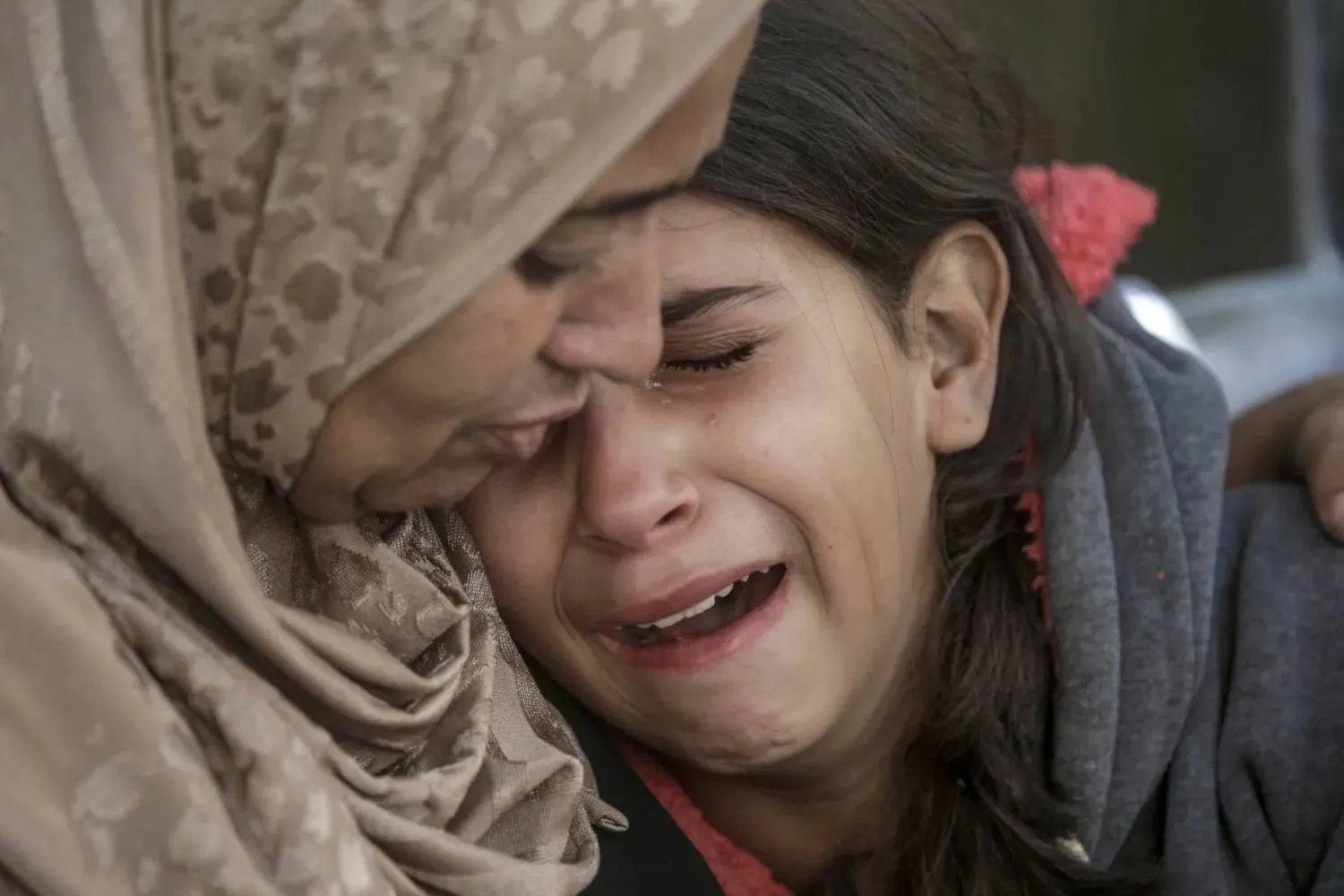
A Palestinian woman holds her crying niece during the funeral of the child’s mother, killed in an Israeli strike in Gaza on Thursday (EPA)
TT

Israel Steps Up Killings to Tighten Security Control in Gaza

A Palestinian woman holds her crying niece during the funeral of the child’s mother, killed in an Israeli strike in Gaza on Thursday (EPA)

Israel has tightened its security grip on the Gaza Strip since the ceasefire took effect on October 10, intensifying a campaign of intermittent assassinations that has escalated over recent days and weeks.

Israel has repeatedly cited security incidents it claims occurred, particularly in Rafah in southern Gaza, which it has fully controlled for many months. In other cases it has carried out assassinations using armed members of its special forces or Palestinian collaborators from local armed groups to kill resistance activists.

Israeli troops killed about 30 Palestinians in a series of strikes late on Wednesday, including at least two commanders from the Ezzedine al-Qassam Brigades, the armed wing of Hamas.

The Israeli military said the operations were carried out in response to gunfire from Palestinian militants in Khan Younis in southern Gaza, although no Israeli soldiers were wounded.

Channel 12 reported that Israel had decided to adopt new measures to intensify the pursuit of Hamas operatives, even if attacks from Gaza do not cause casualties among its forces.

Israeli Army Radio said the Shin Bet internal security service had obtained precise intelligence on a meeting of al-Qassam commanders in the Zeitoun district.

At least two were killed in a strike, including the commander of the Zeitoun battalion and another commander in the naval force.

Reports on the fate of the commanders present at the site were conflicting. Hamas sources told Asharq Al-Awsat that two senior officials had escaped the attempted assassination in Zeitoun because the strike occurred after they had left the area, while a field commander was successfully targeted in Khan Younis.

The sources said Israel’s claim that its forces had come under fire was false, adding that Israel launched a rolling operation that began with an afternoon strike on a group of civilians in the Shejaiya district east of Gaza City.

Soon after, it claimed it had been targeted by gunfire in Khan Younis, but it continued its operation in Gaza City with two strikes on a shelter and on civilians. That was followed by three attacks in Khan Younis, only one of which targeted a field commander, while the other two did not hit any fighters.

Field sources told Asharq Al-Awsat that, before issuing these claims, Israel had attempted to assassinate a senior commander in the al-Quds Brigades, the military wing of Islamic Jihad, who survived the attack while at home with his family in an apartment east of Gaza City.

The sources said an Israeli quadcopter drone dropped several small bombs on the apartment, followed by an explosive drone that crashed into the location and detonated, wounding several members of his family.

The operation came days after an Israeli special forces unit used two armed men to kill Wasim Abdel Hadi, an activist from the Al-Nasser Salah al-Din Brigades, in central Gaza.

It was the second assassination by special forces targeting activists this month. In another incident, a Qassam operative was abducted in the Al-Nasr district of Gaza City by a special unit operating with an ambulance.

The escalation coincides with continued Israeli ground movements inside the Gaza Strip, along with persistent air and artillery strikes and gunfire east and west of the “yellow line” and its surrounding areas, which are referenced in the ceasefire agreement.

According to field sources, Israeli ground forces withdrew from the Shejaiya district early on Thursday after advancing roughly 300 meters. They expanded the yellow line in their favor by taking more land, pushing residents from newly exposed residential blocks toward western Shejaiya as artillery fire intensified on Wednesday afternoon.

The Government Media Office said Israeli forces expanded their control over the streets of Al-Shaaf, Al-Nazzaz and Baghdad, and trapped dozens of families who were unable to flee after tanks advanced unexpectedly. The fate of many residents remained unknown during the bombardment.

These ongoing crimes show clear contempt for the ceasefire decision, and add to nearly 400 violations documented since it took effect, resulting in the deaths of more than 300 Palestinians and hundreds of wounded, worsening the catastrophic conditions facing our people in the small remaining area of Gaza, the office said.

The Gaza Health Ministry said 33 Palestinians were killed over the past 24 hours, including 32 in Israeli air strikes, while the body of another person killed earlier in the war was recovered. Another 88 people were wounded. The ministry said 12 children and 8 women were among those killed, representing 66 percent of the total.

It said 312 Palestinians have been killed since the ceasefire began, and 760 have been wounded, while 572 bodies have been recovered. The figures do not include a Palestinian who was shot dead by Israeli forces on Thursday morning east of Khan Younis.

The overall death toll from Israel’s aggression has risen to 69,546, with 170,833 wounded since October 7, 2023.



Lebanese Foreign Minister Declines Invitation to Tehran, Proposes Meeting in Neutral Country

Lebanese Foreign Minister Youssef Raji receives his Iranian counterpart Abbas Araghchi in Beirut in June 2025 (File – IRNA)
TT

Lebanese Foreign Minister Declines Invitation to Tehran, Proposes Meeting in Neutral Country

Lebanese Foreign Minister Youssef Raji receives his Iranian counterpart Abbas Araghchi in Beirut in June 2025 (File – IRNA)

Lebanese Foreign Minister Youssef Raji has declined an invitation from his Iranian counterpart Abbas Araghchi to visit Tehran, proposing instead that the two meet in a mutually agreed-upon neutral country.

In a post on X on Wednesday, Raji said he was “unable to accept” the invitation at this time, citing unspecified “current circumstances.”

He stressed that his reply “does not mean rejecting dialogue,” rather “the proper atmosphere is not appropriate.”

He added that any renewed engagement with Iran must rest on clear principles, including respect for Lebanon’s sovereignty, non-interference in its internal affairs, and adherence to international norms governing state-to-state relations.

Araghchi had recently invited Raji to Tehran for talks on bilateral relations.

Official Lebanese sources told Asharq Al-Awsat that the invitation was sent personally to the minister, not to the Lebanese state, and that Raji’s response “expresses his own position.”

Lebanon and Iran continue diplomatic engagement despite Beirut’s repeated warnings - conveyed directly to visiting Iranian officials - that Lebanon rejects any foreign meddling in its internal affairs.

Tensions between Raji and Tehran were visible during the August visit of Ali Larijani, secretary-general of Iran’s Supreme National Security Council.

Larijani said he lacked the time to meet Raji; the minister replied: “Even if I had the time, I would not have met him.”

Former Lebanese foreign minister Fares Boueiz said Raji’s latest stance is a clear diplomatic message that relations between Beirut and Tehran are “incomplete.”

When differences arise, Boueiz noted, first meetings are often held in a third country to establish a framework for resolving disputes.

Boueiz added that a foreign minister rarely deviates from the official position of the state. He argued that Raji’s move reflects the views of President Joseph Aoun and Prime Minister Nawaf Salam, and implicitly signal that Iran should halt its support for a particular Lebanese faction and stop its interference.

Lebanon has repeatedly accused Iran of meddling in its internal affairs. During his meeting with Larijani in August, Aoun reiterated that no group in Lebanon may carry weapons or rely on external backing.

While open to cooperation with Iran, Lebanon insists such engagement remains within the limits of sovereignty and mutual respect.

Boueiz recalled that Lebanese-Iranian diplomatic relations stabilized after 1990, when he restored protocol-based engagement in line with the Vienna Convention. During the civil war, Iranian delegations routinely entered Lebanon via Syria without coordinating with the Lebanese government and met directly with Hezbollah.

After Boueiz confronted Tehran’s ambassador in 1990, then-foreign minister Ali Akbar Velayati agreed to normalize diplomatic procedures, leading to formal exchanges and signed agreements.

Some Lebanese observers view Raji’s stance as evidence of diminishing Iranian influence in Lebanon, long bolstered by Tehran’s support for Hezbollah.

Boueiz, however, argues that Iran’s role is closely tied to its evolving relationship with Washington. US-Iran dynamics, including ongoing discussions over sanctions relief and frozen assets, inevitably ripple into Lebanon: “Whenever US-Iran negotiations worsen, tensions rise in Lebanon; when talks calm down, Lebanon feels the relief.”


UN Condemns Houthi Referral of UN Staff to Court

Houthi gunmen display their strength during a gathering north of Sanaa (AFP).  
TT

UN Condemns Houthi Referral of UN Staff to Court

Houthi gunmen display their strength during a gathering north of Sanaa (AFP).  

The United Nations on Tuesday condemned a referral by Yemen's Houthis of some of the dozens of UN staff they have detained to a special criminal court.

The condemnations came while officials in the Yemeni government stressed the need to strengthen military coordination to face the Iran-backed group, enhance the presence of state institutions and improve the operational environment for humanitarian organizations.

UN Secretary-General Antonio Guterres said the Houthis have arbitrarily detained 59 Yemeni UN personnel, who have been held “incommunicado - some for years - without any due process, in violation of international law,” according to his spokesperson Stephane Dujarric.

He said, “United Nations personnel, including those who are nationals of Yemen, are immune from legal process in respect of all acts performed by them in their official capacity.”

The United Nations has repeatedly rejected Houthi accusations that UN staff or UN operations in Yemen were involved in spying.

“We call on the de facto authorities to rescind the referral and work in good faith toward the immediate release of all detained personnel,” Dujarric said.

“The United Nations remains committed to supporting the people of Yemen and delivering principled humanitarian assistance.”

Meanwhile, the Yemeni Social Affairs Ministry welcomed the decision of UN children’s agency UNICEF to relocate its main headquarters from Sanaa to the temporary Yemeni capital, Aden.

In a statement, the ministry said the move comes in response to its repeated calls for the relocating of UN headquarters from the Houthi-controlled capital, Sanaa, to maintain the safety of their staff.

“The Yemeni government, represented by Social Affairs Minister, Mohammed Al-Zaouri, will provide all forms of support and facilities to enable UNICEF perform its tasks more effectively from its new headquarters.”

Strengthen Military Efforts

In Aden, member of the Presidential Leadership Council (PLC) Abdul-Rahman al-Mahrami held a meeting Tuesday with Defense Minister Gen. Mohsen Mohammed al-Daeri to discuss “the latest military conditions on various fronts, the level of combat readiness, the discipline of military units, as well as the ministry's efforts in the fields of training, rehabilitation and raising defense capabilities,” according to state-run news agency, SABA.

While Al-Daeri said Yemen’s armed forces “act in complete harmony in the face of Houthis,” al-Mahrami stressed the “need to strengthen coordination between military axes, and mobilize forces to face a common enemy (Houthis) and protect liberated areas.”

Meanwhile in Mareb, member of the Presidential Leadership Council Lieutenant General Sultan Al-Arada chaired a meeting with senior security officials, and stressed that a robust national security apparatus is crucial for the country's recovery.

“The recovery of state institutions from the Iran-backed Houthi militias is today an irreplaceable national priority,” he said.

The General also underscored the Presidential Leadership Council's commitment to supporting the armed forces and security agencies, enhancing their capabilities, and raising a culture of accountability and transparency.


Trump Says He Plans to Name Gaza Board of Peace Early Next Year

US President Donald Trump speaks during a roundtable discussion in the Roosevelt Room of the White House in Washington, DC, on December 10, 2025. (Photo by ANDREW CABALLERO-REYNOLDS / AFP)
TT

Trump Says He Plans to Name Gaza Board of Peace Early Next Year

US President Donald Trump speaks during a roundtable discussion in the Roosevelt Room of the White House in Washington, DC, on December 10, 2025. (Photo by ANDREW CABALLERO-REYNOLDS / AFP)

US President Donald Trump said on Wednesday that an announcement about which world leaders will serve on the Gaza Board of Peace should be made early next year.

Trump told reporters during an economic event in the White House Roosevelt Room that a variety of leaders want to be on the board, which was established under a Gaza plan that set up a fragile ceasefire between Israel and Hamas group, reported Reuters.