


UNESCO Recognition Inspires Hope in Afghan Artist’s City

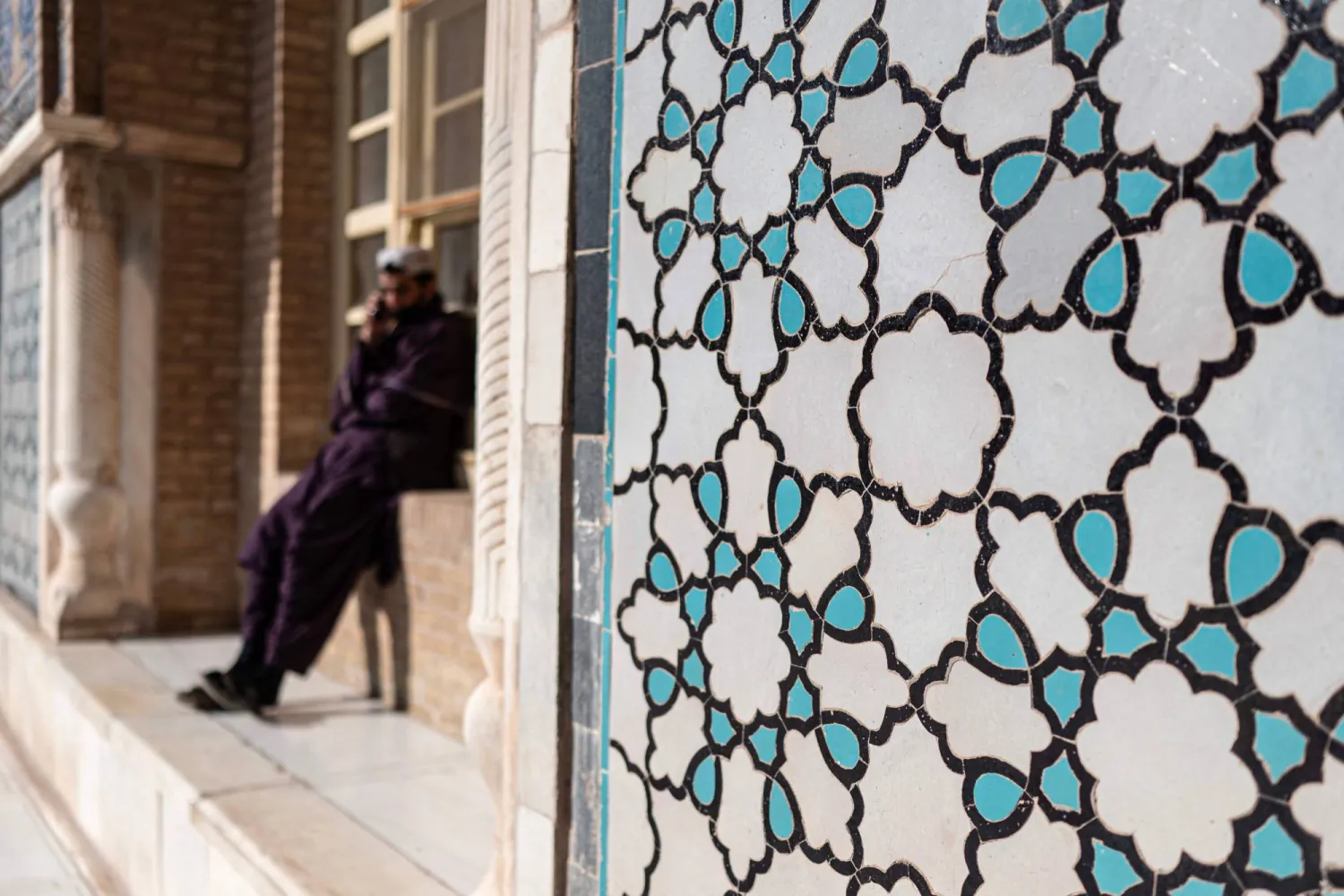
This picture taken on January 8, 2026 shows miniature art carved on the wall of Jami Masjid, also known as the Great Mosque of Herat in Herat. (AFP)
TT

UNESCO Recognition Inspires Hope in Afghan Artist’s City

This picture taken on January 8, 2026 shows miniature art carved on the wall of Jami Masjid, also known as the Great Mosque of Herat in Herat. (AFP)

Hundreds of years after the celebrated painter Kamal ud-Din Behzad roamed the streets of Herat, artists in the Afghan city are finding joy and hope in his recognition by UNESCO.

Sitting cross-legged on a red carpet, artist Mohammad Younes Qane uses an ultra-fine paintbrush to trace details such as a horse's mane or the beads of a necklace.

"When I paint, I'm taken back 500 years, to the streets of Herat back then," when the rulers of the Timurid empire were patrons of artists such as Behzad, Qane said with a smile.

Since he was a teenager, the 45-year-old has been practicing Behzad's celebrated miniature art style, which inspired French artist Henri Matisse.

A contemporary of Italian masters Leonardo da Vinci and Sandro Botticelli, Behzad brought a new style to Herat before settling in Tabriz, in modern-day Iran.

Celebrating his "vibrant cultural expression", the UN's cultural agency inscribed Behzad's style of miniature art on its list of Intangible Cultural Heritage of Humanity in December.

Such recognition was "truly joyful news", coming "at a time when we are in darkness and facing very difficult conditions", Qane said.

Since the Taliban authorities returned to power in 2021 and imposed their strict interpretation of religious law, many artists have left Afghanistan.

Qane has closed his gallery and works at home, with clients now rare and exhibitions non-existent.

He sometimes climbs the hill to a white tomb believed to be Behzad's, where he finds peace.

Taliban officials have banned music in public places, as well as the representation of living things.

- 'Proud of Behzad' -

Numerous residents pointed to the increasing enforcement of the ban on showing human faces, which are a common feature of Behzad-style artworks.

"It's very sad, because we are proud of Behzad in Herat," said one resident, speaking on condition of anonymity for security reasons.

Ahmad Jawid Zargham, the former head of the provincial arts and culture department, said paintings were "simple and without soul" before Behzad.

"He introduced scenes from people's everyday life. For example, ordinary people, passersby, dervishes, mullahs, scenes of teaching girls and boys, or groups of workers busy with architecture," Zargham told AFP.

At Herat's central mosque, which is covered in blue ceramic tiles, there are delicate floral and geometric motifs created by Behzad.

But his decorated manuscripts are kept abroad, at world-renowned institutions such as New York's Metropolitan Museum of Art, the British Library in London and the Topkapi Palace Museum in Istanbul.

Michael Barry, a leading specialist in miniature art, said that people being deprived of their cultural patrimony was "the height of injustice".

At the same time, he remained "very aware of the care that is required to maintain these delicate works", which can easily be damaged by light exposure.

Conscious of the difficulties of repatriating Behzad's artworks, Barry instead enlarged and reproduced them in 2017 for an exhibition at Herat's citadel.

But residents can no longer view the bright autumn colors of the tree of life, a symbol often painted by Behzad, as the wooden door has been padlocked shut.

Despite welcoming the UNESCO recognition, the provincial arts and culture department did not give an explanation for its closure.

Recalling Herat's importance, Barry said the city was the "world capital of painting, poetry, music, philosophy, mathematics. The Florence of the Islamic world".

"The most important center of Islamic civilization in the 15th century endorsed figurative art," he added.

But nowadays, at the citadel, faces shown on panels about the city's history have been painted black.

Despite such measures enforced by the Taliban government's morality police, Behzad is still inspiring young Afghans.

Around a dozen women gathered in a workshop to paint miniature art scenes on glass or paper, which they sell through social media or to acquaintances.

The UNESCO recognition is motivating, said Parisa Narwan, 24, who has been unable to participate in scholarships and exhibitions abroad because it has become practically impossible to get visas.

Artists need opportunities "including international exhibitions and financial support", she said.

One of the other artists contemplated how she would address Behzad today: "I wish he could have lived now -- I would ask him to improve the women's life in Afghanistan because it is really difficult."


Grabbing the Bull by the Tail: Venezuela’s Cowboy Sport

A cowboy gestures during a bull-tailing competition held as part of the "Fiestas del Alma Llanera" celebration in San Fernando de Apure, Apure State, Venezuela, on February 27, 2026. (AFP)
TT

Grabbing the Bull by the Tail: Venezuela’s Cowboy Sport

A cowboy gestures during a bull-tailing competition held as part of the "Fiestas del Alma Llanera" celebration in San Fernando de Apure, Apure State, Venezuela, on February 27, 2026. (AFP)

Four mounted cowboys jostle for position near the bull pen gate.

When the bull bolts out into the ring, a mad scramble begins as the riders vie to grab its tail and knock it to the ground.

Bull tailing, or "coleo" is to Venezuela's "llanos" (tropical grasslands) what rodeo is to Texas -- an integral part of popular culture that has survived opposition from animal welfare groups.

Unlike their Texan counterparts, "coleadores" don't try to ride the bull or grab it by the horns but rather chase its tail.

The coleo is one of the high points of the annual "llanera" fair in the central city of San Fernando de Apure, a three-day extravaganza of cowboy culture, including fast-paced, swirling "joropo" partner dancing listed on the UN's Intangible Cultural Heritage list.

Experts trace coleo to Spanish colonial times and link it to cattle herding work.

It is also practiced across the border in Colombia's "llanos," as well as in Brazil and Mexico, countries with strong cattle breeding traditions.

Most of the "coleadores" or bull tumblers learn the sport from their fathers or grandfathers. Women and children have also been known to compete.

For Neomar Sanoja, one of the judges, it's Venezuela's "national sport" -- a bold claim in a baseball mad nation.

- 'Feel the adrenaline' -

Rafael Delgado, 35, started competing at around 10, encouraged by his father, a ranch hand.

"It's part of our 'llanero' culture, part of being Venezuelan," he told AFP before entering the ring.

To reach the bull's tail, riders spur on their horses and when they draw alongside the animal's flanks, perform acrobatic maneuvers to try flip the beast.

The bull writhes, struggles back on its feet and tries to escape along the "manga de coleo," a 200-meter-long sand corridor, with the riders in hot pursuit.

Points vary depending on how the bull tumbles, with extra marks for those who manage to get all four legs in the air.

About 200 competitors took part in the four-minute bouts in San Fernando de Apure, wearing hockey helmets and padding on their arms and legs as armor.

Llanera music blared while a judge narrated the action with rapid-fire delivery.

Florelbis Linares told AFP she wanted to take up coleo despite the misgivings of her coleatero boyfriend, who she watched perform from the stands.

"You really feel the adrenaline watching from here," the 23-year-old said, her legs hanging over the guardrail around the ring.

- 'Defenseless animals' -

The bull's suffering is little cause for concern among aficionados of coleo.

Most of the animals who enter the ring are headed for the slaughterhouse.

Luis Garcia, a 32-year-old rider, accused critics of the sport of hypocrisy, noting that most show no outrage in the face of intensive cattle rearing and meat consumption.

The AnimaNaturalis animal rights NGO, which is active in Spain and Latin America, has called for the practice to be abolished.

"It is cruelty and an abuse of power by llaneros against defenseless animals," it argued on its website.

"Is this what you call culture?" the Napda Foundation, a Venezuelan animal rights foundation, asked, posting a video of coleo spectators kicking and throwing objects at a bull to force it to get back on its feet.

"The alleged 'humans' behave like beasts. This must stop now."


Michelangelo’s Works Hidden in ‘Secret Room’, Researcher Says

Pedestrians walk past the Basilica of Santa Agnese Outside the Walls as a marble bust is displayed inside after being identified as a work by Michelangelo Buonarroti after centuries without attribution, following a decade of archival research by Italian researcher Valentina Salerno in Rome on March 4, 2026. (AFP)
TT

Michelangelo’s Works Hidden in ‘Secret Room’, Researcher Says

Pedestrians walk past the Basilica of Santa Agnese Outside the Walls as a marble bust is displayed inside after being identified as a work by Michelangelo Buonarroti after centuries without attribution, following a decade of archival research by Italian researcher Valentina Salerno in Rome on March 4, 2026. (AFP)

Renaissance artist Michelangelo ordered many of his artworks to be hidden by his pupils in a secret room to protect them for posterity, an Italian researcher claimed Wednesday.

According to renowned art historian Giorgio Vasari, the Italian genius burned a large number of his own drawings and sketches before his death in Rome in 1564.

But researcher Valentina Salerno says she has unearthed unpublished archival documents that reveal a plot to squirrel away his works.

"One of these three unpublished documents I found in the archives speaks of a room" kept by students of the Michelangelo school, the origins of which "can be traced back" to the artist, Salerno told AFP on the sidelines of a press conference in Rome.

"Assets are hidden inside this room. These assets are locked away so tightly that they require a system of multiple keys, so that no one can access them without the permission of others," she said.

Salerno was researching a book on Michelangelo when she came across a document that showed the artist had in 1550 joined the Brotherhood of the Most Holy Crucifix. Those close to him in his final years were members too.

Over a decade of research, she followed the document trail between a series of archives in the Vatican, Italy and European cities including Paris.

As part of what she called a "maniacal plan" cooked up by Michelangelo, his works were to be hidden "because otherwise it would all end up with a nephew he detested".

"The goal was to pass on to his poor, vulnerable, non-noble descendants the material to be able to continue studying, to transmit his art to future generations," she said.

Those involved in the plan went on to form the famous art Academy of San Luca in the 16th century, she added. It still exists today.

Salerno believes the secret room designed to safeguard the artist's creations was likely somewhere inside the Saint Peter in Chains church in central Rome.

- Michelangelo bust -

During her research, she also stumbled across a reference to a bust at the Basilica of Sant'Agnese, also in Rome, currently attributed to an anonymous artist.

She found documents attributing the white bust to Michelangelo down the centuries.

In the 1930s it appears to disappear from documentation, only to reappear in the 1980s, attributed to a minor artist.

Italy's cultural authorities later declared it to be a work by an unknown sculptor instead.

But Salerno insists the bust is a genuine Michelangelo, not just due to the paper trail, but also because it shares a striking resemblance to Tommaso dei Cavalieri, a young nobleman.

Salerno's work has not yet been peer reviewed, but she is a member of the Vatican committee for the celebrations marking the 500th anniversary of Michelangelo's birth.


Prince Mohammed bin Salman Project Restores Al-Hawza Mosque in Aseer

Following its inclusion in the project in 2022, the mosque's area was expanded to 293 square meters - SPA
TT

Prince Mohammed bin Salman Project Restores Al-Hawza Mosque in Aseer

Following its inclusion in the project in 2022, the mosque's area was expanded to 293 square meters - SPA

The Prince Mohammed bin Salman Project for the Development of Historical Mosques is rehabilitating Al-Hawza Mosque in Dhahran Al-Janoub, Aseer, as part of its mission to preserve Islamic heritage under Vision 2030.

Built in 8 AH by Ali ibn Abi Talib during his trip to Yemen to spread Islam, the mosque is one of the oldest in the region and has undergone expansions in 1213 AH and 1353 AH. Its unique architectural identity reflects the Sarawat region's style, utilizing layered mud bricks and local wood to harmonize with the mountainous environment, SPA reported.

Following its inclusion in the project in 2022, the mosque's area was expanded to 293 square meters, increasing its capacity to 148 worshippers while maintaining authentic features like its historic internal well.

By utilizing specialized Saudi companies and engineers, the project achieves a balance between traditional sustainability and modern standards, fulfilling strategic goals to restore architectural authenticity and highlight the Kingdom’s civilizational depth.