


Lebanon Detains 41 Since War on Suspicion of Collaborating with Israel

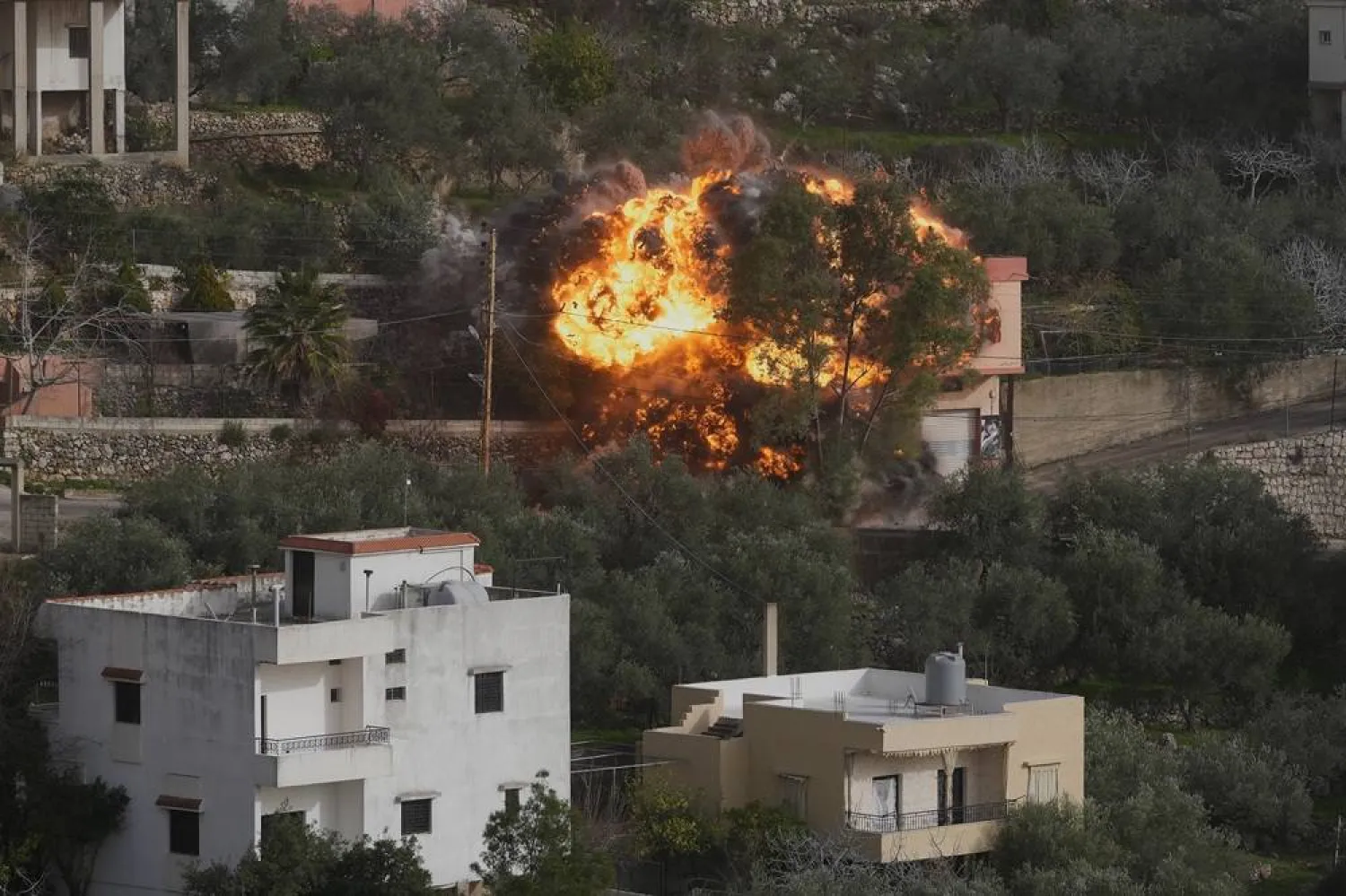
 Flames rise from a building that was hit by an Israeli airstrike in Ain Qana village, south Lebanon, on Feb. 2, 2026. (AP)
Flames rise from a building that was hit by an Israeli airstrike in Ain Qana village, south Lebanon, on Feb. 2, 2026. (AP)
TT

Lebanon Detains 41 Since War on Suspicion of Collaborating with Israel

 Flames rise from a building that was hit by an Israeli airstrike in Ain Qana village, south Lebanon, on Feb. 2, 2026. (AP)
Flames rise from a building that was hit by an Israeli airstrike in Ain Qana village, south Lebanon, on Feb. 2, 2026. (AP)

Lebanon’s State Security agency has arrested a Syrian national suspected of communicating with Israelis for commercial purposes, just two days after entering the country and traveling between the southern cities of Sidon and Bint Jbeil.

The arrest raises the number of people detained in Lebanon on suspicion of collaborating with Israel since the October 2023 war to 41, a record for that period.

The General Directorate of State Security said suspect, identified by his initials (I.A.), was arrested after “close surveillance and monitoring” as part of efforts to combat networks dealing with the Israeli enemy.

He is accused of concluding commercial deals with Israel and was found to have entered Lebanon illegally through unauthorized crossings.

Entered illegally, Moved without a Clear Destination

A security source told Asharq Al-Awsat the suspect, Ibrahim A., born in Aleppo in 2007, slipped into Lebanon two days before his arrest. He was detained in the Sharhabil area of Sidon after drawing suspicion by moving between Sidon and Bint Jbeil without a clear purpose.

He has no registered residence in Lebanon. A search of his phone revealed communications with Israeli-linked sites and numbers. Some appeared commercial in nature, while others were linked to pornographic websites, the source said.

Collaboration cases

The arrest comes amid what officials describe as intensified preemptive security measures, particularly after Israel’s latest war on Lebanon in 2024, during which it benefited from human intelligence networks inside the country.

A senior judicial source said that alleged collaboration cases are now top of the agenda of the Military Court due to their growing number and the gravity of the charges.

Military Public Prosecutor records show that 41 individuals have been referred for investigation and trial on accusations of collaborating with Israel and supplying security information that aided Israeli military operations.

Seven suspects were arrested during the war, while the rest were detained after the November 27, 2024, ceasefire, the source said.

Nineteen have been sentenced to prison terms ranging from six months to seven years of hard labor. The remainder are still on trial.

The security allegations facing the broader group do not apply to the Syrian detainee, the source said. There is no evidence at this stage that he carried out security tasks for Israel, and his contacts appear limited to commercial dealings.

The source described him as withdrawn and unresponsive during questioning, saying he did not clarify where he came from or where he was headed. No one contacted him during his pretrial detention.

The source suggested he may have been subjected to a professional recruitment method designed to shield associates in the event of arrest.

Following preliminary investigations, the suspect was referred to the Military Court.

Earlier Arrests

Last month, State Security announced the arrest of a Lebanese citizen on suspicion of communicating with Israel, following what it described as sustained monitoring of collaboration networks.

Preliminary investigations showed that the suspect had been contacting Israel since early 2024 via applications on his mobile phone, offering services and work to the Mossad.

Legal measures were taken at the direction of the Military Public Prosecutor.

In October, the State Security also announced the arrest of a Palestinian man suspected of communicating with Israel after following the official Mossad page on Facebook.



Hamas Bid to Join Gaza Administration Faces Rejection

People fill water tanks from a mobile tanker in the Maghazi refugee camp in central Gaza (AFP)
TT

Hamas Bid to Join Gaza Administration Faces Rejection

People fill water tanks from a mobile tanker in the Maghazi refugee camp in central Gaza (AFP)

Hamas has repeatedly declared its readiness to hand over authority to the Gaza Administration Committee immediately. However, the transfer has yet to materialize, with Israel still barring the body from entering the enclave.

A Palestinian source close to the committee told Asharq Al-Awsat that Hamas is trying to integrate its members, particularly police personnel, into the body, a move the committee has rejected.

The source said Hamas’s insistence on maintaining a presence in the “day after” the war was further underscored by an informed Egyptian source, who told Asharq Al-Awsat that the group’s public rhetoric does not reflect reality.

Hamas, the Egyptian source said, is seeking to ensure the integration of thousands of its members and secure their salaries, a step opposed not only by the committee but also clearly rejected by Israel and the US.

The Egyptian source added that Israel is adopting a similar approach, delaying the committee’s entry to assume its duties, while mediators, particularly Cairo, are working to ensure the committee operates independently as agreed.

Asharq Al-Awsat sought comment from Hamas but received no response. The group has repeatedly said in recent weeks in official statements that it is ready to hand over its responsibilities to the Gaza Administration Committee.

On Jan. 17, the High Representative of the Gaza Board of Peace, Nikolay Mladenov, said that the committee will work with mediators and all parties to create the conditions that enable the Palestinian technocratic committee to assume its responsibilities.

On Jan. 29, The Times of Israel reported that “Israel assesses that Hamas will formally transfer Gaza’s administration to a new Palestinian technocratic committee, but will effectively remain in control on the ground in the near term, with tens of thousands of gunmen, security apparatuses and key employees remaining.”

Tarek Fahmy, a professor of political science and specialist in Palestinian and Israeli affairs, said Hamas was seeking to buy time and execute a distraction plan by presenting public statements that differ from its actual objectives. This move threatens the “Gaza agreement,” which he said is also jeopardized by Israel’s refusal to allow the committee into the enclave.

Palestinian political analyst Abdel Mahdi Motawea said Hamas aims to control Gaza from within, applying what he described as the formula of “we left the government” while not relinquishing power in practice.

He pointed to the group’s cadres embedded in health, education, and police institutions, adding that the committee’s efforts to reach agreements with private security companies underscored that trajectory.

He warned of concerns that Hamas may seek to retain light weapons under any disarmament deal, in addition to integrating its members into the police, arguing that such a scenario could allow the group to repeat what it did during the 2005 takeover through its armed elements’ control of the enclave.

The potential rejection of integrating Hamas members coincides with US moves to deploy an international stabilization force and disarm Hamas, an announcement expected at the first meeting of the Board of Peace on Feb. 19, alongside support for reconstruction plans, two senior US officials told Reuters on Friday.

The meeting’s agenda includes detailed reports on the work of the newly formed National Committee for the Administration of Gaza, established to manage the enclave’s day-to-day civil affairs in place of Hamas. The committee held its first meeting in January and announced its formation.

Fahmy said Washington is likely to push for the deployment of stabilization forces to support the committee’s work and grant them authority to disarm Hamas if the group continues to stall. He added that Israel could also be given the right to conduct expanded operations in this regard.

The matter will become clearer after the Board of Peace meeting and its outcomes, he said, amid US President Donald Trump’s priorities this month related to the Iran file.

Motawea said Trump and Israel are likely to press ahead with plans to reshape Gaza’s identity through reconstruction initiatives, leaving no room for Hamas in any form. Any suggestion otherwise on the ground, he said, threatens the Gaza agreement and risks derailing it.

Hamas, he added, is playing for time, betting on Israeli elections that could bring change and allow it to remain, as well as on the duration of the US president’s term.

“This is pure illusion on their part,” he said. “It will not be accepted by the US or Israel, and we will return to war once again.”


Lebanon Moves to Curb Illegal Weapons Sources

Members of Lebanon’s Internal Security Forces during earlier security measures at the start of the year (File Photo– ISF)
TT

Lebanon Moves to Curb Illegal Weapons Sources

Members of Lebanon’s Internal Security Forces during earlier security measures at the start of the year (File Photo– ISF)

Lebanon’s Internal Security Forces (ISF) said on Friday they carried out a raid as part of efforts to combat the illicit trade in military-grade weapons, targeting the Chiyah area in Beirut’s southern suburbs.

The operation led to the arrest of several individuals and the seizure of a quantity of weapons, ammunition, maintenance parts, and other items.

The ISF Directorate said the raid resulted in the confiscation of various military rifles and pistols in working order, as well as disassembled pistols prepared for machining or modification, assorted live ammunition of different calibers, rifle and pistol magazines, weapon maintenance parts, wooden and antiquities items, and two motorcycles.

Security Clampdown

A Lebanese security source told Asharq Al-Awsat that the raids in Chiyah, which uncovered apartments used to store, maintain, and trade weapons, fall within efforts to combat organized crime and maintain security, and carry no political or partisan overtones.

The source said the case concerns arms dealers and illicit trafficking networks, and is unrelated to any political party or to the issue of weapons north of the Litani River.

It is not the first time the ISF has carried out such operations, the source added, noting that a similar raid took place in recent months.

Security moves of this kind fall within the ISF’s mandate to pursue organized crime, in parallel with the duties of other security agencies, the source said, stressing that the aim is to maintain order and prevent the uncontrolled spread of the arms trade outside any legal framework.

He added that the competent agencies operate continuously based on available intelligence.

Ongoing Decision

In a political and security reading of the developments, a ministerial source told Asharq Al-Awsat that the recent security raids to seize weapons and pursue traffickers are part of the government’s decision to intensify efforts to combat crime and curb the proliferation of uncontrolled weapons across Lebanese territory, rather than temporary or exceptional measures.

The source said the operations are consistent with the inaugural address and ministerial statement, which stressed strengthening state authority and extending security control.

The adopted approach seeks to prevent uncontrolled weapons from becoming a direct threat to stability, whether through individual crimes or organized networks engaged in the trade, storage, and maintenance of arms, the source added.

The ministerial source said the immediate security objective is to dry up sources of illegal weapons and reduce the ability of criminal groups to use them in robberies, extortion, celebratory gunfire, and security chaos, thereby protecting civil peace and reassuring citizens.

In what appeared to be an effort to frame the raids within a broader context, the source said the government’s approach is not limited to a specific file or region, but addresses the phenomenon of weapons outside state control in all its manifestations, through ongoing political and security tracks.

He stressed that the reference point remains the protection of Lebanese security and the prevention of the use of any weapon to undermine stability.

Weapons Monopoly Plan

Retired Brig. Gen. Saeed Qazah offered a different reading of linking these operations to the issue of restricting arms to the state, particularly when they occur in areas politically and security-wise considered within the influence of Hezbollah.

Qazah told Asharq Al-Awsat that uncovering weapons depots or apartments used to store arms in areas seen as within the party’s sphere of influence should not automatically be read as part of a plan to confine weapons to the state, but rather as part of combating organized crime.

Such phenomena are unrelated to the issue of regulating or controlling strategic weapons, he said, noting that the army’s plan has not been presented in a way that allows every security incident to be linked to it.

Qazah said the new presidency and government appear to be on a clear path to crack down firmly on manifestations of security disorder, pointing to an official decision to combat organized crime, drug trafficking, and arms smuggling across all Lebanese territory without discrimination.

He also highlighted new measures related to licensing individual weapons, saying that including the weapon’s serial number and type on the license constitutes an essential regulatory step to curb chaos in transport and circulation.

Previously, licenses were used as cover to move large quantities of weapons between regions, opening the door to illicit trade and complicating efforts to trace the source of firearms used in crimes, he said.


Egypt Rallies Support on Gaza Before ‘Board of Peace’ Meeting

Trump and leaders and representatives of participating states sign the founding charter of the Board of Peace in Davos on Jan. 22, 2026. (AFP)
TT

Egypt Rallies Support on Gaza Before ‘Board of Peace’ Meeting

Trump and leaders and representatives of participating states sign the founding charter of the Board of Peace in Davos on Jan. 22, 2026. (AFP)

Egypt intensified contacts with Arab and Islamic countries to align positions on Gaza ahead of a planned Board of Peace meeting, pressing for the “full and non-selective implementation” of US President Donald Trump’s plan.

In a phone call on Friday, Egyptian Foreign Minister Badr Abdelatty and Jordan’s Deputy Prime Minister and Minister of Foreign Affairs and Expatriates Ayman Safadi reviewed developments in Gaza and coordinated positions before the Washington gathering.

The two ministers stressed the need to move ahead with the second phase of Trump’s plan, ensure the uninterrupted flow of humanitarian aid, launch early recovery efforts, and prepare the ground for reconstruction.

They underscored support for the National Committee for the Administration of Gaza as a transitional body, paving the way for the Palestinian Authority to resume full responsibility in the enclave. They also backed efforts to deploy an International Stabilization Force to monitor the ceasefire.

Egypt’s Foreign Ministry said Abdelatty and Safadi discussed preparations for the Board of Peace meeting and ongoing Arab and Islamic coordination, with particular focus on implementing all elements of Trump’s plan without omission.

Delegations from at least 20 countries, including several heads of state, are expected to attend the February 19 meeting in Washington, which Trump will chair, Reuters reported on Thursday.

Under the US initiative to end the Gaza war, the National Committee for the Administration of Gaza would temporarily manage the territory under the supervision of the Board of Peace.

De-escalation

In their call, Abdelatty and Safadi reiterated support for Trump’s rejection of annexing the West Bank. They stressed the need to preserve the territorial unity of the Palestinian land between Gaza and the West Bank.

They called for a clear political horizon leading to an independent and sovereign Palestinian state along the June 4, 1967 lines, with East Jerusalem as its capital, based on the two-state solution and relevant international resolutions.

The ministers warned that what they described as illegal Israeli measures in the occupied West Bank risk igniting tensions and derailing de-escalation efforts.

They emphasized the need to contain regional tensions and prioritize political and diplomatic solutions to prevent a wider conflict and bolster regional stability.

They also highlighted the importance of sustained Arab coordination to confront mounting challenges and push for durable political settlements that safeguard Arab interests and regional security.

Ahmed Fouad Anwar, a member of the Egyptian Council for Foreign Affairs and a specialist in Israeli affairs, said Egypt brings cumulative experience to the file and is capable of engaging Israel in ways that secure Palestinian rights or, at a minimum, “reduce losses.”

Speaking to Asharq Al-Awsat, Anwar said Cairo also leverages collective action through regional, Arab, and Islamic coordination, while mobilizing Western public opinion by facilitating visits to the Rafah land crossing to counter Israeli claims of closures and access restrictions.

He cautioned that the proposed international force faces complex questions over its mandate and authority, pointing to what he described as Israeli maneuvering and daily violations aimed at obstructing the agreement.

Stakes

Saeed Okasha, an expert on Israeli affairs at Al-Ahram Center for Political and Strategic Studies, said Egypt’s diplomatic outreach is necessary “even if the odds of tangible results are not high.”

“There must always be movement to unify positions on Gaza, especially since Egypt and Jordan would bear the brunt if the crisis reignites,” he told Asharq Al-Awsat.

He warned that talk of a “displacement scenario” could resurface if fighting resumes in Gaza, posing serious risks to both countries, making Egyptian-Jordanian coordination both logical and urgent.

Okasha said Trump is keen for the Board of Peace meeting to succeed and that it is expected to tackle sensitive issues such as Hamas disarmament and reconstruction.

“These files require unified positions to exert pressure,” he said. “Even if the US stance differs, it will have to take into account coordinated objections.”

Anwar suggested that even the threat of withdrawing from the Board of Peace could serve as leverage if a majority favors a path focused on early recovery and reconstruction, a direction he said Israel resists.

“Balance is required,” he said.

Ambiguity

Gaza was also the focus of a Friday call between Abdelatty and Pakistan’s Deputy Prime Minister and Foreign Minister Mohammad Ishaq Dar.

Okasha said ambiguity in some provisions of the plan complicates implementation. Disarmament of Hamas, for example, is referenced but without clear timelines or mechanisms.

“This ambiguity fuels disputes and gives Israel room to delay,” he said.

On the West Bank, Anwar described the situation as “extremely dangerous,” warning that annexation rhetoric threatens the foundation of a future Palestinian state and undermines the two-state solution.

Okasha called developments there a “major crisis,” noting that the Gaza agreement addressed the West Bank only briefly, a gap he said Israel has used to argue that its policies there are separate from events in Gaza.