


Galapagos Park Releases 158 Juvenile Hybrid Tortoises on Floreana to Restore the Ecosystem

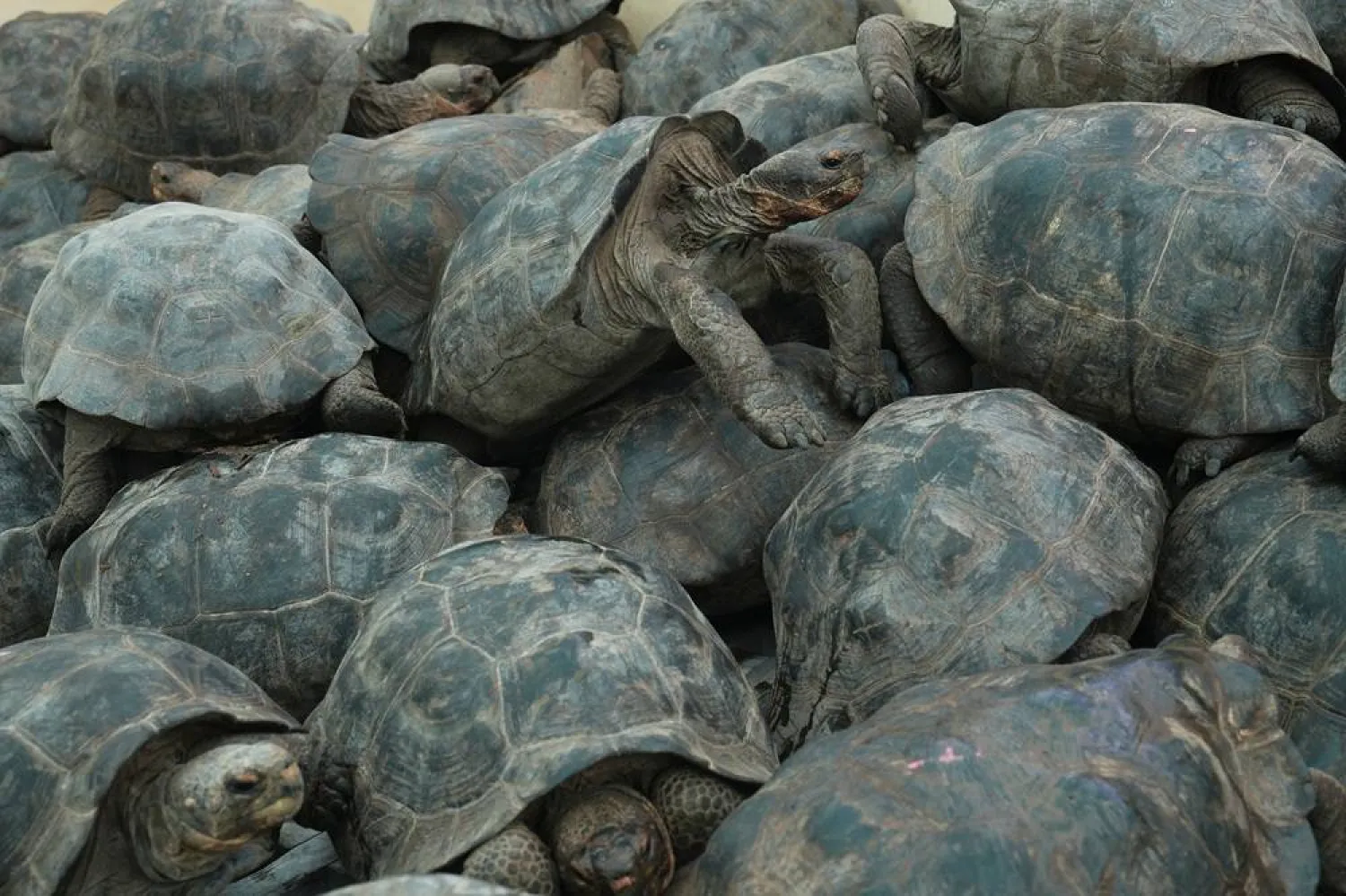
 Juvenile giant tortoises are loaded onto a boat on Santa Cruz Island for transport to Floreana Island for release as part of a project to reintroduce the Floreana giant tortoise to its native island in the Galapagos Islands, Ecuador, Thursday, Feb. 19, 2026. (AP Photo/Dolores Ochoa)
Juvenile giant tortoises are loaded onto a boat on Santa Cruz Island for transport to Floreana Island for release as part of a project to reintroduce the Floreana giant tortoise to its native island in the Galapagos Islands, Ecuador, Thursday, Feb. 19, 2026. (AP Photo/Dolores Ochoa)
TT

Galapagos Park Releases 158 Juvenile Hybrid Tortoises on Floreana to Restore the Ecosystem

 Juvenile giant tortoises are loaded onto a boat on Santa Cruz Island for transport to Floreana Island for release as part of a project to reintroduce the Floreana giant tortoise to its native island in the Galapagos Islands, Ecuador, Thursday, Feb. 19, 2026. (AP Photo/Dolores Ochoa)
Juvenile giant tortoises are loaded onto a boat on Santa Cruz Island for transport to Floreana Island for release as part of a project to reintroduce the Floreana giant tortoise to its native island in the Galapagos Islands, Ecuador, Thursday, Feb. 19, 2026. (AP Photo/Dolores Ochoa)

Nearly 150 years after the last giant tortoises were removed from Floreana Island in Ecuador’s Galapagos archipelago, the species made a comeback Friday, when dozens of juvenile hybrids were released to begin restoring the island’s depleted ecosystem.

The 158 newcomers, aged 8 to 13, have begun exploring the habitat they are destined to reshape over the coming years. Their release was perfectly timed with the arrival of the season’s first winter rains.

“They are large enough to be released and can defend themselves against introduced animals such as rats and cats,” said Fredy Villalba, director of the Galapagos National Park breeding center on Santa Cruz Island, noting that the best specimens with the strongest lineage were selected specifically for Floreana.

These released juvenile specimens, out of a total of 700 planned for Floreana, will be introduced gradually. According to Christian Sevilla, director of ecosystems of the Galapagos National Park, they carry between 40% and 80% of the genetic makeup of the Chelonoidis niger —a species that has been extinct for 150 years.

The lineage of these hybrids traces back to Wolf Volcano on Isabela Island, a discovery that still puzzles scientists today. By selecting adults with the strongest genetic makeup, said Sevilla, the breeding program aims to gradually bring the extinct Floreana species back to its former purity.

Two centuries ago, Floreana was home to approximately 20,000 giant tortoises. However, whaling, a devastating fire, and relentless human exploitation eventually led to their complete extinction on the island.

“In genetic terms, reintroducing a species to that island with a significant genetic component of the original species is vital,” biologist Washington Tapia told The Associated Press.

Tapia, a researcher and director of Biodiversa-Consultores — a firm specializing in the Galapagos Islands — emphasized that this process is about more than just numbers; it is about restoring a lost lineage.

Floreana, an island spanning approximately 173 square kilometers (67 square miles), is a volcanic landmass and the southernmost point of the Galapagos archipelago. Situated in the middle of the Pacific Ocean — roughly 1,000 kilometers (621 miles) from the mainland coast — it remains a remote and vital ecological site.

The tortoises reintroduced to Floreana will share their territory with a diverse population of nearly 200 people alongside flamingos, iguanas, penguins, sea gulls and hawks. However, they must also contend with introduced plant species such as blackberry and guava, as well as animals like rats, cats, pigs and donkeys. These non-native species, introduced by human activity, represent potential threats to the island’s newest inhabitants.

Floreana resident Verónica Mora described the release of the turtles as a dream come true. “We are seeing the reality of a project that began several years ago,” she said, adding that the community feels immense pride in the return of the giant tortoises.

The United Nations designated the Galapagos Islands as a Natural World Heritage Site in 1978. This honor recognizes the islands’ unique abundance of terrestrial and marine species found nowhere else on the planet.



Egyptian Singer Hany Shaker Dies at 74

Egyptian star Hany Shaker (Personal Facebook account)
TT

Egyptian Singer Hany Shaker Dies at 74

Egyptian star Hany Shaker (Personal Facebook account)

Egyptian singer Hany Shaker, dubbed 'Prince of Arab Singing,' passed away Sunday at the age of 74, according to Egyptian television.

He had been receiving treatment in France, where he traveled last March after undergoing medical surgery in Egypt earlier in the year.

Hany Abdel Aziz Shaker was born in December 1952 and graduated from the Higher Institute of Music (Conservatory). However, he started his career early on in children's programs on Egyptian television before being supported by composer Mohamed El Mougy, who introduced him at a major concert with the late Fayza Ahmed, where he performed the song 'Helwa Ya Donia' (Beautiful World), with lyrics by Fathy El Ghandour, according to Reuters.

Shaker released dozens of albums and performed concerts in most countries around the world and participated in major art festivals.

He also appeared in several films, such as (Aysheen Lel Hob) in 1974 alongside Nelly and Mohamed Awad, (Hatha Ohibbo wa Hatha Oreedo) in 1975, and (El Mesbah El Sehry) in 1977.

Shaker served as the head of the Musicians' Syndicate for the first time in 2015, then won a second term before resigning in July 2022.


Bangkok Food Vendor Curbs Push City Staple from the Streets

This photo taken on April 30, 2026 shows a street vendor selling fried food along Silom road in Bangkok. (Photo by Lillian SUWANRUMPHA / AFP)
TT

Bangkok Food Vendor Curbs Push City Staple from the Streets

This photo taken on April 30, 2026 shows a street vendor selling fried food along Silom road in Bangkok. (Photo by Lillian SUWANRUMPHA / AFP)

Across Bangkok, aromas of garlic, chili and grilled meat drift from roadside stalls and carts, but tighter controls on vendors threaten livelihoods and the street food culture that defines the Thai capital.

Convenient, full of flavor and popular among locals and tourists alike, Bangkok's street food is one of the city's signatures -- where sizzling woks and smoky charcoal grills turn boulevards and sidewalks into open-air kitchens from morning until late at night.

But many street sellers in the foodie paradise face an uncertain future as the Bangkok government in recent years has moved to clear footpaths, improve order and relocate vendors from curbsides in packed commercial districts to designated market stalls.

"I am worried because we are here illegally," said Looknam Sinwirakit, who was once fined 1,000 baht ($30) for obstructing the street while selling 50-baht fried glutinous rice cakes in the capital's Chinatown.

This photo taken on April 29, 2026 shows people eating noodles from a street food stall in Chinatown in Bangkok. (Photo by Lillian SUWANRUMPHA / AFP)

One of Bangkok's busiest tourist areas, the neighborhood's steady flow of customers is worth the risk of city fines, Looknam, 45, told AFP.

"Vendors need to earn a living," she said. "It's not fair just to evict us, but if they tell us to (leave) then we have to."

Nearby, durian seller Wong Jaidee, who has sold the strong-smelling fruit for more than two decades, said he also feared being made to move.

"I don't have any backup plan," the 56-year-old said. "Bangkok is a high-priced city and we may not be able to cope."

- Time to move -

Since 2022, the estimated number of mobile vendors in the city has fallen by more than 60 percent, with around 10,000 fewer now on the streets, according to data from the Bangkok Metropolitan Administration (BMA).

While dozens have moved to informal markets and hawker centres -- using a model similar to Singapore, where food vendors are grouped in designated locations -- many others have simply closed their business due to the stricter regulations or because they were no longer profitable, said BMA official Kunanop Lertpraiwan.

The municipality has mostly targeted vendors crowding main roads with heavy pedestrian foot traffic, while those on side streets and in areas popular with backpackers and other tourists were allowed more flexibility, Kunanop said.

"We give them time and communicate with them clearly," he said, adding some sellers were given several months to find a new location.

"It's not like we will move them tomorrow."

The city is pushing more vendors to set up shop in one of five hawker centers opened in recent years -- the latest in April beside Bangkok's popular Lumphini Park.

With rows of food stalls and picnic tables, the new hub so far houses around a dozen vendors who previously sold food on nearby streets.

BMA encouraged them to relocate, and they now pay 60 baht a day to rent a hawker stall.

Panissara Piyasomroj, who sold noodles to morning runners in the park since 2004, said moving into the center meant better conditions, including convenient water and electricity access.

Under a roof to beat the heat, the 59-year-old said her business had been "upgraded" and "looks cleaner".

- 'Part of the culture' -

But for other vendors, the prospect of moving from a familiar setting remains a concern.

Thitisakulthip Sang-uamsap, 67, has sold fried vegetable balls near Chinatown for more than 40 years and worries she could be forced to relocate.

"I live around here... if they ask me to leave, I won't be comfortable," she said, adding she hoped the government would show empathy for older vendors earning little income.

The crowded, bustling sidewalks and the smell of freshly grilled squid and other street treats are for many visitors a key part of Bangkok's charm -- and a cheap, tasty meal on-the-go is worth the hassle of a blocked path.

German tourist Oliver Peter said Thailand has one of the best cuisines in the world, noting his favorite, Pad Thai -- the popular stir-fried rice noodles ubiquitous in Bangkok's streetside woks.

"It would be sad if they go away," he said. "It's part of the culture."


Mexico City is Sinking So Quickly, it Can be Seen from Space

Uneven buildings and grounds at the Templo Mayor shows a city sinking, July 28, 2016, in Mexico City. (AP Photo/Ross D. Franklin)
TT

Mexico City is Sinking So Quickly, it Can be Seen from Space

Uneven buildings and grounds at the Templo Mayor shows a city sinking, July 28, 2016, in Mexico City. (AP Photo/Ross D. Franklin)

Mexico City is sinking by nearly 10 inches (about 25 centimeters) a year, according to new satellite imagery released this week by NASA, making it one of the world’s fastest-subsiding metropolises.

One of the world's most sprawling and populated urban areas, at 3,000 square miles (about 7,800 square kilometers) and some 22 million people, the Mexican capital and surrounding cities were built atop an ancient lake bed.

Many downtown streets were once canals, a tradition that continues in the rural fringes.

Extensive groundwater pumping and urban development have dramatically shrunk the aquifer, meaning that Mexico City has been sinking for more than a century, leaving many monuments and older buildings — like the Metropolitan Cathedral, where construction began in 1573 — visibly tilted to the side. The contracting aquifer has also contributed to a chronic water crisis that is only expected to worsen.

“It damages part of the critical infrastructure of Mexico City, such as the subway, the drainage system, the water, the potable water system, housing and streets,” said Enrique Cabral, a researcher studying geophysics at the National Autonomous University of Mexico. “It’s a very big problem.”

Mexico City is sinking so fast that the subsidence can be spotted from space.

In some parts it is happening at an average rate of 0.78 inches (2 centimeters) a month, according to NASA’s newly released report, such as at the main airport and the iconic monument commonly known as the Angel of Independence.

Overall that means a yearly subsidence rate of about 9.5 inches (24 centimeters). Over the course of less than a century, the drop has been more than 39 feet (12 meters), according to Cabral.

“We have one of the fastest velocities of land subsidence in the whole world,” The Associated Press quoted him as saying.

The NASA estimates are based on measurements taken between October 2025 and January 2026 by a powerful satellite known as NISAR, which can track real-time changes on the Earth’s surface and is a joint initiative between NASA and the Indian Space Research Organization.

NISAR scientist Paul Rosen said that by capturing details of the Earth from space, the project is also “telling us something about what’s actually happening below the surface.”

“It’s basically documentation of all of these changes within a city,” Rosen said. He added: “You can see the full magnitude of the problem.”

With time the team hopes to be able to zoom in even more on specific areas and someday get measurements on a building-by-building basis.

More broadly, researchers hope to apply the technology around the world to track things like natural disasters, changes in fault lines, the effects of climate change in regions like Antarctica and more.

Rosen said it could be used to bolster alert systems, letting scientists alert governments to the need for evacuations in cases of volcano eruptions, for example.

For Mexico City the technology amounts to a big advance in studying the subsidence issue and mitigating its worst effects, according to Cabral.

For decades the government has largely ignored the problem other than stabilizing foundations under monuments like the cathedral. But following recent flare-ups of the water crisis, Cabral said, officials have begun to fund more research.

Imagery from the NISAR satellite and the data that comes with it will be key for scientists and officials as they plan on how to address the problem.

“To do long-term mitigation of the situation,” Cabral said, “the first step is to just understand.”