
Hezbollah Pressure on Military Court Undermines Lebanon’s Weapons Ban

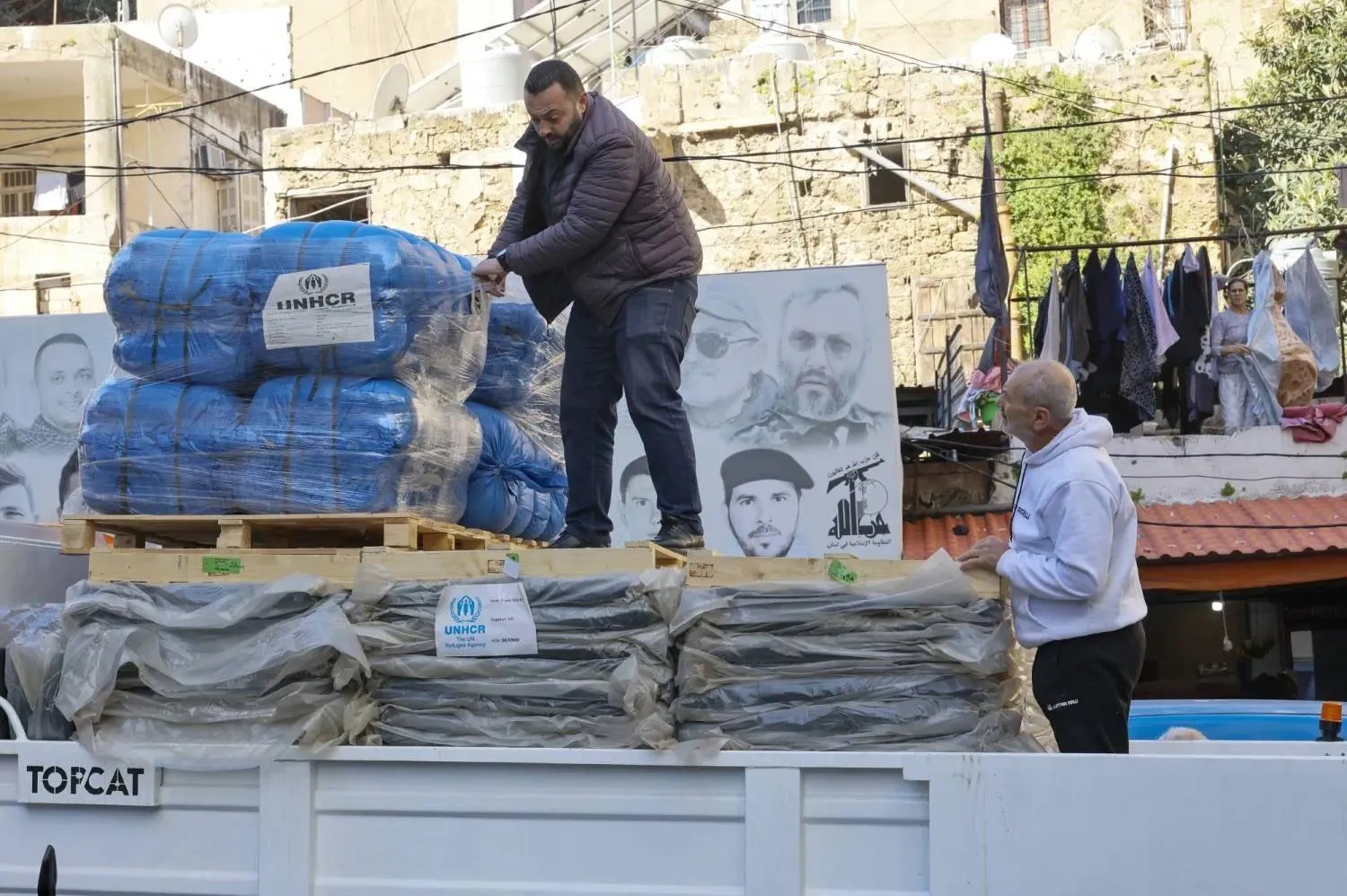
Blankets are distributed at a school converted into a shelter in Beirut, where a banner displaying images of leaders and members of Hezbollah can be seen (EPA). 
TT

Hezbollah Pressure on Military Court Undermines Lebanon’s Weapons Ban

Blankets are distributed at a school converted into a shelter in Beirut, where a banner displaying images of leaders and members of Hezbollah can be seen (EPA). 

Lebanon’s government decision to prohibit any military or security activity by Hezbollah has yet to translate into meaningful enforcement.

Hezbollah has continued to escalate its military operations, launching rockets and drones toward Israeli territory, while signs of deteriorating security have appeared inside Lebanon, particularly among displaced residents who have fled southern Lebanon and Beirut’s southern suburbs.

Security agencies have struggled to identify those responsible for launching rockets toward Israel. However, Lebanese forces recently recorded a notable development with the arrest of around 30 individuals affiliated with or supportive of Hezbollah.

The detainees were apprehended while fleeing alongside civilians from southern areas and the southern suburbs of Beirut after being found carrying individual weapons, including assault rifles, pistols and grenades.

The arrests appeared to signal a tentative shift in how Lebanon’s security and judicial institutions handle the issue of illegal weapons. Yet the move quickly ran up against what officials say is Hezbollah’s continuing influence over judicial decisions.

Last week, the military court tried three Hezbollah members detained days earlier. The court imposed a fine of 900,000 Lebanese pounds —about $10 — on each of them for possessing unlicensed military weapons and waived any prison sentence.

The ruling diverges sharply from typical sentences in similar cases, where possession or transport of unlicensed weapons usually carries at least a one-month prison term.

Judicial sources say the unusually lenient sentence reflects pressure exerted by Hezbollah on the military court to secure the release of its detained members.

According to the sources, the group sought their release last Thursday and pushed for their trial to be held the following day. The military prosecutor’s office objected, resulting in the hearing being postponed until Monday.

The verdict also drew criticism from the government commissioner to the military court, Judge Claude Ghanem, who promptly appealed the ruling before the Military Court of Cassation, requesting tougher penalties.

A judicial source told Asharq Al-Awsat that the ruling was “extremely lenient and failed to account for all the legal provisions under which the suspects were charged.” The source added that the commissioner had received preliminary investigation files concerning four additional detainees and was preparing to file charges against them in the coming hours while seeking stricter sentences.

Only hours after the verdict was issued, Lebanese Justice Minister Adel Nassar ordered that the civilian adviser to the military tribunal, Judge Abbas Jaha, be referred to the Judicial Inspection Authority for investigation.

A Justice Ministry source told Asharq Al-Awsat that the referral stemmed from “the circumstances surrounding the trial and his failure to object to this suspicious ruling.” The source noted that another member of the court panel, a military officer, had opposed the decision while Jaha approved it without reservation.

Weapons and rising tensions in host communities

Legally, the arrest of armed Hezbollah members represents a direct application of the government decision banning any military or security activity by the group. In principle, the ruling applies to anyone carrying weapons outside state authority and places them under threat of prosecution.

The more pressing challenge, however, lies in dealing with armed individuals among displaced populations.

Several neighborhoods in Beirut, including Hamra, Ras Beirut, Sakiat al-Janzir and Ain al-Remmaneh, as well as the towns of Aramoun and Kfarshima in Mount Lebanon, have witnessed repeated incidents involving gunfire, displays of weapons and confrontations with local residents.

Videos circulating on social media show armed men threatening residents, including footage recorded Sunday in Aramoun.

These incidents have heightened anxiety among host communities already grappling with mounting social and economic pressures.

Some residents say the security measures in place remain “below the required level,” arguing that the absence of deterrent action risks encouraging further incidents and creating the impression that the law is applied hesitantly when those involved are linked to Hezbollah.

A Lebanese security source, however, insisted that authorities treat all security incidents seriously. Delays in reaching certain locations, the source said, often result from limited personnel and the difficulty of maintaining coverage across all displacement areas.

Security forces maintain a near-permanent presence at the entrances of schools and facilities housing displaced people, the source added, while most incidents occur in nearby streets and neighborhoods. Patrols respond immediately to reports of gunfire or clashes, detaining suspects or pursuing them if they leave the scene.

Nevertheless, the official acknowledged that the continued incidents could lead to broader friction between displaced populations and local residents — particularly in densely populated areas — at a time when host communities are already under severe economic strain and displacement is expected to continue for months.



Israeli Strikes Damage Hospital in Lebanon

File photo: Destroyed houses that were hit in an Israeli airstrike in Saksakiyeh village, south Lebanon, Friday, April 3, 2026. (AP Photo/Hussein Malla)
TT

Israeli Strikes Damage Hospital in Lebanon

File photo: Destroyed houses that were hit in an Israeli airstrike in Saksakiyeh village, south Lebanon, Friday, April 3, 2026. (AP Photo/Hussein Malla)

A hospital in the coastal Lebanese city of Tyre was damaged by Israeli airstrikes on nearby buildings that wounded 11 people, the health ministry said on Saturday.

The director of the Lebanese Italian Hospital told the state-run National News Agency (NNA) that it would "remain open to provide the necessary medical care" despite the damage.

Strikes destroyed two buildings nearby, an AFP correspondent saw, shattering windows and causing suspended ceilings to collapse in the hospital, the facility's management said.

A series of attacks hit the Tyre region on Saturday, including one on its port that struck a small boat and damaged others moored nearby, the AFP correspondent said.

Israel has been carrying out strikes across Lebanon and launched a ground invasion in the south after Hezbollah entered the war in the Middle East on the side of its backer Iran on March 2.

Tens of thousands of people have left Tyre, but around 20,000 remain, including 15,000 displaced from surrounding villages, despite Israeli evacuation warnings covering most of the city and a broad swathe of southern Lebanon.

The NNA also reported that Israeli forces abducted a man in Shebaa, near the Israeli border in the east, at around 3:00 am on Saturday.


Indonesia Slams 'Unacceptable' Peacekeeper Casualties in Lebanon

FILE PHOTO: UNIFIL vehicles drive on a main road in Qlayaa, amid escalating hostilities between Israel and Hezbollah, as the US-Israel conflict with Iran continues, in Qlayaa, southern Lebanon, March 27, 2026. REUTERS/Karamallah Daher/File Photo
TT

Indonesia Slams 'Unacceptable' Peacekeeper Casualties in Lebanon

FILE PHOTO: UNIFIL vehicles drive on a main road in Qlayaa, amid escalating hostilities between Israel and Hezbollah, as the US-Israel conflict with Iran continues, in Qlayaa, southern Lebanon, March 27, 2026. REUTERS/Karamallah Daher/File Photo

The Indonesian government on Saturday slammed as "unacceptable" an explosion that injured three of its peacekeepers in Lebanon within days of three other blue helmets from the Southeast Asian nation being killed.

The United Nations Interim Force in Lebanon (UNIFIL) said three peacekeepers were wounded in a blast that occurred inside a UN facility near Adaisseh on Friday afternoon, and rushed to hospital.

Two were seriously wounded.

The UN Information Center in Jakarta said the "origin of the explosion" was unknown but identified the injured soldiers as Indonesian.

"Repeated attacks or incidents of this kind are unacceptable," the Indonesian foreign ministry said in a statement.

"Regardless of their cause, these events underscore the urgent need to strengthen protection for UN peacekeeping forces amid an increasingly dangerous conflict situation."

The government urged the UN Security Council to investigate the events and "to immediately convene a meeting of troop-contributing countries to UNIFIL to conduct a review and take measures to enhance the protection of personnel serving with UNIFIL".

Friday's incident came just days after an Indonesian peacekeeper died when a projectile exploded on March 29 in southern Lebanon, where Israel and Hezbollah have been fighting since Lebanon was drawn into the Middle East war.

A UN security source told AFP on condition of anonymity Tuesday that fire from an Israeli tank was responsible for that attack.

A day later, two more Indonesian peacekeepers died after an explosion struck a UNIFIL logistics convoy, also in southern Lebanon.

The father of one of the two fallen soldiers, 33-year-old Zulmi Aditya Iskandar, said this week he was shocked that peacekeepers were losing their lives in the conflict.

"We were really sad and regretful, because this is a UN troop, a peacekeeping troop, not deployed for war," 60-year-old Iskandarudin told reporters at his house in West Java province.

The bodies of the three peacekeepers are scheduled to arrive in Jakarta on Saturday evening, according to the military.

The Indonesian National Armed Forces has said it will deploy more than 750 personnel to Lebanon next month as part of the scheduled UNIFIL peacekeeping troop rotation.


Strike Kills One Iraqi Fighter near Syria Border

Mourners attend the funeral of members of Iraq's Hashed al-Shaabi, who were killed in an airstrike in the town of al‑Qaim near the Syrian border, amid heightened regional tensions due to the US-Israel conflict with Iran, in Baghdad, Iraq, March 12, 2026. REUTERS/Stringer
TT

Strike Kills One Iraqi Fighter near Syria Border

Mourners attend the funeral of members of Iraq's Hashed al-Shaabi, who were killed in an airstrike in the town of al‑Qaim near the Syrian border, amid heightened regional tensions due to the US-Israel conflict with Iran, in Baghdad, Iraq, March 12, 2026. REUTERS/Stringer

An attack killed one fighter from the former paramilitary coalition Hashed al-Shaabi on Saturday, the alliance said, blaming the US and Israel.

Iraq has been dragged into the war between the United States, Israel and Iran, with strikes targeting both US interests and pro-Iran groups in the country, reported AFP.

"This treacherous attack resulted in the martyrdom of one PMF fighter and the wounding of four others, as well as a member of the ministry of defense," said a short statement from the group, which is also known as the Popular Mobilization Forces (PMF), adding it was a "Zionist-American attack".

The PMF is a coalition of armed groups -- formed in 2014 to fight extremists-- that is now part of Iraq's regular army, but also contains pro-Iran factions who have a reputation for acting independently.

PMF positions have been repeatedly targeted since the outbreak of war, with the group consistently blaming the attacks on the US and Israel.

According to the group's statement, the latest attack targeted a position in western Anbar province of the 45th Brigade, which belongs to the US-blacklisted, pro-Iran Kataeb Hezbollah group.

Kataeb Hezbollah is part of the umbrella movement known as the Islamic Resistance in Iraq, which has been claiming daily attacks since the start of the war on US interests in Iraq and the region.

The Pentagon has said helicopters have carried out strikes against pro-Iran armed groups in Iraq during the war.

Washington has strongly denied claims it has targeted Iraqi security forces.