


Israel Isolates South Lebanon with Strikes on Civilian Infrastructure

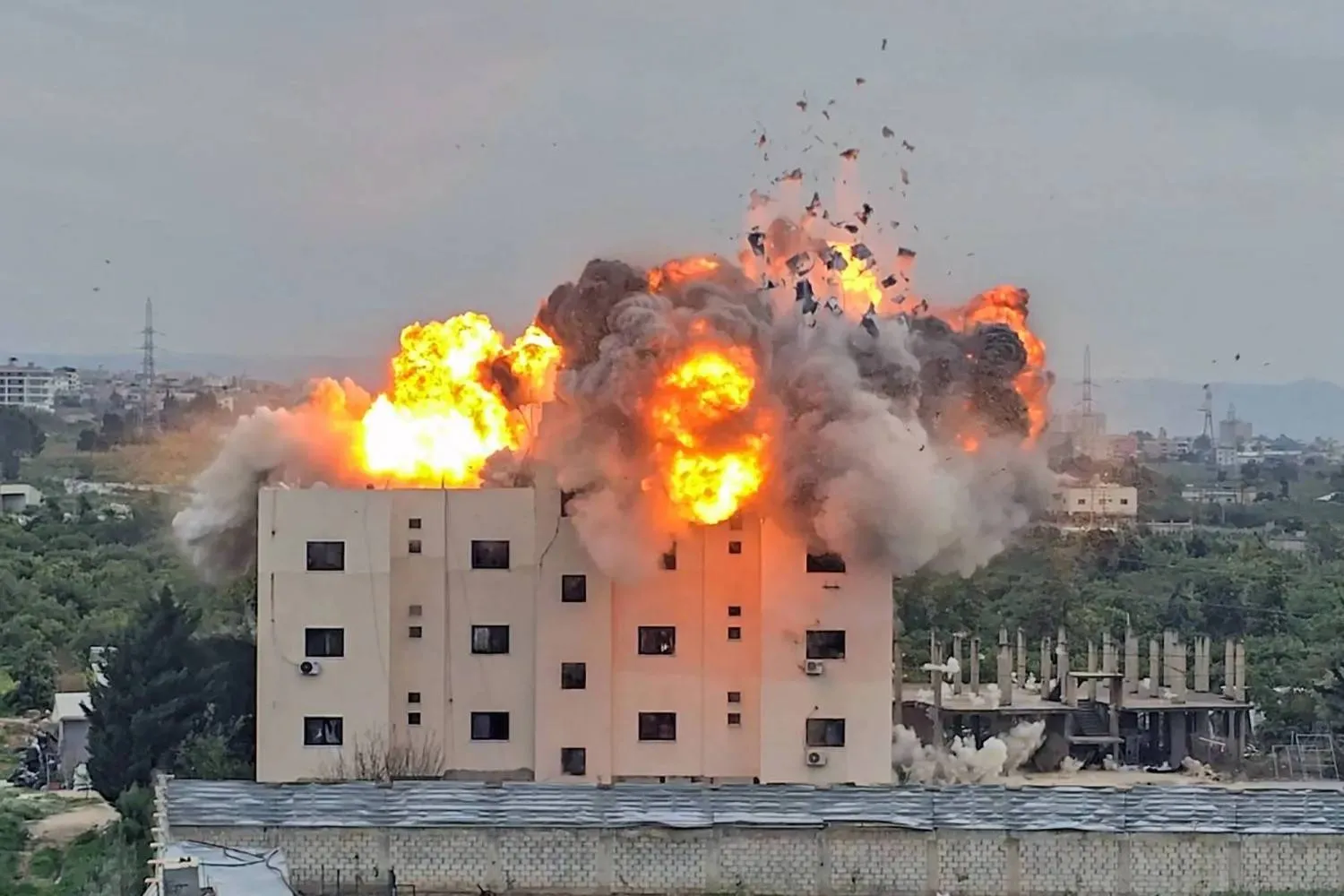
Fire engulfs a building hit by an Israeli strike in Abbasiyeh after an evacuation warning (AFP)
TT

Israel Isolates South Lebanon with Strikes on Civilian Infrastructure

Fire engulfs a building hit by an Israeli strike in Abbasiyeh after an evacuation warning (AFP)

Israel on Friday began striking targets belonging to the Lebanese state and said it intended to hit civilian facilities, as preparations continued for a ground operation in the south.

Early signs of the operation appeared as limited, temporary incursions that expanded on Friday toward the outskirts of the Litani River, with a commando unit deployed to carry out a mission in the second line along the border with Israel.

The Israeli military began targeting civilian assets of the Lebanese state on Thursday, striking a bridge over the Litani River in the Qantara area that links Wadi al-Hujair to villages along the frontline of the border.

It later struck another major bridge over the Litani connecting the towns of Zrariyeh and Tair Falsay, cutting off large parts of the area south of the river from the north.

The Israeli military secured political backing for targeting civilian facilities following threats issued on Wednesday, after Hezbollah fired about 200 rockets toward Israel within a few hours.

Israel’s public broadcaster said Prime Minister Benjamin Netanyahu asked the military to prepare additional civilian targets for approval after the Litani bridge was destroyed.

"This is just the beginning and the Lebanese government and the state of Lebanon will pay an increasing price in damage to Lebanese national infrastructure used by Hezbollah terrorists," Israeli Defense Minister Israel Katz said on Friday.

He said Lebanon would suffer "loss of territory -- until it fulfils its central commitment of disarming Hezbollah.”

Katz’s remarks point to a ground operation the Israeli military has been preparing to launch inside Lebanese territory.

Preparations began last week, with four military divisions and two brigades massed along the border with Lebanon ahead of a possible incursion.

Israeli forces have already carried out limited raids inside Lebanese territory.

Largest incursions in Khiam

A Lebanese security source said the deepest incursion occurred from Tel al-Hamames toward the center of the town of Khiam, where Israeli forces expanded their presence and reached the town center.

The furthest advance from the border was recorded overnight from Thursday to Friday, when an Israeli commando unit reached the outskirts of Majdal Selm.

The unit is believed to have infiltrated through a concealed route in Wadi al-Slouki and detonated a house in the area.

The source described the lines of Israeli incursions in southern Lebanon, saying Israeli forces advanced from Tel al-Hamames toward Khiam and from the town of Adaisseh toward Rab al-Thalathin, expanding from there toward Taybeh.

Fierce clashes were reported and spread to the Mashari’ al-Taybeh area, though the source said Israeli forces did not enter the town.

South of that axis, Israeli forces advanced from an area between Markaba and Houla toward Tallousa in an attempt to reach vantage points overlooking Wadi al-Hujair.

There were also movements from Houla toward Wadi al-Slouki opposite the town of Shaqra, aiming to oversee the valley without descending into it.

The source said this axis saw the largest and most dangerous incursions, in what appeared to be an attempt to reach the Litani River and Wadi al-Hujair, areas Israel views as particularly sensitive.

Other axes saw smaller and less deep incursions despite troop movements, notably the Aitaroun-Yaroun-Bint Jbeil axis, where Israeli forces entered and withdrew. In the town of Qouzah, forces advanced to the outskirts of Beit Lif but did not enter it.

In the western sector, operational Israeli military presence in the towns of Dhayra and Alma al-Shaab remained limited.

Israeli forces nevertheless crossed the Blue Line from multiple directions as the Lebanese army withdrew from border positions to barracks and assembly points under a redeployment plan announced last week.

The move followed a Lebanese government decision not to confront the Israeli incursion. Hezbollah says its fighters are engaging advancing forces inside Lebanese territory and shelling Israeli troop gatherings along the border with rockets and artillery.

The source described the bridge strikes as dangerous, saying the targets were “not purely military” and carried indications of tightening pressure on civilians by forcing them toward specific routes or threatening to trap them inside the area.



Israeli Foreign Minister Says No Plans for Talks with Lebanese Govt

 Israeli tanks maneuver on the Israeli side of the Israel-Lebanon border, amid escalation between Hezbollah and Israel, and amid the US-Israeli conflict with Iran, in northern Israel, March 15, 2026. (Reuters)
Israeli tanks maneuver on the Israeli side of the Israel-Lebanon border, amid escalation between Hezbollah and Israel, and amid the US-Israeli conflict with Iran, in northern Israel, March 15, 2026. (Reuters)
TT

Israeli Foreign Minister Says No Plans for Talks with Lebanese Govt

 Israeli tanks maneuver on the Israeli side of the Israel-Lebanon border, amid escalation between Hezbollah and Israel, and amid the US-Israeli conflict with Iran, in northern Israel, March 15, 2026. (Reuters)
Israeli tanks maneuver on the Israeli side of the Israel-Lebanon border, amid escalation between Hezbollah and Israel, and amid the US-Israeli conflict with Iran, in northern Israel, March 15, 2026. (Reuters)

Israel's foreign minister on Sunday denied reports that Israel could soon hold direct talks with Lebanon and rejected claims it had told the United States it was running low on interceptors. 

Israel's Haaretz newspaper reported on Saturday that ‌Israel and Lebanon were ‌expected to hold ‌direct ⁠talks in the ⁠coming days. Semafor also reported that Israel had informed Washington it was running critically low on ballistic missile interceptors. 

Both reports cited unnamed sources. 

Asked about the weekend ⁠reports, Foreign Minister Gideon Saar said: "For ‌the ‌two questions, the answer is no." 

He also ‌said that Israel sees "eye-to-eye" ‌with the US in the war with Iran, now in its 16th day, and that the two allies were ‌determined to continue until their goals are achieved. 

"We want ⁠to ⁠remove the existential threats from Iran for the long term. We don't want to go every year to another war," he told reporters. 

Saar was speaking from a Bedouin Arab town in northern Israel near an Israeli Air Force base where homes were damaged in an Iranian missile attack last week. 


At Least Four Killed in Overnight Israeli Strikes in Lebanon

Debris is strewn along a street and vehicles after a residential apartment block was struck in an Israeli airstrike in Beirut's southern suburb of Haret Hreik on March 15, 2026. (AFP)
TT

At Least Four Killed in Overnight Israeli Strikes in Lebanon

Debris is strewn along a street and vehicles after a residential apartment block was struck in an Israeli airstrike in Beirut's southern suburb of Haret Hreik on March 15, 2026. (AFP)

Overnight strikes in southern Lebanon killed at least four people, Lebanese state media and the government said on Sunday, as Israel said it was pressing its campaign against Iran-backed Hezbollah.

Israel is fighting a second front in the war in the Middle East in southern Lebanon, against Hezbollah, alongside the air campaign against Iran it launched with the United States more than two weeks ago.

Lebanon's state-run National News Agency (NNA) said Israel struck "an apartment in a residential building" in a northern district of the coastal city of Sidon, killing one person and causing a fire.

An AFP journalist at the scene saw damage to the third storey of an apartment building as the Lebanese army cordoned off the area and rescue teams worked to extinguish the blaze.

Nearby residents rushed into the street, some carrying belongings.

To the southeast of Sidon, in the village of Al-Qatrani, three people were killed in an overnight Israeli strike, according to Lebanon's health ministry.

The Israeli military said in a statement Sunday it continued to strike infrastructure used by Hezbollah throughout Lebanon and hit "several Hezbollah launch sites" in Al-Qatrani, where it said the armed group was preparing to fire off missiles.

It also said it destroyed "command centers" belonging to Hezbollah's Radwan Force in Beirut.

Hezbollah said Sunday it was targeting several Israeli troop positions in villages close to the border.

According to Lebanon's health ministry, Israeli air strikes have killed 826 people in Lebanon since the start of the latest war, which began March 2 with Hezbollah firing missiles at Israel.

Lebanese President Joseph Aoun has proposed negotiations with Israel, but has yet to receive a response.

A Lebanese official told AFP on Saturday that the country was preparing to form a delegation to negotiate with Israel but that there was no agenda, timing or location yet decided for any talks.

French President Emmanuel Macron has said the Lebanese government was ready to engage in "direct talks" with Israel and he offered to host negotiations in Paris, warning that "everything must be done to prevent Lebanon from descending into chaos".


Israeli Ground Incursions in South Lebanon Shift Hezbollah’s Combat Priorities

Two Israeli tanks deployed along the border barrier with Lebanon during fighting with Hezbollah (EPA). 
TT

Israeli Ground Incursions in South Lebanon Shift Hezbollah’s Combat Priorities

Two Israeli tanks deployed along the border barrier with Lebanon during fighting with Hezbollah (EPA). 

Hezbollah has scaled back attacks deep inside Israel as it focuses on confronting expanding Israeli ground incursions into southern Lebanon, while Israel has widened its list of targets across Lebanese territory.

By Saturday afternoon, Hezbollah had issued 22 statements claiming attacks against Israeli forces. Most operations targeted Israeli military positions along the border, air-defense and surveillance systems, and northern Israeli settlements.

The group also said it struck Israeli soldiers and vehicles inside Lebanese territory, including near the municipality of Khiam, the town of Maroun al-Ras, and newly established Israeli positions at Blat and Nimr al-Jamal opposite the border town of Alma al-Shaab. Hezbollah also reported attacks around the Khiam detention center, west of Blida and near Khazzan Hill in Adaisseh.

Efforts to repel Israeli ground advances now appear to top Hezbollah’s battlefield priorities after the Israeli army launched incursions along at least four axes, according to sources in southern Lebanon. They said Hezbollah had mobilized forces since the start of the war in preparation for a possible ground confrontation.

Israeli forces have sought to prevent reinforcements of fighters and equipment from reaching Hezbollah units in the south. Airstrikes severed key routes by hitting two bridges and two crossings linking areas south of the Litani River with those to the north, as well as roads between villages.

Sources stressed that these steps broaden Israel’s target list. “Israel also appears to be trying to empty the area by targeting ambulances and civil defense units in the south,” one source said.

Lebanon’s National News Agency reported that Israeli warplanes launched two airstrikes shortly after midnight on the Khardali road and bridge linking Nabatieh and Marjayoun near a Lebanese army checkpoint. The strikes left a large crater and completely cut the road.

Medical Facilities Targeted

Israeli strikes on ambulance centers and medical facilities since the start of the war have killed 22 paramedics, according to Lebanese officials.

The deadliest attack occurred Friday when an Israeli strike hit a primary health care center run by Lebanon’s Ministry of Public Health in the town of Burj Qalaouiyeh, killing 12 doctors, paramedics and nurses. The Health Ministry described the strike as a “flagrant attack on the country’s official health care network.”

Another strike hit a gathering point for the Islamic Health Authority and the Al-Risala Scouts Association in the town of Souwaneh, killing two people.

The Israeli military said Hezbollah was using ambulances and medical facilities for military purposes and accused the group of transporting rockets and other weapons in civilian trucks along Lebanon’s coastal areas.

Heavy Strikes Across the South

Israeli airstrikes also intensified across southern Lebanon, targeting towns including Majdal Zoun, Yater, Taybeh, Sajd in the Iqlim al-Tuffah region and Zawtar al-Sharqiyah in the Nabatieh district, where a strike destroyed a house belonging to the Harb family.

Two heavy strikes hit the town of Khiam in the Marjayoun district, while Naqoura came under artillery fire and warplanes targeted Kharayeb.

In the Hasbaya district, Israeli artillery shelled the outskirts of Shebaa. Later, Israeli forces targeted Bint Jbeil, Ainata, Aitaroun and the outskirts of Maroun al-Ras as clashes intensified with Hezbollah fighters along several fronts. The Wadi al-Hujayr area also came under artillery fire.

The escalation also affected UN peacekeepers. Kandice Ardiel, spokeswoman for the United Nations Interim Force in Lebanon, said a UN position near Mais al-Jabal was hit, likely by heavy machine-gun fire, sparking a fire at the site and slightly injuring a peacekeeper.

UNIFIL said it had opened an investigation and reminded all parties of their obligation to ensure the safety of peacekeepers at all times.