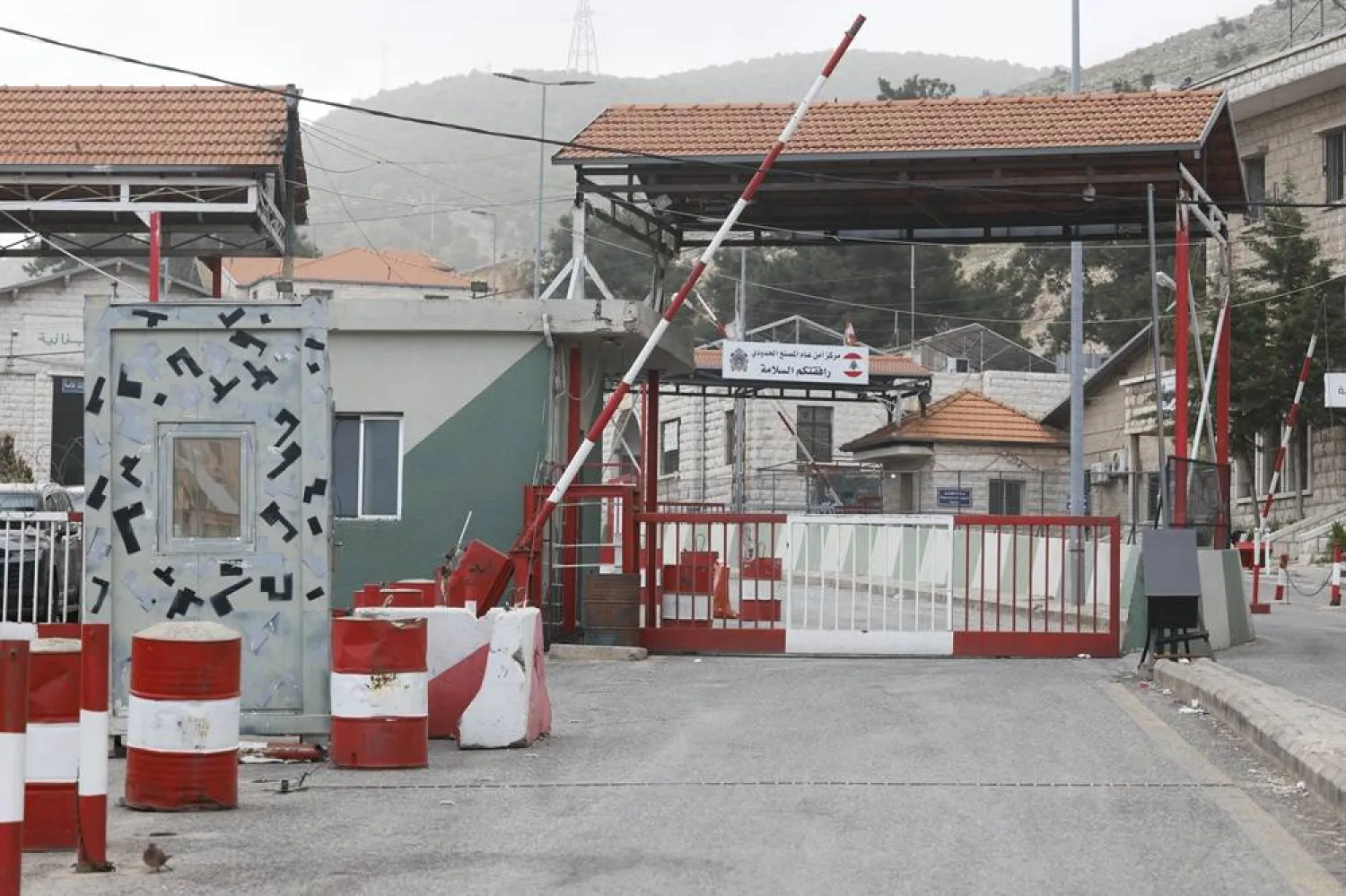

Israeli Threats Shut Masnaa Crossing, Partly Isolate Lebanon from Syria

The Masnaa border crossing with Syria in the Bekaa Valley, eastern Lebanon, 05 April 2026, following an Israeli warning to target the M30 highway between Lebanon and Syria. (EPA)
TT

Israeli Threats Shut Masnaa Crossing, Partly Isolate Lebanon from Syria

The Masnaa border crossing with Syria in the Bekaa Valley, eastern Lebanon, 05 April 2026, following an Israeli warning to target the M30 highway between Lebanon and Syria. (EPA)

Israel has partially severed Beirut from Damascus after shutting the main border crossings between the two countries, following a warning that it would strike the Masnaa crossing.

The move has disrupted trade and travel, funneling movement through a single crossing in Lebanon’s far northeast, far from both capitals.

Syrian and Lebanese diplomatic contacts helped avert an Israeli strike on Masnaa, but failed to reopen it. The crossing remains fully closed. Major General Hassan Choucair, head of Lebanon’s General Security, said protecting personnel and equipment at the crossing was the top priority.

He stressed the crossing was legal and could not be used for arms smuggling, noting all trucks and vehicles undergo strict inspections, and dismissed reports of smuggling as false.

Security measures

A Lebanese security source flatly rejected Israeli claims that the crossings are used to smuggle weapons, saying traffic in both directions is subject to strict inspections by Lebanese and Syrian authorities, making any such operations impossible.

The source told Asharq Al-Awsat the allegations were baseless and carried political and security motives beyond counter-smuggling.

The Israeli escalation over the crossings forms part of broader pressure linked to the war on Lebanon, the source said, and may pave the way for a land blockade along the Lebanese-Syrian border to redraw the rules of engagement with Hezbollah.

The source warned the developments could signal a new security reality on the border ahead of any future confrontation.

Undeclared blockade

Border crossings are no longer mere transit points; they have become a focal point where economic strain meets security and political tensions. With movement paralyzed, losses mounting, and tensions rising, Lebanon appears to be entering a phase of compounded pressure, widely seen as an undeclared blockade.

MP Sajih Attieh, head of parliament’s public works committee, said conditions at the crossings are steadily deteriorating. Of five crossings with Syria, only one remains effectively open, Jousieh in the Qaa area.

He told Asharq Al-Awsat that three crossings in Akkar, Aboudieh, Arida, and Al-Buqiaa remain shut, while efforts to reopen Aboudieh are being hindered by Syrian hesitation due to limited security capacity.

Masnaa, the main artery between Lebanon and Syria in the Bekaa Valley, has been paralyzed since Sunday night after the Israeli warning. Activity has shifted to Jousieh, where trucks loaded with goods are backed up on both sides, along with civilian traffic.

Attieh said the closures have nearly halted land transit and cross-border trade, hitting key facilities, notably the port of Tripoli, which is losing about $100,000 a day due to the suspension of overland transit goods.

State revenues fall

The closures have also choked Lebanese exports, especially fruit, vegetables and local industries, which have lost their main overland route to Arab markets, adding pressure on productive sectors.

Attieh said the impact extends beyond exports. Maritime imports have dropped by up to 70%, affected by the closure of the Strait of Hormuz, triggering a sharp fall in state revenues.

Monthly revenues from customs, imports and value-added tax have fallen from about $450 million to roughly $125 million, he said, adding that the government has frozen implementation of the 2026 budget.

Public spending had been set based on revenues nearing $6 billion, making the freeze unavoidable amid a roughly 70% drop in imports, he said, warning that the risk of a deeper economic crisis will become clearer once the war ends.

France to Host International Meet on Palestinian-Israeli Conflict in June

15 April 2026, Berlin: French Foreign Minister Jean-Noel Barrot, gives a statement at the International Sudan Conference at the Federal Foreign Office in Berlin. (dpa)
TT

France to Host International Meet on Palestinian-Israeli Conflict in June

15 April 2026, Berlin: French Foreign Minister Jean-Noel Barrot, gives a statement at the International Sudan Conference at the Federal Foreign Office in Berlin. (dpa)

France will host an international meeting in June dedicated to the long-touted two-state solution to the Palestinian-Israeli conflict, the French foreign minister announced on Thursday.

"On September 22 last year, France took the momentous decision to recognize the State of Palestine and will host an international conference in Paris on June 12 so that Israeli and Palestinian civil societies can make their voices heard," Jean-Noel Barrot said in a video message played to a gathering of peace activists in the Israeli city of Tel Aviv.

The "People's Peace Summit" in Tel Aviv was organized by the "It's Time" coalition, a grouping of more than 80 peacebuilding organizations working to end the Palestinian-Israeli conflict through a political agreement guaranteeing both peoples' right to self-determination and secure lives.

Several hundred people attended the meeting in Tel Aviv, AFP journalists reported.

"While the Middle East remains deeply scarred by the terrorist attacks of October 7 (2023) in Israel, by more than two and a half years of devastating war in Gaza and by a humanitarian crisis that, sadly, shows no sign of abating, your presence here is an act of resistance against fatalism and resignation," Barrot said.

Palestinian movement Hamas's October 7, 2023 attack on Israel sparked the war in Gaza, where a ceasefire in effect since October has largely halted fighting.

Barrot's remarks come as the government of Prime Minister Benjamin Netanyahu, one of the most right-wing in Israel's history, vehemently opposes the emergence of a sovereign and fully independent Palestinian state in the occupied West Bank and Gaza, and is working on the ground to undermine the possibility of a two-state solution.

Meanwhile, the Palestinian Authority led by President Mahmoud Abbas appears extremely weakened and deeply unpopular.


‘Positive’ Mood in Cairo Talks on New Proposal by Mediators

 A Palestinian man carries jerrycans filled with water through a tent camp in Khan Younis, in the southern Gaza Strip, Thursday, April 30, 2026. (AP)
A Palestinian man carries jerrycans filled with water through a tent camp in Khan Younis, in the southern Gaza Strip, Thursday, April 30, 2026. (AP)
TT

‘Positive’ Mood in Cairo Talks on New Proposal by Mediators

 A Palestinian man carries jerrycans filled with water through a tent camp in Khan Younis, in the southern Gaza Strip, Thursday, April 30, 2026. (AP)
A Palestinian man carries jerrycans filled with water through a tent camp in Khan Younis, in the southern Gaza Strip, Thursday, April 30, 2026. (AP)

Hamas described as “positive” an initial meeting held by its delegation on Wednesday evening with mediators in Egypt to discuss a new Gaza ceasefire proposal.

Asharq Al-Awsat reviewed a message sent by Hamas to Palestinian factions describing the talks as “a preliminary, frank, clear and brief meeting, held in a positive atmosphere.”

The message said Hamas told the UN’s senior representative for Gaza on the Board of Peace, Nickolay Mladenov, and his team that “there must be clear implementation of the first phase before moving to the second,” noting this stance had already been adopted by the movement and other Palestinian factions.

It added that mediators are awaiting Israel’s response to determine next steps.

A senior Hamas source confirmed the message, saying the atmosphere in Wednesday’s meetings with mediators was positive. Another meeting was held later the same evening with Mladenov and other figures, the source said.

Mladenov, who arrived in Cairo from Israel on Tuesday, carried Israel’s position on the recently updated proposal covering the first and second phases, the source added. Further meetings are expected on Thursday.

The source said Israel is still trying to obstruct the agreement by pushing conditions linking progress to disarmament, including seeking signed approval from Hamas and other factions, a demand all factions in the Cairo talks reject.

Mediators, including Mladenov, are attempting to find workable approaches, the source said, with talks set to continue through Friday.

Leftist factions raise concerns

Despite Hamas describing the talks as positive and calling for a clear implementation timeline and firm guarantees, some factions, particularly leftist groups within the Palestine Liberation Organization, raised concerns over the latest mediators’ proposal.

A senior source from leftist factions said their observations focused on the absence of a binding timeline for Israeli withdrawal and the lack of a clear monitoring mechanism.

The source also cited the need for a defined schedule for the second phase and warned of a reduced Palestinian national role in favor of an international administration.

Other concerns included ambiguity in implementing the first phase, linking reconstruction to disarmament, and the exclusion of areas beyond the “Yellow Line” from reconstruction plans.

The factions proposed affirming the right to self-determination and a Palestinian state in line with international legitimacy, and that Gaza’s administrative committee begin work from the first phase.

They also suggested weapons be neutralized through a national agreement within security arrangements overseen by guarantor states, particularly Egypt, and held in custody there.

They further proposed that weapons neutralization coincide with a full Israeli withdrawal, the disarmament of armed groups linked to Israel, and the deployment of international forces starting from the “Yellow Line,” to be completed after withdrawal.

They called for international guarantees for both withdrawal and reconstruction, ensuring reconstruction begins in all areas vacated by Israeli forces, including those beyond the “Yellow Line,” alongside the launch of an early recovery plan at the start of the remaining first phase.

The proposal stressed the need to ensure freedom of political and civil activity under national laws. It said any arrangements in Gaza must not contradict Palestinian Authority laws and called for strengthening national consensus.

It also called for addressing armed groups through a separate track, with the possibility of integrating them into official institutions.

The proposal urged a comprehensive solution to the detainees’ issue, particularly those from Gaza, and said any arrangements for weapons neutralization should be linked to resolving this issue.

The Hamas source said the factions’ observations were conveyed to the mediators and Mladenov.


Israel Army Says Soldier Killed ‘in Combat’ in South Lebanon

 Israeli military vehicles drive in Lebanon, as seen from the Israeli side of the Israel-Lebanon border, April 30, 2026. (Reuters)
Israeli military vehicles drive in Lebanon, as seen from the Israeli side of the Israel-Lebanon border, April 30, 2026. (Reuters)
TT

Israel Army Says Soldier Killed ‘in Combat’ in South Lebanon

 Israeli military vehicles drive in Lebanon, as seen from the Israeli side of the Israel-Lebanon border, April 30, 2026. (Reuters)
Israeli military vehicles drive in Lebanon, as seen from the Israeli side of the Israel-Lebanon border, April 30, 2026. (Reuters)

The Israeli army said Thursday that a soldier was killed in southern Lebanon, the fourth such death since a fragile ceasefire took effect there earlier this month.

Sergeant Liem Ben Hemo, 19, "died in combat in the south of Lebanon", the army said in a statement, adding that another soldier was wounded in the incident.

The latest death brings to 17 the number of soldiers killed since the war began with Iran-backed Hezbollah on March 2, according to an AFP tally based on military figures.

One Israeli civilian working for the army has also been killed.