


How France Fell for Re-imagined 19th-Century Workers’ Canteens

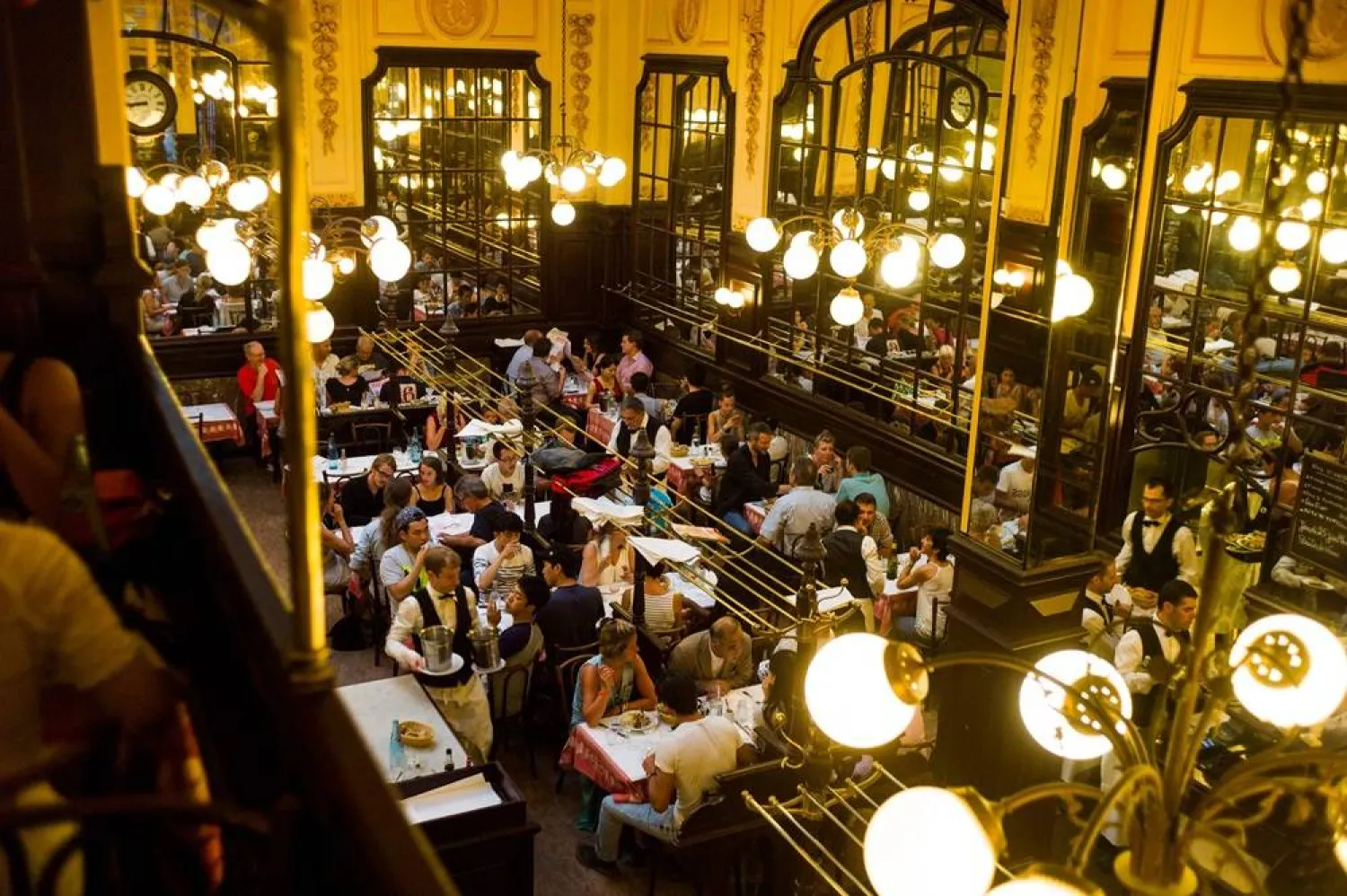
A general view shows the diner room of French brasserie Bouillon Chartier, on July 24, 2013, in Paris. (AFP)
TT

How France Fell for Re-imagined 19th-Century Workers’ Canteens

A general view shows the diner room of French brasserie Bouillon Chartier, on July 24, 2013, in Paris. (AFP)

So-called bouillon restaurants are mushrooming all over France, reviving a traditional low-cost Gallic meal concept that can compete with fast-food on prices and easily beat it on quality.

"It's exploding! 253 bouillon restaurants have opened in France in four years," Bernard Boutboul, a restaurant consultant, told AFP.

"It's an ultra-intensive expansion, driven by a trend of returning to traditions, with the reappearance of iconic French dishes at very low prices."

Created in the 1850s by the butcher Adolphe-Baptiste Duval to fill workers' stomachs with hearty meals, Duval's ran 250 restaurants in the capital by the turn of the 20th century.

That made them France's first mass chain of restaurants, serving traditional recipes at low prices in high-volume and bustling restaurants.

But as eating habits changed, with higher quality and more expensive brasseries dominating the French food market, and international and fast-food trends appearing, the bouillon concept fell out of favor.

Its revival began in 2005 with the resurrection of the Bouillon Chartier, an ornate Parisian landmark that had been slowly fading.

"A bouillon is the gateway to French gastronomy," explained Christophe Joulie, part of the gastronomic family who took over the Chartier.

He modernized the kitchens and put beef bourguignon with macaroni back on the menu.

"For me, you have to be able to have a starter, main course and dessert for under 20 euros," he said.

With its leek vinaigrette for one euro and bills scribbled on paper tablecloths by apron-clad waiters, the restaurant hums with activity as locals and tourists alike pack out its tables, which crucially cannot be reserved.

"In a world where fast food is taking up more space, it's French-style fast food, because we serve a full dish for less than a sandwich at McDonald's," said Joulie.

- 'Dust off' -

Even multi-Michelin-starred French chef Thierry Marx has got in on the act, attracted by the idea of providing quality food at affordable prices.

He has opened a bouillon in a northern Paris suburb.

"In the 1960s, it took the equivalent of an hour of the minimum wage to eat at a bistro," he told AFP. "Today, with an hour of minimum wage, you only get fast food, something from the bakery -- or a bouillon dish."

Other restaurateurs with a keen eye for the market have sensed an opportunity.

"We looked at needs and changing habits and realized there was demand for intergenerational social spaces with no price-based exclusion," Enguerran Lavaud, director of Groupe Bouillon Restaurants, told AFP.

"I wanted to dust off the bouillon -- its mass-market French dishes available from noon to midnight."

Boosted by its Instagram presence, his Bouillon Pigalle now serves 2,300 customers a day, often with long queues along the pavement.

Since 2017, the concept has spread, attracting more and more restaurateurs across France from Angers to Nancy and Toulouse.

Some are adapting the concept.

In the Romainville suburb northeast of Paris, a family of Mauritian origin took over a large brasserie in 2026 to turn it into a "Mauritian-style bouillon".

There is an Italian bouillon in Paris too.

Industry insiders say they do not fear competition around what has become a "bouillon culture".

"But there are bouillons and bouillons: those that can't sustain the low prices over time, and whose menus change all the time, won't make it to 2027 or 2028 because you have to protect the quality of the experience to protect volume - and therefore prices," warned Lavaud.

According to consultant Bernard Boutboul, you specifically need "at least 300 seats and not exceed an average bill of 18 euros".



Rare 19th-Century Octagonal Quran Goes on Display at Makkah’s Holy Quran Museum

The manuscript, featuring a unique octagonal design and compact size, was written in India during the 19th century. (SPA)
TT

Rare 19th-Century Octagonal Quran Goes on Display at Makkah’s Holy Quran Museum

The manuscript, featuring a unique octagonal design and compact size, was written in India during the 19th century. (SPA)

The Holy Quran Museum in Makkah is showcasing a rare and unique historical Quran written in India during the 19th century, reported the Saudi Press Agency on Sunday.

The manuscript features a unique octagonal design and compact size, offering easy portability while reflecting a blend of practicality, artistic precision, and innovation in Quranic production.

The exhibit supports the museum’s mission to educate visitors about the history and evolution of Quranic calligraphy, while contributing to the growing cultural and tourism landscape of the Hira Cultural District and reinforcing Makkah’s global cultural significance.


AlUla Marks World Heritage Day, Showcases Millennia of Human Civilization

AlUla remains committed to the preservation of its archaeological sites and inscriptions through specialized restoration and rehabilitation projects - SPA
TT

AlUla Marks World Heritage Day, Showcases Millennia of Human Civilization

AlUla remains committed to the preservation of its archaeological sites and inscriptions through specialized restoration and rehabilitation projects - SPA

AlUla Governorate is celebrating World Heritage Day, observed annually on April 18, by showcasing a historical legacy spanning thousands of years as a crossroads of ancient civilizations and a living testament to cultural continuity and architectural development, reinforcing its status as a premier global cultural center, SPA reported.

The governorate is home to landmarks of universal value, most notably Hegra, the first Saudi site inscribed on the UNESCO World Heritage List.

Other significant sites include AlUla Old Town, featuring over 900 traditional mud-brick houses that reflect the region's historical social fabric and unique architectural heritage.

AlUla remains committed to the preservation of its archaeological sites and inscriptions through specialized restoration and rehabilitation projects.

These efforts ensure the sustainability of its heritage for future generations, aligning with international standards for protecting human history and promoting global cultural awareness.


UK Proposal to Charge Tourists to Visit Museums Sparks Backlash

FILE PHOTO: People walk in front of the British Museum in London, Britain, September 28, 2023. REUTERS/Hollie Adams/File Photo
TT

UK Proposal to Charge Tourists to Visit Museums Sparks Backlash

FILE PHOTO: People walk in front of the British Museum in London, Britain, September 28, 2023. REUTERS/Hollie Adams/File Photo

Britain is considering introducing entry fees for tourists visiting some of England's most renowned museums, a proposal that has drawn criticism from restitution groups and countries while disputed artefacts remain on display.

Free admission to Britain's national museums and galleries was introduced in 2001 by former Labour Prime Minister Tony Blair in a bid to make culture more accessible to all.

Last month, the UK government said it would work with the museum sector to explore the potential benefits of charging international visitors at ⁠national museums, including how ⁠this could support the arts sector. It would provide an update of the consultation before the end of the year, it said.

However, the proposal is facing backlash amid growing calls worldwide for artefacts to be sent back to their communities or countries of origin, Reuters reported.

Although some efforts have been made to confront the long-standing issue, artifacts as well as human ⁠remains taken during the colonial era are still held in various museums across Europe. Some long-standing claims for artifacts involving the British Museum include Greece's Parthenon Sculptures, known as Elgin marbles, and Nigeria's Benin Bronzes.

The British Museum has previously said that the strength of its collection lies in enabling millions of visitors to understand the world's cultures and how they are interconnected.

Ghana, which has some of its regalia and other artifacts in British institutions, said charging foreign visitors to view such objects raises issues of "fairness," particularly where restitution discussions remain ongoing, ⁠foreign minister ⁠Samuel Okudzeto Ablakwa told Reuters.

The proposal, if implemented, would be "unethica," said Eric Phillips, vice chair of the Caribbean Community's reparations commission, a bloc of 15 member states including Jamaica and Barbados.

"Why should we have to pay to see our heritage?" Phillips said.

Arley Gill, chairman of Grenada's national reparations committee, said the priority should be to return the artifacts to their "rightful owners."

Open Restitution Africa (ORA) said Africans and others already face barriers to accessing artifacts taken from their countries and held in Western museums, including visa requirements and travel costs.

"Introducing entry fees further compounds these inequalities," ORA said.

Meanwhile, the US-based non-profit Restitution Study Group said a fee exemption for such visitors would be a "meaningful gesture."

The government declined to comment on the criticism.