
Ukrainian Haiku Poet Finds Small Miracles in War

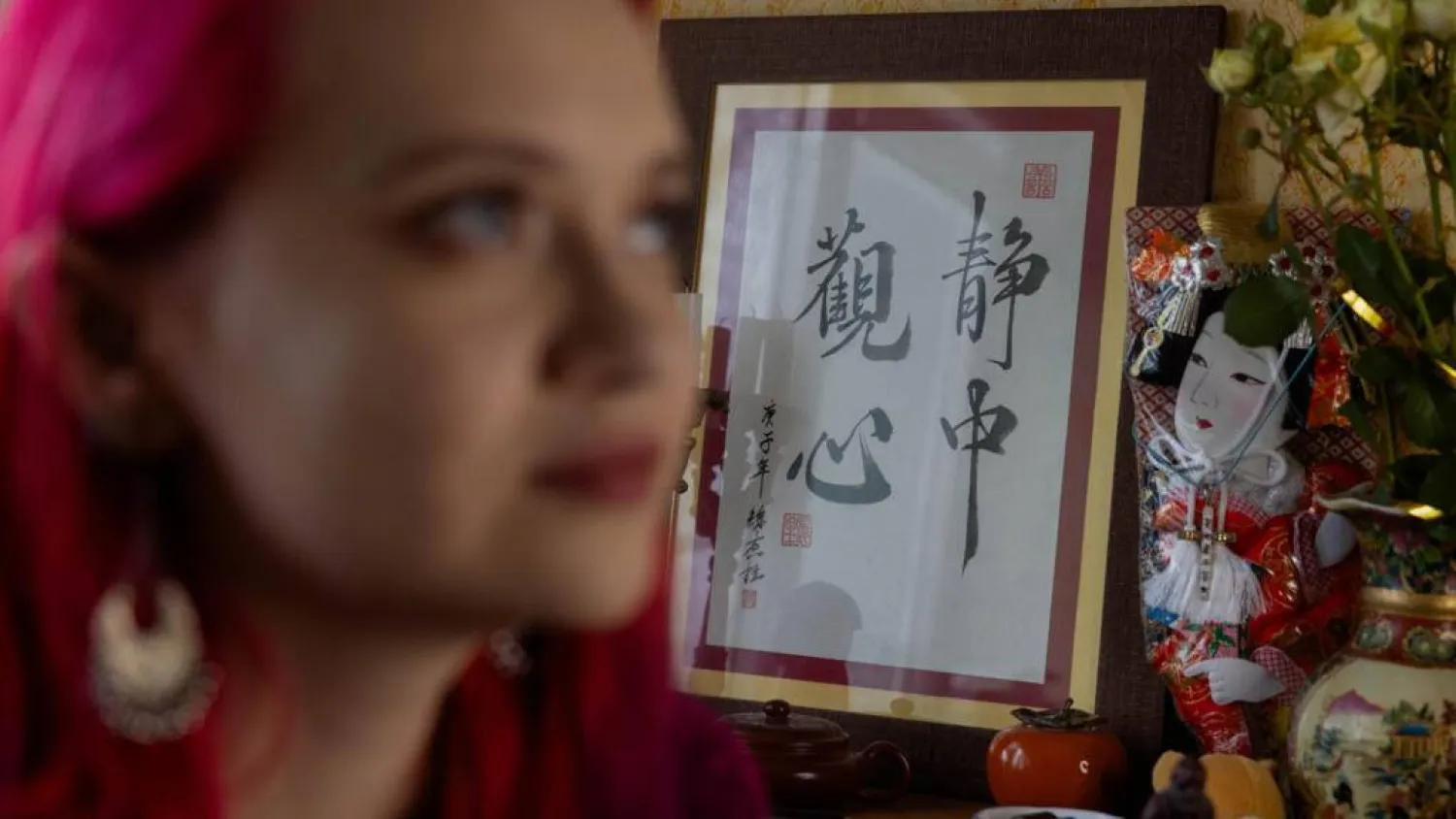
For Vladislava Simonova, haiku is a way of finding poetry in ordinary moments. Tetiana DZHAFAROVA / AFP
TT

Ukrainian Haiku Poet Finds Small Miracles in War

For Vladislava Simonova, haiku is a way of finding poetry in ordinary moments. Tetiana DZHAFAROVA / AFP

A temperamental lift leads to the apartment in central Ukraine of a 27-year-old poet celebrated in Japan but almost unknown in her own country.

With pink hair, fuchsia sweater and matching socks, Vladislava Simonova tells the story of her burgeoning career 7,800 kilometers (4,850 miles) away in a country she has never visited.

But here in the central Ukrainian city of Poltava, she lives near a trolleybus depot, which is just one of the sites targeted by Russian drones whose constant buzzing puts her on edge.

Just as she mentions the word "explosion" to describe the terror of Russian strikes, a drone whizzes overhead and explodes in the distance.

Next to her, a shelf holds 15 books with colorful spines -- a collection of contemporary Ukrainian poets -- two Japanese teapots, three religious icons and a figurine of Phoebe Buffay from the series "Friends".

"I never thought that I would be writing about war," she told AFP.

"With time, I somehow came to realize that ... tiny details can convey the tragedy of this great war much better than perhaps dozens of reports," she added.

Simonova is among a whole generation of artists bearing witness to the invasion that has devastated Ukrainian cultural life.

Simonova said she discovered haiku -- her preferred form -- in 2013, when she was a teenager.

The three-line poems, made up of 17 syllables in a 5-7-5 pattern, were codified in 17th-century Japan to capture the beauty of nature, daily life and fleeting moments with simplicity.

For years, she studied the Japanese masters -- Basho, Buson, Issa -- and wrote more than 600 haiku which, she said, gradually became less "clumsy":

He walks so proudly,

On soft apricot petals

This plump little cat.

24.04.2015

Not bothered by rain,

I tremble my way back home

With a pine sapling.

16.10.2014

- 'Communion' -

In 2018, Simonova won a competition organized by a Japanese foundation.

When Russia launched its full-scale invasion in February 2022, she was living in Kharkiv.

Russian forces tried to seize the northeastern city and have been shelling it constantly since being pushed back.

For three months when Russian troops first crossed the border, she survived by living in an underground shelter.

Instead of a storm --

The rumbling of explosions.

Springtime has arrived.

14.05.2022

A house in ruins.

Through the hole in the rooftop,

Stars are glimmering.

14.05.2022

In March 2022, from her shelter, Simonova gave a written interview to Japan's The Asahi Shimbun newspaper.

A few weeks later, renowned poet Madoka Mayuzumi got in touch.

She told AFP that Simonova has a "deep understanding" of the essence of haiku.

"Even in the midst of war, she gazes up at the moon and stars and admires flowers... her haiku reflect a communion with nature," Mayuzumi said.

"Despite the themes that tend to be sombre, her work possesses a sense of optimism," Mayuzumi added.

Bees oblivious

To the air-raid siren's sound.

Linden trees in bloom.

19.06.2022

With around 10 others, Mayuzumi helped Simonova translate and publish her first collection in Japan in 2023.

The book received "very high praise", Mayuzumi said.

Throughout Japan's history, she added, people have written haiku in dark times, including after the 1945 atomic bombings and the 2011 tsunami.

- 'Cherry blossoms' -

In August 2022, the underground shelter in Kharkiv where Simonova had lived was destroyed by a Russian missile. She moved to Poltava.

She published a second collection in Japan in 2024, followed by another in Denmark in early 2026.

She dreams of publishing one in Ukraine.

Before the war, she wrote in Russian. She later switched to Ukrainian.

The translation of the poems was complex. The two related languages often use words of different lengths -- "umbrella", for example, is one syllable in Russian, but four in Ukrainian.

Simonova does not read prose, "only poetry". And the Bible. She belongs to Poltava's tiny Catholic community.

During AFP's visit, she suggests going to the park, says goodbye to her husband -- who stays at home -- before hurrying down the stairs of her Soviet-era apartment block. The lift was not working.

It is a cold spring Sunday and the park is almost empty. She sits on a tree branch near a pond, wearing a multicolored puffer jacket.

Since childhood, Simonova has suffered from a serious heart condition that leaves her exhausted.

She discovered haiku in a hospital, in an anthology that also contained "Persian poems".

As the wind blows, she stands up and reads aloud for the first time in public, reciting each poem twice.

The first is for friends no longer around:

They scatter away

Like cherry blossoms in wind,

People I hold close.

The second is a memory of Kharkiv.

I clutch in my palm

Some fragments of a missile.

The pain stays with me.

She leafs through her pink-covered collection, then chooses one last poem.

What a sky it is!

And yet from that very sky

Missiles fall on us.


Elizabeth Blackadder Exhibition Reveals Wintry Tuscan Landscapes

"Winter Hillside", circa 1955-56, is one of the works to be exhibited at the Jenna Burlingham Gallery. (Jenna Burlingham Gallery)
TT

Elizabeth Blackadder Exhibition Reveals Wintry Tuscan Landscapes

"Winter Hillside", circa 1955-56, is one of the works to be exhibited at the Jenna Burlingham Gallery. (Jenna Burlingham Gallery)

She may be best known for accessible paintings of flowers and cats, but a new exhibition of Elizabeth Blackadder’s work focuses instead on chilly landscapes and pared-back still life compositions.

The show in Hampshire, far from Blackadder’s Scottish home, presents a less familiar side of the artist, with most of the pieces exhibited for the first time, reported The Guardian.

Earlier works include a series of Italian landscapes rendered in gouache and watercolor in the 1950s soon after Blackadder left art college. The still life oil paintings are from the 1960s and 1970s.

The art writer and editor Anna Brady said Blackadder, who died in 2021 aged 89, painted the Italian landscapes after winning a travelling scholarship.

Writing in the show’s catalogue, she said: “Based in Florence, Blackadder would take a bus out into the countryside to paint. While we may have romantic ideals of painting trips to Tuscany, the reality of being a young woman, painting outside and alone, through a bitter winter in postwar Italy would have been altogether harsher. We can almost feel the chill on her fingertips in the group of inky Tuscan landscapes.”

In the later still life paintings, personal objects, such as a coffee pot, appear time and again.

Brady said: “Blackadder seems to gain confidence in doing more with less, her compositions becoming increasingly refined and pared back to the essentials.”

The gallery director, Jenna Burlingham, said: “What makes this exhibition so exciting is that it shines a light on works from the first two decades of Elizabeth Blackadder’s career.”


Architecture of the Prophet’s Mosque Exhibition Showcases Its Historical Development Across the Ages

The Exhibition of the Architecture of the Prophet’s Mosque in Madinah is a cultural and educational platform that introduces visitors to the history of the Prophet’s Mosque. (SPA)
TT

Architecture of the Prophet’s Mosque Exhibition Showcases Its Historical Development Across the Ages

The Exhibition of the Architecture of the Prophet’s Mosque in Madinah is a cultural and educational platform that introduces visitors to the history of the Prophet’s Mosque. (SPA)

The Exhibition of the Architecture of the Prophet’s Mosque in Madinah is a cultural and educational platform that introduces visitors to the history of the Prophet’s Mosque and the various stages of its expansion over time, the Saudi Press Agency said on Tuesday.

Through interactive content, it showcases the mosque’s architectural evolution across different Islamic eras, highlighting the historical and architectural significance of this great Islamic landmark.

The exhibition features several interactive screens that enable visitors to access historical information and architectural details of the Mosque, alongside displays of its most prominent landmarks and facilities using modern techniques that enrich the visitor experience and deepen their understanding of the mosque’s history and its significance in Islam.

The exhibition also includes a dedicated hall featuring valuable historical artifacts documenting the different stages of the mosque’s architecture throughout the ages, as well as scale models illustrating the historical phases and expansions the mosque has undergone from its establishment to the present day.

The exhibition is located in the courtyards of the Prophet’s Mosque, at the southern courtyard exit near gates (308) and (309). It welcomes visitors daily, to explore exhibits that document the architectural history of the Mosque and showcase key aspects of Islamic architectural heritage connected to this significant religious landmark.


Egypt Unveils a Striking Trove of Ancient Artifacts as the Country Tries to Boost Tourism Industry

 In this photo provided by Ministry of Tourism and Antiquities, recently unearthed ancient artifacts are displayed on May 31, 2026, in Ehnasiya district in Beni Suef, 130 kilometers (80 miles) south of Cairo, Egypt. (Ministry of Tourism and Antiquities via AP)
In this photo provided by Ministry of Tourism and Antiquities, recently unearthed ancient artifacts are displayed on May 31, 2026, in Ehnasiya district in Beni Suef, 130 kilometers (80 miles) south of Cairo, Egypt. (Ministry of Tourism and Antiquities via AP)
TT

Egypt Unveils a Striking Trove of Ancient Artifacts as the Country Tries to Boost Tourism Industry

 In this photo provided by Ministry of Tourism and Antiquities, recently unearthed ancient artifacts are displayed on May 31, 2026, in Ehnasiya district in Beni Suef, 130 kilometers (80 miles) south of Cairo, Egypt. (Ministry of Tourism and Antiquities via AP)
In this photo provided by Ministry of Tourism and Antiquities, recently unearthed ancient artifacts are displayed on May 31, 2026, in Ehnasiya district in Beni Suef, 130 kilometers (80 miles) south of Cairo, Egypt. (Ministry of Tourism and Antiquities via AP)

Archaeologists unearthed a set of ancient artifacts in Egypt including Pharaonic funerary furniture, remains of a Roman basilica and a marble head of Aphrodite, the ancient Greek goddess of love and beauty.

The discoveries, announced Sunday, are part of the Egyptian government’s efforts to boost the country’s tourism industry and bring cash to the economy. At the center of these efforts was the November inauguration of the long-delayed Grand Egyptian Museum, a megaproject located near the famed Giza Pyramids and the Sphinx.

The remains of the basilica and Aphrodite’s head were found in an ancient necropolis in the province of Beni Suef, 130 kilometers (80 miles) south of Cairo, the Tourism and Antiquities Ministry said.

The Ehnasiya necropolis, which is also known by its ancient Roman name, Heracleópolis Magna, was one of the most significant cities of ancient Egypt.

Archaeologist Mohammed Abdel-Badei, head of the antiquities department at the Supreme Council of Antiquities, said that they found large stone blocks supporting columns, weighing up to 45 tons, that had been used in building the basilica. Three of the blocks remain standing in their original positions, he said.

Aphrodite’s head, measuring about 24 centimeters by 25 centimeters (9½ inches by nearly 10 inches), includes detailed features of the goddess' face and curly hair, reflecting the classical artistic traditions of the Greek and Roman periods, he said.

In this photo provided by Ministry of Tourism and Antiquities, recently unearthed ancient artifacts are displayed on May 31, 2026, in Ehnasiya district in Beni Suef, 130 kilometers (80 miles) south of Cairo, Egypt. (Ministry of Tourism and Antiquities via AP)

Archaeologists found inscriptions linked to Senusret III, who ruled between 1837 B.C. and 1819 B.C. during the ancient 12th Dynasty. The inscriptions include his throne, birth names of the Pharaoh, who is also known as Sesostris III, and was one of the most prominent rulers of Egypt’s Middle Kingdom.

Also unearthed were fragments of wall statues and terracotta molds, believed to have been used in coin crafting during the Roman period.

The findings show that Ehnasiya had been an active economic and commercial hub when Egypt was part of the Roman Empire between 30 B.C. and A.D. 395, Abdel-Badei said.

New findings in the ancient city of Heliopolis

In Cairo, archaeologists found a nearly complete set of funerary furniture in the Matariya neighborhood of Cairo, which was once part of the ancient city of Heliopolis, the ministry said.

Abdel-Badei, the head of the antiquities department, said that they unearthed a mudbrick burial with gilded remains in a coffin, believed to be for a military figure. They also found a cache of cosmetic tools, including a copper mirror and alabaster kohl containers.

Also found was a collection of yellow-colored metal earrings, consisting of five pairs of varying sizes, believed to be made of gold, he said.

The discoveries in Beni Suef and Cairo are the latest archaeological findings, which the government hopes will boost the vital tourism sector, partially driven by antiquities sightseeing.

A record number of about 19 million tourists visited Egypt last year, a 21% increase from 2024, according to official figures. The first four months of 2026 saw 6.1 million tourists visiting the country, compared with 5.7 million during the same period in 2025, the prime minister’s office said in May.