



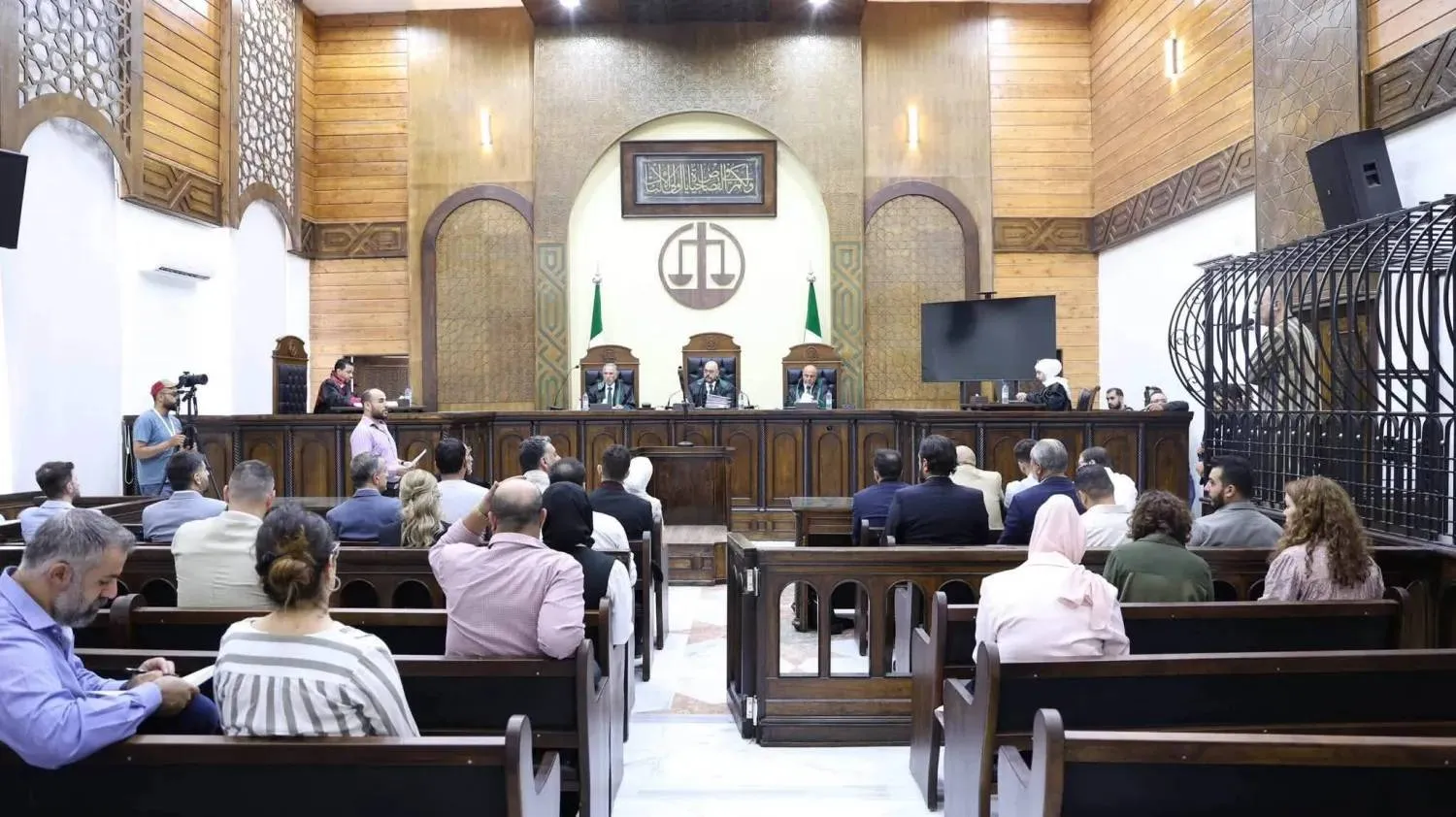

Atef Najib denied all charges against him during the fifth closed-door session of his trial before Damascus’ Fourth Criminal Court, which adjourned proceedings until the 21st of this month.
Tuesday’s session was devoted to hearing witnesses for the public prosecution and civil claimants, amid reports that the defense lawyer retained by Najib had faced public pressure.
Fadel Abdulghany, chairman of the Syrian Network for Human Rights, who attended the hearing, said the court heard 14 testimonies from people who said they had been directly subjected to abuses by Najib.
As in the previous hearing, Najib denied responsibility for all charges against him.
Abdulghany said the next session would continue hearing witnesses. More than 51 claimants have joined the case, requiring the court to hear further testimony and examine documents and other evidence related to the charges.
Najib had denied the accusations during earlier sessions, saying he was not in Daraa when the Omari Mosque was stormed. He also denied that the Political Security branch he headed had detained children.
The fifth session was presided over by Judge Fakhreddin Mustafa al-Aryan, alongside judges Abdul Hamid Mohammed al-Hamoud and Hossam Hussein Abdul Rahman. Judge Omar Mahmoud al-Radi attended as the representative of the public prosecution.
Relatives of victims from Daraa province also attended, along with members of the National Commission for Transitional Justice, representatives of the United Nations Office of the High Commissioner for Human Rights, the Syrian Network for Human Rights, activists and representatives of international and official bodies following the proceedings.
Syrian Bar Association President Mohammed Ali al-Tawil told Asharq Al-Awsat that Najib’s trial was Syria’s first and most prominent transitional justice case and carried significant symbolic importance.
He said the bar association was closely following the proceedings, which he described as moving in a “good, smooth, lawful and positive manner,” despite the abuses suffered by Syrians under the former government and at Najib’s hands.
Al-Tawil said the first session was devoted to preliminary questioning, while the indictment was read during the second and Najib was allowed to respond.
The third, fourth and fifth sessions were devoted to hearing public prosecution witnesses. Around 35 testimonies have been heard, and the court will continue hearing witnesses at the next session.
Should the defense call witnesses, Najib’s lawyer will submit their names to the court, which will decide whether to hear their testimony, al-Tawil said.
He said the defense lawyer, a member of the Quneitra branch of the bar association, had come under considerable pressure for representing Najib.
The association supported the lawyer “to guarantee the defendant’s right to a defense, which is protected by law,” al-Tawil said, despite its conviction that Najib had played a prominent role in events in Syria in 2011.
He said a criminal court could not be properly constituted without a defense lawyer and that the bar association would appoint one if none were retained.
Al-Tawil said Syrian trials had undergone a significant qualitative transformation, citing the assessment of representatives of United Nations organizations monitoring Najib’s trial.
Hearing public prosecution witnesses is a key stage in criminal proceedings and one of the means of evidence used by the court in reaching its judgment. The court examines testimony alongside documents and other evidence in the case file, while guaranteeing the defense the right to question witnesses.
Ahead of the fifth session, the Justice Ministry released video clips of testimony given during previous hearings. The witnesses’ faces and identities were concealed in coordination with the witness protection program.
The testimony included details of torture and physical abuse suffered by detainees, particularly in the 2011 case involving children in Daraa, and Najib’s alleged responsibility.
Najib was a Political Security officer with the rank of brigadier general and is a maternal cousin of Bashar al-Assad. He served at several Political Security branches in Damascus and Tartous before becoming head of the branch in Daraa.
His name became associated with the detention of children accused of writing anti-government slogans on school walls at the start of the uprising in Daraa.


