


'All These Rashes': Chickenpox Surges in Gaza Camps

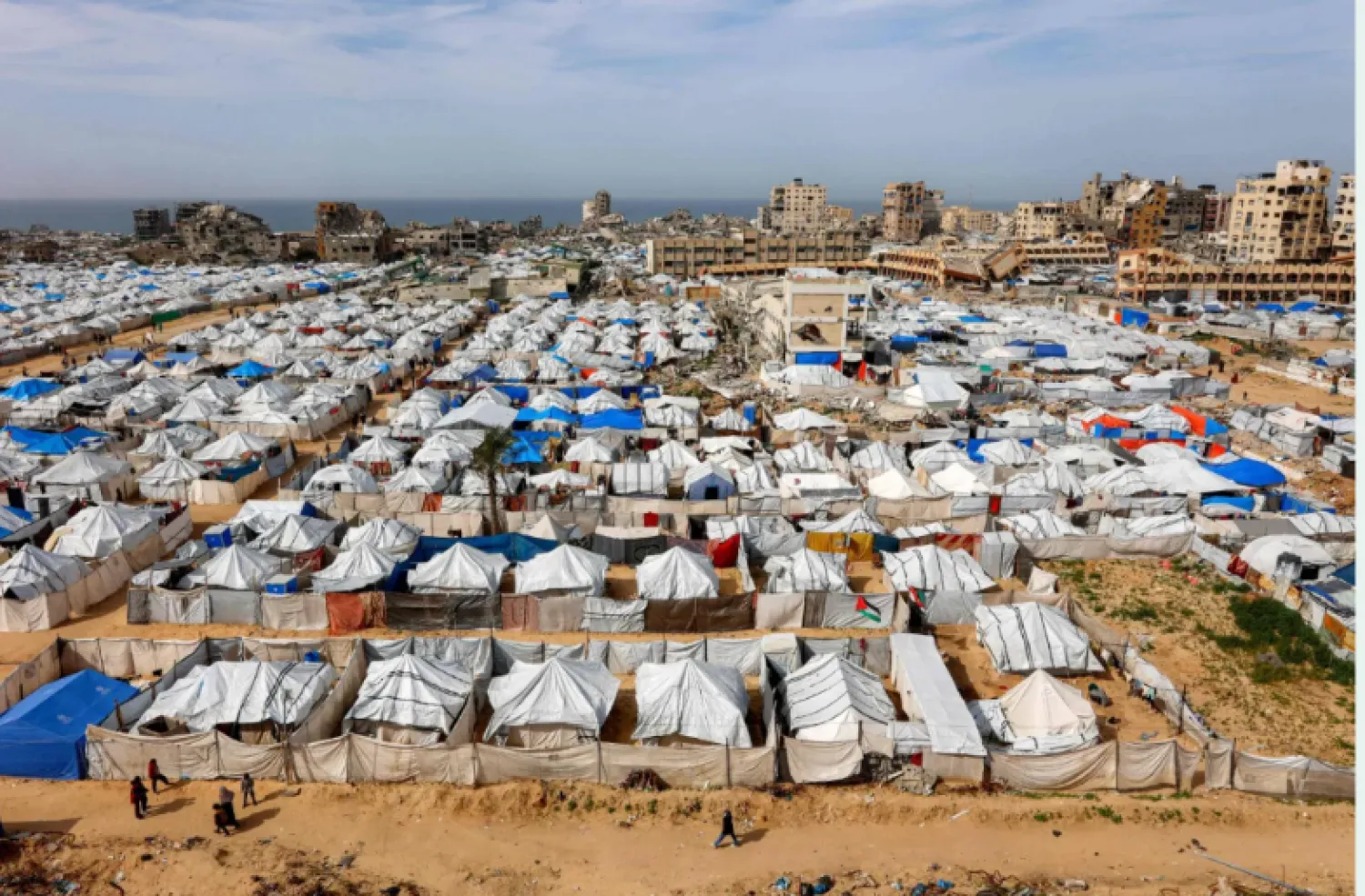
Tents of displaced Palestinians in Gaza City last February (AFP)
TT

'All These Rashes': Chickenpox Surges in Gaza Camps

Tents of displaced Palestinians in Gaza City last February (AFP)

Eight-year-old Ruba Saadeh spends her days confined to the tent she shares with her family in Gaza, her body dotted with inflamed red blisters as chickenpox sweeps through overcrowded camps like the one they live in.

Doctors and displaced families in Gaza say the highly contagious disease has surged in recent months as war has forced hundreds of thousands of Palestinians into cramped tent camps with no clean water for hygiene.

"The doctor told us she needs daily cleaning and should be isolated for 20 days," Ruba's 19-year-old sister Alaa told AFP. "But how can we isolate her? We all live in one tent."

UNICEF said health officials had already recorded more than 9,300 suspected cases of chickenpox across Gaza in early July, concentrated mainly in Khan Yunis in the south.

"That's the most densely-populated area in the Gaza Strip... families are sheltering almost on top of each other," spokeswoman Louise Wateridge told AFP.

- Impossible to isolate -

Raed Abdel Karim Abu Sariya, a dermatologist with the Palestinian Red Crescent Society, said that a lack of space to isolate patients is fueling the spread.

"Chickenpox patients must be isolated because the disease spreads through respiratory infection," he said.

But in Gaza's camps, he said, separating the sick from the healthy is virtually impossible.

"Imagine 10, 15 or even 20 people living in a small tent. Where can they isolate a patient?" he said, as he diagnosed a child who had red blisters on his stomach.

AFP footage from Gaza City shows stagnant pools of murky water full of garbage surrounding makeshift shelters, while children walk barefoot between rows of tents.

Outside a Palestinian Red Crescent medical center, patients queued for treatment as Abu Sariya examined child after child with the telltale rash.

Alaa, Ruba's sister, blamed the spread of the illness on "overcrowding in the tents, and the fact that we only get water once a week, and it's salty and not clean".

Alaa said the family also struggles to obtain basic cleaning products.

While in wealthier nations chickenpox can be seen as an unpleasant but manageable milestone in a child's life, the insalubrious conditions in Gaza's camps make it very difficult for patients and their families to prevent its spread or deal with symptoms.

"We have been living through three years of war. My father is unemployed and we cannot afford to buy cleaning materials," Alaa said.

- Can't sleep 'among rodents' -

For families like the Saadehs, even basic precautions have become luxuries.

"What did we do to deserve living like this?" Ruba demanded. "We have all these rashes."

"I used to shower every day," she told AFP. "Now there is no soap, no shampoo, no detergent... We live in tents, and I can't sleep because of the rats."

Medics say the outbreak underscores the mounting public health challenges facing Gaza's displaced population, where preventing infection has become as difficult as treating it.

International aid organizations have repeatedly warned that medical supplies remain grossly inadequate.

"Chickenpox is one part of it but there's also respiratory infections, watery diarrhea, we've now got more than half of households reporting skin diseases, fleas, lice, scabies," said Wateridge.

"There's an increasing number of children that are requiring hospitalization, but this is while Gaza's health system is on the brink of collapse."

Gaza's health care system has been severely damaged during the two-year war between Israeli forces and the Palestinian movement Hamas, with Israel targeting medical facilities it accuses of sheltering militants.

"When we're talking about chicken pox or any of these diseases, it's not gonna go away unless you solve the causes, the root causes of the situation," said Wateridge, calling for more medicine to be allowed into the territory.

"There has to be space for people to live and not to be sleeping on the floor, not to be sleeping among these rodents."

Israel’s Ben-Gvir Advocates Killing ‘30 to 40’ People in Gaza Nightly While Speaking to Ex-Hostage

Thousands of makeshift tents of displaced Palestinian families are put up on the beach in western Gaza City, Gaza Strip, 14 August 2026. (EPA)
TT

Israel’s Ben-Gvir Advocates Killing ‘30 to 40’ People in Gaza Nightly While Speaking to Ex-Hostage

Thousands of makeshift tents of displaced Palestinian families are put up on the beach in western Gaza City, Gaza Strip, 14 August 2026. (EPA)

An extremist Israeli lawmaker in Prime Minister Benjamin Netanyahu's coalition publicly advocated for killing “30 to 40” people in Gaza each night, comments that surfaced Sunday and were quickly shared by Palestinian media.

Minister of National Security Itamar Ben-Gvir made the statement while speaking to a former Gaza-held hostage, Rom Braslavski, on Braslavski's podcast. The two were discussing Israel's recovery from the Hamas attack of Oct. 7, 2023, when Ben-Gvir criticized Israel's recent drawdown of strikes in Gaza.

“It’s no secret, I disagree with the prime minister,” he said. “I think targeted assassinations should be carried out in Gaza, taking down 30 to 40 every night. Not just those who pose an immediate threat — there are people there who are not worthy of life. They shouldn’t live. They’re not even people.”

In the past, similar statements by Ben-Gvir and other Israeli officials were widely condemned. Many have been presented to the UN’s world court as evidence of genocidal intent. Israel denies it has committed genocide in Gaza.

Israel’s domestic media has made scarce mention of the statement, highlighting how once-fringe ideologies like Ben-Gvir’s are surging in the leadup to Israeli elections Oct. 27.

Figures like Ben-Gvir have become more popular among Israelis since Hamas’ brutal attack in 2023, when the fighters killed about 1,200 people and took 251 hostage. Many hostages have recounted long-term starvation, physical and psychological abuse and, in some cases, sexual abuse.

Ben-Gvir does not have power over the country’s military and cannot order strikes on Gaza. But, after operating for decades within Israel's far-right fringe, he is now one of the most influential people in the country.

He has substantial control over key parts of Israel’s security apparatus, running the country’s prisons — where thousands of Palestinians from Gaza and the West Bank are incarcerated — as well as the national police force.

He has previously boasted of lessening food rations for Palestinian prisoners. Israel’s top court ruled in 2025 that the prison service under Ben-Gvir was depriving Palestinians of a minimum subsistence diet.

Ben-Gvir criticizes drawdown of Israeli strikes in Gaza

Until recently, Israel was striking Gaza nearly every day, attacks that have killed over 1,250 people since an October truce deal came into effect, according to Gaza’s Health Ministry.

Israel's military, which says the strikes have targeted Hamas fighters, appeared to ease off on the attacks in a quiet concession to US President Donald Trump after Netanyahu rejected the president’s latest attempt to move the truce forward.

Israeli media last week reported that the authority for carrying out strikes has now been limited to the army’s chief of staff, raising the ire of right-wing lawmakers such as Ben-Gvir.

Ben-Gvir advocates mass emigration, expulsion of Palestinians from Gaza

In the same taped appearance, the lawmaker advocated for mass emigration of Palestinians from Gaza — a proposal that international lawyers say could amount to ethnic cleansing — and resettlement of Gaza by Israel.

Twenty years ago, Israel withdrew from the Gaza Strip, dismantling a block of 21 Jewish settlements known as “Gush Katif” and pulling out its forces.

“I see all of Gaza as ours,” said Ben-Gvir in the interview. “Settlements not just in Gush Katif but throughout Gaza, encouraging as much emigration as possible, sending them to their countries, and for the terrorists, no emigration, nothing, just to kill them one by one.”

Trump’s latest proposal involves Hamas gradually giving up its weapons while Israeli forces halt their attacks and begin withdrawing from Gaza. Hamas accepted the deal, although the group linked the surrender of its heaviest weapons to the creation of a Palestinian state, something Israel’s current government and most of its political class adamantly reject.

Netanyahu says Israel will not retreat from any of its positions in Gaza until Hamas has been completely disarmed. The stance leaves other elements of the ceasefire, including the deployment of international forces and any reconstruction of the devastated territory, on hold.


Pope Calls for an End to West Bank Israeli Settler Violence Against Palestinians

Israeli troops arrive during a military raid in the town of Qusra, south of Nablus, West Bank, 16 August 2026. (EPA)
TT

Pope Calls for an End to West Bank Israeli Settler Violence Against Palestinians

Israeli troops arrive during a military raid in the town of Qusra, south of Nablus, West Bank, 16 August 2026. (EPA)

Pope Leo called on Sunday for an end to violence against Palestinians in the occupied West Bank, amid a surge of attacks by militant settlers and a siege in the territory's village of Qusra.

Israeli settlers encircled houses after cutting off water and electricity, in what rights groups have said is a concerted effort to seize more land, ‌and further ‌eat into territory where Palestinians aim ‌to ⁠establish a state.

"I ⁠renew my appeal for an end to the repeated violence against the Palestinian civilian population in the West Bank," the Pope said, without mentioning specific confrontations or attacks.

"I urgently ask the international community to take ⁠action so as to advance the ‌two-state solution, for ‌a fair and lasting peace," the Pope added after ‌noon prayers at his Castel Gandolfo residence ‌outside Rome.

The Vatican has long backed the idea of a future Palestinian state, which has been recognized by more than 150 of 193 ‌UN member states as encompassing the Gaza Strip and West Bank, including East ⁠Jerusalem.

Israeli ⁠Prime Minister Benjamin Netanyahu's right-wing coalition government has overseen massive settlement construction in the West Bank that Finance Minister Bezalel Smotrich says is aimed at burying the idea of such a state.

The United Nations and most governments consider the settlements to be illegal under international law related to military occupation. Israel seized the West Bank in the 1967 war, but argues the territory is disputed rather than occupied.


Egypt’s Sisi Discusses Gaza with Trump Envoy Kushner

Egyptian President Abdel Fattah al-Sisi. (dpa file)
TT

Egypt’s Sisi Discusses Gaza with Trump Envoy Kushner

Egyptian President Abdel Fattah al-Sisi. (dpa file)

US President Donald Trump's envoy and son-in-law Jared Kushner talked with Egyptian President Abdel Fattah al-Sisi on Sunday about the implementation of the Gaza ceasefire, Sisi's spokesperson said.

The meeting in the Mediterranean city of El-Alamein "stressedthe need for all parties to fulfill their obligations under the Gaza Strip ceasefire agreement", spokesperson Mohamed El-Shennawy said in a statement.
