
Baby Moose Trapped in Lake Is Saved by Alaska Man and Police as Its Worried Mom Watches 

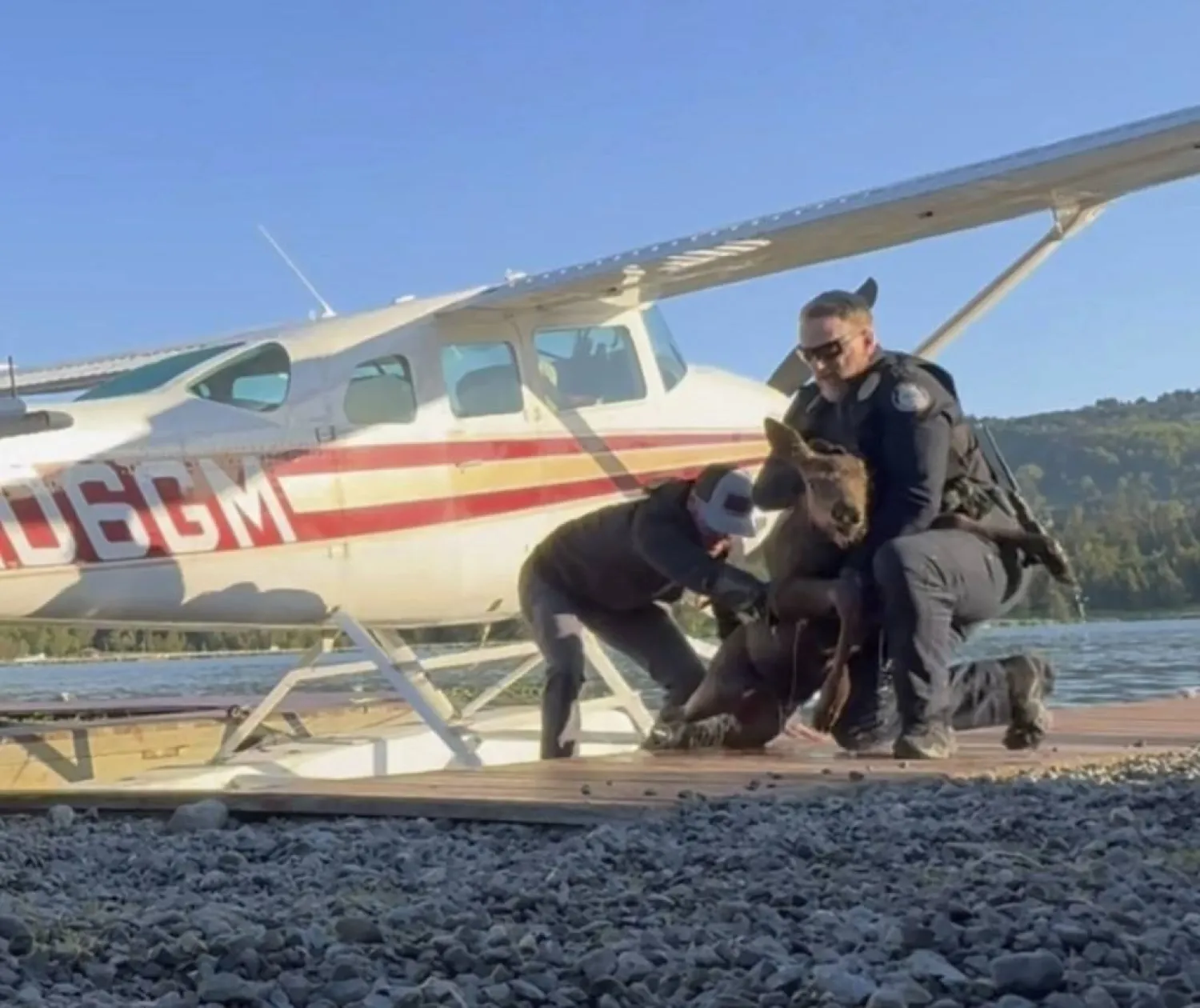
In this image taken from video provided by Spencer Warren, who works for a wilderness guiding service, he arrived about 6:30 a.m. Friday, June 14, 2024, to prepare the floatplane for a client’s trip when he discovered the calf trapped in Beluga Lake in Homer, Alaska. (Spencer Warren via AP)
TT

Baby Moose Trapped in Lake Is Saved by Alaska Man and Police as Its Worried Mom Watches 

In this image taken from video provided by Spencer Warren, who works for a wilderness guiding service, he arrived about 6:30 a.m. Friday, June 14, 2024, to prepare the floatplane for a client’s trip when he discovered the calf trapped in Beluga Lake in Homer, Alaska. (Spencer Warren via AP)

An Alaska man and two police officers rescued a baby moose from what police described as “a sure demise” after it fell into a lake and got stuck in a narrow space between a floatplane and a dock.

Spencer Warren, who works for the outdoor tourism company Destination Alaska Adventure Co., had arrived at work about 6:30 a.m. Friday to prepare a floatplane for the day's trip when he heard what he thought was an odd-sounding bird.

He quickly spotted the moose calf stuck between the floats of the plane and the dock at Beluga Lake in Homer, a Kenai Peninsula community about 220 miles (350 kilometers) south of Anchorage. The floats replace the wheels on a plane, allowing it to take off and land on water.

He immediately thought, “Oh, man, where is mama? I know she's nearby,” before spotting the worried mother about 4 feet (1.2 meters) away with another calf. Mother moose can be dangerously protective of their calves — a photographer was killed by a mama moose protecting her young just last month in Homer.

The baby moose tried to get out of the lake, but couldn't get its footing on the top of the metal float with its hooves. Its wary mother was keeping Warren, the would-be rescuer, from getting too close as it struggled.

“It's like an ice rink for the moose and its hooves,” Warren said of Friday's rescue. “So he just kept slipping and slipping and could not get up.”

Warren checked in with his boss, who called Homer police.

One officer eventually positioned his police cruiser between the mama moose and the floatplane to allow another officer and Warren to rescue the calf, Homer Police Lt. Ryan Browning told The Associated Press.

The calf had one leg outstretched across the top of the plane's float, where it was stuck.

“You know, kind of thankfully, he wasn’t moving so that it made the rescue a little bit easier,” Warren said. “We just lifted him straight out and, put him on the dock there.”

The exhausted calf splayed out on the boardwalk until an officer helped it stand. The calf reunited with its mother and she licked the water off its body — all of it caught on camera by Warren.

“Anytime you can rescue a little critter, it always makes you feel good,” Browning said.


Rover Discovers More Building Blocks of Life on Mars

NASA’s Curiosity Mars rover took this selfie at a location nicknamed “Mary Anning” after a 19th-century English palaeontologist in this image released by the US space agency on Nov 12, 2020. (NASA/JPL-Caltech/MSSS/Handout via Reuters)
TT

Rover Discovers More Building Blocks of Life on Mars

NASA’s Curiosity Mars rover took this selfie at a location nicknamed “Mary Anning” after a 19th-century English palaeontologist in this image released by the US space agency on Nov 12, 2020. (NASA/JPL-Caltech/MSSS/Handout via Reuters)

A NASA rover has discovered more building blocks of life on Mars after carrying out a chemistry experiment never before conducted on another planet, scientists said Tuesday.

The organic molecules are not definitive evidence of past life, the NASA-led team emphasized, because they could also have formed on the red planet or crash-landed on meteorites.

But it proves that these important clues to Martian history have been preserved on the surface for more than three billion years, they added.

Back then, the surface of Mars was thought to have been dotted with huge lakes and rivers full of liquid water, a key ingredient for life as we know it.

NASA's Curiosity rover landed in a former lakebed called the Gale crater in 2012, and has been searching for signs of possible past life since.

The car-sized rover carried two tubes of a chemical called TMAH, which can break apart organic matter to see what it is made out of.

"This experiment's never been run before on another world," Amy Williams, an astrobiologist working on the Curiosity mission told AFP.

The team were under pressure because they only had "two shots to get it right", added Williams, the lead author of a new study describing the results.

The experiment, conducted in 2020, detected more than 20 organic molecules, including several that had never before been confirmed on Mars.

These included a molecule called benzothiophene, which has also been found in meteorites and asteroids.

"The same stuff that rained down on Mars from meteorites is what rained down on Earth, and it probably provided the building blocks for life as we know it on our planet," Williams said.

Another molecule containing nitrogen "is a precursor to how DNA is eventually built," she added.

"We're seeing the building blocks for life -- prebiotic chemistry on Mars -- preserved in these rocks for billions of years."

- Future missions -

But none of this can prove that life -- even tiny, microbial organisms -- once flourished on Mars.

One way to potentially make such an "extraordinary claim" would be to bring some Martian rocks back to Earth so scientists can study them more closely, Williams said.

NASA's Perseverance rover has already collected a bunch of rocks for such a mission, called Mars Sample Return.

However, the mission has effectively been cancelled by the administration of President Donald Trump following a US Congress vote in January.

Future missions could still benefit from Curiosity's demonstration that experiments using the TMAH chemical work on other worlds, the new study in Nature Communications said.

The European Space Agency's Rosalind Franklin rover, which has a much longer drill than Curiosity, will take the chemical to Mars.

After years of delays, NASA announced last week that the ESA's rover is now scheduled to blast off towards the red planet in late 2028.

The chemical will also be on board the Dragon rotorcraft, which is planned to launch in 2028 on a mission to explore Saturn's moon Titan.


Hot Air Balloon with 13 Aboard Makes Emergency Landing in California Backyard

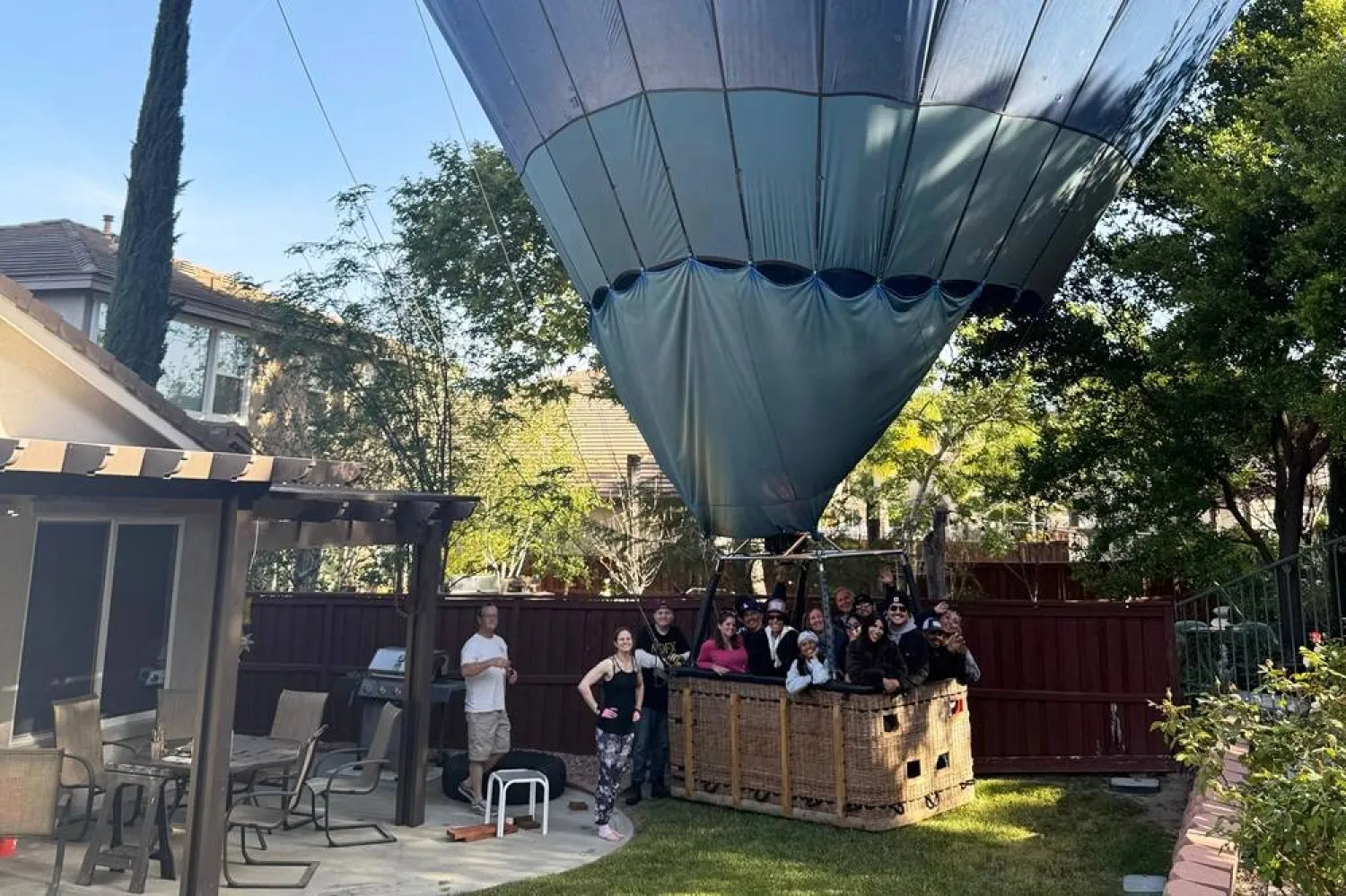
This photo provided by Hunter Perrin shows people riding a hot air balloon posing for a photo after making an emergency landing in Perrin's backyard on Saturday, April 18, 2026, in Temecula, Calif. (Hunter Perrin via AP)
TT

Hot Air Balloon with 13 Aboard Makes Emergency Landing in California Backyard

This photo provided by Hunter Perrin shows people riding a hot air balloon posing for a photo after making an emergency landing in Perrin's backyard on Saturday, April 18, 2026, in Temecula, Calif. (Hunter Perrin via AP)

A balloon landed in a Southern California backyard — a balloon with 13 people.

The enormous hot air balloon, with a pilot and passengers in the basket, descended perfectly Saturday on a small plot of grass at a home in Temecula. Hunter Perrin said he had no idea that he had visitors until a neighbor alerted him.

“I was watching TV and my wife was doing yoga,” Perrin told The Associated Press. “There was a man standing in front of my door saying, ‘They just landed.’ What? I was very confused.”

But there they were, a group of anxious people suddenly relieved to be on solid ground. Perrin's grassy backyard patch is only about 10 feet (3 meters) wide.

“It was unbelievable, like something out of a Disney fairy tale,” Jenna Perrin said. “The balloon didn't hit our house or our trees. It was kissing the fence.”

Brianna Avalos and her husband were riding in the balloon to celebrate their 10th wedding anniversary. She said the pilot informed passengers that he needed to make an emergency landing because of low fuel and a shift in winds.

“At first I was like, ‘Oh my God! We’re in a backyard! This is crazy!’” Avalos told KABC-TV.

The blue balloon with gold stars and a crescent moon image was a spectacle as it came to rest in the backyard, towering over Perrin's home. The pilot disembarked the passengers, returned aloft and then landed the balloon nearby in the street, where it was dismantled.

“He was an amazing pilot,” Avalos said.

Denni Barrett, the owner of Magical Adventure, which provides the balloon rides, declined to identify the pilot but said he had “exercised great judgment” and “done the right thing.”

“Most of our landings are in wine country,” Barrett said, referring to vineyards in California's Riverside County. “Usually they're bigger backyards.”


How a Paris-Area Wildlife Hospital Keeps Rescued Animals Wild

A baby fox is treated at the Wildlife Veterinary Hospital in Maisons-Alfort, outside Paris, April 17, 2026. (AP)
TT

How a Paris-Area Wildlife Hospital Keeps Rescued Animals Wild

A baby fox is treated at the Wildlife Veterinary Hospital in Maisons-Alfort, outside Paris, April 17, 2026. (AP)

A wildlife hospital in a southeastern Paris suburb is a place of no cuddles but lots of care. It helps injured, sick and orphaned animals — often victims of human activity and increasing urbanization — heal so they can return to their natural habitat.

Last week, a female fox cub was found alone in a garden on the city's outskirts, with no sign of her mother nearby. Now a team of volunteers takes care of her around the clock.

“We’ll make sure she’s eating well,” animal caretaker Valentin Delon said. “If that’s not the case, we might provide supplemental bottles to ensure she gains enough weight.”

Over the past year, the Wildlife Veterinary Hospital in Maisons-Alfort has taken in more than 10,400 wild animals, including a wide variety of birds and European mammals such as foxes, deer and hedgehogs.

Like the little brown-furred cub, the animals can easily capture a caretaker's heart, but bonding with humans is not an option when the goal is to eventually return them to the wild.

The baby fox was found by residents who own hunting dogs. Estimated to be about 2 weeks old, she was far too young to survive on her own.

At the Maisons-Alfort hospital, veterinarian Julie Piazza carefully examined her and aside from a minor injury, possibly caused by a wild animal or a dog’s bite, she was found to be in good health.

The cub was fed artificial milk — a product matching the composition of animal-produced milk — and because of that, her abdomen was swollen, Piazza said.

"That’s common in a young one that has had a disruption in its diet,” she added.

Once healed, the animals are transferred to outdoor enclosures and aviaries to prepare for a reintroduction into their natural environment.

Delon, the caretaker, says that “any kind of imprinting” — measures that attach the animals to their caregiver long-term — must be avoided.

“So we don’t cuddle them, we don’t talk to them,” she said. “There’s really a distance to maintain for their own good in the end, so they can be released later.”

Because she is just a cub, once she grows sufficiently, the baby fox will first be transferred to a rehabilitation center and placed with other foxes in an enclosure.

“We can’t just release her into the wild like that,” Delon said. “She really needs to go into an enclosure first, and then gradually we’ll open the door so she can come and go while still being fed. Then we’ll gradually reduce the food, and that’s how we achieve a truly gradual release.”

Juveniles are especially vulnerable

The hospital ran by the Faune Alfort group is the only facility in the greater Paris area that treats a wide range of wild species. Some 86% of its patients are birds.

Last week, there was a swan with a broken wing, injured hedgehogs, dozens of ducklings often found on balconies and elsewhere without parents, and lots of pigeons that are treated just as carefully as rarer birds.

Elisa Mora, head of communications for Faune Alfort, a nonprofit group running the Maisons-Alfort hospital, said a record 200 admissions were reported in a single day last summer. The hospital is mostly financed by donations from individuals and charities, and relies on volunteers to help feed and care for the animals.

April to September is the “juvenile period when wild animals reproduce” and the admissions peak, Mora said.

“Wild animals are already vulnerable, but juveniles even more so,” she said. Those too badly injured or unable to return to the wild have to be euthanized.

Veterinarian Jean-François Courreau launched Faune Alfort in 1987, inspired by students willing to better treat wild animals. Six years later, the idea turned into a proper hospital, hosted by the National Veterinary School of Alfort, established in the 18th century.

“It’s hard to stand by helplessly in front of an animal in distress without being able to do anything,” Courreau said, adding that it's his duty to help as a vet.

When people find a wild animal in distress, they think “I can’t do anything, and the animal is going to die,” he said. “So when they know a care center exists and that they can bring the animal there, it’s a huge relief.”

The vast majority of animals brought to the hospital — as many as 60% to 80% of admissions — are victims of road collisions, animals caught in barbed wire or injured by people using gardening tools or agricultural machinery, among other causes.