
Recent Aviation Disasters Cause Fears About the Safety of Flying

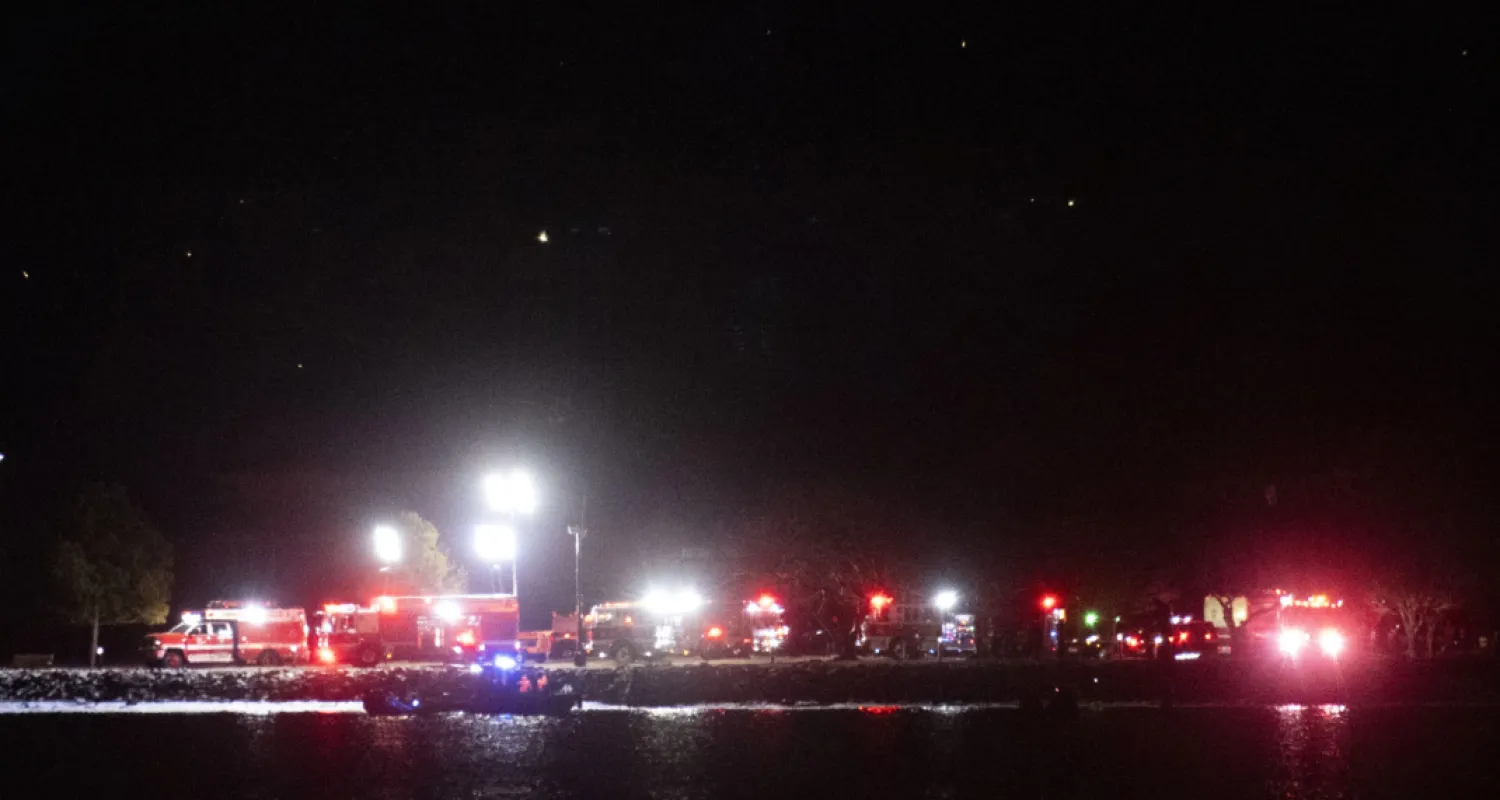
A boat on the Potomac River, cruises past emergency response vehicles seen staging at Joint Base Anacostia Bolling, in the early morning hour, Thursday, Jan. 30, 2025 in Washington, as seen from across the river near Ronald Reagan Washington National Airport in Arlington, Va. (AP Photo/Kevin Wolf)
TT

Recent Aviation Disasters Cause Fears About the Safety of Flying

A boat on the Potomac River, cruises past emergency response vehicles seen staging at Joint Base Anacostia Bolling, in the early morning hour, Thursday, Jan. 30, 2025 in Washington, as seen from across the river near Ronald Reagan Washington National Airport in Arlington, Va. (AP Photo/Kevin Wolf)

The spate of recent aviation disasters and close calls have people worried about the safety of flying.

The midair collision that killed 67 near Washington, the fiery plane crash in Philadelphia and now a missing plane in Alaska are only the most high-profile disasters. There was also a Japan Airlines plane that clipped a parked Delta plane while it was taxiing at the Seattle airport earlier this week and a United Airlines plane caught fire during takeoff at the Houston airport Sunday after an engine problem sparked a fire on the wing.

That's not even to mention the security concerns that arose after stowaways were found dead inside the wheel wells of two planes and aboard two other flights. And don't forget about the time that a passenger opened an emergency exit door on a plane while it was taxiing for takeoff in Boston.

So of course people are wondering whether their flight is safe?

What happened in the worst incidents? The Jan. 29 collision between an American Airlines passenger jet and an Army helicopter killed everyone aboard both aircraft. It was the deadliest plane crash in the US since Nov. 12, 2001, when a jet slammed into a New York City neighborhood just after takeoff, killing all 260 people on board and five on the ground. There hadn't even been a deadly crash of any kind involving a US airliner since February 2009, The AP reported.

Crashes are more common involving smaller planes like the single-engine Cessna that crashed in Alaska on Thursday. Ten people including the pilot were killed.

A medical transportation plane crashed in Philadelphia on Jan. 31, killing the six people onboard and another person on the ground. That Learjet generated a massive fireball when it smashed into the ground in a neighborhood not long after taking off from a small airport nearby.

How worried should I be? Fatal crashes attract extraordinary attention partly because they are rare. The track record of US airlines is remarkably safe, as demonstrated by the long stretch between fatal crashes.

But deadly crashes have happened more recently elsewhere around the world, including one in South Korea that killed all 179 people aboard in December. There were also two fatal crashes involving Boeing’s troubled 737 Max jetliner in 2018 and 2019. And last January, a door plug blew off a 737 Max while it was in flight, raising more questions about the plane.

And federal officials have been raising concerns about an overtaxed and understaffed air traffic control system for years, especially after a series of close calls between planes at US airports. Among the reasons they have cited for staffing shortages are uncompetitive pay, long shifts, intensive training and mandatory retirements.

President Donald Trump added to those concerns Thursday when he blamed the midair collision on the “obsolete” air traffic control system that airports rely on and promised to replace it.

But even with all that, Transportation Secretary Sean Duffy went on Fox News earlier this week and tried to assure viewers that air travel is "way safer than traveling in a car and train. This is the safest mode of transportation.”

And the statistics back that up.

The National Safety Council estimates that Americans have a 1-in-93 chance of dying in a motor vehicle crash, while deaths on airplanes are too rare to calculate the odds. Figures from the US Department of Transportation tell a similar story.

What is being done? The National Transportation Safety Board and Federal Aviation Administration are investigating these recent crashes and close calls to determine what caused them and look for ways to prevent similar incidents.

There have already been troubling revelations about the midair collision, but it will take more than a year to get the full report on what happened.

The NTSB always recommends steps that could be taken to prevent crashes from happening again, but the agency has a long list of hundreds of previous recommendations that have been ignored by other government agencies and the industries it investigates.

But Duffy said the public is right to say that crashes like the recent ones are unacceptable. That is why he plans to make sure “safety is paramount” as he leads the agency that regulates all modes of transportation.

“I feel really good about where we’re at and where we’re going and the plans we have in place to make sure we even make the system safer and more efficient than it is today,” Duffy said in the Fox interview.


Cities Around the World Welcome 2026 with Fireworks and Heightened Security

Fireworks are seen over Sydney Harbour during the New Year's Eve midnight display, at Mrs Macquaries Point in Sydney, 01 January 2026. EPA/DAN HIMBRECHTS
TT

Cities Around the World Welcome 2026 with Fireworks and Heightened Security

Fireworks are seen over Sydney Harbour during the New Year's Eve midnight display, at Mrs Macquaries Point in Sydney, 01 January 2026. EPA/DAN HIMBRECHTS

From Sydney to Paris to New York City, crowds rang in the new year with exuberant celebrations filled with thunderous fireworks or light shows, while others took a more subdued approach.

As the clock struck midnight in Japan, temple bells rang and some climbed mountains to see the year’s first sunrise, while a light show with somersaulting jet skis twinkled in Dubai. The countdown to 2026 was projected onto the Arc de Triomphe in Paris, while in Moscow people celebrated in the snow, The Associated Press reported.

In New York City's Times Square, revelers braved frigid temperatures to celebrate with the famed New Year’s Eve ball drop.

In Rio de Janeiro, crowds packed more than 4 kilometers (2 1/2 miles) of the city’s Copacabana Beach for concerts and a 12-minute fireworks show, despite high tides and large waves that rocked barges carrying fireworks.

Other events were more subdued. Hong Kong held limited celebrations following a recent fire at an apartment complex that killed 161 people.

Australia saluted the new year with defiance less than a month after its worst mass shooting in almost 30 years.

Crowds bundled up against the chilly temperatures cheered and embraced as the New Year’s Eve ball covered in more than 5,000 crystals descended down a pole and confetti fell in Times Square.

Revelers wearing tall celebratory hats and light-up necklaces had waited for hours to see the 12,350-pound (5,602-kilograms) ball drop. The festivities also included Tones and I performing John Lennon's “Imagine” just before midnight.

The television hosts interviewed visitors who were attending from such places as Florida, Mexico and South Korea, and read people's wishes for the new year.

A sixth grader from Dallas, Texas, told one of the hosts that he wants to get good grades in 2026 and have a better year.

Police in the city had planned additional anti-terrorism measures at the ball drop, with “mobile screening teams.” It was not in response to a specific threat, according to NYPD Commissioner Jessica Tisch.

Moments after the ball dropped it rose again, sparkling in red, white and blue, to mark the country’s upcoming 250th birthday.

A few miles away in a decommissioned subway station, Zohran Mamdani was sworn in as mayor during a private event just after midnight Thursday.

A heavy police presence monitored crowds watching fireworks in Sydney.

Many officers openly carried rapid-fire rifles, a first for the event, after two gunmen targeted a Hannukah celebration at Bondi Beach on Dec. 14, killing 15.

An hour before midnight, victims were commemorated with a minute of silence, and the crowd was invited to show solidarity with Australia’s Jewish community.

New South Wales Premier Chris Minns had urged residents not to stay away from festivities, saying extremists would interpret smaller crowds as a victory: “We have to show defiance in the face of this terrible crime."

Indonesia scaled back festivities in solidarity with communities devastated by floods and landslides in parts of Sumatra a month ago that killed over 1,100. Fireworks on the tourist island of Bali were replaced with traditional dances.

Hong Kong rang in 2026 without fireworks over Victoria Harbor after the massive fire in November. Facades of landmarks were turned into countdown clocks and a light show at midnight.

And in Gaza, Palestinians said they hope the new year brings an end to the conflict between Israel and Hamas.

“The war humiliated us,” said Mirvat Abed Al-Aal, displaced from the southern city of Rafah.

Around Europe Pope Leo XIV closed out the year with a plea for the city of Rome to welcome foreigners and the fragile. Fireworks erupted over European landmarks, from the Colosseum in Rome to the London Eye.

In Paris, revelers converged around the glittering Champs-Élysées avenue. Taissiya Girda, a 27-year-old tourist from Kazakhstan, expressed hope for a calmer 2026.

“I would like to see happy people around me, no war anywhere,” she said.

“Russia, Ukraine, Palestine, Israel, I want everybody to be happy and in peace."

In Scotland, where New Year’s is known as Hogmanay, First Minister John Swinney urged Scots to follow the message of “Auld Lang Syne” by national poet Robert Burns and show small acts of kindness.

Greece and Cyprus turned down the volume, replacing traditional fireworks with low-noise pyrotechnics in capitals. Officials said the change was intended to make celebrations more welcoming for children and pets.


Heavy Snow in Poland Leaves Drivers Stranded in Tailbacks of up to 20 Km

Cars drive on a road during heavy snowfall in central Warsaw, Poland, 30 December 2025. (EPA)
TT

Heavy Snow in Poland Leaves Drivers Stranded in Tailbacks of up to 20 Km

Cars drive on a road during heavy snowfall in central Warsaw, Poland, 30 December 2025. (EPA)

Heavy snowfall in Poland caused tailbacks stretching as far as 20 km (12.43 miles) on a motorway between ​the capital Warsaw and the Baltic port city of Gdansk during the night, police said on Wednesday.

While the situation left hundreds of people trapped in their cars in freezing conditions, by the early hours of ‌Wednesday morning traffic ‌was moving again, ‌according ⁠to ​police.

"The ‌difficult situation began yesterday after 4 p.m., when the first trucks on the S7 route... began having trouble approaching the slopes," said Tomasz Markowski, a spokesperson for police in the northern city of ⁠Olsztyn.

"This led to a traffic jam stretching approximately ‌20 kilometers overnight." Deputy Infrastructure Minister ‍Stanislaw Bukowiec ‍told a press conference that nobody had ‍been hurt as a result of the difficult situation on the roads.

Anna Karczewska, a spokesperson for police in Ostroda, said officers had ​tried to help drivers who found themselves stuck. Ostroda lies on ⁠the highway about 40 km west of Olsztyn.

"We helped as much as we could, and we had coffee and hot tea for the drivers, which the Ostroda City Hall had prepared for us," she said.

State news agency PAP reported that there had also been some disruption to railways and airports, ‌but that services were returning to normal.


Infant Screen Exposure Shapes Long-Term Brain Changes and Teen Anxiety, Study Finds  

The study concluded that children exposed to high levels of screen time before age two are exposed to endure adolescent mental health. (The University of Queensland)
TT

Infant Screen Exposure Shapes Long-Term Brain Changes and Teen Anxiety, Study Finds  

The study concluded that children exposed to high levels of screen time before age two are exposed to endure adolescent mental health. (The University of Queensland)

Children exposed to high levels of screen time before age two showed changes in brain development that were linked to slower decision-making and increased anxiety by their teenage years, according to new study released by the Agency for Science, Technology and Research in Singapore.

Prepared in collaboration with the National University of Singapore (NUS) Yong Loo Lin School of Medicine, the study focuses on infancy, a period when brain development is most rapid and especially sensitive to environmental influences.

The amount and type of screen exposure in infancy are largely determined by parental and caregiver awareness and parenting practices, highlighting a critical window for early guidance and intervention, showed the study, published in eBioMedicine on Tuesday.

It said the researchers followed 168 children before age two and conducted brain scans at three time points (ages 4.5, 6, and 7.5), which allowed them to track how brain networks developed over time rather than relying on a single snapshot.

Children with higher infant screen time showed an accelerated maturation of brain networks responsible for visual processing and cognitive control.

The researchers suggest this may result from the intense sensory stimulation that screens provide. Notably, screen time measured at ages three and four did not show the same effects, underscoring why infancy is a particularly sensitive period.

The study showed that children with high screen exposure, the networks controlling vision and cognition specialized faster, before they had developed the efficient connections needed for complex thinking. This can limit flexibility and resilience, leaving the child less able to adapt later in life.

It said this premature specialization came at a cost: children with these altered brain networks took longer to make decisions during a cognitive task at age 8.5, suggesting reduced cognitive efficiency or flexibility.

Those with slower decision-making, in turn, reported higher anxiety symptoms at age 13. These findings suggest that screen exposure in infancy may have effects that extend well beyond early childhood, shaping brain development and behavior years later.

In a related study, the same team found that infant screen time is also associated with alterations in brain networks that govern emotional regulation — but that parent-child reading could counteract some of these brain changes.

Researchers found that their results give a biological explanation for why limiting screen time in the first two years is crucial.

“But it also highlights the importance of parental engagement, showing that parent-child activities, like reading together, can make a real difference,” said Asst Prof Tan Ai Peng, Clinician-Scientist at NUS, and the study's senior author.

The study concluded that children exposed to high levels of screen time before age two are exposed to endure adolescent mental health, particularly on cognitive performance and anxiety levels.