



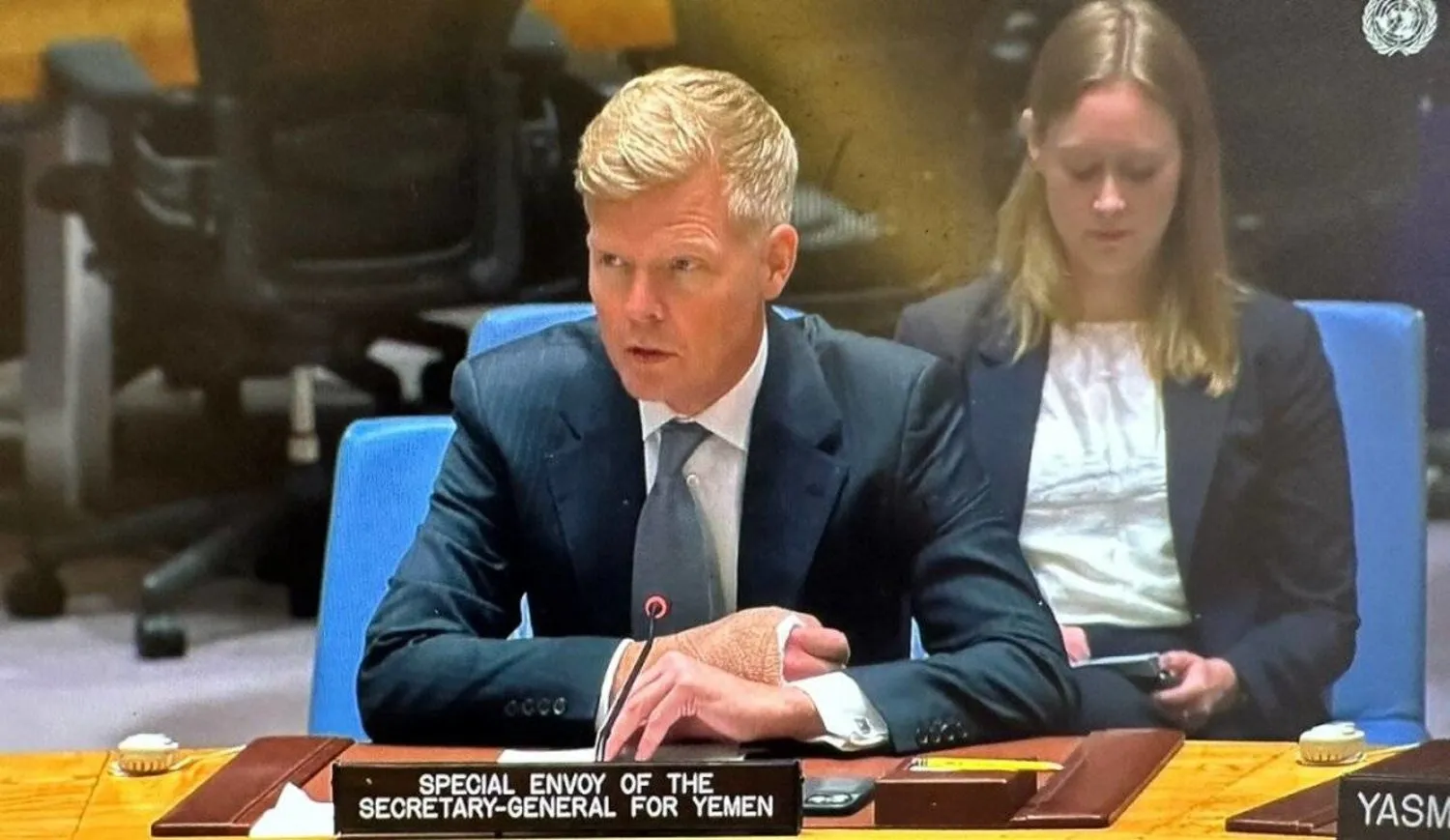

UN Special Envoy for Yemen Hans Grundberg warned on Wednesday of the current fragile situation in Yemen despite military de-escalation, mentioning the ongoing reports of violence across frontlines, notably in Al Jawf, Taiz, Marib and Saada.
Briefing the Security Council on the situation in Yemen, Grundberg underscored the need for a formal ceasefire and said that the political process must start as soon as possible.
The UN envoy then expressed his cautious optimism particularly after Yemeni parties in recent weeks have taken some additional positive steps to build further confidence.
He then called on the parties to comply with their obligation under international law to immediately release all those who remain in arbitrary detention, including journalists, human rights defenders, political opponents, and other arbitrarily detained civilians.
Grundberg briefed the Security Council on his efforts to secure an agreement on a way forward that could sustainably end the conflict.
He said he has met with the President of the Presidential Leadership Council, Rashad Al-Alimi, in Aden, and with Houthi leadership, represented by Mehdi Al-Mashaat, in Sanaa.
He also met with senior regional and Yemeni officials in Riyadh and Abu Dhabi, and senior officials in Washington D.C.
“There is clear determination on all sides to make progress towards a deal on humanitarian and economic measures, a permanent ceasefire and the resumption of a Yemeni-led political process under UN auspices,” Grundberg affirmed.
He then welcomed the ongoing efforts of the Kingdom of Saudi Arabia and the Sultanate of Oman to support the UN’s mediation role.
And while progress is being made, the envoy said there are still issues that require further discussion. “Indeed, the parties have an obligation to build on the progress made to-date and to take decisive steps towards a peaceful and comprehensive solution,” he added.
Grundberg explained that more than one year after its announcement, and seven months since its official expiration, the truce continues to deliver.
He noted that the truce has provided a conducive environment and starting point to build towards next steps, including commercial flights to and from Sanaa Airport and fuel and other commercial ships entering via Hodeidah port.
However, he said the continuing reports of violence across frontlines, notably in Al Jawf, Taiz, Marib and Saada highlight the fragility of the current situation and underscore the need for a formal ceasefire.
He then expressed his concern about the deteriorating economic situation and restrictions on freedom of movement and its impact on economic activity and people’s livelihoods.
“The inability of the Government of Yemen to export oil, which generated more than half of total government revenues last year, is straining the government’s capacity to meet its obligations to the Yemeni people,” Grundberg reminded the Council.
Despite these profound challenges, the UN envoy said there is room for cautious optimism after the Yemeni parties have taken in recent weeks some additional positive steps, such as last month’s release of 887 detainees.
“I am confident that these releases will build further confidence between the parties and support an environment conducive for dialogue,” he said, calling on the parties to continue to work with his Office to fulfil their commitments to release all conflict-related detainees in line with the Stockholm Agreement.
Grundberg then said that the cornerstone of an agreement on the way forward must be the resumption of a Yemeni-led political process under the UN auspices to bring an end to the conflict, adding that challenges in Yemen cannot be addressed through partial or temporary solutions.
“Only an inclusive and comprehensive political process can sustainably forge a new political partnership and bring the promise of a secure and economically stable future, in which state institutions function effectively and Yemen returns to peaceful relations with its neighbors,” he stressed, adding that this political process will need to address complex issues on the long term future of Yemen and must start as soon as possible.
The UN envoy also said that the recently-held dialogue among a number of southern political groups in Aden underscored, once again, the urgent need for Yemenis to collectively discuss and define their own future through a Yemeni-led, UN-sponsored process.
Equally essential is the meaningful participation and representation of women and youth in all aspects of the peace process in line with UNSC resolution 1325, as well as civil society, he added.
The Council also received an update on the humanitarian situation in the country.
Edem Wosornu, Director of the Operations and Advocacy Division at the UN’s humanitarian affairs office, OCHA, told the Council she hoped there could be an end to the terrible war in Yemen and for a sustainable peace agreement.
Speaking on behalf of UN Undersecretary-General for Humanitarian Affairs Martin Griffiths, she said the humanitarian community will continue to deliver aid to as many people in need in Yemen.
“Now is the time for the parties, with the full support of the international community, to drive resolutely toward peace and an end to this conflict,” Wosornu added.


